Archive for the ‘Kandy’

Burning for (Sinhala) Buddhism?

7-2

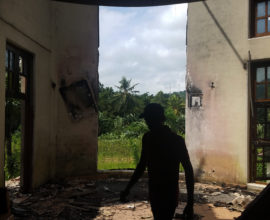
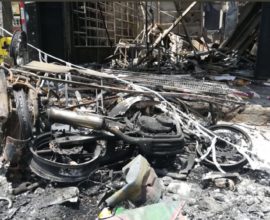
Image from Sunday Leader First, I want to convey my deepest sympathies to the family and friends of late Venerable Bōwatte Indrarathana (VBI) for the shocking and untimely way he embraced his death on the most venerable day of the Buddhist calendar. No amount of academic analysis will bring a life back. However, we must move on and learn from this how to avoid such tragedies. Such learning cannot come without preliminary analyses of the reasons and backgrounds. Suicides are at least three major types: Suicide for personal reasons of shame or pain, Suicide as a military attack and Suicide as a political protest. Irrespective of the doubts if that was a pre-arranged publicity tactic, I consider the suicide of VBI as a political act embedded in the Buddhist tradition. This essay is a brief reflection on his death and the politics of it. Politics of Suicide The act of suicide is historical, supra cultural and could be reviewed from…

Continue reading »
  • 28 Jun, 2012
  • 23 Comments
  • Colombo,
    Kandy,
    Sport

The Oldest and the Greatest: A reflection on the Bradby Shield and what it stands for

4782465930_478c4ba84a_z

Image courtesy Trinity College website History and tradition are great mentors. History assures us of who we are, and if we are brave enough, it can also teach us where we have failed or triumphed, behaved honourably or been disgraced. Tradition, for it to be useful, must be wisely chosen and morally crafted; because it is the conduit through which history’s best lessons flow down the ages. Great traditions are not always old, but the best ones are usually those that stand the test of time and like good wine, enhanced by age. Where it is not mistaken for blind ritual, tradition sets out an honour code on how we should behave as well as treat ourselves and others with dignity. As much as history and tradition helps chasten us and help preserve the integrity of our social fabric, they are also vulnerable to misinterpretation and exploitation. Sometimes, when history is ousted by myth and tradition is confused with petty…

Continue reading »

Review of ‘Kandy at War’ by Channa Wickremesekera

DSCF5675

Image courtesy Sri Lanka Travel Guide “When we think of it, we see at once what the confusion of thought was to which the Western poet [i.e. Rudyard Kipling], dwelling upon the difference between East and West, referred when he said, ‘Never the twain shall meet.’ It is true that they are not yet showing any real sign of meeting. But the reason is because the West has not sent out its humanity to meet the man in the East, but only its machine. Therefore the poet’s line has to be changed into something like this: Man is a man, machine is machine, And never the twain shall meet.” Rabindranath Tagore[1] This is what the Portuguese unleashed in 1505 in Lanka, the machine of plunder. They were followed by the Dutch and ultimately the British in the late 18th century. They were able to control, exploit and plunder most of island except the Kandyan kingdom. The kingdom successfully resisted colonisation…

Continue reading »

Militarisation of Sri Lanka and its infiltration into Higher Education

220898-protests-1312070814-209-640x480

Evidence of militarisation is everywhere – most recently in the sphere of higher education.  The armed forces are involved with development projects, in welfare, and in farming. They are even involved in city beautification, the maintenance of playgroups and shops, of course Sports, and now higher education.  Their increased presence is evident in subtle changes in our daily lives.  The large number of ‘yu ha’ vehicles dropping and picking up school-going children is one that confronts me each school day. Militarisation is, however, not just confined to their conspicuous presence in public spaces but extends to public acceptance and reinforcement of an attitude that glorifies the forces which in turn enables the process of militarization. The military does not operate through a process of consensus building and does not, in general, function according to democratic principles. While those at the lower rungs of the military hierarchy bear the brunt of this oppressive system, civil society is not immune. Last week,…

Continue reading »

In conversation with Joshua Roman: Videos and photos

_DSC0067

Performing at the Lionel Wendt. Photo by Ruvin de Silva. TED Fellow and gifted cellist Joshua Roman was in Sri Lanka recently for his debut concert in Colombo. He also performed in Kandy. Cellist Yo-Yo Ma called him an “extraordinary young musician”. Those who came to listen to him play in Colombo and Kandy, accompanied by Eshantha Peiris on the piano, left richer for having experienced his music. As with Mandhira de Saram, Joshua started playing an instrument very young, at age three. Joshua speaks about his family’s influence on his music, and choice of instrument. We also talk about the cello he brought to Sri Lanka, which made in 1899, was perhaps the oldest western musical instrument to ever grace the stage at the Lionel Wendt and the venue in Kandy. Joshua speaks about his approach to music, and how though trained and obviously adept at playing classical music, he always tries to experiment and likes to play contemporary…

Continue reading »

Resource book for historians, researchers and media: A year of tweeting from Groundviews

groundviews-followers-small

Visualisation of our Twitter followers. See larger version here. We used the web service Tweet Book to capture all our tweets over the past year in a single PDF. We’ve tweeted thousands of times over the past twelve months and have covered, The media fallout of the farcical fast of senior government Minister Wimal Weerawansa in front of the UN HQ in Colombo. Praise for our model of journalism on C-SPAN video in the US, captured from an event at the United States Institute of Peace. Key statements by world leaders like Desmond Tutu on post-war reconciliation and accountability for war crimes Bell Pottinger’s sickening relationship with the incumbent government, largely hidden from public scrutiny Key reports on Sri Lanka from, inter alia, HRW, AI, ICG and the US State Department, including responses from senior Ministers and the Foreign Ministry Foreign relations and the tussle in Sri Lanka between India and China The court proceedings on Sarath Fonseka The UNP’s perennial…

Continue reading »

Exclusive: Syllabi and timetables from compulsory University ‘leadership’ training course

01

Image from Virakesari Online Great controversy and concern surrounds the ‘leadership’ training programme designed by the Ministry of Defence for under graduate students, conducted in around 28 military installations around the country. As the Young Researchers Collective recently noted on Groundviews, “Although the government has stated that this will be a leadership training program rather than a military training program, it has conceded that the military will be involved in a number of aspects of the program. Students have also been informed that this training is “mandatory” for university entrance, though there now appears to be a great deal of confusion with regards to this provision as Government officials have issued a series of contradicting statements. These decisions have also been challenged by many students, rights groups, student unions, teachers’ unions and academics who have raised a number of concerns about the way in which this program has been conceived and implemented. This issue has also exacerbated a worsening crisis…

Continue reading »

Watch Moving Images at Kandy International Film Festival (KIFF)

Compelling stories in high-definition

We are very pleased to announce that films from Moving Images will be part of the first Kandy International Film Festival (KIFF). Though the official schedule is still being finalised, we have been informed by the organisers that Moving Images will be screened from 4 – 6pm on Saturday, 25th at the Kandy City Centre. A moderated discussion will follow. The selection of films will be from A Lost White Tribe: The Eurasians of Sri Lanka by Menika van der Poorten and Koothu, kerosene and paper: portraits of resilience by Kannan Arunasalam. Please join us. Ticketing information for KIFF can be accessed here. The Kandy Film Festival will be a four-day celebration of global cinema, with a special focus on Asian film and upcoming talent, in the UNESCO world heritage city of Kandy, Sri Lanka. Against a stunning background of gardens, hilltops and cultural architecture, the Festival will showcase an exciting program of films celebrating diverse techniques, styles and themes…

Continue reading »

Around the World in 32 Years: A Mini-Memoir

Long-Reads-Small

[Editors note: Emil van der Poorten is a regular columnist in the Sri Lanka media. His short article in the Edmonton Journal (Violence still plagues my Sri Lankan homeland) prompted an invitation to contribute a more fuller account of his life to Groundviews. Emil's story and his many adventures with politics recounted here with an acerbic wit offer unique insights into political figures and events that have shaped our lives.] Looking through the scraps of memorabilia from the time prior to my departure to Canada and then through my Canadian clippings to those accumulated in Sri Lanka since my return was a fascinating and nostalgic experience that I would not have indulged in without the stimulus of having to write this piece for “Long Reads” in Groundviews. The exercise was not unlike browsing through old diaries, except the material in those scrapbooks was more akin to snapshots from a lifetime spent in significantly different circumstances in two very different parts…

Continue reading »

UPDATE: Google Map on Flood-affected areas in Sri Lanka

Screen shot 2011-01-13 at 11.15.14 PM

View Flood-affected areas in Sri Lanka – January 2011 in a larger map The map above identifies the main flood-affected regions, sites where relief and rescue operations have been conducted, areas prone to landslides and specific locations that are at risk.  Please click on the link below the map to view it on a larger screen. You may click on individual markers for detailed information and zoom in to view the location of specific shelter camps located in the east. Please note that this map is updated as soon as the Editors of Groundviews receive detailed information and reports from the ground. After our last updated post on 12 January 2011, a Daily Mirror SMS update at 12:50PM reported that there were 21 deaths and over 1,000,000 people affected as a result of the floods and bad weather that continues to devastate these regions. The Eastern Province is the worst affected with over 860,000 flood victims according to the latest figures…

Continue reading »

UPDATE: Situation report on flood-affected areas and a call for assistance

The Editors of Groundviews have received several updates during the course of the day confirming that the situation on the ground is quite severe and we now have a humanitarian crisis in those flood-affected regions with over 950,000 individuals affected from over 250,000 families. The Disaster Management Centre has confirmed as of 1:00PM today that 18 people have been killed and 47 have been injured as a result of the floods. Ada Dernana notes the following in a news story published today, Director General of the DMC, Major General Gamini Hettiarachchi speaking at the media conference said that 11,338 homes had been partially damaged while 1,609 homes had been fully damaged. He added that around 200 tanks had also been damaged in the floods. Meanwhile, P.B. Samarasinghe, Director General of the Meteorological Department said that rains are expected for the next three days while this was the heaviest rains that the country had witnessed in over thirty years. (Emphasis ours.)…

Continue reading »

On Flooding and Disaster Management

167401_497808493424_105303528424_5932902_3207540_n

Photo courtesy www.facebook.com/battipeople Over the last two days, torrential rainstorms in the Central and Eastern province have caused severe flooding, landslides and an overwhelming humanitarian crisis with 758,000 people affected island-wide (according to the latest update at 7:14AM today from the Disaster Mangement Centre [via JNW]) 809 houses have been fully damaged and 2948 houses have been partially damaged. There have been nine deaths; nine injuries and four people are still missing (last update Sunday evening.) An article in the Daily Mirror details the extent of the crisis, According to the Centre (Disaster Management) some 55,936 families belonging to 14,519 families have been displaced and had been housed at 138 camps that have been opened.  Several Divisional Secretariat offices in the East were also reportedly under water while Badulla District Secretary Keerthi Disasnayake was also reportedly marooned as a result of a land slide which occurred along the Badulla-Mahinyangana Road. The following areas in the country have been affected by the…

Continue reading »

Smarter investing in Science and Higher Education

I experienced three disturbing scenarios within the last 5 months. In no particular order they are as follows. I recently visited Sri Lanka after seven years. End of it I was overwhelmed by nostalgia and wanting to go back home. When I left my country for higher studies I had plans to come back. Right after the PhD, I wanted to stay a little longer and get some more research experience. So I took a postdoctoral position at a prestigious university. Of course I had to give up my probationary lecturer position and pay back the bond. After coming back from the recent visit, I searched for suitable jobs with enough chance to do scientific research in Sri Lanka. I actually sent my resume (CV) out. I am still waiting to hear. No vacancies! I also looked into becoming a lecturer at a university. That is the only viable option for science graduates. Starting salaries of a senior lecture positions…

Continue reading »
  • 7 Jan, 2010
  • 5 Comments
  • Diaspora,
    Kandy

Don’s Diary: One week in Sri Lanka

Strict Instructions – where is the “please”? (Avoid taking the drink bottle out of the canteen)

Saturday: Fly from Heathrow to Colombo; uneventful journey; drink gin and tonic, take long sleep. Hear that an aunt passed away just before departure. Sunday: Catch up on sleep and go to funeral. My cousin goes through religious rituals, with the priest dragging on. He is a nice guy, my cousin, meticulously following all instructions from the priest. When in his position, at my dad’s funeral a few months ago, I had a quiet word with the priest: “Itupaththu Oraam nootaaNdu aiya, vEhamaahap pOngO (it is the twenty first Century, priest, go faster)”, and he obliged. Doesn’t matter though, because the only person at the event with good knowledge of Sanskrit was my dad, and he was dead. At my aunt’s funeral, I think of her amazingly peaceful life. “Wouldn’t hurt a fly” is most appropriate. Monday: Email from a friend inviting me to an event on Sunday afternoon in memory of Kailasapathy, the founding President of the Jaffna University….

Continue reading »

Ragging in our universities: A symptom or a disease?

Sri Lanka is one of the few countries that provides students the opportunity of a free secondary education. More than 200,000 students sit for the GCE Advanced Level examinations in Sri Lanka every year, of which only around 20,000 are selected to the fourteen universities across the country. It is possible to conclude then that this 10% who make it, are among the brightest and best brains in the country, who deserve every bit of the chance they get to ensure a better life for themselves. Surprisingly then, barely one year into their University careers, a few of these same students get angrily referred to in the media and among the public as being “mentally unstable” and even “psychotic”. The reason? Ragging. Ragging is thought to have begun in educational institutions in the 18th Century and was very much in vogue in European countries. The concept was then adopted in the US in a milder form known as ‘hazing’, and spread…

Continue reading »
Page 1 of 212

About Groundviews

Located at the Centre for Policy Alternatives in Colombo, Sri Lanka, Groundviews is a citizen journalism website that uses a range of genres and media to highlight critical perspectives on governance, reconciliation, human rights, the arts and literature, democracy and other issues. The site has won two international awards, including the prestigious Manthan Award South Asia in 2009. The grand jury's evaluation of the site noted, "What no media dares to report, Groundviews publicly exposes. It's a new age media for a new Sri Lanka... Free media at it's very best!"

cezarneaga.eu