Archive for the ‘Post-War’

Buddha wept as we beat our women

violence

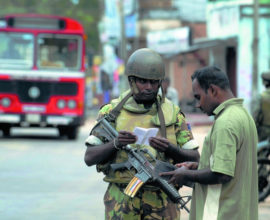
54% of adolescent girls in Sri Lanka feel that a husband is justified in beating his wife. The UNICEF Global Report Card on Adolescents 2012 however is not available yet to try and unpack this further. What do they mean? Surely, they cannot be suggesting that the arbitrary violence that some wives are subject to in Sri Lanka is acceptable; burned rice that results in cut lips and black eyes? It must be wives that were somehow overly flirtatious with another man. Wives that have behaved, or even worse, dressed, inappropriately. Wives that have proved to be whores! What about those husbands that use wives like dogs? Psychologists call it displaced aggression, commonly known as kick-the-dog syndrome. Surely the adolescent girls can’t mean these husbands? Their wives did nothing more than open the door and welcome them home. What about the husbands that come home inebriated and then proceed to beat their wives to a pulp for looking at them…

Continue reading »

Coping with little support: Batticaloa’s women ex-combatants and their reintegration

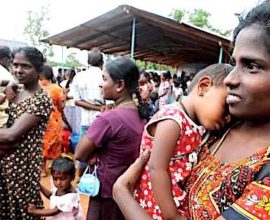
Photo by author The end of hostilities in May 2009 saw some 270,000 to 300,000 Tamils fleeing the conflict zone in the North and settling in camps for internally displaced people. Fleeing the fighting, together with the civilians, were thousands of Tamil Tiger combatants – many of them injured women fighters – both young women and more experienced middle-aged female fighters. M10 – who lost her left leg in a 1995 battle in the Wanni region – surrendered herself at the Omantai military checkpoint in the closing days of the war after fleeing the heavy shelling on Puthikkudiyiruppu with civilians. There she was immediately taken to Pampaimadu Camp for interrogation by Sri Lankan army intelligence and the Criminal Investigation Department (CID) of the police force.  A year later, in late April 2010, M10 was released. M7, like M10, is an injured ex-Tamil Tiger young woman combatant who surrendered at the Omantai checkpoint in the closing days of the war.  In…

Continue reading »

Cluster bombs in Sri Lanka: From denial to discovery

Sudar Oli - 06.03.2012

Ravi Nessman from Associated Press has broken what’s perhaps the most important story on the war, since it ended three years ago. In a story published by AP a few hours ago, he notes, The Associated Press obtained a copy Thursday of an email written by a U.N. land mine expert that said unexploded cluster bomblets were discovered in the Puthukudiyiruppu area of northern Sri Lanka, where a boy was killed last month and his sister injured as they tried to pry apart an explosive device they had found to sell for scrap metal. The email was written by Allan Poston, the technical adviser for the U.N. Development Program’s mine action group in Sri Lanka. “After reviewing additional photographs from the investigation teams, I have determined that there are cluster sub-munitions in the area where the children were collecting scrap metal and in the house where the accident occurred. This is the first time that there has been confirmed unexploded…

Continue reading »

Not In Our Name: Against religious extremism in Sri Lanka

Screen_Shot_2012_04_26_at_7.52.36_PM

A week ago, a violent a mob of about 2,000 Sinhalese, including a group of Buddhist monks led by the Mahanayaka of the Rangiri Dambulu chapter Inamaluwe Sumangala thero, stormed and vandalised a mosque in Dambulla. The mosque was declared an illegal structure, but it is unclear how this far this is accurate. The shameful behaviour and expression employed by the Mahanayaka of the Rangiri Dambulu chapter Inamaluwe Sumangala thero, along with the monks he led and the crowd of thugs is not remotely associated with or reflective of the philosophy of the Dhamma, the teachings of the Buddha, or the way in which a Buddhist monk is supposed to behave and speak. Many online have already expressed their dismay and deep concern over the actions of a few, placing Sri Lanka in the media spotlight again for all the wrong reasons. We have a choice, but time is running out. Speak up. Sign up to this online statement and…

Continue reading »

Human Rights and Reconciliation Challenged in Dambulla and by Disappearances

rock_cave_temple_-_dambulla

In more ways than one, a sleeping Buddha in Dambulla Rock Cave Temple. Courtesy University of Peradeniya Whilst the country awaits the decision of the regime regarding which recommendations, if any, of the LLRC report it will implement, human rights and reconciliation continue to be challenged, by disappearances and now, the ugly spectre of religious intolerance. From October 2011 to March 2012, there have been some 56 cases of disappearances and abduction recorded.  Some 29 of these have been in February and March of this year and 19 happened whilst the UNHRC was in session.  Of the 29 cases, 16 have been reported from Colombo and 08 from the Northern Province.  Five of the cases reported from the north are said to be ex-LTTE cadre who had been detained, released and then abducted. Egregious cases include that of Mr Ramasamy Prabhakaran who was abducted in Colombo two days before his fundamental rights petition was to come up before the Supreme…

Continue reading »

Fake video and lies: The strange case of Dambulla’s Inamaluwe Sumangala thero

Screen Shot 2012-04-24 at 11.08.16 PM

The Mahanayaka of the Rangiri Dambulu chapter Inamaluwe Sumangala thero, one of the key figures in the on-going tensions in Dambulla over the presence of a mosque and kovil near his Temple, perhaps in response to the public outcry against the violence instigated by him, has told the BBC that TV footage that showed monks engaged in violence – including one monk disrobing and exposing himself to the mosque – were fake. The Mahanayaka of the Rangiri Dambulu chapter Inamaluwe Sumangala thero told BBC Sandeshaya that he only led a ‘peaceful and democratic protest against illegal constructions’. He maintained that no violence was used. “Videos that portrayed the protest as violent were technically manipulated,” said the Mahanayaka thero who also heads a media outlet. Let us for the sake of argument not disbelieve or dismiss what Inamaluwe Sumangala thero says. Musāvāda veramaṇī sikkhāpadaṃ samādiyāmi, or refraining from incorrect or false speech, is after all one of the five Noble Precepts….

Continue reading »

Deeds of mosque in Dambulla and photos of damage: How is this structure illegal? (UPDATED)

Dam-11

Groundviews was sent a copy of what we were told was the deed of the mosque at the centre of an on-going controversy in Dambulla, Sri Lanka. We were also sent photos of the damage and vandalism wrought by the mob violence a few days ago. We’ve uploaded the document to Scribd as a PDF, and the high resolution, original scanned images of the deed to Flickr. Both are embedded below, along with four photos of vandalism to copies of the Quran and the cupboards in which they were stored. Groundviews has already flagged that the basis upon which the PM, in a televised submission, said that the mosque was an illegal construction is hugely suspect. In a video of a community meeting uploaded to YouTube two days ago, in the presence of Senior Minister for Urban Affairs A H M Fowzie and the Assistant Government Agent, there is a discussion in Sinhala about, inter alia, the legality of the…

Continue reading »

Delivering on the LLRC Recommendations

Sri Lanka Civil War

Immediately after the Resolution on SL was adopted in Geneva a month ago, US Secretary of State issued a short media release that said the US believes, the resolution “encourages the Government of Sri Lanka to continue on the path toward reconciliation” and for the second time said, “….. and I look forward to discussing future actions with Foreign Minister Peiris soon.” The first time in January this year, was ignored by Minister Peiris. This time he is ready to meet Madam Clinton with the “Action Plan” drawn for the implementation of the LLRC Recommendations, with no public statements made. That gives an indication as to how the Rajapaksa regime tries to handle the most important national issue. The Rajapaksa regime believes it can continue to play “opposite doubles” on the same issue. It believes it could say a loud and noisy “NO” to the Sri Lankan citizens here using all the media and publicity stunts possible, while saying “YES”…

Continue reading »

The questions unanswered by Ass. Sec. Robert Blake: Mapping US engagement in and concerns over Sri Lanka (UPDATED)

mahinda-oblake

Image courtesy Colombo Page From around 5pm to 5.30pm today, Ass. Sec. Blake took questions from those on Twitter in South and Central Asia. Ass. Sec. Blake is the Assistant Secretary, South And Central Asian Affairs at the US State Department and former Ambassador to Sri Lanka. South and Central Asia is a large swathe of physical as well as ideological terrain. Fearful that Sri Lanka would be forgotten in the deluge of tweets under the hashtag #AskSCA, we published a story on Groundviews flagging our own questions, and what at the time were a few other questions to Ass. Sec. Blake posed by others on Twitter. The session didn’t see Ass. Sec. Blake answer many questions. It started by his office noting that, https://twitter.com/state_sca/status/192565222714777600 This was followed by a few tweets on Nepal, and a congratulatory tweet on the new US Ambassador in New Delhi. The first tweet responded to was on the Maldives, followed by one US foreign…

Continue reading »

Ask Ass. Sec. Robert Blake a question on Sri Lanka over Twitter

mahinda-oblake

Image courtesy Colombo Page Robert Blake is the Assistant Secretary, South And Central Asian Affairs at the US State Department and former Ambassador to Sri Lanka. The man likes cricket and our own Murali, and given his current portfolio, is a key figure in US-Sri Lanka relations post-war. He is currently taking questions on Twitter on US relations with South Asia. https://twitter.com/usembsl/status/192098700833726465 Through the hashtag #AskSCA, there are already a number of questions from India, Pakistan and Bangladesh, but very few from Sri Lanka. We have posed four, based on the US Senate’s Committee On Foreign Relations report on Sri Lanka (SRI LANKA: RECHARTING U.S. STRATEGY AFTER THE WAR), published in December 2009, which has a number of important recommendations we’ve not heard about since. https://twitter.com/groundviews/status/192447985777520643 https://twitter.com/groundviews/status/192447995483140096 https://twitter.com/groundviews/status/192448006493192193 https://twitter.com/groundviews/status/192448015359934465 In addition to ours, @Apelankawe and @thrishantha have posed some interesting questions. https://twitter.com/thrishantha/status/190067440342933506 https://twitter.com/apelankawe/status/191882256841846786 https://twitter.com/apelankawe/status/191883208256790531 Till now, not a single mainstream media Twitter account in Sri Lanka, or even full time…

Continue reading »

A Vision for Our Nation

Siri Pada

Photo by the author There is a vision of our land that has persisted over three millennia and is ingrained in the heart and soul of every citizen. A vision of a land, resplendent, beautiful, safe from violence, disease and famine and a land where the tolerant and compassionate philosophy of the Buddha guides human interaction. But today, the ecomomic and political winds from without and within, seek to blow us further and further from this course. The future for our children develops into the proportions of a nightmare. We have brought mindless violence upon ourselves and upon the very land itself. From the top of Siri Pada to the coast in the four directions the nation grows increasingly barren. The rivers run our precious topsoil to the sea. The cities and industries turn the very air we breathe into poison. The cancer that has been released on the country as ‘mindless progress’ now visits our homes as cancers, emphysema,…

Continue reading »

The futility that is Omanthai: Post-war Sri Lanka’s reconciliation shortfalls

colombo_check_point

Image courtesy JDS Omanthai Checkpoint, 12.30am: As the conductor switches on the bright florescent lights inside the bus, the bus comes to an abrupt halt, jolting awake blurry-eyed passengers travelling from Jaffna to Colombo, who, in response to the instruction “okkomala bag arung eliyata bahinna…” (“Everyone, take all your bags and get off the bus…”), scramble around in search of their respective bags, still half asleep. Once having located their individual items of luggage, young and old alike, stumble out of the bus one after another and walk towards the takarung (metal sheet) shed, where males and females follow separate queues to have their bags checked by male and female army personnel, respectively. The checking too has now become so superficial and lackadaisical that it’s obvious it’s being conducted purely out of protocol, rather than as an actual security measure. Omanthai, having been one of the, if not, ‘the’ largest Government controlled checkpoint throughout the war, remains to date, more…

Continue reading »
  • 14 Apr, 2012
  • 0 Comment
  • Development,
    Diaspora,
    Jaffna,
    Post-War

Co-operatives: A better option to channel relief to war victims in Sri Lanka

38608898

Photo courtesy  Sampath Wijenayake It is no secret that many members of the Tamil diaspora are actively involved in helping the victims of the war in Sri Lanka in some way or the other.  There are those who send assistance direct to known or identified victims. There are others who respond to calls from various organisations for funds to help them.  Such organisations are now available in abundance both in the United Kingdom and elsewhere. However, only a few of such organisations would be able to render accounts to benefactors on how much they have collected and what amounts have been spent to provide relief and even on what kind of relief or assistance  have provided using their funds.   Occasionally we hear about  organisations that collected monies and  duped gullible sympathisers.   In any case in  most instances the victims are mere receivers of assistance and have no say whatsoever in  deciding the nature, the extent and the kind of assistance they…

Continue reading »

Whose Arms Will Embrace You? The United States and the Beijing Consensus

China's President Hu shakes hands with Sri Lanka's President Mahinda Rajapaksa in Sanya

China’s President Hu Jintao shakes hands with Sri Lanka’s President Mahinda Rajapaksa in Sanya, Hainan province, April 10, 2008. Image by Reuters, courtesy Transcurrents. The United States is increasingly playing a game of subtle communication in the international arena. I suspect we had a passing glimpse of this at the 19th Session of the Human Rights Council, which gathered in Geneva last month. The question is: who is the United States talking to and what is it trying to say? There has been much discussion about President Obama’s “Return to Asia” strategy, arising out of a 2009 speech during which he declared that as an Asia Pacific nation, the United States will seek to be more involved in the issues affecting the region. There has been an equally vibrant discussion in policy and scholarly circles about the so-called Beijing Consensus, a term used to describe the Chinese government’s embrace of capitalism, while remaining autocratic. It is to these nations who have…

Continue reading »

Restoring Government in Sri Lanka

sri-lanka-27feb12

Image courtesy Transcurrents If Sri Lanka is fast becoming a pariah state in the eyes of the world, it has nothing to do with the recent UNHRC Resolution. The writing has long been on the wall. As a nation, we are ruled by a group of men who seem to have nothing but contempt for the rule of law, let alone for truth in the public sphere. Violence and threats of violence against critics, the suppression of media freedom, extra-judicial killings, misplaced economic priorities and corruption on a scale that made even previous governments look clean, have become the order of the day. The minimal definition of government has to do with the rule of law: namely, that as a people we should be governed not by arbitrary fiat but by a system of laws to which the law-makers and law-enforcers themselves are accountable. The opposite of government is sovereign will, where the King/President decides what is “good for the…

Continue reading »
Page 2 of 5012345...102030...Last »

About Groundviews

Located at the Centre for Policy Alternatives in Colombo, Sri Lanka, Groundviews is a citizen journalism website that uses a range of genres and media to highlight critical perspectives on governance, reconciliation, human rights, the arts and literature, democracy and other issues. The site has won two international awards, including the prestigious Manthan Award South Asia in 2009. The grand jury's evaluation of the site noted, "What no media dares to report, Groundviews publicly exposes. It's a new age media for a new Sri Lanka... Free media at it's very best!"

cezarneaga.eu
canakkale canakkale canakkale balik tutma search canakkale vergi mevzuati bagimsiz denetim vergi mevzuati ozurlu engelliler