Archive for the ‘Peace and Conflict’

THE SRI LANKAN REPUBLIC AT FORTY: REFLECTIONS ON THE CONSTITUTIONAL PAST AND PRESENT

z_page-36-Ceylon-became

Image courtesy Daily News Forty years ago this week, at the auspicious time of 12:34 p.m. at the Navarangahala on 22nd May 1972, a new constitution was signed into law, creating the Republic of Sri Lanka. This was the first time in the history of the island that the republican form of state was established, discounting the period under which parts of the littoral were controlled by the Dutch East India Company during the time the Netherlands were a confederated republic. Given that the political history of the island spans over two millennia from its mytho-historical origins, four decades might not seem like a long time. But looking back to 1970-72, the country and the world in which the first republican constitution was created seems very different from the present, although the continuing resonance of many of the dominant themes of that era are still felt in today’s Sri Lanka. In the Third World, it was the epoch of anti-colonialism…

Continue reading »

What’s next for General Fonseka?

120521102321-sarath-fonseka-story-top

Image courtesy CNN It has been a couple of days since the former military commander of Sri Lankan Army and common opposition’s presidential candidate General Sarath Fonseka was released from the prisons and I can’t think of a better timing than this for me to express some of my thoughts related to these developments, which I am sure many here would share with me, at yet another crucial time for our nation. First of all, many have correctly pointed out to me about the technicality of the use of the rank General when referring to Mr. Fonseka and it is my personal belief that it is one way for me to demonstrate my suspicion as to whether the so-called court martial was really working in a fair, transparent manner contrary how it would have been through a civilian court, while at the same time joining thousands of fellow Sri Lankans who aren’t ready to forget the existence of the first-ever…

Continue reading »

Transcript of first one-to-one interview with Sarath Fonseka after release from prison

fonseka_free_000_del6120967_595

Image courtesy the Economist GV editors note: In the transcript below and the video of it available on the BBC online, the BBC correspondent in Sri Lanka Charles Haviland asks “Are the terms of your release unconditional – will you be allowed to go  back to politics?” Sarath Fonseka responds by noting that “As yet I have not seen this legal document.  Unless they have remitted the prison sentence which I have completed already, unless they do that I can’t do politics.  I can do politics but I can’t vote or contest.  So as it is, we don’t know exactly what is there in the document but we’ll come to know.” In this regard, we reproduce below the letter sent by the Ministry of Justice to the Commissioner General of Prisons. Download as PDF here. Start of transcript The BBC met Sarath Fonseka on Tuesday morning at the rented house where the family now stays on the outskirts of Colombo. …

Continue reading »

Truth and Dialogue as Theatre: Some Reflections on the Frontline Club Panel on Sri Lanka

Screen Shot 2012-05-19 at 10.45.21 PM

I watched the Frontline Club panel on Sri Lanka, belatedly and reluctantly. I am skeptical about such public enquiries and debates into complex matters, which threaten to reduce the dialogue and truth into performance. In my view, the problem with these ‘events’, for that is what they are, is that the truth is reduced to a many-sided thing; the more one counts the sides the more fragmented the truth itself becomes. But of course you never get ‘all sides’ of the story. So, for example, someone keeping a count of the sides could say the Muslim question or the gender dimension figured not at all. In fact, Stephen Sackur set the tone for an evening of performance with his opening line: “First thing to say is that it is fantastic to see such a great audience.” The panelists inevitably came with their own scripts—prepared remarks, notes, papers (Mr. Wijesinha had loads of them), computers etc. Then there were the self-appointed…

Continue reading »

3 years after the end of war: Official statements vs. reality

0_13374004831054_news

Sri Lankan Army soldiers march during a Victory Day parade rehearsal in Colombo on May 16, 2012. Sri Lanka celebrates War Heroes Week with a military parade scheduled for May 19. PHOTO/ AFP, text courtesy Haveeru Online “There is no State of Emergency today.” – President Rajapaksa’s Address to the Nation, 19 May 2012 vs. “Therefore, the attempt of the Sri Lankan government to replace emergency laws with another set of laws under a different name, yet meant to do the same task is not surprising. State of emergency is not only a particular set of laws. Removing emergency regulations while continuing with militarisation and a massive project of policing in socio-cultural arenas do not indicate a journey towards normalcy.” – Amali Wedagedara, Groundviews, 5 September 2011   “It is no secret that through 30 years there were armed groups and militias operating, especially in the North and East. All such groups have now been disarmed.” – President Rajapaksa’s Address…

Continue reading »

Three years after the war in Sri Lanka: To celebrate or mourn?

Header Image

Photo courtesy Vikalpa For the 3rd successive year, the Sri Lankan government has made elaborate arrangements to celebrate the end of the war in Colombo. This year, May was declared as “war hero’s commemoration month”. For the last few days, roads were closed in Colombo causing great inconvenience, as preparations were being made for celebrating the end of the war. However, in the North, among Tamils, where the last phase of the war was fought, the mood was far from celebratory, but outright mourning and grieving. In the morning of 18th May, I joined a commemorative Mass in a church that was yet to be rebuilt after the war. More than the church building, two monuments stood out. One for Fr. Sarathjeevan (popularly known as Fr. Sara, who died on 18th May 2009) and another for all people who had been killed in the war. Villagers including school children and Hindus flocked to this church. Amongst those present were families of those killed…

Continue reading »

A different take from the Sangha: The dhamma and religious co-existence in Sri Lanka (UPDATED)

Screen Shot 2012-05-16 at 7.45.10 AM

[Editors note: Sanjay Senanayake in a comment below raises a number of concerns regarding inflammatory statements made by Rev. Dambara Amila Thero in the past, which invariably inform the appreciation of the interview below. Sanjay also alleges that the thero had in the past assaulted journalists from Young Asia Television, which produced this video. We have asked them for a response.] When first put online by Young Asia Television after it was broadcast on Sri Lankan TV, Groundviews requested the producers to sub-title this video in English to make more widely accessible what Rev. Dambara Amila Thero has to say about the practice of the Dhamma in Sri Lanka today, his views on political Buddhism and religious co-existence in Sri Lanka. What he says is particularly important and resonant in light of the outrageous violence spearheaded by the Chief Prelate of the Dambulla temple a few weeks ago. This interview is essential viewing for those who expressed their condemnation over…

Continue reading »

Reconciling what? History, Realism and the Problem of an Inclusive Sri Lankan Imaginary

When Memory Dies

What does reconciliation signify in the Sri Lankan context? In many post-conflict contexts the idea of reconciliation dominates public discussion. This is no different in Sri Lanka. But what exactly is meant by reconciliation? As Susan Dwyer (1999) points out there has been a “global frenzy” on this topic in the post-Apartheid era with the South African Truth and Reconciliation Commission often held up as an exemplary model. Much of this discussion, though, lacks analytical clarity. This is a brief attempt to explore one challenge posed to the notion of reconciliation in Sri Lanka: where or how can an inclusive Sri Lankan imaginary be located? I approach this issue through the area of my disciplinary training, literature, and attempt to reflect on how literary representations in general have struggled to articulate an inclusive conception of Sri Lankaness. A pervasive historical consciousness and the dominance of realism as a genre of writing, I argue, emerge as two inter-related phenomenon that are…

Continue reading »

Surrendering and Disappearing: Where are they now?

Image from WSWS

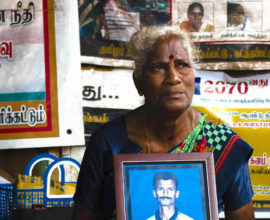
“Disappearance is far worse than death, because when a person dies, when I know that, so and so is dead, the story ends and somehow or other we close the chapter. But when a person has disappeared, it is an eternal suffering.”                                                                          (A.Santhipali, before the LLRC at Jaffna on 12th November 2010) In the controversial Commission of Inquiry on Lessons Learnt and Reconciliation, 53 LTTE cadres who surrendered during the final days of the war in May 2009 are alleged to have been disappeared and are reported to be under the category of ‘missing’. What happened to these 53 people? Their relatives and close kith and kin say that they were last seen and heard surrendering to the Sri Lankan Army. In the LLRC report, many family members of former LTTE cadres have complained that their husbands, wives, sisters, brothers, sons and daughters have disappeared after they surrendered to the Sri Lankan security forces. These family members still await…

Continue reading »

Not In Our Name: Campaign update and video

Screen_Shot_2012_04_26_at_7.52.36_PM

After the email update reproduced below was sent on 2nd May, less than a week after the Not In Our Name initiative was launched, Deshabandhu Jezima Ismail, senior lawyer and HR activist JC Weliamuna, two-time Secretary to Presidential Commissions of Inquiry into Disappearances MCM Iqbal, well-known economist Muttukrishna Sarvananthan, Prof. Michael Roberts and Ranjini Obeyesekere, both leading academics, Tamil activist, poet and academic Cheran, Channa Daswatta, one of Sri Lanka’s best known architects and Harsha de Silva, Member of Parliament, along with dozens of others, have signed up to the initiative. “I put my name here just to give evidence to my children that at some point in the future, if they happen to suffer from communal violence as a result of what happens under president Rajapakse Government, their father did his bit to condemn his silence.” – Thrishantha Nanayakkara “The conduct of some of the Buddhist monks at Dambulla was disgraceful. It was an insult to the Buddha.” – Mangala…

Continue reading »

The Mind of Compassion: Buddhism and Violence

Screen Shot 2012-05-02 at 4.58.48 PM

A lion carries a dead wild boar in his mouth. He is walking through the grasslands, victorious after the hunt. On the dead boar is a crudely imprinted crescent moon and star.  This is an image found in a Sinhala Facebook page (https://www.facebook.com/pages/මාගේ-හෘද-සාක්ෂිය/351343628228268) that among other things compares Sri Lankan Muslims to wild boar, puppies (the Sinhala wording is cruder) and crows. The Facebook page has more than 5,000 likes and increases daily. It is only one of many that stalks cyberspace. This is Sri Lanka in 2012! We are recovering from 26 years of war but it seems like some of the citizens of this country want to be at perpetual war. The latest fracas is the ‘Dambulla incident’  where a mob led by Buddhist monks of the area are agitating for what they call an illegal structure masquerading as a mosque to be torn down as it contaminates the sacred Buddhist area of the Dambulla temple. It is…

Continue reading »

Photo essay: Freedom, Religion, and Dambulla

Screen Shot 2012-04-30 at 10.16.35 PM

Navin Weeraratne’s photo essay around the recent violence in Dambulla has already been shared widely on Facebook, and elsewhere on the web. Describing himself to us as “an amateur photographer, toy painter, and pub quizzer”, Navin has succeeded in capturing some of the best photos on the controversy surrounding the mosque ostensibly within the “sacred grounds” of the Dambulla Temple. As journalist Dharisha Bastians avers on Navi’s Facebook page, “This story needs to be told. It really is a wonderful piece of journalism at a time when mainstream reporting can only say so much.” When going through the album, make sure to read the captions.

Continue reading »

The Geneva Debacle of March 2012: The lessons not learnt

6934853965_7295234e19_b

Photo courtesy Vikalpa The outcome in Geneva last year (March 2011) of the voting on Sri Lanka’s conduct of the war and related human rights record was very clearly in favour of the Sri Lankan government. The line up in the voting and the scale of the majority were such that is appeared that this year too the outcome would be similar, despite some recent wavering by India. But the conduct of the Sri Lankan government in the mean time was so counter- productive that it precipitated the debacle of March 2012. We should have anticipated the disaster but it seems to have taken the Sri Lankan government by surprise. If the Sri Lankan government had learnt at least the main lessons that it had opportunities to learn in recent years, the voting would have been very different – perhaps even more favourable to the Sri Lankan government than last year. Apart from mindlessly deflecting votes that could have come…

Continue reading »

Discovering the White Van in a Troubled Democracy: An analysis of ongoing “abduction blueprint” in Sri Lanka

Screen Shot 2012-04-26 at 7.56.32 AM

The author demonstrating in Colombo against white van abductions. Photo courtesy Vikalpa.  In a country that has achieved so much in literacy, education and social development, is it not indeed unfortunate that “White Van” has frightened the entire nation? Appearance of a white van assures a disappearance of some one.  If you Google or do any other internet search  (or any media that is not controlled by the Government) on Sri Lanka, “White Van” resembles the Defence Authorities of our country.  Are we not ashamed of it? “White van operation” is the most used mode of enforced disappearances in Sri Lanka at present. Enforced disappearance violates a range of human rights including  the right to security and dignity of a person, right to a legal personality, humane conditions of detention, right to fair trial, right to a family life and when killed, the right to life. The disappeared person is often tortured and in constant fear for life, removed from…

Continue reading »

Buddha wept as we beat our women

violence

54% of adolescent girls in Sri Lanka feel that a husband is justified in beating his wife. The UNICEF Global Report Card on Adolescents 2012 however is not available yet to try and unpack this further. What do they mean? Surely, they cannot be suggesting that the arbitrary violence that some wives are subject to in Sri Lanka is acceptable; burned rice that results in cut lips and black eyes? It must be wives that were somehow overly flirtatious with another man. Wives that have behaved, or even worse, dressed, inappropriately. Wives that have proved to be whores! What about those husbands that use wives like dogs? Psychologists call it displaced aggression, commonly known as kick-the-dog syndrome. Surely the adolescent girls can’t mean these husbands? Their wives did nothing more than open the door and welcome them home. What about the husbands that come home inebriated and then proceed to beat their wives to a pulp for looking at them…

Continue reading »
Page 1 of 10012345...102030...Last »

About Groundviews

Located at the Centre for Policy Alternatives in Colombo, Sri Lanka, Groundviews is a citizen journalism website that uses a range of genres and media to highlight critical perspectives on governance, reconciliation, human rights, the arts and literature, democracy and other issues. The site has won two international awards, including the prestigious Manthan Award South Asia in 2009. The grand jury's evaluation of the site noted, "What no media dares to report, Groundviews publicly exposes. It's a new age media for a new Sri Lanka... Free media at it's very best!"

cezarneaga.eu
canakkale canakkale canakkale balik tutma search canakkale vergi mevzuati bagimsiz denetim vergi mevzuati ozurlu engelliler