Archive for the ‘Identity’

HEY MAN!

45403_NpAdvHover

Photo courtesy Reuters Hey, MAN! Yup you. Got a minute? Because I would like to talk to you. Yup, to you. Because you whistled out a love song in my honour from your guard-post on Bauddhaloka Mawatha as I was hopping out of a tuk-tuk to get into work this morning. You were on duty. You and I are not in love. And you can’t hold a tune if your life depended on it. And so I am curious as to why you did it. Did the tune spring out from your lips and into your pants and give you the rise that eluded you earlier this morning? Did it score you points with your chums at the post? Did it make you feel good? Strong?  Manly? Did it make you feel like a MAN? Are you curious about how it made me feel? Well it didn’t make me feel too good to be honest. I felt small. I felt…

Continue reading »

Violence Against Women: This is my story

violence

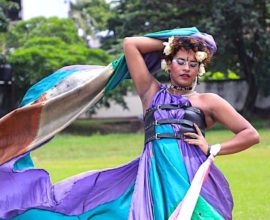
Two months ago I sat for my first year final exams at the Open University of Sri Lanka. Last month’s edition of the Hi Magazine showcased 3 pages of clothes from designer K.T Brown – modelled by me. And in December, I will be on Art TV – as a contestant for the Super Model of Asia Pacific 2011. I suffer from no grandiose illusions about myself. I am no super model. I am extremely uncomfortable in front of the camera and at age 26 have only just begun studying for my degree. Yet, every one of these steps is a huge achievement for me, for just over three years ago I was trapped in an abusive marriage. It was a marriage  that wore down every shred of confidence I ever owned – confidence I have struggled to take control of and own ever since. It has never been easy for me to speak of what took place during those…

Continue reading »

Why not sing Kolaveri Di in Jaffna Tamil?

Screen Shot 2012-01-03 at 10.20.13 PM

It was less than 200 years ago that the title of “orator” or “navalar” was bestowed on Kandar Arumukam Pillai, by the grateful inhabitants of South India. Leaving his native Jaffna for a time, he had spearheaded a renaissance of the Tamil language and culture in South India preaching, printing and endowing educational institutions. Thus began a long history of Jaffna Tamil involvement in the renaissance of Tamil. Thamotharampillai, Winslow and Kanagasabai Pillai are but a few whose contribution to the Tamil renaissance that rushed through South India and Jaffna.[1] Jaffna’s isolation from Sanskritic influence and its commitment to education has meant that it considers itself culturally superior to the natives of Tamil Nadu, it considers it language and culture purer and closer that of that Sangam ideal. Therefore it comes as no surprise that the blast of the trumpet against the now infamous “Kolaveri” song should be so strong in Jaffna. The day before yesterday SJ Stalin released a…

Continue reading »

Ending the Exile and Back to Roots: Fears, Challenges and Hopes

02_nomoretears

[Editors note: The author was married to Dr. Rajini Thiranagama (née Rajasingham), a Tamil human rights activist and feminist murdered in 1989 by the LTTE. She was one of the founding members of the University Teachers for Human Rights, Jaffna, which during the war, published some of the most hard hitting critiques and exposes of Government as well as LTTE atrocities and human rights violations. Since 2009, Dayapala Thiranagama's insightful articles to Groundviews have been amongst the site's most read and shared.] ### “Politics can be relatively fair in the breathing spaces of history; at its critical turning points there is no other rule possible than the old one, that the end justifies the means” (Arthur Koestler, Darkness at Noon, London, 1940, Page 81). On 27  December 1989 I arrived in Heathrow along with my two young daughters, aged 9 and 11 years. At  the Immigration Desk the  Officer asked me how long we intended  to stay.I replied ‘a couple of weeks’. My…

Continue reading »

The Incomplete Thombu: A compelling interlace of architecture, drawing, memory and art

The Incomplete Thombu - Front

Front cover of The Incomplete Thombu. Click here for larger image. Put simply, The Incomplete Thombu by Sri Lankan Tamil artist T. Shanaathanan is, for us, one of 2011′s most compelling publications. It is art, but in the form of a book that deftly entwines it with architecture, drawing, the memory of loss and an eerily compelling exploration of what makes a home, a home by those who have left it behind, or lost it to the war. Short excerpts in the book by those who have lost their home are always poignant, sometimes humorous but never vindictive. There is a fragile, essential humanity to these stories that with a light touch reveals so much the war took away from residents in Sri Lanka’s Northern Province. There are 80 stories captured in the tome and they range in tone, identity, location and age. The drawings by the subjects themselves are very powerful depictions of loss – not just of property,…

Continue reading »

Response to Michael Roberts’ ‘Turning Former LTTE Personnel into Sri Lankan Citizens?’

Camp

Photo courtesy Lankapuvath Michael Roberts’ recent Groundviews piece on the government’s rehabilitation programme of alleged former LTTE combatants is generally approving of that programme, not only directly but also indirectly in making the kinds of criticisms that actually add to the approbation. Professor Roberts has added his distinguished academic authority to a set of circumstances that perhaps justifies a more discriminating analysis. His uncritical and at times inaccurate and misleading observations therefore require a response, providing also the opportunity to critique, both the policy and legal perspectives involved. In this article I will attempt to remedy the lacunae in my previous piece on this issue, published here[1] in late 2010, which did not discuss the legal dimensions nor use testimonies of persons released from rehabilitation centres[2] to substantiate certain assertions made in that article. Statistics: Do we know how many persons have been rehabilitated? In a section titled ‘Numbers’ Roberts discusses the number of persons who were held at rehabilitation…

Continue reading »

A Commissioner’s Perspective: Citizens’ Commission on the Expulsion of Muslims from the Northern Province by the LTTE

DSCN0274

As one of the members of the Citizens’ Commission on the Expulsion of Muslims from the Northern Province by the LTTE in October 1990 (Citizens’ Commission), it is my privilege and pleasure to say a few brief words on behalf of all the Commissioners on the occasion of the launch of our Report. The Citizen’s Commission was an initiative of the Law and Society Trust (LST) and its partners’ in the absence of an official government inquiry into the expulsion of Muslims from the Northern districts by the LTTE. Our mandate was to document comprehensively  and in depth the experiences of the expulsion, the subsequent two decades of displacement and resettlement of the Northern Muslims as well as their expectations of the state and civil society. The fact that this was conceived of as a ‘Commission’, I think has important methodological as well as conceptual implications. A commission of inquiry (CoI) is generally appointed by the Executive Branch to inquire…

Continue reading »

Some observations on the Final Report of the Commission on the Expulsion of Muslims from the Northern Province by the LTTE in October 1990

Picture 039

This report provides what will be the definitive account of the story of the Northern Muslims following on their expulsion from the Northern Province by the LTTE in October 1990. Faithful throughout to the narrative of the affected, and respectful in its well- nuanced references to earlier writings- Hasbullah, Thiranagama and others- its approach earns the reader’s respect and trust. Commencing with accounts of pre- existing relations between co –existing Muslim and Tamil communities, the Report tightly states that. “October 1990 was a water-shed in terms of both Muslim identity and Tamil identity in the North due to the horror of the expulsion. By driving the Muslims out of their homes, the LTTE finally created a mono-ethnic North.” While the affected people’s  narrative uses terms such as “People from Batticaloa have come” it is clearly orders  from  the top that was responsible for this instance of  “Tamil Turning Terrorist” against Muslims, to use the report’s words. The creation of a…

Continue reading »

The Citizens’ Commission on the Expulsion of the Muslims from the Northern Province by the LTTE in October 1990

Picture 066

In October 1990, the Liberation Tigers of Tamil Eelam (LTTE) expelled the entire Muslim population of the Northern Province of Sri Lanka. Within a period of 2 weeks the LTTE systematically chased out close to 75,000 Muslims residing in the districts of Kilinochchi, Mullaiteewu, Jaffna, Mannar and parts of Vavuniya. The LTTE expulsion of Muslims has not been adequately integrated into any mainstream historical narrative in Sri Lanka. Most commentators routinely get the date of the expulsion wrong and few give it the status of a highly significant historical event that it warrants. This is unfortunately true of most events involving Sri Lanka’s Muslim community. The Law and Society Trust (LST) in partnership with the Rural Development Foundation (RDF), the Community Trust Fund (CTF) and the Peoples’ Secretariat (PS) and an advisory group of prominent Muslim civil society actors conducted a two year long truth seeking initiative in the form of a Citizens’ Commission. The objective of this exercise has…

Continue reading »

The Sri Lanka Reader: History, Culture and Politics

Screen Shot 2011-11-20 at 2.49.06 PM

Duke University Press( Durham and London) has published this superb anthology edited by that most perceptive and shrewd observer of Sri Lanka and its complex social, economic and political history, John Clifford Holt who is William R. Kenan, Jr., Professor of Humanities in Religion and Asian Studies at Bowdoin College in Brunswick, Maine in the United States.  He has written several books and, of those, the ones I am familiar with and profited from reading are The Buddhist Visnu: Religious Transformation, Politics and Culture(2004), The Religious World of Kirti Sri: Buddhism, Art and Politics in Late Medieval Sri Lanka(1996), Discipline: the Canonical Buddhism of the Vinayapitaka(1981), and Buddha in the Crown: Avalokiteswara in the Buddhist Traditions of Sri Lanka(1991), for which he received an American Academy of Religion Book Award for Excellence.  Prof. Holt is the recipient of an honorary Doctor of Letters from the University of Peradeniya and, in 2007, was selected by the University of Chicago Divinity School…

Continue reading »

WE REMEMBER after 21 years…

1900638785_e45c942810

No. 1, Jesuit Street, Batticaloa, September 24, 2011. The Editor, Groundviews. 21st Year Commemoration Dear Sir, At the last general meeting of the Batticaloa Peace Committee our talks led us to the conviction that we should speak out. We commemorated then the grouping of tragic events in our vicinity 21 years ago that proclaimed the vast gap between the aspirations of the Tamil people and the blindness of national leaders. With this short list of violent events, the die was cast, setting the nation on a continuous confrontation that ended only with the annihilation of any hope of equality of status for Sinhalese and Tamil people of the country. Our civil war has now been fought, and both sides, in fact, all sides have lost lives uncountable and decades of years. There have been no winners. All have been losers. Far more lives were lost than we can enumerate. The tragic cases we choose now to highlight were the trend…

Continue reading »

Turning Former LTTE Personnel into Sri Lankan Citizens?

79a08b2cdf80fb8476da75dab4c3880c

Editors note: Also read a response to this article by Valkryie, titled Response to Michael Roberts’ ‘Turning Former LTTE Personnel into Sri Lankan Citizens?’] Whatever the death toll during the last stages of Eelam War IV in 2009 the official government data in that year acknowledged that 11,696 (9078 male and 2024 female)[i] of those who survived had identified themselves or been identified as members of the LTTE — whether combatants or active functionaries. There were others who had been arrested elsewhere in the island (that is beyond the battlefields), often on flimsy evidence, in the years 2006-09. Muralidhar Reddy stresses that “once bracketed in the category of a combatant, irrespective of the degree of their involvement in the war, there was no mechanism for those detained to prove their innocence.”[ii] In parenthesis let me add that grapevine information from Tamil sources indicate that in April-May 2009 quite a few Tigers seem to have successfully merged themselves with the population that was…

Continue reading »

Reflections on Issues of Language in Sri Lanka: Power, Exclusion and Inclusion

jaffna

Photo credit Dinuka Liyanawatte / Reuters, from Time magazine. Keynote address delivered on 17th October 2011 at ‘Language and Social Cohesion: 9th International Language and Development Conference, Colombo co-organized by the Ministry of National Languages and Social Integration, Ministry  of Education, GIZ, AusAID and British Council. ### Approach Language is never a simple issue of communication; in contemporary social and political practice everywhere, language goes much beyond its basic utilitarian purposes. In this sense, Sri Lanka is no exception. By now, Sri Lanka has ended an immensely destructive military conflict that had much to do with a crisis of identity linked as much to language as to ethnicity and contested notions of binary-nationalisms and competitive interpretations of history. In this context, this is a crucial time to seriously consider the politico-developmental position of language in imagining the future of the country. Today, I will briefly focus on the historical development of the politics of language in Sri Lanka and explore…

Continue reading »

Bully Boys and Bully Girls

duminda_silva

A few evenings ago, parents were invited to our son’s school which goes up to Grade 8 for a presentation on Bullying.  Dr. Tina Daniel, Asst Professor of Psychology at Carleton University engaged in researching children’s relationships, violence and bullying facilitated the session.   She and her research colleagues had already spent the day in school first making a presentation at the assembly, then a workshop with teachers and classroom sessions with children themselves. In her presentation she showed footage of an actual playground incident where a girl aged 12 was being bullied by another bunch of girls.  As she deconstructed the scene, there was a child seated on the ground and about five girls hovering around her and it appeared innocent enough, but a closer look revealed her being taunted and teased, as she had her head down crying.   It appeared that this pack of girls had a leader who was directing all this. Dr. Daniel stated that bullying does…

Continue reading »

We the Sinhalese

ceylon-superb-sinhalese-women-skeen-1880

Image courtesy Lankapura An oyster sucks in particles from its environment and creates a pearl. If instead, it filters out every particle, it is destined to be a lesser being. In untold generations, the Sinhalese people were fashioned from extraditions, waves of invasions, conquered kingdoms and stranded travelers to this fecund island. They are the children of exiles, conquerors and refugees, some noble and often not…. They are begotten of peoples who have absorbed and yielded, been besieged and withstood and been enriched, pearl-like. In time the Sinhalese defined themselves as a race and a culture that can be distinguished from the cultures of India. This is laudable in the face of that overshadowing mass.  We have swum through multi-colored waters and still stand as a discernible ethnicity…but are we quite as boldly discernible and as splendidly isolated as we believe? Our outline has to have merged and blended with the communities we have mingled with; the aboriginal, australo-negroid Veddha,…

Continue reading »
Page 1 of 1212345...10...Last »

About Groundviews

Located at the Centre for Policy Alternatives in Colombo, Sri Lanka, Groundviews is a citizen journalism website that uses a range of genres and media to highlight critical perspectives on governance, reconciliation, human rights, the arts and literature, democracy and other issues. The site has won two international awards, including the prestigious Manthan Award South Asia in 2009. The grand jury's evaluation of the site noted, "What no media dares to report, Groundviews publicly exposes. It's a new age media for a new Sri Lanka... Free media at it's very best!"

cezarneaga.eu