Archive for the ‘UN Panel Report’

Eating properly and smiling: The evasive Valerie Amos on Twitter

Screen Shot 2012-12-18 at 10.52.52 PM

On 18th December 2012, at around 10pm in Sri Lanka, Valerie Amos, the UN Under-Secretary-General for Humanitarian Affairs and Emergency Relief Coordinator took to Twitter, ostensibly to answer questions related to the UN’s role, relevance and responsibilities regarding humanitarian aid and relief work. The event with Baroness Amos was announced via the Twitter account of, inter alia, UN OCHA, which also had a photo of her in front of a laptop, getting ready to face the questions. RT @unocha: .@valerieamos is now replying to questions from @alertnet and Twitter users around the world. #AskValerietwitpic.com/bn3zd4 — Groundviews (@groundviews) December 18, 2012 The event was conducted with the hashtag #AskValerie. Baroness Amos is (whether through office aides or by herself it remains unclear) fairly active on Twitter via @ValerieAmos. However, despite her own and OCHA’s familiarity with web based social media interactions, yesterday’s Twitter question time with Baroness Amos was a cogent example of how not to curate and conduct public debates…

Continue reading »

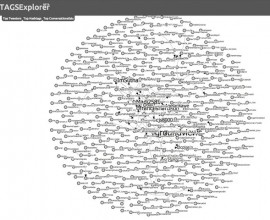
#UPRLKA: Complete tweet archive and related visualisation around Sri Lanka’s UPR review

Screen Shot 2012-11-02 at 12.04.48 PM

Image courtesy Sydney Morning Herald On 1st November 2012, Sri Lanka was taken up for discussion as part of the Universal Periodic Review (UPR) at the UN Human Rights Council (HRC). The last UPR was in 2008, and under scrutiny was Sri Lanka’s human rights record over the past four years, that significantly, saw the end of the country’s 27 year old war. A number of leading Sri Lankan and international human rights organisations, independent media including Groundviews and Vikalpa, as well as other leading voices on Twitter agreed to use #UPRLKA and #UPR14 hashtags in tweets around Sri Lanka’s case at the UPR. Since #UPR14 was a generic hashtag, #UPRLKA was encouraged as the primary hashtag to use when tweeting on Sri Lanka. Groundviews started to archive every single tweet (and retweet) with #UPRLKA on 29th October (Monday). At the time of writing, we have archived 3,592 tweets, the majority of which were posted on 1st November, leading up…

Continue reading »

Sri Lanka’s Killing Fields: War Crimes Unpunished: Unofficial video now online

Screen Shot 2012-03-15 at 8.51.33 AM

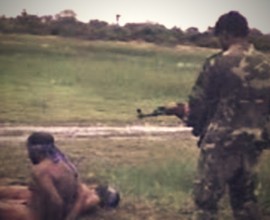
Channel 4′s new documentary on Sri Lanka, Sri Lanka’s Killing Fields: War Crimes Unpunished aired for the first time in the UK last night. Before it is even available on Channel 4′s official web based on-demand service, it’s now up on YouTube. It is likely that the video is soon taken down by Youtube over copyright violation claims, and Channel 4 notes the video will be officially available soon. In a series of tweets to Channel 4, we informed that the Adobe Flash based on-demand service of the channel, not just because it won’t play on any Apple iOS device, is far less suitable for the viral dissemination of the video than featuring it, like this unofficial version, on YouTube or Vimeo. Not doing so, and not making the video more easily downloadable, we said severely limited its access within Sri Lanka. We also asked Channel 4 to take a page out of the viral dissemination of KONY 2012. Finally,…

Continue reading »

Post-war situation in Northern Sri Lanka & Prospects for Reconciliation

Statis 2 - Degra

Changes since the end of the war: 30 months after the end of war, more people travel between the once off limits North[i] and the South and many of the travel restrictions have been eased. The dreaded Medawachiya checkpoint is no more, and since 2010, we have not taken a flight or ship to Jaffna, travelling by road instead. Displaced people who were detained for about 6 months have now been allowed freedom of movement and many have been allowed to go back to their places of origin. Many youth detained in “rehabilitation” centres have been released and allowed to go back to their families and communities. Death certificates have been issued to few of the people killed during the war. Few schools, hospitals, and some main roads and bridges have been built and glamorous ceremonies held to open these by government and military officials. Three major elections have also been held in the North. But much remains to be…

Continue reading »

Channel 4′s ‘Killing Fields’: Journalism, Advocacy or Propaganda?

Screen Shot 2011-09-13 at 7.25.24 AM

Image from Channel 4 Introduction The UK based Channel 4 documentary, “Killing Fields”, possesses an interesting characteristic. It has the power of accentuating the prejudices and biases of viewers. The reaction found on a variety of forums is arguably more illuminating than the documentary itself. Those who feel the Sri Lankan government has done no wrong, are further convinced that there is an international conspiracy and the entire documentary is fake. There are those who are convinced that the Sri Lankan armed forces are evil. There are also those that believe the documentary is evidence of the need for a separate Tamil nation and are busy distributing DVDs to Western politicians. The remainder are horrified by the footage and can not watch the entire documentary. With the broadcast of the “Lies Agreed Upon” [1]  documentary by the Sri Lankan television station Ada Derana [2] , we now have two very one-sided documentaries. Only together can any semblance of balance be achieved. Callum Macrae,…

Continue reading »

War Crimes Investigations in Sri Lanka: An Unpopular View

5F4A18ADD57A0F339B09213AC557831A1

“In trying to do good, we have been living beyond our moral resources and have fallen into hypocrisy and self-righteousness” — William V. Cannon, commenting on the Vietnam War, New York Times, February 6, 1966 “Conquer the angry man by love, Conquer the ill-natured man by goodness. Conquer the miser with generosity. Conquer the liar with truth.” — The Dhammapada p. 223 Despite the best efforts of the Sri Lankan government, the claim that Sri Lanka is a “Killing Field” is fast becoming a social and political rallying point for diverse interest groups. Allegations of government war crimes outlined in the Darusman Report, the now infamous Channel 4 video, and the case filed by Tamils against Genocide (TAG) with the Department of Justice in the United States, as well as electronic reports published across the world have by now overshadowed the victory over the LTTE. The government’s uncompromising resistance to investigate war crime allegations by any external body could turn…

Continue reading »

Darusman Deconstructed: Godfrey Gunatilleke’s Critique

UN_panel_on_sri-lanka11-111111

With the solitary, honourable exception of Sunday Times columnist Lasanda Kurukulasuriya, (‘Give a dog a bad name and hang him’, From the Sidelines, Sunday Times, Colombo, August 14, 2011), the Lankan media and Colombo’s commentariat completely missed the most important intellectual event in civil society in this post-war phase of our contemporary history. A media accustomed to lionising the less distinguished among our retired senior professionals and intelligentsia, was either ignorant of or chose to ignore a symposium held by the oldest among our independent think tanks, the MARGA Institute, precisely on the most pressing subject of the day, the Darusman report or more accurately the UNSG’s Advisory Panel Report. Worse, the media and our commentators seem unaware of the extended analysis of the Darusman Report by the doyen of Sri Lanka’s intelligentsia, one of our most refined literary critics, most distinguished civil servant, and among a handful of our globally most respected minds, Godfrey Gunatilleke. Entitled ‘Truth and Accountability:…

Continue reading »

Sri Lanka’s Tamil question: Justice, Lies and Videotape

Screen Shot 2011-08-06 at 3.18.47 AM

Sri Lanka’s thirty year war is now more of words than of guns, but it is no less bitter. RNW’s team in the country met with fierce resistance from the Sri Lankan government to the current calls for justice from the international community. But the problem is that the international community’s presence in the country is dwindling, a fact witnessed when travelling across the east of the island – where once there were distinctive white NGO vehicles on every corner, the sight is now rare. With the help of one remaining NGO which requested anonymity, RNW met nine freshly ‘reintegrated’ former Tamil Tiger guerillas who spoke of their desire for justice for all Sri Lankans. But people in the heavily militarized north and east live in fear of reprisal if they openly criticise the authorities – which is why a vociferous Tamil diaspora, the foreign media and a UN investigation have stepped in. The Sri Lankan government is now hitting…

Continue reading »

Why Government Rhetoric and Propaganda Might Divide Sri Lanka

SRI LANKA-UN-UNREST-PROTEST

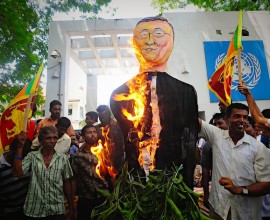
In an interview Professor Rajiva Wijesinha gave The Sunday Leader concerning government responses to international pressure, he remarks that “people believe what they want to believe”. Wijesinha’s ironically astute observation sheds light on why government responses to war crimes allegations during the final stage of the Eelam War are not being rallied against locally. Leaving aside the lack of press freedom, the fear psychosis and the problem of discontent (over 16 Sri Lankans commit suicide daily), the desire to simply ‘move past’ a nerve-wracking 30 years of war is strong. At this point it is no surprise that internal criticism of the government response to war crimes allegations is yet weak. While the government strongly condemns what it deems the rhetoric, propaganda and bias of Western media, it is in turn a useful exercise to see what kind of political rhetoric is intrinsic to the official government response, and what kind of moral and political commitments are implicit in that…

Continue reading »

Holes in the UN Secretary General’s Panel of Experts Report: Examining the Probable Alternate Events

UN_panel_on_sri-lanka11-111111

Last week, I attended a seminar conducted by the Colombo-based Marga Institute, a think tank devoted to studying and influencing human development in Sri Lanka. Marga is in the process of putting together a review of the UN Secretary General’s advisory panel report on Sri Lanka (the well-known Darusman Report), which will analyze several aspects of this document, including its legal credibility; the manner in which it makes its allegations and narrates the series of events that made up the final stages of the war; the recommendations of the report; and, very importantly, the impact all of this will have on the reconciliation process in Sri Lanka, via accountability and restorative justice. The seminar itself was to elaborate on the thinking behind the review, discuss the draft, and possibly include the conclusions of such discussions in the final review. The seminar was therefore conducted in a series of panel discussions, each looking at a different aspect of the Darusman Report,…

Continue reading »

Resource book for historians, researchers and media: A year of tweeting from Groundviews

groundviews-followers-small

Visualisation of our Twitter followers. See larger version here. We used the web service Tweet Book to capture all our tweets over the past year in a single PDF. We’ve tweeted thousands of times over the past twelve months and have covered, The media fallout of the farcical fast of senior government Minister Wimal Weerawansa in front of the UN HQ in Colombo. Praise for our model of journalism on C-SPAN video in the US, captured from an event at the United States Institute of Peace. Key statements by world leaders like Desmond Tutu on post-war reconciliation and accountability for war crimes Bell Pottinger’s sickening relationship with the incumbent government, largely hidden from public scrutiny Key reports on Sri Lanka from, inter alia, HRW, AI, ICG and the US State Department, including responses from senior Ministers and the Foreign Ministry Foreign relations and the tussle in Sri Lanka between India and China The court proceedings on Sarath Fonseka The UNP’s perennial…

Continue reading »

Photographic evidence of war crimes in Sri Lanka, or not? (Updated)

Shelling-photo-11-small

“The resulting carnage, photographed by Harun, was indescribable, but worse was to come.” The Living Scotsman’s review of The Cage: The Fight for Sri Lanka and the Last Days of the Tamil Tigers by former UN spokesperson Gordon Weiss flags, inter alia, photos taken by Ret. Col. Harun Khan when his UN convoy came under attack in the final days of the war. The so-called Convoy 11 incident is covered in detail in Gordon’s book. As our review notes, “Weiss speaks of photographic evidence of the carnage taken by Col. Khan, but there is none to be found in the book itself. Dismembered babies may have been too gruesome to include in the tome, but are photographic evidence of the deliberate targeting of civilians. Weiss does not say who has these photos, but we can assume, amongst others, the UN does.” Referring to the Living Scotman’s review, we asked Weiss, via Twitter, whether Col. Khan’s photos would be publicly released….

Continue reading »

Sri Lanka’s Diplomatic Offensive Won’t Make Killing Fields Disappear

Screen shot 2011-06-30 at 6.57.18 AM

Screen grab from Channel 4′s Sri Lanka’s Killing Fields (New York) – The Sri Lankan government continues its diplomatic offensive, denying and dismissing the growing evidence of war crimes during the final bloody battles between the Sri Lankan armed forces and the separatist Liberation Tigers of Tamil Eelam (LTTE) that ended in May 2009. Last week, at a panel presentation of the Channel 4 film, the ‘Killing Fields of Sri Lanka’, Sri Lanka’s United Nations Ambassador Palitha Kohona said, “To suggest that the Sri Lankan military was so foolhardy as to deliberately target the civilians, I think is a blatant lie… We had no intention of creating martyrs, we had no intention of creating more volunteers for the LTTE.” If the killings of civilians were not deliberate, the Sri Lankan army attacks were clearly indiscriminate, which is no less a war crime. The recent findings of the panel of experts set up to advise UN Secretary General Ban Ki-moon concluded that…

Continue reading »

Two years after the end of the war in Sri Lanka

WAR_deshan_01

Photo courtesy Deshan Tennekoon, Groundviews The UN panel report or the Darusman report was condemned and rejected. The stand taken by the government was that “not a single civilian was killed during the last stages of the war. If some of those dead were found to be in civilian clothes, they were Tigers in disguise, even if they happened to be children or elderly women. No one can say we committed war crimes because no one saw what happened during the last stages of the war. Therefore we don’t have to answer any questions raised by UN or the international community.” In a way this is true – no one saw what happened at Mullivaikal, Pudukudiyiruppu and Nandikadal in May 2009. There were no witnesses. The UN and the international community actually abandoned those 300,000 civilians, who were left alone to face the LTTE on the one hand and the Sri Lankan army on the other, and God knows who…

Continue reading »

The war that confronts us: Looking at Sri Lanka’s official responses to Channel 4 video

Screen shot 2011-06-27 at 10.40.10 AM 1

Image courtesy Channel 4 Channel 4’s Sri Lanka’s Killing Fields is anything but understated. It is designed to shock, even if you are the most hardened of viewers. Images of blood-soaked bodies assail you from every angle. As a cellphone camera jerks around, you see the bulging eyes of a man-turned-killing machine. He appears to be enjoying himself. You feel disoriented. When you think you cannot take it anymore, there it is: Another body eviscerated, another child screaming for her mother, another man’s eyes tied shut, another gunshot through the head, and still another naked body piled atop a truck laden with violated human flesh. And then you are left with nothing but darkness. And silence. That silence lingered as the lights went up on the UN Church Center, where NGO workers and UN staffers, reporters and diplomats attended a subdued screening of Channel 4’s controversial (and at times sensationalist) documentary, Sri Lanka’s Killing Fields. Though the screening was punctuated…

Continue reading »
Page 1 of 41234

About Groundviews

Located at the Centre for Policy Alternatives in Colombo, Sri Lanka, Groundviews is a citizen journalism website that uses a range of genres and media to highlight critical perspectives on governance, reconciliation, human rights, the arts and literature, democracy and other issues. The site has won two international awards, including the prestigious Manthan Award South Asia in 2009. The grand jury's evaluation of the site noted, "What no media dares to report, Groundviews publicly exposes. It's a new age media for a new Sri Lanka... Free media at it's very best!"

cezarneaga.eu