Long Reads

Colonizing Childhood and Zionist Pedagogy: Interview With Prof. Nurit Peled-Elhanan

nurit_peled

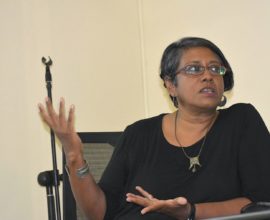
Nurit Peled-Elhanan is a professor of language and education at the Hebrew University of Jerusalem, peace educator and activist and co-laureate along with late Prof. Izzat Gazzawi of the 2001 Sakharov Prize for Human Rights and the Freedom of Speech awarded by the European parliament. Peled-Elhanan has translated Albert Memmi‘s Le Racisme (1982) and Marguerite Duras‘ Écrire (1993) into Hebrew. In 1997, her daughter Smadar, aged 13, was killed in a suicide bomb attack in Jerusalem. “Terrorist attacks like this are the direct consequence of the oppression, slavery, humiliation and state of siege imposed on the Palestinians”, she told reporters in the aftermath of Smadar’s death. She and her family work with the Palestinian and Israeli Bereaved Families for Peace. Professor Peled has critically dissected the ideological content of Israeli schoolbooks for the past five years. She considers children as victims of Israel’s militaristic, settler-colonial culture. Her radical views have exacted a professional cost. “University professors have stopped inviting me…

Continue reading »

A Missing Person in Sri Lanka: Heartfelt Issues & Ground Realities

sri-lanka-missing-people.jpeg-620x412

Image courtesy Salon / AP Photo by Eranga Jayawardena When I was in Sri Lanka from mid-April to early June 2009 I was on holiday with my wife and not able to pursue investigations in any depth. In contrast my sojourn in May-June 2010 focused on a range of studies and travels. One gem of a life-story surfaced near my second home in Wellawatte when I was able to chat with a domestic servant at a Tamil house nearby, a lady who had been through the crucible of Eelam War in the Vanni Pocket. I shall call her Sambandhi. She was a wizened wiry soul who had survived the war together with husband, but (1) had one daughter killed by shrapnel; (2) one son (who was then aged c. 21) hospitalized in mid-2009 with the loss of one eye and injuries to face and other eye;[i] and (3) was wracked with pain because one of her sons had been conscripted…

Continue reading »

Mixed Messages and Bland Oversimplification in President Rajapaksa’s Independence Day Speech

37-Chicago_Maaveerar_Naal_USA1_21081_435

In a significant act of outreach the Independence Day ceremonies were held in Trincomalee, a provincial city with a pronounced ethnic mix; while President Rajapaksa presented one part of his message in Tamil, repeating what he had said earlier (in English?) and then reiterating the same points in Sinhala. In keeping with the occasion and location, he referred to the Dutch and British interests in Trincomalee during the imperialist past as a prelude to his argument that Sri Lankans “have had to face continued challenges to protect the freedom and independence of our motherland.” In line with this emphasis, he also reminded the UN and the West of the obligations within the UN Charter which enjoin member nations to refrain from “interven[ing] in matters which are essentially within the domestic jurisdiction of any state.” It is the latter emphasis which has attracted local newspaper headlines. However, to my mind what was more significant and heart-warming was his criticism of religious…

Continue reading »

Parama Weera: What it takes, and what it means

AFP/Getty 510928028

Image credit Ishara S.Kodikara/AFP/Getty Images via The Baltimore Sun The eyes stared expressionlessly back at me from the fifteen small pictures, some clear, and some blurred; reflections that only hinted at the men behind those eyes. But sharp or soft, they all looked so innocuous, so devoid of any indication of what they had once seen. So normal. To look into those fifteen pairs of eyes, to read their names on the Wall that held thousands of similar names, was to gain no hint of the impossible acts of bravery that their owners had committed. Acts that would now see them join the eight who had gone before. Twenty-three names for twenty-three men. Twenty-three individual acts of supreme courage, selected out of twenty-eight years of war. The faces were tucked away in the second page of the Sunday Times, and I stared back at them for awhile before reading the short paragraph beneath each. The words were trite, cliched, dry;…

Continue reading »

Operation Liberation: 25 years on

secfield20061201

The commanders of “Operation Liberation” commonly known as “Vadamarachchi Operation”. From left to right: Lt Col. Vipul Boteju, Lt Col. Sarath Jayawardane, Col. Wijaya Wimalaratne, Brig. Denzil Kobbekaduwa and Maj Gotabaya Rajapakse [1987, Jaffna] Image courtesy Defence.lk Twenty five years ago, on May 26th 1987, the Sri Lankan military forces launched ‘Operation Liberation’, which, at the time, was the biggest military operation in Sri Lanka since independence. At least 5,000 troops broke out of their bases in Jaffna in a bid to take the battle to the rebel Tamil Tigers who had kept the soldiers confined to the barracks for more than a year. The operation met with significant success. Within a week the Vadamarachchi sector of the peninsula was brought under government’s control, and scores of rebels killed or captured and some of their munitions factories destroyed. However, any ambitions the Sri Lankan government had about widening the operation to cover the entire Jaffna peninsula had to come to…

Continue reading »

THE SRI LANKAN REPUBLIC AT FORTY: REFLECTIONS ON THE CONSTITUTIONAL PAST AND PRESENT

z_page-36-Ceylon-became

Image courtesy Daily News Forty years ago this week, at the auspicious time of 12:34 p.m. at the Navarangahala on 22nd May 1972, a new constitution was signed into law, creating the Republic of Sri Lanka. This was the first time in the history of the island that the republican form of state was established, discounting the period under which parts of the littoral were controlled by the Dutch East India Company during the time the Netherlands were a confederated republic. Given that the political history of the island spans over two millennia from its mytho-historical origins, four decades might not seem like a long time. But looking back to 1970-72, the country and the world in which the first republican constitution was created seems very different from the present, although the continuing resonance of many of the dominant themes of that era are still felt in today’s Sri Lanka. In the Third World, it was the epoch of anti-colonialism…

Continue reading »

Women Left Behind: Truth Commissioning in Sri Lanka

5380440818_c2e51dda81_b

A mother displaying the photographs of his sons which are missing during the Lessons Learnt and Reconciliation Commission (LLRC) session in Trincomalee, December, 3-5, 2010. Photo courtesy Centre for Human Rights The power and promise of national exercises like the LLRC lie in the way that they can access the voices of those who have not traditionally been heard, and use them to build a more representative and inclusive collective memory. Yet for Sri Lanka’s Tamil women, the LLRC simply reaffirms bad old habits, writes Jo Baker [i] In the lead up to the release of the report by Sri Lanka’s Lessons Learned and Reconciliation Commission (LLRC), strong concerns have been publicly raised about the value of a process that aims to build a clear picture of the conflict, without fully including or representing those who were most directly affected. This has led to important questions regarding who has been heard, how their concerns have been addressed, and whether they will…

Continue reading »

Turning Former LTTE Personnel into Sri Lankan Citizens?

79a08b2cdf80fb8476da75dab4c3880c

Editors note: Also read a response to this article by Valkryie, titled Response to Michael Roberts’ ‘Turning Former LTTE Personnel into Sri Lankan Citizens?’] Whatever the death toll during the last stages of Eelam War IV in 2009 the official government data in that year acknowledged that 11,696 (9078 male and 2024 female)[i] of those who survived had identified themselves or been identified as members of the LTTE — whether combatants or active functionaries. There were others who had been arrested elsewhere in the island (that is beyond the battlefields), often on flimsy evidence, in the years 2006-09. Muralidhar Reddy stresses that “once bracketed in the category of a combatant, irrespective of the degree of their involvement in the war, there was no mechanism for those detained to prove their innocence.”[ii] In parenthesis let me add that grapevine information from Tamil sources indicate that in April-May 2009 quite a few Tigers seem to have successfully merged themselves with the population that was…

Continue reading »

War Crimes Investigations in Sri Lanka: An Unpopular View

5F4A18ADD57A0F339B09213AC557831A1

“In trying to do good, we have been living beyond our moral resources and have fallen into hypocrisy and self-righteousness” — William V. Cannon, commenting on the Vietnam War, New York Times, February 6, 1966 “Conquer the angry man by love, Conquer the ill-natured man by goodness. Conquer the miser with generosity. Conquer the liar with truth.” — The Dhammapada p. 223 Despite the best efforts of the Sri Lankan government, the claim that Sri Lanka is a “Killing Field” is fast becoming a social and political rallying point for diverse interest groups. Allegations of government war crimes outlined in the Darusman Report, the now infamous Channel 4 video, and the case filed by Tamils against Genocide (TAG) with the Department of Justice in the United States, as well as electronic reports published across the world have by now overshadowed the victory over the LTTE. The government’s uncompromising resistance to investigate war crime allegations by any external body could turn…

Continue reading »

The absence of Patriotism, Pluralism and Cosmopolitanism: ‘Sri Lanka’s Killing Fields’ in retrospection

20091105-194022-pic-325117824_s640x445

ASSOCIATED PRESS PHOTOGRAPHS Former Sri Lankan child soldier Warnakulasuriya Anthony Sunil Rexy (right) laughs with other inmates as they play earlier this month at a government rehabilitation center in Ambepussa. Original in The Washington Times. The TV programme entitled Sri Lanka’s Killing Fields, produced by Channel 4 of the UK, sparked substantial debate and discussion in every strata of interest on Sri Lanka, including the realms of high politics and diplomacy, national an international journalism, the non-governmental sector and the programme carried sufficient weight to trigger a renewed interest on Sri Lankan affairs in the West – which – due to the absence of key strategic interests in Sri Lanka, does not generally have a place in Western foreign policy agendas. While the Government of Sri Lanka condemned the programme as false and criticised its intent at causing international embarrassment to Sri Lanka, Western governments reiterated their common request that Sri Lanka should seriously investigate the allegations of crimes of…

Continue reading »

Identities And Borders In South Asia: A View From The Left

partition

Partition, 1947, courtesy The Hindu Introduction From the partition of British India to the civil war in Sri Lanka, the attempt to impose national borders in accordance with ethnic, linguistic or religious identities in South Asia has spawned civil wars and crimes against humanity, resulting in almost unimaginable suffering and bloodshed. This is all the more preposterous in a region where migration and the mixing of peoples and cultures have been occurring from time immemorial. The Left potentially has a conceptual and theoretical framework which would allow it to propose solutions to these conflicts, yet flawed interpretations of ‘the right to self-determination’ have led many on the Left to compound the problems instead. A different interpretation suggests that the key goals should be less violence and more democracy, and taking down barriers between peoples rather than erecting more and more of them. The birth of India and Pakistan It is surely a paradox that a non-violent movement in India for…

Continue reading »

Notes on Possibilities after the UN Report: Including Nationalism and ‘The Geopolitics of Emotion’

Buddhist-monk-1-C

Photo courtesy Deborah Philip It was my sense after May 18, 2009 when the LTTE was defeated that Sri Lanka was missing an opportunity to redefine itself as part of a kinder, gentler, global community. Instead it heightened nationalist discourse, extended emergency rule, surveillance and militarization, and devised new forms of censorship. Sri Lanka missed the opportunity to become one of South Asia’s more enlightened nations by not reaching out to one of its more battered and war-scarred communities after 18/09.  The UN report has returned us to that moment, and if intelligently and constructively used may help us explore roads not taken, toward a better, brighter and kinder future for all its citizens. Political philosopher Judith Butler wrote after 9/11 and the attacks on the twin towers in New York City in a book titled: Precarious Life: “that we can be injured, that others can be injured, that we are subject to death at the whim of the other,…

Continue reading »

Educating the Soul, the Spirit and then the Mind

Edu

Photo courtesy The Schools Project Background Over the years, I have spent much time with children and teachers in schools running leadership programs not only in Sri Lanka, but also in Canada, the Indian subcontinent and in Africa where I do a  simple exercise on their Hopes & Fears, and I am always moved by, especially the fears children have for their future.   They realize that they are coming out into an angry, uncertain world in social and environmental turmoil.   Of course they have hope, yet many feel insecure and ill equipped to meet these challenges. This is not surprising as globally, we are yet teaching children as if the world out there is impersonal and separate from them.   There is not much in it to increase self-awareness, mindfulness, self-reflection, emotional intelligence and social skills.  It is yet about knowledge and scientific discovery, even then the system has not yet figured out how to teach them, for instance, the uncertainty…

Continue reading »

A Home for Books

BOOKS

Original photo courtesy Tarika Wickremeratne For as long as I can remember we have had books in the house. To my child’s eye it seemed that every room was spilling over with books. Books in bedrooms, living room, dining room, kitchen and even bathroom. Most of the books belonged to my father – his study held his law books and his other books were distributed among the other rooms – Dictionaries (the love of his life), classics, spirituality, fiction, art etc. They were housed in various book cupboards, either inherited from his parents or bought from various furniture auctions held on Saturdays and that were common enough during the 60s and 70s. Most of them were of the art deco style, glass fronted wooden cupboards with an abstract wooden design against the glass, others were plain and serviceable. If the book cupboards had keys they were never locked. We were never told which books we could or couldn’t read and…

Continue reading »

Small Country Diplomacy

Colonel-Gaddafi

Bosom buddies, Libya’s Qadaffi and Sri Lanka’s President, courtesy Sunday Times Of late there have been several critical comments levied against the manner in which Sri Lanka has conducted her diplomatic relations.  Traditional alliances with the Western world have become somewhat stilted, new alliances have been forged, while fortunately the tempo of our relations with the SAARC countries, our regional neighbours, have remained stable.  The shifts in the balance of power relations have created a certain amount of suspicion and hostility among the Western Powers.  The entry of China, the bête noir of India, has also introduced heightened alertness, but not disharmony into the Indo- Lanka relations.  Sri Lanka needs to fine tune her diplomatic skills as we are dependent on the West for much of our trade, financial aid and investments as much as we are on India, especially with the need to keep the regional balance. Some of the charged atmosphere in Sri Lanka’s international relations, have not…

Continue reading »
Page 1 of 212

About Groundviews

Located at the Centre for Policy Alternatives in Colombo, Sri Lanka, Groundviews is a citizen journalism website that uses a range of genres and media to highlight critical perspectives on governance, reconciliation, human rights, the arts and literature, democracy and other issues. The site has won two international awards, including the prestigious Manthan Award South Asia in 2009. The grand jury's evaluation of the site noted, "What no media dares to report, Groundviews publicly exposes. It's a new age media for a new Sri Lanka... Free media at it's very best!"

cezarneaga.eu