Archive for the ‘Economy’

Chaos in Colombo: Mêlée over jobs indicates a serious economic problem in Sri Lanka?

IMG_0963

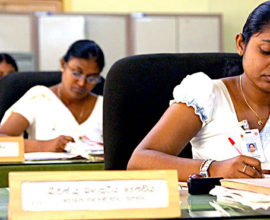
Anushka Wijesinha (who blogs here), a Research Economist at the Institute of Policy Studies, sent us these incredible photos and video of the chaos in Colombo today when thousands of Korean job seekers appeared for Korean exam applications at the Police Park down Havelock Road. Mainstream media reports a figure of 10,000, which going by the video and photos appear to be mostly young men. In a speech by Dr. Anura Ekanayake, outgoing CCC chairman and IPS Board member, he noted that of the 4.5% unemployment rate overall in Sri Lanka, 18.1% of youth (age 15-24) are unemployed and within this around 10.7% of those qualified with A/Ls are unemployed. Anushka observed that, Many were queuing from 5pm yesterday, which means they had spent the night on the pavements. By the time the centre closed at 11.15am (as was informed by the officials there to those gathered 3,500 applicants had been registered. There was at least 1,000 more in the…

Continue reading »

Katunayake Protest as an Invitation to Political Economy

5790453662_68ffdb8600_b

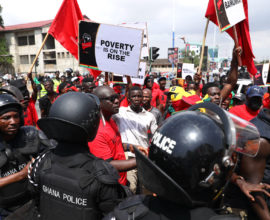
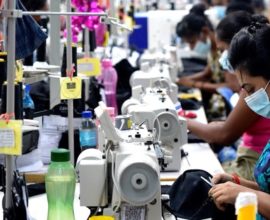
Photo courtesy Vikalpa [Editors note: For background on the Katunayake protests, read Protests in Katunayake Free Trade Zone: No police in sight] The state sponsored triumphalist ideological noise of Sinhalese ethno-nationalism was suddenly disturbed, on the eve of the officially declared month for the commemoration of war heroes (ranaviru), by an unexpected eruption of workers at Katunayake Free Trade Zone (FTZ) into the political field. The majority of these were women workers who came from rural areas, effectively defying the sanctioned definition of traditional Sinhala women, as propagated by the current nationalist ‘truth-regime.’[1] Although the government media points its fingers at some political parties over the May 30th clash between thousands of workers and the police at the Katunayake FTZ, the protest campaign likely reflected the worker’s own fear and distrust of the Pension Bill, introduced by the government for private sector workers. A young worker died and hundreds were injured as a result of police gun fire, enraging trade…

Continue reading »

Killing and State Intervention into a Funeral: A New Form of Suppressing Liberty in Sri Lanka

Screen-shot-2011-06-03-at-2.52.47-PM

Crime of “Dissent” & of Murder Killing of Roshen Shanaka Ratnasekara,  a factory worker in the Free Trade Zone (FTZ), Katunayaka gives a signal to the country on how peaceful protesters would be dealt with. Those who are familiar with police accountability will accept that police cannot carry guns and ammunition, without accountability. The records of the police must reveal as to who issued firearms and ammunition and who, in fact, ordered the police to fire.  Police is required to make frank notes of their actions after they return to the station. However, all these come out only if a credible investigation is conducted. Knowing the track record of governance in the country and impunity with which law enforcement and political authorities operate, there is hardly any genuine hope of such transparency in any investigation. The purpose of this article is to briefly examine the legality of use of excessive force by law enforcement officers and the impact of the…

Continue reading »

The limits of the Mahinda Chintanaya: FTZ workers and Buddhist monks rise up against government

5793365214_1d498297fb_b

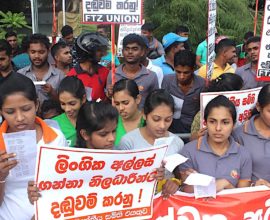
Photo courtesy Vikalpa Protests in Katunayake Free Trade Zone: No police in sight has audio and video footage of the violent protests over the course of the week in the Katunayake Free Trade Zone. A 10 minute video of the protests on Thursday, after the Police killed 21 year old Free Trade Zone (FTZ) worker Roshan Chanaka, can be seen below. As Rasika Jayakody notes in an article dealing with Rohan’s killing, “Apart from this tragic death, this brutal police attack against Free Trade Zone workers left more than 200 people injured. On Monday evening, Ragama and Negombo hospitals were flooded with injured protesters. It is, undoubtedly, one of the brutal crackdowns in recent history. There are several video footages which clearly show the barbaric and inhuman manner that some police officers carried out attacks against unarmed protesters.” The withdrawal of the proposed pensions bill is a major embarrassment for the government. So embarrassing in fact that some reports suggest…

Continue reading »

People are not a flock of sheep: The murder of a 21 year old by the Police

Screen shot 2011-06-03 at 2.52.47 PM

The 21 year old Free Trade Zone (FTZ) worker Roshan Chanaka, who was seriously injured during the clash between the police and the FTZ protesters on Monday, passed away mid-week to his deadly injuries. His death has now sent shock waves to the government. According to reliable sources, prominent cabinet ministers were seen at his residence this morning, shedding crocodile tears over Roshen’s death. It is reported that all the SLFP party organizers in Gampaha district are advised to attend his funeral and console his family members. Giving a new twist to this controversy, IGP Mahinda Balasuriya has resigned from his portfolio. He has sent his retirement papers to the Ministry of Defence and has gone on leave with immediate effect. Senior DIG N.K. Illangakoon has taken over the duties as the acting Police Chief. Therefore, quite obviously, this cannot be considered as just another premature death caused by ‘misfortune’. It has toppled the top chair of the Police Department….

Continue reading »

Protests in Katunayake Free Trade Zone: No police in sight

5790453662_68ffdb8600_b

Vikalpa captured these images and video at the protest held yesterday in the Katunayake Free Trade Zone. Tens of thousands of workers have been involved in violent demonstrations this week against a proposed pension bill seen as grossly unfair. Over 200 were injured on Monday alone, by Tuesday, the demonstrations forced the closure of 70% of the factories in the zone, forcing the government to withdraw the bill. In March, the government noted how it would benefit the working classes, Referring to President Mahinda Rajapaksa’s recent statement on the proposed pension scheme in Parliament, Labour Minister Gamini Lokuge told the Sunday Observer that the Bill will be presented in Parliament next month. The working class in the country will be provided a permanent income for life after retirement under this scheme. “Although the private sector pension scheme issue was discussed with trade unions in the past, it would definitely be introduced this time in keeping with the Mahinda Chintana concept,…

Continue reading »

Placing ‘Defeating Terrorism: Sri Lankan Experience Seminar’ in a critical light

Screen shot 2011-06-02 at 2.04.57 PM

Admirably, the Government was kind and open enough to provide a live web feed of the proceedings of the three day Defeating Terrorism: Sri Lankan Experience seminar, held in Colombo. This allowed for non-invitees and non-participants like us to monitor the saccharine presentations via the web, flagging inconsistencies as well as inconvenient truths that were unsurprisingly left out or marginalised in the proceedings. Often tongue-in-cheek but flagging serious issues and concerns, our updates over Twitter and on this site were anchored to content presented at the seminar by a range of government and army representatives. We published a key address by Australian counter-terrorism expert David Kilcullen on Day One and, given it’s official stance, rather surprising comments by the US Embassy’s Defence Attache on Day Two. On day three, the final day of the seminar, we listened in real time to the presentations by Ajith Nivard Cabraal, Governor of the Central Bank, Lalith Weeratunge, Permanent Secretary to the President of…

Continue reading »

Some Quick Reflections on the Legislative Process in Sri Lanka

house.fin.serv.com

The author (centre) with Ambassdor Terry Miller, Director Center for International Trade and Economics and Lisa Curtis, Senior Research Fellow Heritage Foundation and some guests at the talk delivered at the Heritage Foundation. ### I am on an American Airlines flight from Phoenix, Arizona to St Louis, Missouri having enjoyed the only break in the rigorous seven week Eisenhower Fellowship program at the Grand Canyon, America’s great natural wonder.  I came to Phoenix after a few rewarding days in Boston, rather Cambridge, having met with some of the most respected academics at MIT and Harvard on issues of public policy.  The ravioli lunch with five types of mushrooms and the long chat with perhaps the largest buyer of apparel from Sri Lanka was a treat even though out of my direct line of interest of the fellowship.  It was wonderful to hear Martin Trust say that Sri Lanka has some of the most ethical entrepreneurs and very high quality workers…

Continue reading »

Democracy, Economic Growth And Terrorism: The Sri Lankan Case

5189229766_5310326e78_b

Photo courtesy Vikalpa This article will briefly discuss alternative explanations to the two youth insurrections and the separatist movements that occurred in post-independence Sri Lanka.[1] While the most recent conflict between the Liberation Tigers of Tamil Eelam (LTTE) is more widely known, there have been two additional, and equally destructive insurgencies in Sri Lanka that are largely ignored by policy makers as well as academics today. The first Janatha Vimukthi Peramuna (JVP) (Marxist) insurrection in 1971 was followed by a second bloodier insurrection from 1987-1989. All three insurrections carved deep social, ethnic and political divisions within Sri Lanka. The conflict between the LTTE and the state led to the death of nearly 80,000- 100,000 people and the victimization of many more. The obscure JVP insurrection in the late 1980s led to the death of nearly 45,000 to 65,000 youth in the country (Gunesekara 1998:10). Both groups engaged terrorism when confronting the state[2]. The JVP was led by ‘Sinhalese educated youth’…

Continue reading »

Lanka @ 63: The ‘military business model’ of post-war economic development

5186113463_37271ebd65_z

On 4 February, Sri Lanka celebrated its 63rd birthday. After nearly three decades of armed conflict, it is now one of Southasia’s calmest and fastest-growing countries. Its social indicators, apart from the northeast zone, remain the best in the region, and its strategic location is inviting investments from both Asian giants, China and India. Its stock markets are booming, its growth rate bouncing at around eight percent, and tourists are back to enjoy sun, sand, sea, and the island’s natural beauty. Along with big sister India, Lanka is the only other country in the South Asian region with unbroken if rather tattered democracy since independence from the British Raj in 1948, and the International Monetary Fund (IMF) recently congratulated the government of Sri Lanka when it released a Standby Agreement (SBA) loan tranche despite the high ratio of public debt to GDP. As many economists know, however, stock-market booms do not necessarily correlate with socio-economic peace, equity and justice, or…

Continue reading »

The Growth Ideal or not so Ideal

growth

© TechNation As Sri Lanka eases away from the emergency and security phase to a growth and development phase, there is a wonderful opportunity for us to create a balance between growth and the beauty of its nature and people – in fact pacing and sequencing the growth by being thoughtful, planning well not for now, but for the next one hundred years – will be prudent to recreate the pearl of the orient.   Yet, the force against this kind of restraint and balance is great as the world marches to the drum of ‘growth is great’. We have put too much stock on the notion that growth will help everyone, except, what we see is that the rich usually get richer, unless there are carefully planned social, educational, health care and environmental systems in place backed up by an exceptional process for justice to serve and protect every citizen.  This may bring about a kind of a social equality…

Continue reading »

“Chiran Jayathu” – “Aayubowewa”

Let all as citizens comprising the civil society of Sri Lanka, join together in unison and with one voice, in response to the earnest appeal made by Renton de Alwis in “Back to Basics” stating “Our President is taking on the next phase of his governance. There is so much more he has to do to guide this nation on. For that we must wish him well and more importantly, resolve that there is so much each of us as individuals and as one big family of 20 million people can and must do, to help ourselves” and wish H.E. the President on his birthday and assumption of his second term of office saying “Chiran Jayathu” and “Aayubowewa”, Happy Birthday and All the Very Best, thus expressing sincere appreciation of his leadership and governance of the past and also for the expected delivery in the future as supported by the following: “I am proud to announce that my country has…

Continue reading »

Jaffna and the North of Sri Lanka today: Post war realities, challenges and opportunities

[Editors note: Also  see interview with Dr. Muttukrishna Sarvananthan here, along with one other from a leading rights activist in Jaffna. From the psycho-social trauma and destruction of the social fabric in Jaffna after close upon three decades of brutal war to the challenges of post-war development, entrepreneurship and economic revival, these two interviews focus on two leading Tamil civil society activists who have lived in Jaffna from when the war was still raging.] Dr. Muttukrishna Sarvanathan is the principal researcher at the Point Pedro Institute, which is a non-for-profit think tank that provides analysis and advocacy on political and economic issues afflicting the Sri Lankan Tamil population in the north. In an exclusive interview conducted in mid-October Dr. Sarvanathan speaks to Sergei De Silva-Ranasinghe about a range of current and contentious matters related to post-war stabilization and nation building in Sri Lanka and how they have impacted on Sri Lanka’s indigenous Tamil population. 1. Tell us about what has happened…

Continue reading »

Submission before Lessons Learnt & Reconciliation Committee (LLRC) by Chandra Jayaratne

[Editors note: Chandra Jayaratne is a Fellow of the Institute of Chartered Accountants of Sri Lanka and of the Chartered Institute of Management Accountants, UK, a former President of the Ceylon Chamber of Commerce and LMD Sri Lankan of the year 2001.] ### 1. Appreciation of Opportunity The eminent members of the Commission and its Secretary are thanked for extending, on their own accord, this opportunity to make submissions before the LLRC. These submissions draw on a wide canvass, strictly within the scope of the warrant of the LLRC and stress issues of concern and detail specific action recommendations for due consideration by the Commission. The LLRC is kindly requested to note that all submissions made herein are based on personal beliefs and commitments and does not represent views of any of the present or past affiliations and positions of leadership held in any private sector or civil society organizations. 2. The Immediate Correction of the Lost Opportunity The opportune…

Continue reading »
  • 21 Sep, 2010
  • 2 Comments
  • Colombo,
    Economy,
    Politics and Governance,
    Post-War,
    Sport

In conversation with Dr. Indrajit Coomaraswamy on Sri Lanka’s post-war economic development

Dr. Indrajit Coomaraswamy is a Former Director, Economic Affairs Division at the Commonwealth Secretariat. Indrajit was also a staff officer at the Central Bank of Sri Lanka. As Wikipedia notes, From 1981 t 1989 he was seconded to the Ministry of Finance and Planning. Thereafter he worked for the Commonwealth Secretariat from 1990–2008, holding the posts of Director, Economic Affairs Division and Deputy-Director, Secretary-General’s Office and was brought back to the Commonwealth Secretariat to head the Social Transformation Programme Division, as Interim Director. Given Indrajit’s sporting background, we began by talking about his achievements in rugger and cricket at the University of Peradeniya in the early 70s and afterwards at Cambridge University, which to this day he said irked his mother who was of the opinion that he had spent far too much of time playing sport and far too little studying! I then asked Indrajit, an economist by training, about the global financial crisis and how, at the time,…

Continue reading »
Page 3 of 612345...Last »

About Groundviews

Located at the Centre for Policy Alternatives in Colombo, Sri Lanka, Groundviews is a citizen journalism website that uses a range of genres and media to highlight critical perspectives on governance, reconciliation, human rights, the arts and literature, democracy and other issues. The site has won two international awards, including the prestigious Manthan Award South Asia in 2009. The grand jury's evaluation of the site noted, "What no media dares to report, Groundviews publicly exposes. It's a new age media for a new Sri Lanka... Free media at it's very best!"

cezarneaga.eu