Archive for the ‘Development’

‘Women’s Issues’: Shooting the messenger

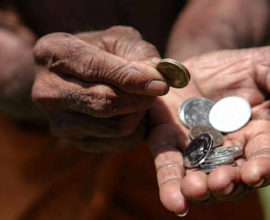
womens-hands-uganda_snyder

Image courtesy ICRW ‘Are we not raped every day when we walk down the street and are leered at ? Are we not raped when we are treated as sex objects, denied our rights, oppressed in so many ways ?’ Archives of Manushi, written by Sohaila (1983) Sri Lanka reminds one of one’s gender. To be female in a public bus is to be visually harassed (or more) and to be reminded of the persistent failures of the establishment to address those issues which are truly important. Organisations such as Sri Lanka Unites have attempted to shine a light on this issue with their Show You Care campaign. Yet, public harassment deserves attention on a larger, central government scale in a manner which considers multiple regions. This lack of personal safety is yet another reminder of the stark inequality in this nation. The lives of bus-folk are worlds apart from those at the other end of the spectrum. The normalisation of cat-calling, hooting and…

Continue reading »

Strengthening innovation in Sri Lanka: In conversation with Anushka Wijesinha

Screen Shot 2013-04-07 at 4.56.18 PM

Anushka Wijesinha is a Research Economist at the Institute of Policy Studies of Sri Lanka and is one of the most prominent voices in Sri Lanka today championing innovation. We begin by Anushka explaining what innovation means to him in a Sri Lankan context, and why it is so important to support it in post-war Sri Lanka. In talking about innovation as a system, he talks about the differences between Research and Development and innovation. Anushka is then asked whether he sees enough of that which he champions and sees as innovative policies, products and practices in Sri Lanka today. We then talk about the nature and indeed crisis within Sri Lanka’s tertiary education system – from ossified curricula to outdated pedagogy – as stymieing the growth and potential of innovation. Anushka then looks at how failure can be instructive for innovation, and whether cultures and countries that embrace failure are more innovative than those, like Sri Lanka, which censure…

Continue reading »

Gratitude for Life

Sunrise Sri Pada

While the word biodiversity is gaining currency worldwide as a result of the Convention on Biological Diversity (CBD) an internationally binding set of agreements. Whose articles are legally binding and used today to address some or other aspect of nature. Thus it is critical to appreciate the true nature of biodiversity and what role it has in our future. Biodiversity is the measure of the variability of living organisms at any spatio-temporal point i.e. the number of different species at anyplace at any given time.   It does not mean wild, endemic, rare or even native, it is merely a measure of diversity.  This measure has various meanings, from indicating a potential for conservation to indicating changes in the environment.  It also signifies the way natural cycles work, cycling  substances such as carbon, oxygen  or water.  The conservation of biodiversity refers to the conservation of this diversity of actions. The variability of our living world, has been the source of human…

Continue reading »

Former War Zones in Sri Lanka Left Struggling

Road Development

As Jaffna continues its steady return to normalcy, the rest of the North and parts of the East of the country are still struggling to get over the wounds of the 30-year war that ravaged it. Past the teams of de-miners that litter the side of the A9 road, beyond Kilinochchi towards Mullaitivu, the real remains of what was a war zone are clearly seen. Kilinochchi, having suffered heavy damages during the final stages of the war, serves as the last reminder of development with newly built banks and shops lining the road. Beyond the new buildings lie the true problems facing the people of these former war zones. The development, while welcomed, does not deal with issues facing the people of the region. Large areas of land are being cultivated with paddy; however, a telling feature of these crops was the lack of farmers or their houses. Tarajah, a local vegetable seller in Jaffna, explained that the majority of…

Continue reading »

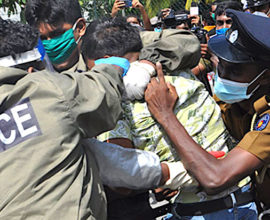
Urban wetlands park plays host to Army tank

Israeli Tank In Palestine-2

Urban Development Authority (UDA) has seen fit to place a used army tank there for everyone to see. Every evening, as the park fills up, people clamour to get an up close look at the vehicle. While such objects naturally attract the attention of most people, it is surprising that the authorities have chosen to place this in a “child friendly” environment. In fact, the image of the people crowding a tank in a public place is not too dissimilar to those images seen of people in the West Bank in Palestine crowding around abandoned Israeli tanks (see attached photos). The only difference between the situations is Palestine is a war zone, the Urban Wetlands Park is exactly what the name suggests, a park. Officials have claimed that the tank was one that was used during the war and they wanted to give the public an opportunity to see it up close. As to why they chose to put it…

Continue reading »

Feminism bottom-up: Women’s Support Networks in the North and East

Before, during and after the three decade long conflict, women have played a major role in supporting their families, community support systems, and the economy. This video highlights the stories of women groups that set up successful support networks in the north before the war, through which they addressed various community and livelihood issues, as well as violence against women. During the war these networks disbanded, and many women lost network members and vital assets. In a post-war context, these women are going back to their villages and are starting from scratch again. As these women share their experiences pre, during and post war it also creates a discussion around what feminism really is?  The video reflects on successful grassroots activism and challenges the popular notion of feminism being western and top to bottom or elite.  It also highlights the obstacles these activists face due to various social norms and oppressive structures. Repost This Article

Continue reading »

Real and Phantom Per Capita Income in Sri Lanka

Screen Shot 2013-01-30 at 7.42.25 AM

Image courtesy Colombo Gazette The Per Capita Income (PCI – average annual income per person) is derived by dividing the Gross National Product/Income (GNP/I) of a country by the total population of a country during a given period of time. It is a commonly used yardstick for practical and analytical purposes. However, it is important to understand that the per capita income of a country does not necessarily indicate the level of development of that country. For example, according to the World Development Indicators 2012 of the World Bank, while the Per Capita Income of Cuba was $5,520, PCI of India was $1,270, PCI of Timor-Leste was $2,220, and Sri Lanka’s Per Capita Income was $2,240 in the year 2010. The foregoing figures do not imply that Cuba is economically better-off than India or Sri Lanka; similarly it does not imply that Sri Lanka is economically better-off than India, and Sri Lanka and Timor-Leste are on par in terms of…

Continue reading »

The Rajapaksa ‘Sangamaya’: Creating employees and customers of citizens

mr-and-gaddafi

Image from Lanka Standard The following video features the last couple of a minutes of a longer speech delivered by Dr. Nihal Jayawickrama at the launch of The Sri Lankan Republic at 40: Reflections on Constitutional History, Theory and Practice, a collection of scholarly essays edited by Asanga Welikala, a Senior Researcher at the Centre for Policy Alternatives (the institutional home of Groundviews) on 21st December 2012. In this excerpt, Dr. Jayawickrama offers a devastating critique of the Rajapaksa administration and its mode of governance. He notes that Sri Lanka today has moved beyond an Executive Presidency based model to a corporate governance mode for the entire country – the Rajapaksa ‘sangamaya‘ (or company) – as noted by the President’s brother, Basil Rajapaksa. After flagging in brief some of the serious challenges that arise from this mindset and mode of governance, Dr. Jayawickrama ends with a pertinent question: “What if the [Rajapaksa] ‘samagama‘ goes bust? The speech in full can be viewed…

Continue reading »
  • 9 Dec, 2012
  • 6 Comments
  • Colombo,
    Development

Re-imagine Development: Where Nobody Gets Left Behind

Cartoon by W R Wijesoma - Development that leaves some behind

Cartoon by W R Wijesoma – Development that leaves some behind [Note: This was originally written as part of the When Worlds Collide Sunday column in Ceylon Today, and published on 9 December 2012] Paul Hermann Müller (1899 – 1965) was a Swiss chemist. He won the 1948 Nobel Prize in physiology (medicine) for his 1939 discovery of DDT’s insecticidal qualities and its use in controlling disease carrying mosquitoes. That knowledge was soon put to wide use. DDT was sprayed during the latter part of World War II to contain malaria and typhus among troops and civilians, and then adopted as an agricultural insecticide. Christopher William Wijekoon (CWW) Kannangara (1884 – 1969) was Lankan lawyer, legislator and effectively the country’s first minister of education during the pre-independence era. In the mid 1940s, he introduced far reaching reforms in that sector, enabling children from all levels of society to study from kindergarten to (and including) university level for free. It’s unlikely…

Continue reading »

Mihin Lanka: Not yours to fly

Screen Shot 2012-11-28 at 10.57.56 PM

In response to a news report over the truly staggering losses incurred by Mihin Lanka, we tweeted, https://twitter.com/groundviews/status/273595581967003648 Economist Anushka Wijesinha through three tweets, helped put the staggering losses by Mihin Lanka in perspective. https://twitter.com/anushwij/status/273797691534880768 https://twitter.com/anushwij/status/273799240306786304 https://twitter.com/anushwij/status/273800288773734400 Even more outrageous is what the Daily FT report flags as the fiscal management policy of Mihin Lanka, The Auditor General had observed that although the company is running at a continuous loss, the annual remunerations paid to the six-member Board of Directors have increased over the years. Rs. 11 million has been paid to Directors as remunerations last year – an increase on the Rs.4.9 million paid for the previous year. According to the Auditor General’s report, the Mihin Lanka Chief Executive Officer (CEO) who is also the CEO of Sri Lankan Airlines is paid Rs. 500,000 a month by each of the institutions as remuneration. Emphasis ours. Who is holding the President accountable for this? Repost This Article

Continue reading »

Whose beaches in Sri Lanka?

sri-lanka-tourisam-2011-12-13-9-41-7

Photo by AP Photo/Gemunu Amarasinghe, via Sulekha Tourism will bring millions to Sri Lanka but will we see any of it? During the last week of October this year, the BBC Sinhala Sandeshaya service featured a story about Sri Lankan tourism, which was in turn aired by the Sri Lanka Broadcasting Corporation. The piece drew particular attention to irregularities in development and other environmental concerns caused by the tourism industry in Sri Lanka. In the same dialogue, a civil society organization (CSO) representative raised the issue of poor environmental management, referring to the establishment of camp sites within the country’s nature reserves. This action is illegal under the provisions stipulated in the Flora and Fauna Act of Sri Lanka. The Deputy Minister Laxman Yapa Abeywardena responded to these allegations by slinging mud against the CSO engagements on various aspects of the issue: “When there is a tourism project proposed by an investor, we follow all the rules and regulations according…

Continue reading »

Re-imagining development in Sri Lanka: In conversation with Nilakshi De Silva

Screen Shot 2012-11-20 at 7.42.25 AM

Nilakshi De Silva is a Senior Research Professional at the Centre for Poverty Analysis (CEPA), and in this interview, talks about the multi-faceted challenges facing development in Sri Lanka post-war, including the nature and extent of poverty in the country. She is the second interviewee from CEPA featured on Groundviews this year, the first being CEPA’s Executive Director, Priyanthi Fernando. The interview with Nilakshi is anchored to Re-imagining Development? An Exchange of Ideas based on the Sri Lankan Experience, the title of CEPA’s 2012 Symposium looking at equitable, sustainable, inclusive development in Sri Lanka. Though the Symposium’s dedicated site features a lot of interesting content but no real conversation around some of the ideas flagged in this interview, CEPA’s institutional output has for years focussed on development as more than just economic prosperity or year on year GDP growth. Early on in the conversation, Nilakshi flags the importance of looking at poverty not just as something that afflicts the poor,…

Continue reading »

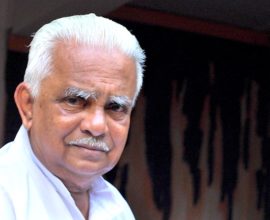
In memory of Ray Wijewardana

ray-wijewardene1

Image courtesy Moving Images, Moving People! One day in year 2005, Ray visited the University of Moratuwa as the chancellor. I think it was an official meeting to organize an innovations exhibition showcasing the work done by the students. After the meeting, Ray wanted to visit my laboratory located in the Sumanadasa building. I was a bit scared to show it to Ray, because it was full of junk material bought to make field robots. The research lab had no windows. So it was a bit damp and smelly too. He just smiled when I warned him of such possible disappointments. No sooner he entered; he grabbed a chair, sat, and kept looking at the work in progress of a legged robot like a child being mesmerised by a favourite toy. “Why legs? Why not wheels Thrish?” he asked. I knew that he was trying to test me. I said “simply because they have to move on soft terrains in…

Continue reading »

Challenges for a Sustainable Economic Development in Sri Lanka

width_650.height_434.mode_MaxWidthOrHeight.pos_Default.color_White

Image courtesy Norwegian Embassy, Sri Lanka First of all, I would like to define sustainable development.  According to the Brundtland report it is “a development that meets the needs of the present without compromising the ability of future generations to meet their own needs.” But it is important to go further in the definition: “Sustainable development has 2 concepts: the first one is the needs, particularly the needs of the poor, to whom priority should be given. The second is the idea that the actual state of technology and social organization impose limitations to the capacity of the environment to satisfy present and future needs.” This definition is an invitation to think differently. Sri Lanka has to thrive by following this path for a sustainable development, which is taking care of poverty, and economic development while taking into account environmental constraints. Sri Lankan growth rate is high (8%), true story, but if we dig a little further, we can see…

Continue reading »

Impeaching Sri Lanka’s Chief Justice: A primer

DIVI-N-Athpoth

Image courtesy Read Sri Lanka [Editors note: The Supreme Court ruling on the Divineguma Bill presented to Parliament just before this article was published noted that the Bill has to be passed with 2/3rd majority in Parliament and that Clause 8 has to be approved at a referendum. See original tweet by Daily Mirror here.] The current battle between the Judiciary and the Executive/Legislative, culminating in the ongoing attempt by the government to impeach the Chief Justice, has received a lot of attention in the traditional media, and on Facebook and Twitter. People who don’t usually bother keeping abreast of the goings on in the country have been activated enough to post messages and share articles on FB. However, most of them don’t seem to be aware of the context to this crisis and how it has developed in relation to two other important current issues, the Divi Neguma Bill and the debate about the 13th Amendment to the Constitution. Here’s my…

Continue reading »
Page 1 of 912345...Last »

About Groundviews

Located at the Centre for Policy Alternatives in Colombo, Sri Lanka, Groundviews is a citizen journalism website that uses a range of genres and media to highlight critical perspectives on governance, reconciliation, human rights, the arts and literature, democracy and other issues. The site has won two international awards, including the prestigious Manthan Award South Asia in 2009. The grand jury's evaluation of the site noted, "What no media dares to report, Groundviews publicly exposes. It's a new age media for a new Sri Lanka... Free media at it's very best!"

cezarneaga.eu