A-Z of Sri Lankan English

A-Z of Sri Lankan English: Z is for Z-score and zipperman

real meaning of education z

Image via Sri Lanka Guardian There are only two Z-words that I have come across in SLE: Z-score and zipperman. Both are terms which are found in standard English, but which have particular meanings and associations in a Sri Lankan context. The Z-score is the controversial system used to determine university entrance based on average A-level marks for each subject adjusted according to regional quotas. Z-score, or standard score, is a mathematical term referring to the calculation of the standard deviation from the mean. (There is also the “Altman Z-score” which is used to predict whether a firm will go bankrupt.) Here in Sri Lanka, the Z-score has become an emotive issue, with repeated accusations that the system is unfair, arbitrary and non-transparent. The issue has been reported on Groundviews, including under the headline “The Z-score imbroglio”. Zippermen are men who expose themselves in public – ‘exhibitionists’ or ‘flashers’ in standard English. This meaning of the term seems to be…

Continue reading »

A-Z of Sri Lankan English: Y is for y’all

Yall-Spoken-Here_3985-l

Image from Neato Shop Many languages have singular and plural forms of the second person pronoun you, including Sinhala and Tamil. English doesn’t, except in certain dialects: yous or youse is heard mainly in Scotland, Ireland and Australia; and y’all is common in the US, as in the expression “Y’all have a nice day!” Y’all is also common in colloquial Sri Lankan English (“When did y’all come?”), as well as the possessive form y’all’s (“Where are y’all’s books?”). The all is just a plural marker, so it could just mean some of you, not necessarily all of you, which becomes y’all all, or all of y’all, as in these quotes: “So y’all all came together? Like going on a pilgrimage?” (Monsoons and Potholes, by Manuka Wijesinghe, page 22) “Ah? Then what’re all’f y’all doing here?” (A Cause Untrue, by David Blacker, page 557) I often see this contraction of you all spelt as you’ll (“Nice to hear that you’ll enjoyed…

Continue reading »

A-Z of Sri Lankan English: W is for will and would

daily mirror

Will and would have a habit of changing places in Sri Lankan English. Sometimes will is used where standard British or American English would prefer would (“I knew the car will be there”), and sometimes it’s the other way round (“We would inform you as soon as we hear”). The former (will for would) tends to happen in reported speech where the main verb is in the past tense (“He said he will be late”), and in conditional sentences where the verb in the if clause is in the past tense (“She’ll come if you asked her”). In both cases, the sequence of tenses in standard grammar means that an English teacher is likely to underline the word will with a red pen. But the following quotes from contemporary fiction suggest that the “error” is a common one: … and I knew the paddy field will soon come into view … (Bringing Tony Home, by Tissa Abeysekara, page 44) It…

Continue reading »

A-Z of Sri Lankan English: V is for vel festival

vel festival

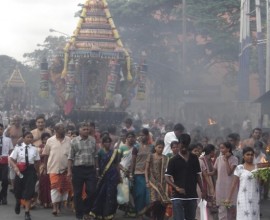
A Hindu vel festival is better described in pictures than words. The photos here were taken a few years ago at the annual festival on Havelock Road, on a rainy August morning… ### A-Z of Sri Lankan English is“an all-new, occasional alphabetical dip“into the variety of English spoken in Sri Lanka, published exclusively on“Groundviews. The original A-Z of Sri Lankan English was published in the travelsrilanka magazine, and can be found here. Repost This Article

Continue reading »

A-Z of Sri Lankan English: U is for up

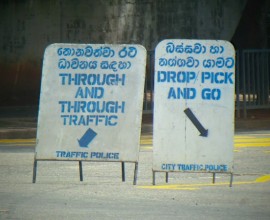
drop pick and go

The verb cope up is one which divides opinion: is it acceptable Sri Lankan English, or simply an error? It is certainly commonly used in SLE (“He’s finding it hard to cope up”), but it is also true to say that it is a signal that the speaker is not necessarily adhering to recognised international standards. In standard usage, cope is used without the particle up: “He’s finding it hard to cope”, “How is she coping with the pressure?” Improvement in the healthcare system helped it cope up with the very large number of war casualties from 2006-09. (Groundviews 16/08/08 – comment dated 16/01/10) The same applies to the verb bear up: “She couldn’t bear up the pain”. In this case, however, the verb bear up is used intransitively in standard English (“How are you bearing up?”), but not transitively (i.e. with a direct object), where the up is dropped: “She couldn’t bear the pain”, “I can’t bear it any…

Continue reading »

A-Z of Sri Lankan English: T is for this thing

Screen Shot 2012-07-07 at 11.24.39 AM

Original photo by Deshan Tennekoon What do you call something whose name you don’t know or can’t remember, or which you prefer to avoid naming for whatever reason? A whatsit or a widget? a thingy or a thingummy? a thingamabob or a thingamajig? a gadget, a gubbins or a gizmo? a whatsitsname or a whatchamacallit? The proper term for all these words is a placeholder name. Wikisaurus lists dozens of them here. In Sri Lankan English that something is normally called a this thing, but this doesn’t appear on the Wikisaurus list. It can refer to any inanimate object (“Did you remember to bring your this thing?”); it serves as a euphemism (“You could see his this thing!”); and it can be made plural (“Don’t forget your this things!”). It can function as an adjective (“You must be feeling very this thing”), or as a verb (“They must have this-thinged it earlier”), sometimes with the addition of the suffix –fy…

Continue reading »

A-Z of Sri Lankan English: S is for Singlish

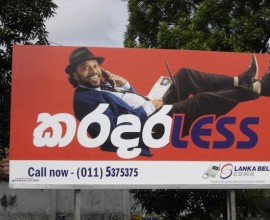
karadaraless

Singlish is the term used to describe the mixture of Sinhala and English which is frequently used by bilingual speakers. But Singapore got there first: Singlish is generally accepted as referring to colloquial Singaporean English. In a Sri Lankan context, the word tends to be used humorously or derogatorily to refer to colloquial usage which is considered substandard. Singlish is alive and well in the advertising industry, in baila lyrics, and online. Regional equivalents include Hinglish, which is thriving in India, Banglish, which the Bangladeshi government has recently attempted to outlaw on radio stations, and Tanglish, as popularised in the lyrics of the song “Why This Kolaveri Di”. Some people use the term Singlish interchangeably with Sri Lankan English, but it is important to make a distinction between the two. Singlish may be considered one feature of SLE, but it is only part of the story – not least because it ignores the significant influence of Tamil. Singlish includes the…

Continue reading »

A-Z of Sri Lankan English: R is for rubber slippers

product_26956

Image courtesy Odel They’re called thongs in Australia, jandals in New Zealand, Hawaii chappals in India and Pakistan. According to Wikipedia, they’re known as slip-slops in South Africa, go-aheads in the South Pacific, japonkis in Poland, and vietnamkis in Russia. The standard term in the UK and the US is flip-flops. Here in Sri Lanka they’re most commonly referred to as rubber slippers; also bathroom slippers, and Bata slippers (or Batas). And some of us like to talk about our Arugam Bays. To a speaker of British English, slippers are an item of footwear worn inside the house. They are usually closed but loose-fitting, and often fur-lined to keep your toes warm. It’s unlikely that you would step outside in them. But in other less chilly parts of the English-speaking world, the word slippers is more likely to refer to any type of open sandal, usually made of leather, plastic or rubber, including flip-flops. In South Asia, slippers are the…

Continue reading »

A-Z of Sri Lankan English: Q is for quazi

A-Z-Sri-Lankan-English

Equality before the law? I’m no lawyer, but I have always wondered how this fundamental principle is possible in a country with several different legal systems operating alongside one another. The main systems are Roman-Dutch law and the British legal system, bequeathed by the colonial administrators. But three other systems also survive – Kandyan law, Thesavalamai, and Muslim law, which cover certain areas of civil law such as marriage, divorce and inheritance. Roman-Dutch law was introduced by the Dutch, and confirmed under the British as the common law of Sri Lanka. Today it exists only in Sri Lanka and South Africa. Kandyan law relates to marriage, divorce and inheritance, and applies to Sinhalese of Kandyan descent (whether or not they are resident in Kandy). Thesavalamai relates to property and inheritance, and applies only to Jaffna Tamils. Muslim law is administered by the quazi courts, which have jurisdiction over marriage and divorce settlements within the Muslim community. Quazi is the Arabic…

Continue reading »

A-Z of Sri Lankan English: P is for pre-poya

pb-110615-poson-buddhism-01.photoblog900

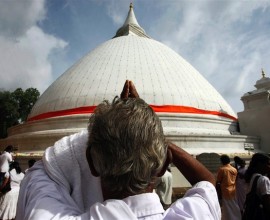
Photo courtesy M.A. Pushpa Kumara / EPA, via Photo Blog on MSNBC Poya must be one of the first Sri Lankan English terms to enter the vocabulary of foreigners when they arrive in Sri Lanka. A poya day is a full moon holiday, a day when devout Buddhists go to the temple and observe sil. To non-Buddhists it is a welcome day off, but (not so welcome for some) a day when meat and alcohol are not available in shops and supermarkets, and are not supposed to be served in restaurants and hotels. Many people are critical of a system which reportedly gives Sri Lanka more public holidays than any other country, and which is seen to favour Buddhism over other religions. But most of us look forward to poya days anyway! The day before a poya day is called pre-poya. This is a day when evening events and get-togethers are often organised – the equivalent of a Saturday night, the…

Continue reading »

A-Z of Sri Lankan English: O is for our people

sri-lanka-sand_23037_600x450

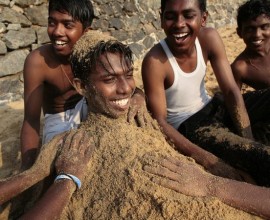
Boys will not always be boys! Photo credit: National Geographic The possessive pronoun “our” is deceptively simple. But who are the “we” that it refers to? The expression our people is a remarkably high-frequency term in Sri Lankan English. On a search of the Groundviews website, the phrase gets around 400 hits, compared to just 331 in the 100-million-word British National Corpus. In British English, the phrase most often refers to members of a particular organisation (“I’ll get one of our people to call you back”). With reference to nationality, it is rarely used to refer to the whole population of the country, except perhaps in a political context with nationalistic overtones – for example, an anti-immigration tirade bemoaning the plight of “our people”. More often it would be used in the context of a specific group such as Irish Catholics, the Bangladeshi community, etc. In Sri Lankan English, the expression can convey a sense of patriotism, but it is…

Continue reading »

A-Z of Sri Lankan English: N is for na tree and nil manel

nil manel

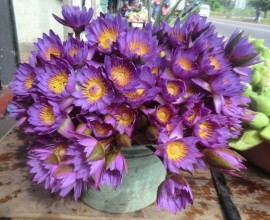
The national tree and the national flower were both in the news this year. In August the uprooting of the Indian willows lining Independence Avenue to be replaced by indigenous na trees as part of Colombo’s beautification programme provoked angry reactions, as reported on Groundviews here. The na tree (English name: ironwood; botanical name: mesua ferrea) is the national tree of Sri Lanka. It is a tall tree known for its pink (young) leaves and fragrant white flowers, and for its hard wood and medicinal properties. It is arguable that in the long term the indigenous na trees will be more attractive (and more appropriate) than the Indian willows, but the “wanton destruction” undertaken by the Army without any prior notice or apparent consultation, together with the nationalist symbolism of the move, was provocative and heavy-handed. There is a magnificent mature na tree in the corner of the British Council garden. The tree was recently under threat from planned redevelopment…

Continue reading »

A-Z of Sri Lankan English: M is for monitor lizard

Water_Monitor

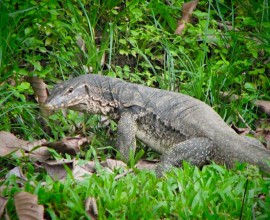
Sunimal Fernando, speaking from the audience at my presentation on Sri Lankan English at the recent conference on Language and Social Cohesion (Colombo, 17-19 October), confirmed my own conclusion, that while the “English as a Life Skill” programme continues, Sri Lankan English has been quietly dropped from the agenda. This may be welcome news to those who feel Sri Lankan English has no relevance to English language teaching in Sri Lanka, but I argued in my presentation that without a recognised “standard Sri Lankan English” as a model, there is a danger that “English our way” will mean abandoning standards altogether, which is exactly what the critics feared in the first place. One of the reasons why Sri Lankan English became sidelined (and this was also confirmed by Sunimal Fernando) was resistance from academics and ELT professionals in Jaffna, who felt that it was a Colombo-centric concept which did not take adequate account of the way English is used by…

Continue reading »

A-Z of Sri Lankan English: L is for link language

A-Z-Sri-Lankan-English

The A-Z of Sri Lankan English is back after a break. These short pieces focus on different aspects of the way English is used in Sri Lanka. Collectively they provide a cross-section of the type of features that comprise Sri Lankan English, and demonstrate its unique identity as a distinct variety of English. The whole A-Z can be found here; and more on Sri Lankan English can be found here. ### When my daughter was studying at “a leading girls’ school in Colombo”, she had a subject called “Link”. She used to talk about “Link homework” and “the Link exam”, rarely referring to the subject by its other name – Tamil. “Link” had become shorthand for the slot in the timetable where Sinhala-medium girls study Tamil, and Tamil-medium girls study Sinhala. It seems odd to refer to Tamil as a “link language”. The reason for learning Tamil is to communicate with Tamil speakers, not as a “link” to anyone else….

Continue reading »

A-Z of Sri Lankan English: K is for kadé

I normally try to stay on the right side of the descriptive-prescriptive divide, but today I’ve got my prescriptive hat on. I deplore the habit of some writers, editors and publishers of employing French and German accents when rendering Sinhala and Tamil words in English. You might read about more important issues on Groundviews today, but this is my personal bugbear. The most common example is kadé with an acute accent, like café – cute, because a kade is sort of like a café I suppose, apart from the croissants and cappuccino. But unfortunately the é vowel in French is a different sound from the e in kade, so it doesn’t help. Why not just spell it kade? I have come across the acute accent being appropriated with the same function in words such as amudé, andé, dané, kondé, kalé, pin katé, haminé, hiramané, karadaré, and even twice in éllé… Ané deviyané! The late Nihal de Silva used the German…

Continue reading »
Page 1 of 212

About Groundviews

Located at the Centre for Policy Alternatives in Colombo, Sri Lanka, Groundviews is a citizen journalism website that uses a range of genres and media to highlight critical perspectives on governance, reconciliation, human rights, the arts and literature, democracy and other issues. The site has won two international awards, including the prestigious Manthan Award South Asia in 2009. The grand jury's evaluation of the site noted, "What no media dares to report, Groundviews publicly exposes. It's a new age media for a new Sri Lanka... Free media at it's very best!"

cezarneaga.eu