
Ini Avan: Hauntingly beautiful but…
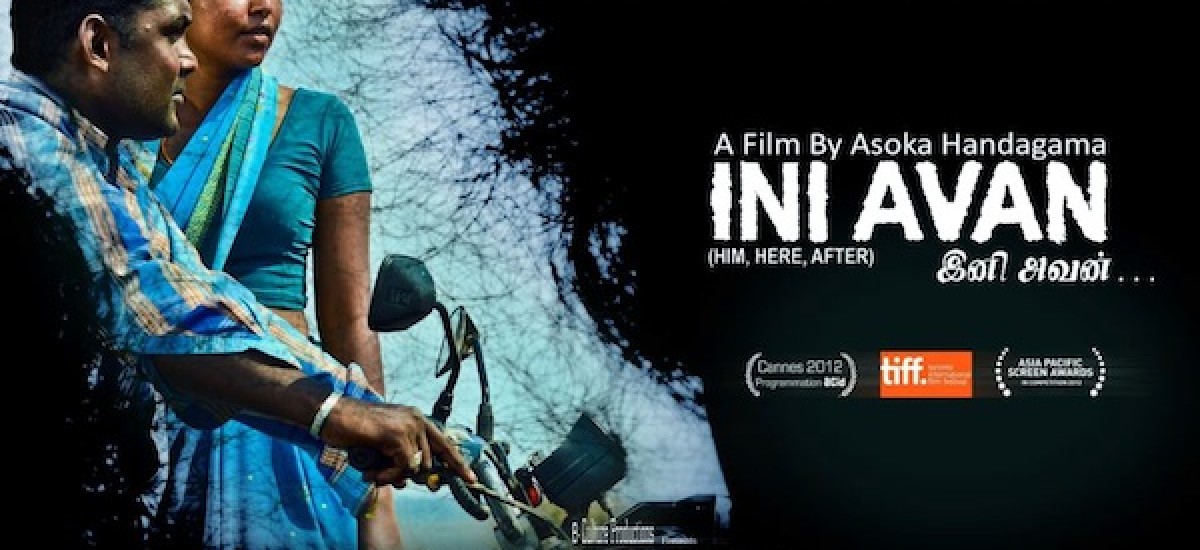
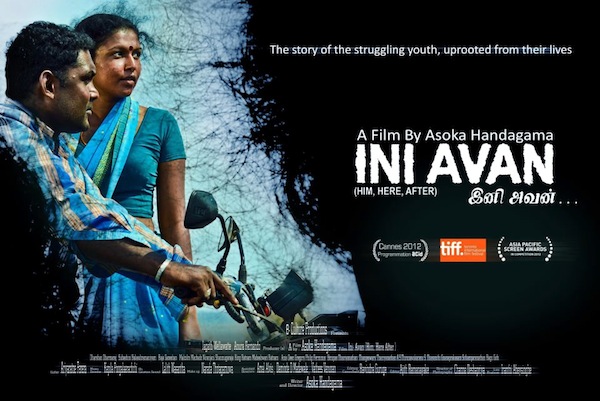
Ini Avan, Asoka Handagama’s latest film, in Tamil, has won international cinematic acclaim. And it is easy to see why. The film has interesting characters who within their confined destinies take some unpredictable turns and moves at a compelling and deliberate pace through carefully designed frames with strong aesthetic appeal that are also revisited, like recurring motifs, to telling effect. The camera-craft is sophisticated and the casting and acting impressive.
The tale itself, involving different narratives—built mainly around an ex-LTTE fighter struggling to rebuild his social life and livelihood, a young woman whose love for the former comes up against barriers of caste prejudice and forced marriage, and an enigmatic middle-aged woman battling against the odds to provide for her family —is powerful and complex in its own way. While drawing attention to the internal contradictions within post-war Tamil society, the narratives do not necessarily follow predictable trajectories.
Ini Avan is beautiful but at the same time leaves behind some discomforting questions regarding the film-maker’s portrayal of state and society in the North. The questions I want to focus on in this very brief reflection are those that have to do with the absence of the military and the state from the film because this, in my view at least, impinges significantly on the very integrity of the film.
Ini Avan was shot around two years after the war, yet the military, which even today is so much more than just a ‘presence’ in the North, is very conspicuous by its absence from the film. The film registers the increasing presence of Sinhalese civilians in and around Jaffna but omits to acknowledge the authoritarian presence of thousands of Sinhalese military personnel. This creates a terrain faux on which the drama of the film is played out. One is not suggesting that every thing that happens in every one’s life in the North is shaped by the military. However, it is well known that the latter has a very heavy footprint in so many spheres of life, particularly in the case of ex-LTTE combatants who are marked for thick surveillance and monitoring by the military. But Handagama’s hero and indeed all other characters live in a parallel universe, one in which with the end of the war the soldiers quietly went back to wherever they came from, leaving them to contend with unscrupulous agents of corrupt private interest or internal social and personal wounds.
The singular absence of the state from the film is but an extension of the absence of the military, since, in the North, the former does not exist independently of the latter. While the three main characters are portrayed as active agents striving to do more than just submit, the picture that emerges of Tamil society is a somewhat dis-embedded one. Can the many contemporary cleavages in Tamil society in the North be entirely abstracted from the forces of the state and the military? This is pertinent because Ini Avan is very much a ‘post-war’ film, in as much as the conflict and war are still the underlying principal force and referents, yet the film totally eliminates its only surviving, not to mention victorious and hegemonic, architect. It is hard to explain this as anything else but an erasure; the authenticity of location is ruptured by the manifest falseness in representation. One wonders whether this was a condition under which the film was allowed to be made in the first place?
Ini Avan reduces social travails in the North to one in which some less powerful but relatively more principled individuals battle others who are either seeking to profit from the former’s predicament or are blinded by hurt and prejudice. The film captures a social context that is fraught with trauma and divided along lines of gender, caste, and class but these cleavages are totally abstracted from the present, thus erasing, albeit very aesthetically, the specificities and embeddness of Tamil society in a highly militarised and undemocratic post-war Northern Sri Lanka. The film combines a construction and focus on the ‘enemy within’ Tamil society with an individuation and abstraction of post-war social dynamics, which the Sinhala-Buddhist state and large sections of the majority are more likely to be comfortable with.
In this sense, for all its aesthetic appeal, Ini Avan, is a film set to a Sinhalese grammar. It is a film in Tamil but the gaze is distinctly Sinhala.
Repost This Article


well said and beutifully articulated. This has parralalels to Santosh Sivans The terrorist. Once gain a Tamil film well shot but the grammer is NewDelhi central government based.
Will be interested to know who fufned the film.
I am not sure why the author of this piece has decided to be ‘anonymous’. But I presume, it is more to do with obscuring his/her hegemonic ‘gaze’ within the Tamil society, in order to present this piece as a ‘neutral’ review of a film. It is preposterous to suggest that the military presence in the North has some thing to do with “a social context that is fraught with trauma and divided along lines of gender, caste, and class”, as if the pre-war Tamil society was a wonderful utopia.
Is this a ploy to deflect the attention from the continuing political, economic, cultural and environmental oppression ?
Ashoka Handagama had the guts to make this movie and all the others he has made before it, while the reviewer doesn’t have the guts to put his/her name to it. This movie deals with the micro level of social and individual life, deep within the folds of society; it is a worm’s eye view ‘beneath ‘ and ‘ below’ the level of the overtly political. It is a profoundly human drama.
The anonymous critic makes the standard point that dogmatic, mechanistic ‘socialist realists’ used to, namely that it doesn’t deal with bigger realities of systemic oppression, i.e. that it is not political.
Hanadagama’s humanistic gaze is what gives the movie its universality. As for being “set to a Sinhala grammar” and having a “distinctively Sinhala gaze”, were that an accurate criticism the Sri Lankan armed forces would have been depicted as liberators, the Tigers demonised and their cause reviled, but they are not.
If the film were “distinctively Sinhala”, the sophisticated Parisian audience watching it in an art movie theatre off the camps elysee– and audience which included a professor of cinematographie who is on the jury at Cannes, and some former French DPLs to Sri Lanka, would surely have noticed. From the applause and the post-screening enthusiasm, they didn’t.
Perhaps the anonymous reviewer lacks the capacity to evaluate art– not to mention ‘grammar’ and ‘gazes’ in any categories other than ‘Tamil’ and ‘Sinhala’! That sounds like racism– perhaps an inverted racism– to me. Maybe he/she should try ‘good movie’ and ‘bad’?
In Sri Lanka there is no freedom of expression. Revealing ones identity is like inviting abduction, torture, disappearance by the “establishment”
When yesteryear’s Aniruddha Tilakasris pick on today’s anonymous writers, one can only laugh with contempt. And only an idiot would hold “…From the applause and the post-screening enthusiasm, they didn’t.”
Hey Agnos, that’s as much as you know. ‘Anuruddha Tilakasiri’ — in English and Sinhala – was Ms Tisaranee Gunasekara, albeit with a readthrough and incidental inputs from me. Ask her.
The pseudonym was first used by the famous political columnist of the ATHTHA, Surath Ambalangoda, a committed Communist, who was employed at the time by Irwin Weerakkoday of Phoenix advertising, but who wrote in support of the pro-people programmes and presidency of Premadasa in the Silumina under this pen-name. When his son fell very sick, the column ceased. Ask Irwin Weerakkody.
That’s when Tisaranee volunteered. Her initial Sinhala columns were corrected stylistically by President Premadasa himself, a master of Sinhala prose.
I must add though that I supported and continue to endorse everything that Anuruddha Tilakasiri wrote in defence of the Premadasa Presidency, except for a few vitriolic paragraphs on NGOs and civil society, which I failed to persuade her to desist from.
Oh by the way Ms Gunasekara had already said that she was Anuruddha Tilakasiri, on the record, on the front page of the Lakbima more than a decade ago. But you wouldn’t read ‘Sinhala grammar’ would you?
The irony of it. A government employee, chastising a writer for not having guts, when the reason for the need for “guts” is precisely the government he works for. I have to hand it to you. You could have been a good street thug.
Tamil films must only be made by Tamils. How can a Sinhalese understand how Tamils think ?
I appreciate the critique presented by “Anonymous” (like I have a reason for writing under a pseudonym, I believe the writer has his or her reasons for wanting to remain anonymous and I cannot understand why this should be of bother to some commentators who most often are racists, chauvinists or sycophants. ) However to me there is a deeper flaw in the film. This is its absence of historicity. An example is the attempt (as revealed in some of the dialogue) to equate the drug lord villain of the movie with the leaders of the rebel movement, in that they both sought nothing but blind obedience from their leaders for their personal gain. In any revolutionary guerilla movement, insisting on blind obedience to the leader is a first principle. It is true that what began as a freedom struggle degenerated into a putrescent terrorist phenomenon, yet the motivations of a drug lord or mafia leader and his or her followers are quite different from the cause set forth by a revolutionary guerilla leader. It is less the leader’s ability to command such passive obedience than the active readiness of many followers to lay their down their lives at the command of their leader because of their belief in this higher goal.
I recall way back in the mid seventies going with a friend to watch the film “Kaludiya dahara” which was set in the back drop of the 1971 insurrection. (My friend, who played an active part in the insurgency, was later apprehended , convicted and sentenced to two years in jail.) I vividly remember him getting up and walking out of the cinema hall as he couldn’t bear to watch how the movie portrayed the JVP youth as nothing but aimless drug addicts cavalierly waging war against the state. My friend and many others whom I knew (however infantile, idealist or adventurist they may have been in hindsight) believed they were involved in a liberation struggle and were ready to give their life for that cause. Hence I understood his anguish watching the film. Ini Avan is cinematically a superior film but like Kaludiya Dahara, it lacks a historical soul. In that sense it is a reactionary film that helps reinforce the status quo.
‘cyberviews’ writes that “In any revolutionary guerilla movement, insisting on blind obedience to the leader is a first principle. It is true that what began as a freedom struggle degenerated into a putrescent terrorist phenomenon, yet the motivations of a drug lord or mafia leader and his or her followers are quite different from the cause set forth by a revolutionary guerilla leader.”
In the first place this comment betray truly colossal ignorance of the numerous ideological struggles (‘line struggles’) in the history of the Chinese Communist party in its long guerrilla phase. It is an insult to the Vietnamese Communist guerrillas and Cuba’s revolutionaries in the Sierra to say– in the face of all documented evidence that Gen Giap followed Ho Chi Minh out of blind obedience to the leader, or that Che and Camilo followed Fidel out of blind obedience to him!
In the second place what is the relevance to Ini Avan or indeed the Tamil struggle? Which, pray, was the ” revolutionary guerrilla movement” and who was the “revolutionary guerrilla leader”? C’mon, have the guts to answer those questions.
In the third place, the film KaluDiya Dahara depicted the “revolutionary guerrilla leader” as fantasising about living as a planter in the Hill country. 15 years after the movie, Rohana Wijeweera lived his clandestine life as …a tea planter in the hill country. That is testimony of the insightfulness of the movie, ‘reactionary’ or not.
In the fourth place, what does ‘reactionary’ have to do with an evaluation of a piece of cinematic art?
Dear PR;
“Tamil films must only be made by Tamils.”
In the instance wild-life films only be made by animals?
A wonderfully novel and creative thought to ponder. Ha! Ha!!
Thanks!
the climate of fear necessitates anonymity.
@ Dr Dayan Jayatilleke
In your usual ad hominem style you have taken just a part of what I had said out of context and critiqued it with a newly found revolutionary fervour, citing a host of revolutionary leaders whom I hold in great respect. In fact for your easy reference I am quoting below the whole paragraph which actually tries to portray that guerilla leaders and their followers are driven by a cause: “… An example is the attempt (as revealed in some of the dialogue) to equate the drug lord villain of the movie with the leaders of the rebel movement, in that they both sought nothing but blind obedience from their leaders (sic – it should be ‘followers’)for their personal gain. In any revolutionary guerilla movement, insisting on blind obedience to the leader is a first principle. It is true that what began as a freedom struggle degenerated into a putrescent terrorist phenomenon, yet the motivations of a drug lord or mafia leader and his or her followers are quite different from the cause set forth by a revolutionary guerilla leader. It is less the leader’s ability to command such passive obedience than the active readiness of many followers to lay their down their lives at the command of their leader because of their belief in this higher goal.” As regards having the guts, I would like to say that I am a ‘hare’ and run with the ‘hare’ hence I admit that what I have is the timidity of a ‘hare’. I remember a time you were a ‘hare’ that ran with the ‘hare’ and even hid like one when pursued by the ‘hounds’. But then later you started running with the ‘hounds’ while running with the ‘hare’. Still later you openly ran with the ‘hounds’ and hence became bold in your statements because there was no need for guts – you were saying things you wanted them to hear. Now I see you wanting to run with the ‘hare’ again, but you have a big credibility gap to bridge. Personally, given your vast intellect, it would be great to have you (warts and all) batting on the side of the oppressed.
Re Kaludiya Dahara, as I said, the film was released in the backdrop of the 1971 insurrection. The leaders of the JVP in 1971 and what they stood for (and even Rohana Wijeweeera to some extent, despite his Indian exapnsionist’ bogeyman) were different to those of the post 77 era. What we saw in this era was once again a liberation movement degenerating especially between 87-90 into a ‘putrescent terror phenomenon’. It was this latter day Wijeweera that was found ensconced in a planter’s bungalow. It is no different to what became of you, except that you did it legitimately as an ambassador.
Finally, regarding what ‘reactionary’ has got to do with a piece of cinematic art, I am quite surprised that as someone who roots deeply for Gramsci, you should ask this question. Art doesn’t take place in a vacuum. It reflects a discourse and very often the dominant discourse of the ruling elite. And when that dominant discourse creates an oppressive superstructure, anything reinforcing it is “reactionary”.
“It is an insult to the Vietnamese Communist guerrillas and Cuba’s revolutionaries in the Sierra to say– in the face of all documented evidence that Gen Giap followed Ho Chi Minh out of blind obedience to the leader, or that Che and Camilo followed Fidel out of blind obedience to him!”
What is the documentary evidence you are talking about?
Thanks!
Mapa