
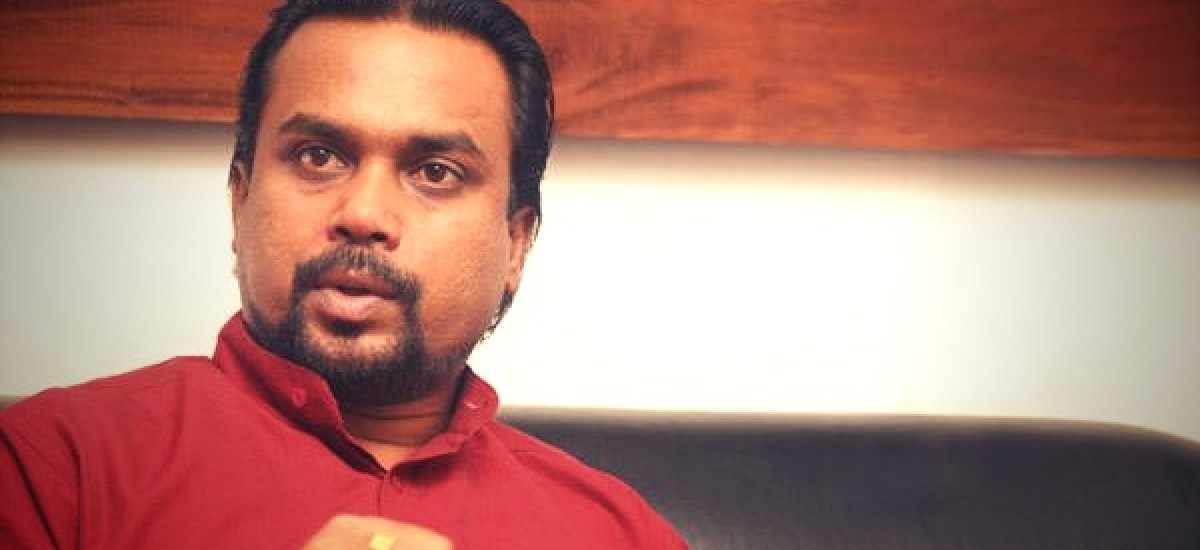

Portrait of a card-carrying Sri Lankan patriot.
###
I am not a patriot. I am not a patriot if it means that to be a patriot I must deny that innocent people have been killed. I am not a patriot if it means that I have to turn a blind eye to the destructive activity of self-righteous members of the Sangha who feel it within their purview to destroy a Muslim shrine. Neither am I a patriot if it means I have to be amongst the Sinhalese who support this crime. Nor am I one if, like the Catholic Church I remain silent or am partisan to the Rajapaksa regime. I am not a patriot if I have to ignore criminality because it grants a certain kind of peace. I am not a patriot if it means I must remain speechless and unresisting. A few short weeks ago, Groundviews carried an article by Meena Serendib on Why the Diaspora must return to Sri Lanka. She cites Indrajit Samarajiva who supposedly avers that radical change demands radical sacrifice, and, while I have not read very much of Mr Samarajiva’s work, I am here to add support to that sentiment and also to the views expressed in Ms. Serendib’s article. Not only must the diaspora return, but the voice of the diaspora and the Sri Lankan middle classes must become a radical, insistent one. The greater crime now, is to remain speechless.
Sri Lankans live in a conditioned peace, not dissimilar to the conditioned freedom we have lived in for the last sixty-three years. Frantz Fanon, the most influential voice of the anti-colonial struggle urged for a ‘greater and more terrible force’ that would counter the oppression of the colonial power. Freedom was meant to be taken, and not simply accepted. Yet, the postcolonial nations have built their lives, meanings and identities on the structures of their colonial parent. Post-colonial, indeed, but hardly decolonized. Decolonisation is a condition that goes beyond the attainment of Independence. While the nation has gained legitimate freedom from the colonial power, such independence is hardly the goal of the Fanonian revolutionary. True decolonisation is not about accepting the condition of freedom or rather a conditioned freedom, it is about taking freedom. Forming a truly free, postcolonial, postracist, decolonized polity is inevitably a dirty and violent process in the Fanonian view – it is a radical process. Violence itself has surfaced quite readily throughout South Asian history. We have fractured, each of us; India, Pakistan, Sri Lanka – and none more so than the latter. Whilst there is still a breath of resistance in the speech and the lives of many members of the Indian and Pakistani public – especially their massive diasporic population[1], Sri Lankans around me dissolve into their usual stance of a carefully negotiated acceptance, indeed we are a nation characterised by that vile little utterance, “What to do , aney?” How terrible to be reduced to such a colloquialism. How terrible that we are still, even with the memories of countless colonizers still fresh in our minds, willing to be bound to yet another regime.
Our postcolonial inheritance is that we must think constantly about freedom, and that we must militate constantly in order to ensure that freedom. With the UN report on Sri Lanka being sent to the human rights council, our meditation must not rest simply on the issue of rights, but upon the freedom that gives birth to the discourse in rights. The freed nation is bound in chains of its own making. These chains, forged in the fires of violent struggle keep the nation viscerally attached to the entity that it sought to be independent from. The nation creates identities, structures, norms, systems and knowledges that are conceived within the womb of its colonizer, each is a nod to the need for acceptance, for inclusion and for recognition from its now distanced parent. Yet, the discourse of its freedom insists that these identities and systems are entirely independent, for each is a new declaration of autonomy and self-hood. Is this truly freedom, or is it freedom only in name? Freed into a name of its own, the nation builds great expectations, and these invariably do not come into fruition; or in manifestation become strange and unholy beasts. A disillusionment bred by the non-fulfilment of the promise of a political-economic order disrupts the heart of the nation and , when its acclaimed identity of independence meets the paradox of its dependant freedom, the nation is thrown into a violent resistance with and against a self it does not know, against its internal Other.
And so, the freed nation takes hold of its inheritance of violence, a history of violent evolution. Postcoloniality presumes freedom, but also accepts that chains exist; chains of structure and institution that refuse a truly independent identity. And yet, Man’s eternal search, indeed freed Man’s eternal search is for the truth of his being. He finds shades of it in fear, in a juxtaposition with external alterity, but such liberation is only found in relation to another. In this way it is almost possible to say that there is no freedom, and that it is in the search for freedom that Man and the Nation he builds for himself is lost and fractured. In seeking a freedom we are seduced into desiring, but yet a freedom we do not and cannot know, we ‘descend’ into many forms of violence. The physical clash of fundamentalisms, identities, into outright civil war; the demonization and dehumanisation of those we fear; slavery; oppression; racism; political branding, and most insidious of all, academic categorizations that positions certain ideas, concepts and movements into points of weakness. Do we not see all of these in the Sri Lankan polity? Perhaps the next step is to mount the final struggle, and to take freedom.
Sri Lanka’s colonial period under the British was not as fraught as those of its South Asian counterpart. Whereas India obtained freedom through long years of both violent and non-violent struggle against an oppressive British regime, the colonial administration treated Sri Lanka in a similar manner as the French did their colonies – indeed in the seminal Buddhism Transformed, Gananath Obeyesekere performs a brief but pithy examination of how middle class activity allowed this to be. In this way, colonization, while eventually having far tighter a grip on the island as it did on India, happened in a rather gentle manner. Similarly, the ‘nationalist’ struggle in Sri Lanka did not have the same intensity as the Quit India movement; neither did it use any militant resistance to the British. Jayadeva Uyangoda and Sunil Bastian, in a paper to the CSDG group of King’s College[2] , describe the anti-colonial movement in Sri Lanka as decidedly ‘conservative’. The strain of conservatism continues, as we complacently accept the face of a self-righteous Sangha, a weakened non-Buddhist leadership, a virtually non-existent political opposition, a civil society that is either mired in decadence or struck voiceless on the charge of ‘Westernism’, and the increasing perversity of this government. There is no sense of accountability, and worse, no militation for accountability. The lesson from Fanon is clear; decolonization happens not only on paper but primarily in our minds and in our attitudes. We must ‘descend’ into the violent struggle; we must militate. When did Sri Lankans, and the Sinhala middle classes especially, forget the potency of resistance? When did we give up the fight?
Remember that the state is not supposed to be the enemy of the people. Here, in Sri Lanka, however, we have a state that has risen up in defence of itself, and indeed continues all out hostilities against its own people. While the civil war against the LTTE is over, a civil war against the Sri Lankan polity continues. The state uses its army, and its network of informants and media personnel to suppress free speech, identity, academia and even now goes as far as to rewrite history and memory. It speaks in terms of absolutes and has no need to, nor any pressure to be accountable for what it does[3]. Lasantha Wickrementunge and countless others have been murdered or tortured for speaking their minds. The Channel 4 documentary revealed to us the brutality of the war crimes performed by the government and the LTTE. Emergency regulations were lifted, only to give way to harsher Anti-Terror legislation. Even during the World Cup – something seemed rather amiss amongst our Cricket team, and the mass resignation of many key players spoke volumes about the level of government fiddling. The stories stream in of inconveniently minded persons and officials who are ‘transferred’ in order to keep silent. This is guerrilla warfare from the state, a conqueror’s tactic to keep all voices beating to the same drum. Arundhati Roy refers to such moves as a form of vertical colonization in a recent interview, and this indeed is what it is. Fanon suggested that the colonizer will perhaps change, but we remain colonized if we do not lash out in a radical vein. The colonial struggle is ongoing, the colonizer now is the government and the system to which your mind is chained. Shed your complacency and militate, so you can truly be free.
[1] Fatima Bhutto, Arundhati Roy, Nivedita Menon, Omar Waraich, Shashi Tharoor, Meena Kandasamy ( ad infinitum)
[2] Paper of June 2008, ‘State Responsiveness to Public Security Needs: The Politics of Security Decision Making’
[3] Nor, it would seem do its satellites. The conversation on the Facebook and Twitter pages of Milinda Moragoda are fascinating. Never has a candidate or his staff found so many ways of not answering a hard question. Indeed, sometimes it falls to complete silence; several hours ago I responded to a tweet from Mr Moragoda’s campaign manager complaining about people trying to shift the debate to larger issues. I suggested that the ‘shift’ people were attempting to make were simple questions of accountability and asked him if it was wrong to force a candidate’s accountability. I am still awaiting his response.