
Crossing Red Lines: The New Tamil Consensus in Sri Lanka


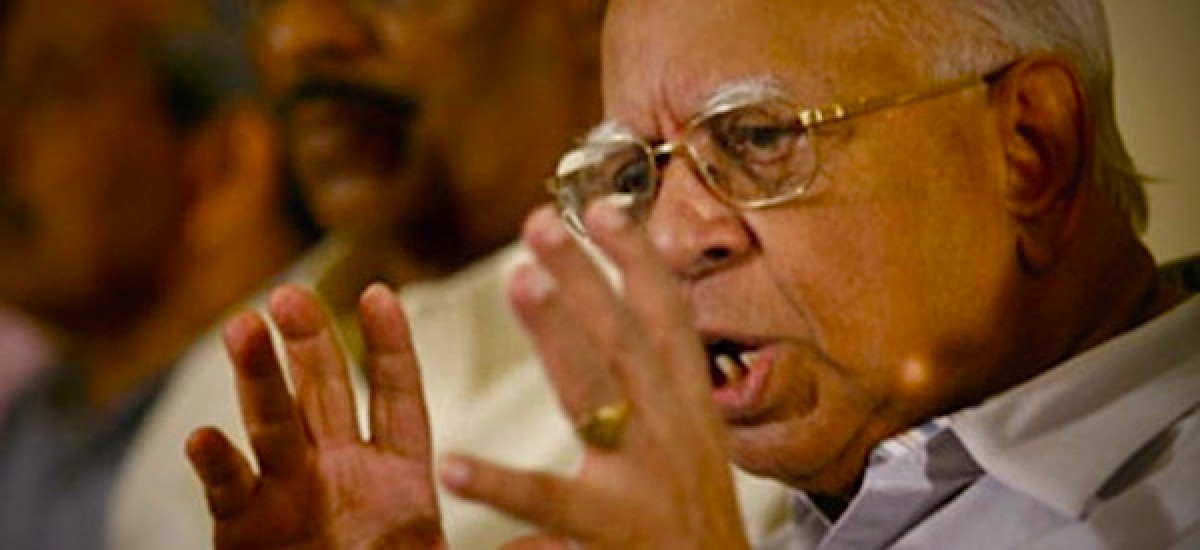
R Sampanthan is a Member of Parliament and leader of the Tamil National Alliance and Illankai Tamil Arasu Kachchi. Photo from vivatamils.2009 on Flickr.

A visit to the Mayan exhibition in Paris tells the tale of a splendid ancient civilization with an advanced mathematics, now reduced to marginality by colonial conquest. It also reminds one that the civilization of the Sinhalese, whose language is distinctive, whose collective existence is not far flung and whose state is in a strategically hostile situation or environment, can be reduced to an exhibit in an ethnographic museum, if it is not collectively strong, adaptable and very smart indeed. This must not be taken as a chauvinist, racist or ethnocentric sentiment: for example, I am neither Mayan nor Guatemalan, yet I am anguished by their fate.

An American witticism attributed variously to Dr Henry Kissinger and film director Oliver Stone says “just because you are paranoid, it doesn’t mean they aren’t out to get you”. It increasingly seems that Tamil Nadu is to Sri Lanka what Florida is to Cuba. The voices raised in three intersecting, interactive circles, Tamil Nadu, the Tamil Diaspora and Sri Lankan Tamil politics, against the carrying out of the sentence on the killers of Rajiv Gandhi, Nehru’s grandson and Indira Gandhi’s son, tell a story. These voices include the Tamil Nadu State Assembly, the TNA, and the Global Tamil Forum (GTF). It would be only the naïve who regard these protests as stemming from a principled opposition to the death penalty. There seems to be a touch of solidarity in these protests and certainly a sense of impunity, by which I mean, a sense of entitlement which assumes that even the murder of the grandson of the iconic founding Prime Minister of India, should not be treated as a heinous atrocity punishable by death, but should be somehow overlooked; allowed almost to slide. These protests and petitions must surely alert the Sri Lankan people to the dangerous neighborhood in which we inevitably exist.

A notable event took place recently in Delhi. It was attended by all parties claiming to represent Sri Lanka’s Tamils of the North and East barring the EPDP of Douglas Devananda. The meeting was therefore a largely representative one. A report by the Conference Coordinator Selliah Nagarajah, posted on August 28 from New Delhi, on the website Sri Lanka Guardian says that:

“The conference of the Sri Lankan Tamil Parties organised by the Parliamentary Forum for Human Rights for Global Development (PFHRGD) was held on 22 & 23 August 2011 at the Constitution Club Hall, New Delhi. It was to serve as a forum to discuss all the issues relating to the Sri Lankan Tamil problem and to ascertain the opinion of the Sri Lankan Tamil leaders on how the Indian government could facilitate an early resolution. It was further aimed at providing an opportunity for the Sri Lankan Tamil leaders to present their consensual views to the Indian Parliamentarians in helping them set out a framework of action required to be taken by the Indian government in its continued endeavour to find a lasting resolution to the Sri Lankan Tamil problem…

Nine registered political parties were invited for the conference and eight parties attended the two day meeting. The following represented the eight political parties: Akila Ilankai Thamil Congress: Gajendrakumar G Ponnambalam, Selvarajah Kajendran; Ilankai Tamil Arasu Katchi : Mavai Senathirajah, M.A. Sumanthiran; Eelam People’s Revolutionary Liberation Front: Suresh Premachandran, Nadesu Sivasakthi; Eelam National Democratic Liberation Front: G.Gnanasekaran, S.Raveendran; Tamil Eelam Liberation Organisation: Selvam Adaikalanathan; Tamil United Liberation Front: V.Anandasangari; Pathmanabha Eelam People’s Revolutionary Liberation Front: T.Sritharan , Thurairetnam; Democratic People’s Liberation Front: Kandiah Sivanesan, Benedict Thanabalasingam.

…Delegates expressed their serious concerns on the present situation of the Tamils in North Eastern Sri Lanka and unanimously decided to approve the following resolution on matters of immediate concern. Therefore we request the following must be done as a matter of urgency…” (‘What They Talked About Tamils’, Sri Lanka Guardian)

There was no endorsement in the text, of the 13th amendment, even as the base line for a settlement. There was no criticism of the Tigers for having murdered leaders and members of every one of these organisations. There was no denunciation of the murder of Rajiv Gandhi though the meeting took place in India in the 20th anniversary year of that heinous assassination. Among the multi-point resolution passed, Point 2 not merely stands out but leaps out at the reader: “…The army must be withdrawn from the North and East immediately.” (ibid) 

In case this is regarded as a one-off reference, we have clear confirmation of its import from Mr Suresh Premachandran as quoted by the Daily Mirror:

The Tamil National Alliance (TNA) has with the help of some Lok Sabha members had submitted a memorandum to Indian Prime Minister Manmohan Singh requesting him to prevail upon the Sri Lankan government to remove the military camps in the North, TNA parliamentarian Suresh Premachandran said today… “We interacted with a number of Lok Sabha MPs from the ruling party and the opposition and submitted this memorandum to Dr. Singh through them”, he said and added that the dismantling of High Security Zones was another key demand highlighted in the memorandum.’ (‘TNA Submits Memo to Manmohan’, Kelum Bandara, Daily Mirror, Wednesday Aug 31st, 2011) 

After a decisive and total military defeat of a powerful armed secessionism, and with the Sri Lankan armed forces a strong, determined, legitimate and permanent presence in the Northern and Eastern areas of a re-unified country, it is absurd that the latest expression of a Tamil consensus holds out for ‘the immediate withdrawal of the army from the North and East’. This is beyond anything that JR Jayewardene, Premadasa, CBK or even Ranil would accede to while embattled by the Tigers! More basically, which army anywhere in the world, least of all South Asia, would withdraw from a geo-strategically vital frontier?

What is the guarantee that the TNA, with Provincial powers and added legitimacy in hand, would not launch an agitation for the removal of the Sri Lankan armed forces, as it has called for in this memorandum, and seek Tamil Nadu or Central Government support for such agitation, whether or not it succeeds in drawing them in? Do we want the North converted into another Kashmir?

Of no little significance is the discussion of the ‘war crimes/international inquiry’ issue, as reported by the conference convenor in the article on the SLG website.

“…At this stage, Mr Kagendran and Mr Ponnambalam, delegates of the Akila Ilankai Thamil Congress, wanted the conference to pass a resolution calling for an international investigation into allegations of war crimes and crimes against humanity. Chairperson objected to the inclusion of a new item in the agenda at this late stage as he had no mandate to deviate from the agenda. Several delegates suggested that it could be taken up as an added issue under matters discussed under the topic “Immediate Concerns” earlier. The conference reopened the agenda on “Immediate Concerns” and agreed to include the following as item 7 of the matters requiring urgent action:

“An independent international inquiry into allegations of war crimes and crimes against humanity should be conducted.”

Now, what is one to make of the fact that no tendency or powerful single party was willing or able to take a moderate stand and put the brakes on these two calls, i.e., for the immediate withdrawal of the army and the holding of an international inquiry?

If the immediate withdrawal of the Army from the country’s North and East and the conducting of an ‘independent’ international inquiry into allegations of war crimes and crimes against humanity are two planks of the Tamil consensus, or rather, the Northern and Eastern Tamil consensus—with the EPDP as an honourable exception—what does this say about the degree of militancy or radicalism of Tamil sub-nationalism? Perhaps more pertinently what does it say about the total divorce from reality of those who subscribe to these views? These are two issues on which no Sri Lankan government or Southern political party will, should or can concede or compromise on, because they lie at the core of vital national interests.  They are ‘red lines’ and non-negotiable.

The drift apart in political discourse between the dominant Southern and Northern blocs may make for a cold peace. The lack of a commitment on the part of the Tamil parties to a mutually agreed upon ceiling on devolution feeds the Southern centralist apprehension that any large unit devolution would be a jumping off point for centrifugal demands. A noteworthy interview given by the TNA’s Premachandran, to Shakuntala Perera of the Daily Mirror a few days ago, provides ample evidence that these apprehensions are not entirely paranoid in nature. 

“Q: You often speak of the Indian example. How much is India a model for you on these issues?

A: Even though India is a federal system the provinces are still asking for greater power. So on these grounds there are various Chief Ministers fighting for more. There is no real power devolution in that sense. While Jammu and Kashmir has one system, somewhere else the system is different, depending on the people and the language etc. They even want to divide Andrapradesh.”

Mr. Premachandran is a plain-spoken man. It is exceedingly obvious from his answer that even Indian model federalism or more correctly quasi-federalism, is not enough for him, though (i) the Tamil people of Northern Sri Lanka are far less numerous and a far smaller fraction of this country’s population than those of the regions he names and (ii) the provisional IRA and the Catholic minority of Northern Ireland have accepted power sharing/devolution within a unitary state. One can only guess at his commitment to the 13th amendment and the role he and his co-thinkers within the TNA will play in the likely event that they control the Northern Provincial council. Given the strategic location of the area, its interactivity with and susceptibility to politico-ideological osmosis from Tamil Nadu, any Sri Lankan government would be given pause by the prospect.

Still, matters are by no means hopeless. As President Rajapaksa informed Parliament in his address which signaled the termination of the Emergency, elections to the Northern Provincial Council will be held next year, which will bridge the political deficit between that province and all the others. This is an exercise in devolved power through basic electoral democracy. Who can deny that democracy is either the best solution or the best pathway to a solution? And who can deny that the likeliest chance to make peace would be an understanding based on a deliberative dialogue, between President Rajapaksa and Mr. Sambandan? There is obviously a deficit to be bridged. And this is where the non-state, social sector can contribute towards greater understanding between communities and regions.  The Sri Lankan corporate sector, the professionals, and most significant of all, a concerted multi-faith effort, in particular by those religions that cut across the ethnic divide (providing an example of unity in diversity and a transcendent identity), can deepen and develop the positive yet modest role that they already play to bridge those gaps. In fact it may be an urgent imperative to prevent a cold peace from degenerating into an externally provoked and catalysed civic conflict.

Print this post

3,388 views

20 Comments

  1. What sort of red line is the learned professor crossing to utter utter lies?

    http://www.koreaherald.com/national/Detail.jsp?newsMLId=20110904000307
    “But now that the situation is totally stable and there has not been a single incident since the military defeat of the LTTE in May 2009, it seems to us appropriate to try and stimulate and rekindle interest for Korean investors,” Peiris said.

  2. http://www.koreaherald.com/national/Detail.jsp?newsMLId=20110904000307
    Reclaiming the pearl of Sri Lanka, 4 September 2011:

    ”…. no restriction on foreign companies owning immobile property and, now that the war is over, political stability.”

    Professor, you are crossing too many red lines !!

  3. no way to withdrwa SRI LANKAN SECURITY FORCES FROM NORTH-EAST AT ALL.IF WE REMOVE LTTE AND OTHER TREEORIST WILL HARM DAILY PEACEFUL LIFE ORDINIARY TAMIL CIVILIAN IN AREA.TNA OR ANY POLITICIAL PARY IN AREA CONNOT PROVIDE SECURITY CIVIL SOCIETY AND CIVILIAN IN NORT-EAST.
    SECURITY FORCES NEED RUN PECAEFUL LIFE FOR TAMILS.

  4. This is impossible under current situation – too many red lines on the ground:
    Godfrey Gunatillake, LLRC, 12 August 2010:
    ‘’the fundamental principle underlying democracy is the sovereignty of the people and it is the way in which government structures enable people to exercise their sovereignty from the bottom upwards that makes up for democracy’’

  5. ”Red lines” depend on who tries to ”cross” them:

    http://transcurrents.com/tc/2010/08/displacing_northern_tamils_to.html
    Displacing Northern Tamils to set up Sinhala military cantonments would increase resentment by Tisaranee Gunasekara, 1 August 2010:
    ‘’… Ragamwela villagers are Sinhalese; they can protest against the injustice done to them, still, without being labelled ‘Tiger pawns’. But protests are an unaffordable luxury for the residents of three Tamil villages in Murukkundi, displaced from their homes when the state confiscated 4,000 acres in Kilinochchi to build 12,000 prefabricated houses for military families. …’’

  6. There is a saying: You don’t have to go round the head to touch your nose – take your finger straight to the nose.”

    Is the author going round the head to touch his target(whatever it is) and the following gentlemen straight to their targets:

    http://transcurrents.com/news-views/archives/139
    National integration is still where it was when Prabhakaran’s body was found at Nandhikkadal, Somapala Gunadheera, 2 May 2011:
    ‘’…. If we are wise, we should first put our own house in order before we challenge the UN…. It is not yet too late to begin. The mission needs a powerful Presidential Task Force for National Reconciliation. Such a Force can cut the ground from under the feet of the ongoing controversy and many more to be expected.’’

    http://transcurrents.com/news-views/archives/213
    Osama and Prabhakaran: The killing of two terrorist leaders, Harim Pieris, 5 May 2011:
    ‘’…. However the West’s war on terror and specifically its war on Al Queda have been complimented by a dialogue and outreach to the Muslim world. Similarly Sri Lanka’s own war on terror, concluded now almost two years ago, must also be complemented and succeeded by dialogue and an outreach through friendship to the Tamil community. ….”

  7. We all know that the “We Tamil” Dravidian movement is an essentially fascist racist movement. C’mon DJ, if you give this sort of warning to the village thug (you know who) what do you think he will do?

    As I have said before, the best thing that “Tamils” can do is to allow “Sri Lankanness” to flourish, thereby permitting to the Hela/Sinhala idiocy to die a natural death. When that happens Sri Lankans will be Sri Lankans. Tamils will still have choice of being Tamil as well.

    Tamil racism will only fan Hela idiocy (now that’s a Helluva idiocy) and will make the lives of northern Tamils miserable.

    So Tamil-Racism is self-destructive unless there is another game a foot…; and other players at the table. Hmmmm…

  8. Tamils could have solved this problem by dealing with the Buddhist clergy in the 50s/60s instead of with the Banadaranaikes and Senanayakes.

    It isn’t too late now and it’s the only way out:

    THE SANGHA AND ITS RELATION TO THE PEACE PROCESS IN SRI LANKA, A Report for the Norwegian Ministry of Foreign Affairs, Iselin Frydenlund, International Peace Research Institute, Oslo (PRIO) (2005): ‘’Lack of political consensus in the south and opposition to the various peace processes by nationalist and Buddhist pressure groups have time and again made peacebuilding difficult in Sri Lanka. …. One possible strategy for supporting pro-peace actors might be to encourage support from countries like Thailand – which, like Sri Lanka, is also a Theravada Buddhist country”

    Review(2007) of Buddhism, Conflict and Violence in Modern Sri Lanka, Dr Elizabeth Harris, Liverpool Hope University(2006): ‘’ Chandra R. de Silva implies that Buddhist monastic opposition to a non-unitary state has contributed to the conflict. He appreciates the reasons for this, but pleads for a system of monastic education that would expose monks to other religions and cultures. …. one of the most complex and intractable conflicts in the world’’.

    • Tamils must consider this most seriously – time is running out for them.
      Almost too late.

    • rita
      v.interesting.
      mmmm… Tamils need to think … persuade Buddhists… clergy…..
      63yrs too long ……
      perhaps Sri Lankans could write to penfriends(oops, e-freinds or facebook?)in Thailand.

    • I didn’t know till now that there was created a body called All Party Committee on Development and Reconciliation on 2 July 2009:
      http://www.lankatruth.com/index.php/news/local-news/2827-jvp-proposals-for-all-party-committee-for-development-and-reconciliation
      JVP proposals for ‘All Party Committee for Development and Reconciliation’, 20 July 2009

      A way of beating the recommendations(too extensive for Rajapakses) for devolution in APRC who were going to submit their report in mid-July?

      Patriotic Sri Lankans can keep up with the number of bodies created by this government ?

      I bring it here to say that the government crosses too many red lines by accepting the disparity between the mandate and the actual work carried out by these bodies.

      • Dias

        One way of preventing our parliamentarians cross too many red lines:
        JVP should look at the following and ”rope in” parliamentarians who attend international meetings and insist on follow-up work with the other parliamentarians once they get back home:

        http://cpa.informz.net/cpa/archives/archive_1134894.html
        Parliamentarians fight mismanagement, corruption and abuse of power to prevent conflict
        ”…. The group was composed of Parliamentarians from Cyprus, Pakistan, Rwanda, Kenya, Uganda, Guyana, Northern Ireland and Sri Lanka.”

        http://cpa.informz.net/cpa/data/images/concludingstatement.pdf
        PARLIAMENT, AID EFFECTIVENESS AND CONFLICT PREVENTION
        They recognized that Parliamentarians have a leading role in conflict prevention and building a durable peace. Parliament must therefore be strengthened by improving democratic governance, particularly its oversight functions and systems for ensuring accountability by the executive, including the budget process and public sector financial management. Parliament must also raise standards of natural resource management, a leading cause of tension in many states today, by
        ensuring that there are fair and equitable systems for the distribution of benefits to all segments of the nation.


    • rita
      thought-provoking.
      Unconventional way of resolving this wretched conflict ?
      Tamils must actually pursue this – appealing to Buddhist clergy !
      Perhaps YMBA, YWBA, … should be involved ?
      We can’t go on any more …
      Occupation army excesses … Grease Devils …
      Why are we tolerating sheer … inhumanity ???????

  9. If they have truly, effectively eliminated LTTE (not merely the leadership that existed then, but the concept and the need for that concept), then why is the President, the diplomats and the whole establishment fighting the Diaspora now, characterizing them as LTTE rumps?

    • Hi,
      My comment above was with respect to Wijayapala’s question “So are you saying that Mahinda and Gotabhaya failed to defeat the LTTE?”. I should have made that explicit, somehow.

  10. We needn’t have permanent friends and foes but we need to have permanent principles.
    That will help keep all from crossing red lines.

  11. Tamil speaking Sri Lankans had shown almost an inexhaustible capacity to produce engineers, doctors, accountants, clerks and shopkeepers but the Tamil political culture failed to produce an enlightened political leadership that could rise above their Jaffna peninsularity of mind and lead the Tamil speaking Sri Lankans towards realistic and attainable political goals. Not since Sir Pon Arunachalam left the Ceylon National Congress, rupturing hopes of communal harmony, has Tamil speaking Sri Lankans produced a political leadership which has had the vision to accept co-existence in a multi-ethnic society as the most natural, viable and peaceful path for the welfare of all communities in Sri Lanka.
    Tamil speaking Sri Lankans suffered the most in Sri Lanka because of their leaders’ blind refusal to co-exist in a multi-ethnic society sharing the land in common with the other communities. Their suicidal political ambitions, arising from an exaggerated view of their self-importance and superiority, drove them to an end at Nanthik Kadal, they never thought would come.
    Tigers wanted more than 100,000 Muslims in Jaffna Peninsula to get out within 3 hours, leaving their belongings and treasured valuables – that was a text book example of ‘ethnic cleansing’. Tigers made Idi Amin look like an angel as Idi Amin had a heart to give the Asians in Uganda three months to leave the country and not 3 hours.
    Tigers did the most to destroy the Tamil speaking Sri Lankans. In counting on gains through its strength as a conventional military force, and dragging out the war for 25 years Tigers missed opportunities to even entrench their own position. Tigers’ singular focus on military strength, to the detriment of political gains and support from the people on the ground, all while ensuring their emergence as the dominant Tamil armed force was the cause of their demise.

Leave a Reply

This is a moderated forum. Comments are the sole responsibility of the person posting them. Please do not post comments that are off topic, defamatory, abusive, threatening or an invasion of privacy. Comments are automatically scanned for spam and obscenity.

Comments are only approved if they are in line with the site guidelines. Those that do not will be edited or deleted without prior intimation. Comment approval may take up to 24 hours.

Thanks in advance for your civil and constructive engagement.

Spam protection by WP Captcha-Free

About Groundviews

Located at the Centre for Policy Alternatives in Colombo, Sri Lanka, Groundviews is a citizen journalism website that uses a range of genres and media to highlight critical perspectives on governance, reconciliation, human rights, the arts and literature, democracy and other issues. The site has won two international awards, including the prestigious Manthan Award South Asia in 2009. The grand jury's evaluation of the site noted, "What no media dares to report, Groundviews publicly exposes. It's a new age media for a new Sri Lanka... Free media at it's very best!"

cezarneaga.eu
canakkale canakkale canakkale balik tutma search canakkale vergi mevzuati bagimsiz denetim vergi mevzuati ozurlu engelliler