
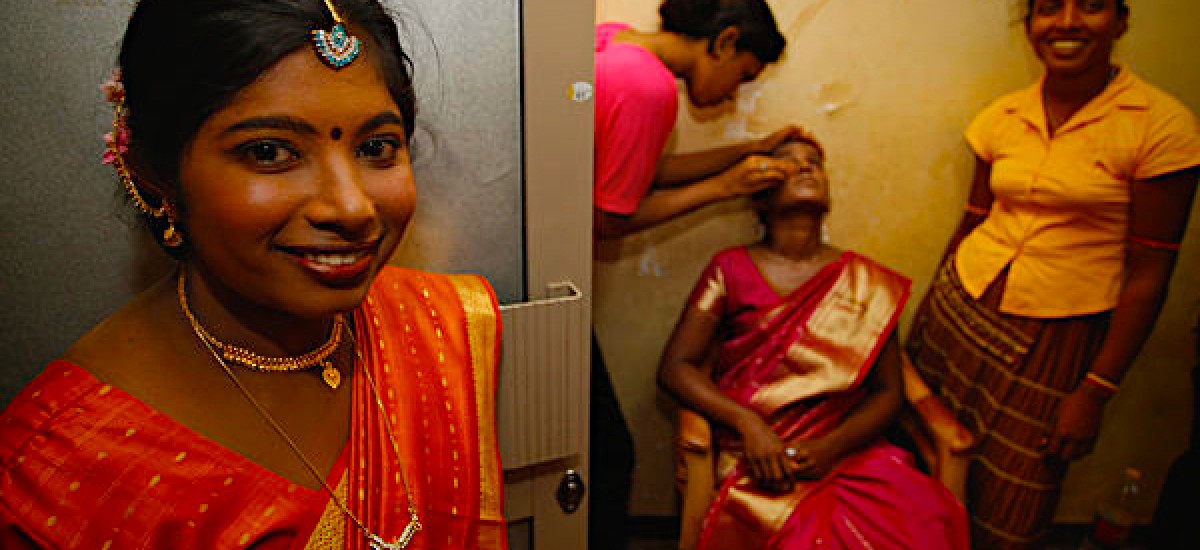

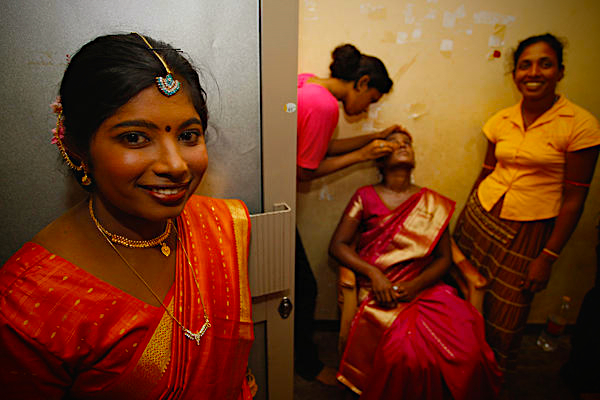
A former female Tamil Tiger rebel dressed in bridal attire looks on as others dress up another bride during a mass wedding ceremony at a government rehabilitation camp near Vavuniya in northern Sri Lanka in June. Eranga Jayawardena/AP. From Christian Science Monitor.
“The people have used ballots instead of bullets, that’s a great victory for us”, said Sri Lankan Health Minister Maithripala Sirisena last Sunday, even though the ruling party he represents suffered a heavy defeat at the polls in the war-torn north and east of the island-nation.
By RNW’s International Justice Desk in Sri Lanka
The Tamil National Alliance (TNA), formerly controlled by the LTTE (Tamil Tigers), won control of three quarters of the councils in the Tamil majority region.
Premature
The government’s optimism may be premature though. RNW recently visited Sri Lanka to interview former Tamil Tigers fighters. They still sound determined, even though the Tamil war has ended. “Yes, if life doesn’t improve here then I would fight again”, said one of them, named Madu. “I don’t want war again but we need basic rights.” RNW interviewed nine former Tiger fighters in the walled compound of an NGO which is keen to remain anonymous, in the eastern town of Batticaloa. Six men and three women sat and spoke openly to RNW about the war and their lives today. Despite government proclamations of racial harmony peace, many Tamils in the east and north of Sri Lanka still live in fear of the police. They complain they do not enjoy equal rights with Sinhalese citizens.
A state of rehabilitation
Looking around the table the former guerilla fighters are unassuming and meek. But look a little closer and you notice scars from the war – both physical and emotional. All nine joined the Tamil Tigers during the 30-year civil war, most voluntarily, two were coerced. Some surrendered in the war’s denouement in the Spring of 2009, others were captured afterwards. All were sent to so-called ‘rehabilitation camps’, effectively prisons, where at first many experienced maltreatment and shortages of food and medicine.
Reintegration
Later with the help of NGOs their experience of the camps became more positive as they were taught skills and received ID cards, ready to attempt reintegration into post-conflict life. The three women, in their twenties and thirties, spoke of the anxiety of uncertainty – unsure if they were in prison, if and when they would be released, and whether they would be allowed proper contact with loved ones. ‘Actually the most important question was: what will happen tomorrow?’ said Parinita. Most of all, they wanted their freedom back.
Freedom, but not as we know it
‘But once we were released, we still had no freedom,’ said Abi, referring to the many military checkpoints that Tamils still have to go through every day. Police are suspicious and oblige former Tigers to sign a ‘Good behavior paper’ every month. ‘We don’t have equal rights here. Last month the police suddenly arrived and searched my house. I don’t know what they wanted.’, Abi said.
Jobs
Many Tamils claim that it is harder for them to find work than it is for Sinhalese. The group points out that no Tamils are allowed to join the police force, and that even in Tamil-majority districts local government jobs are difficult to get without speaking fluent Sinhala. The former Tigers complained of ‘Sinhalese colonization’ of the north and east of the island. Colombo offers incentives to Sinhalese people to move to the former Tamil strongholds. Tamil ‘rehabilitation’ sometimes involves Hindu Tamils being made to take part in traditional Sinhalese Buddhist rituals.
Speaking in tongues
Even the police and military in Sri Lanka’s north and east don’t speak, or refuse to speak, Tamil. RNW experienced this first hand when witnessing a Tamil being questioned in Sinhala by police – when the man asked to be addressed in English as his Sinhala was poor, he was ignored.
Violence
In the West the image of Sri Lanka as being free from oppression and violence has taken root. Recent investigations by Britain’s Channel 4 and the UN have focused on atrocities committed during the civil war. Human rights issues existing today in the north and east are being overlooked. These are the same rights issues that helped lead the country into one of the world’s bloodiest civil conflicts in the 1980s.
Battle for peace
Former Sri Lankan president Chandrika Kumaratunga now urges her successor Mahinda Rajapaksa to work towards an ‘inclusive society’ and share political power with minority Tamils. “I too, am glad, extremely happy that the war has ended and terrorism defeated”, she says. “But, I cannot blind myself to the fact that although we have won the civil war, we have not even begun the battle for peace.”
Take up arms?
Closing the interviews with the nine Tiger fighters, RNW returned to the question of long-term peace – with the Tamil Tiger leadership dead and the infrastructure supporting their cause all but wiped out, could they imagine picking up arms again? “If we don’t feel our rights being respected in the coming years then yes, I can imagine I would,” said Saathuryan.
Click here to read the first story in this series of three from the RNW team in Sri Lanka
###
Content from Radio Netherlands Worldwide (RNW) is republished with permission on Groundviews for further debate and discussion, under a content sharing agreement between this site and RNW’s South Asia Wired programme.