Archive for the ‘Religion and faith’

A-Z of Sri Lankan English: P is for pre-poya

pb-110615-poson-buddhism-01.photoblog900

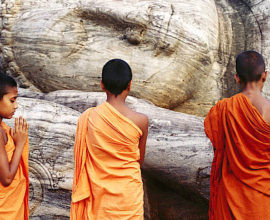
Photo courtesy M.A. Pushpa Kumara / EPA, via Photo Blog on MSNBC Poya must be one of the first Sri Lankan English terms to enter the vocabulary of foreigners when they arrive in Sri Lanka. A poya day is a full moon holiday, a day when devout Buddhists go to the temple and observe sil. To non-Buddhists it is a welcome day off, but (not so welcome for some) a day when meat and alcohol are not available in shops and supermarkets, and are not supposed to be served in restaurants and hotels. Many people are critical of a system which reportedly gives Sri Lanka more public holidays than any other country, and which is seen to favour Buddhism over other religions. But most of us look forward to poya days anyway! The day before a poya day is called pre-poya. This is a day when evening events and get-togethers are often organised – the equivalent of a Saturday night, the…

Continue reading »

Accountability and Universal Values in Development

ElectricityDistributorsSriLanka

Photo courtesy World Bank “If a tree falls in a forest and lands on a politician, even if you can’t hear the tree or the screams, I’ll bet you’d at least hear the applause.” Paul Tindale Something is of universal value if it has the same value or worth for all, or almost all, people. This claim could mean two importantly different things. First, it could be that something has a universal value when everybody finds it valuable. This was Isaiah Berlin‘s understanding of the term. According to Berlin, “…universal values are values that a great many human beings in the vast majority of places and situations, at almost all times, do in fact hold in common, whether consciously and explicitly or as expressed in their behavior…”. If such were the case, it would seem logical that ‘a benign quality of life’ would constitute a most fundamental universal value.  From there arises the various issues of fertility, pleasure, or democracy…

Continue reading »

Can Rationalists Awaken the Sleep-walking Lankan Nation?

Keepers of Rationalist Flame L to R - Abraham Kovoor, Carlo Fonseka, Dharmapala Senaratne

Assorted charlatans and religious zealots across the island of Sri Lanka must have heaved a collective sigh of relief when they heard that Dharmapala Senaratne was no more. He had made it his business to make life difficult for those preying on the gullible public. Rationalist and myth-buster Dharmapala made his final exist a few days before 2012 dawned. At 67, he still had a few more years of the good struggle left in him. He would surely have enjoyed countering the false prophets of doom — and their credulous followers — who predict the end of the world on 21 December 2012. Although Dharmapala was also a teacher and lawyer with decades of experience, he was best known for his public activism as a rationalist. His was a determined and sceptical voice questioning fanatical peddlers of all kinds of dogmas, faiths and (mutually exclusive) brands of ‘salvation’. Even more importantly, he fearlessly took on confidence tricksters hoodwinking superstitious people…

Continue reading »

The Citizens’ Commission on the Expulsion of the Muslims from the Northern Province by the LTTE in October 1990

Picture 066

In October 1990, the Liberation Tigers of Tamil Eelam (LTTE) expelled the entire Muslim population of the Northern Province of Sri Lanka. Within a period of 2 weeks the LTTE systematically chased out close to 75,000 Muslims residing in the districts of Kilinochchi, Mullaiteewu, Jaffna, Mannar and parts of Vavuniya. The LTTE expulsion of Muslims has not been adequately integrated into any mainstream historical narrative in Sri Lanka. Most commentators routinely get the date of the expulsion wrong and few give it the status of a highly significant historical event that it warrants. This is unfortunately true of most events involving Sri Lanka’s Muslim community. The Law and Society Trust (LST) in partnership with the Rural Development Foundation (RDF), the Community Trust Fund (CTF) and the Peoples’ Secretariat (PS) and an advisory group of prominent Muslim civil society actors conducted a two year long truth seeking initiative in the form of a Citizens’ Commission. The objective of this exercise has…

Continue reading »

Authoritative Ethical Realist Reads Rajapaksa’s Role

news_06082009_94049

The Pope with Archbishop Malcolm Ranjith Though my political approval of and personal liking for Mahinda Rajapaksa, (certainly in relation to his competitors and immediate predecessors) are shared by nine out of ten Sri Lankan citizens (according to the Gallup poll), it is not comfortable to be alone in one’s analysis and evaluation, among one’s own social stratum, the intelligentsia, especially the English-speaking and writing urban intelligentsia. It is therefore a good feeling when you discover that your views coincide with someone who stands above the fray, and cannot but evoke respect from all rational people. Nicest of all, is when the public personage with whose views your own coincide, has achieved a status and recognition that is truly global. My perspectives on Mahinda Rajapaksa, his administration, Sri Lankan politics and the issue of accountability and international pressure have been denounced by political partisans of almost all sides. The Tamil Diaspora accuses me of Sinhala chauvinism or neo-nationalism (as Taraki put…

Continue reading »

The rich man in his castle, The poor man at his gate

08.05.2010- Slave_Island_eviction_1

Photo courtesy JDS This was a part of well-loved hymn I would love to sing during the early years of my school career. I cannot actually remember whether these words were omitted by then as they are now, or if I sang it without disdain at that time. As I became politically aware, these words stirred resistance within me as I felt that it was contrary to my faith and the book that guided it. It came back to me as I read last Sunday’s paper and other recent reports of the attempts being made at grabbing land, the poor who have had promissory deeds or real deeds evicted without any compensation, the Mews Street fiasco but very specially the video clip of the political offspring doing some threatening of what would happen to people if they do not vote with the current political juggernaut. What came back to me was actually in question form. Why have not any of…

Continue reading »

Sinhala Buddhist Rationale In An Omnivorous Society

1178995742merv

Photo courtesy Ada Derana My new neighbour, a quiet middle class, young Sinhala Buddhist professional from beyond Matara, who started constructing his own house, brought down a “Kattadi mahathtaya” from his village to evoke blessings on the property, the new construction and on himself and his young family, before the foundation stone was laid. The ritual went on with loud chanting and drumming through midnight, a public nuisance, but tolerated in silence, as it was his belief for which he also had a right. Early morning we woke up when a cockerel screamed it’s life out. The final sacrifice of a “life” made in this ritual called the “Bhahirava poojah”. This is no isolated event in this Sinhala Buddhist society, where people construct their own houses and often indulge in such sacrificial poojahs. May be there are other similar rituals too, when “life” of animals and birds are sacrificed, in lieu of a safe and prosperous future for the person(s)…

Continue reading »

Osama, Prabhakaran and Me

BIN LADEN MESSAGE

Photo from The Atlantic I have a bone to pick with these two. In fact maybe an entire rib cage. One of them caused me to question my nationalism and my identity as a Sri-Lankan and the other caused me to have to answer countless questions about my religious beliefs. In essence all my adult life, my religion and my country have been under attack; and yet how did I turn out to be such a pacifist? Shouldn’t I theoretically have bombs in my make-up case and hidden amongst my Manolo’s? Considering the chaos that these men have caused in their bid to achieve their agenda’s I should be a roving lunatic with a thirst for vengeance. As noble as their intentions may have been to their followers, they did harm their own and others in the process, to no significant outcome. In my opinion that is. Firstly let us start close to home. I was brought up in the…

Continue reading »

In the midst of the Adi Vel festival

06082011449

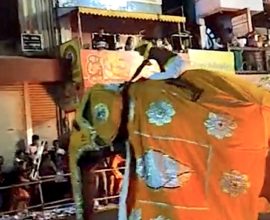
All photos by Iromi Perera 9.30am Saturday morning. I was walking on the pavement in Bambalapitiya when I found myself in the midst of the Adi Vel festival. I had passed it earlier near the Kovil in Kirullapone and had found myself feeling slightly unsettled after seeing men being hung on hooks and suspended from trucks in order to ask for help from a higher God. But I was there and seeing the hundreds of people involved in the Vel festival in different ways just made me stop and watch.  I wished I knew more about the festival to have appreciated it fully. I also wished I had my camera with me but at that moment, my mobile had to suffice. The decorated coaches pulled by men and women, people getting their children and themselves blessed by the priests, devotees with their offerings, the breaking of the coconuts, people fulfilling vows by rolling on the ground (the entire distance of the…

Continue reading »

The Power of Graciousness: Treading the middle-path in post-war Sri Lanka

20110430_asd000

Photo courtesy The Economist, Truth and consequences I am not only a pacifist but a militant pacifist. I am willing to fight for peace. Nothing will end war unless the people themselves refuse to go to war. Einstein This government inherited a very complex challenge with the LTTE so focused on the mission of creating Eelam using any means possible, with terror as its central strategy. At the same time, I do not stand in judgment on Prabhakran for starting this movement as he probably had just cause at the time and I even do not judge the use of force and violence to make a point, like Mandela did to get the attention of the Apartheid government in South Africa of their unjust policies.   I do, however, abhor what Prabhakaran did as a ruthless leader who did not value any life in his quest to achieve his goal. LTTE had clearly showed that they were not interested in talking…

Continue reading »

Spirtuality, Religion and Human Conflict

80bbbca828155feb0a6bc0638b996b10

Image credit NowPublic Spirituality The desire for the triumph of good over evil is an inherent human spiritual need and consequently it is the underlying theme of all religious teachings. It is a universally accepted truth that the propagation of good leads to happiness while the propagation of evil leads to suffering. The concept of Good can be defined as human thoughts, words and deeds which benefit and sustain the physical, emotional, intellectual and spiritual wellbeing of humanity without compromising all other life and non life which supports and sustains human survival. It follows that the definition of Evil is the exact opposite of Good. A feature common to all religions is the personification of good and evil primarily through icons such as God and the Devil portrayed as super natural beings. The purpose of it could be that personification of abstract concepts serves to facilitate better understanding of same. Religious belief is further reinforced by unique faith based doctrines…

Continue reading »

Buddhism and its impact on governance

Screen shot 2011-05-17 at 11.08.07 PM

Image from Travel Blog Today, Wesak is the most revered day in the Buddhist calendar. Unfortunately, in Sri Lanka, the celebration is led by a small group of apparently sanctimonious humbugs followed closely by a larger herd of population of self inflicted ignorance. Their mutual objective being the public display of religious fervor through the performance of religious observations at the obvious expense of the practice of Buddhist precepts. It appears that they are trying to create an image of high standards of moral and ethical conduct despite their very apparent behaviour to the contrary. The negative reaction of the leadership to the UNSG’s request to respond to the POE report is the most powerful case in point. Their floundering behaviour of non- cooperation was followed by outright denial of allegations of war crimes and human rights abuses compounded by denigration of the UNSG and Panel of Experts by political buffoons even as country representatives at Wesak celebrations at the…

Continue reading »

Vesak and Violence Against Women

FE198A6C1F28878264F1F164E4391

Original photograph REUTERS/Damir Sagolj I have not hidden my increasing disdain for the way Buddhism is practiced and promoted in Sri Lanka. To say the least, we have not only forgotten what it is truly about, we often downright contradict and insult it. I wrote about it here, almost exactly a year ago, after the Poson holiday of 2010. In the last year, I have become even more disillusioned with the establishment of Buddhism in Sri Lanka – I am always shocked by the bigoted sermons given on TV, the terrible behaviour displayed by monks turned politicians, and how the Nationalistic element of Sri Lankan Buddhism has seeped into everything. I felt even more wary as we as a nation approached Vesak this year. For anyone that needs a heads-up, the Vesak full-moon Poya day is a special day for Buddhists. The Buddha was apparently born, attained enlightenment and passed onto Nirvana all on Vesak poya days. Don’t ask me how…

Continue reading »

The burka ban: Europe and Muslims on collision course?

remote_image20110414-27136-14dr2t6-0

‘I think someone forced you to wear this. I will help you. Here is a fine of €200’. Sounds stupid? Well that’s the bizarre logic of the French rescue plan/law to help around 2000 Muslim women get out of the burka. Whilst prostitution and pornography flourish it is the burka that is banned. The debasement of women in the sex industry is well known but it is the attire of Muslim women that inspires French chivalry. I doubt anyone’s being fooled here – this has nothing to do with helping women but is another instance of the exploitation of women and women’s issues. The ban is ridiculous. It’s another blemish in the deteriorating relationship between European Muslims and White Europe. But why is Europe getting all jittery about what Muslims wear or to state another example, how they build their mosques? In Switzerland they banned minarets when there were only four in the country. Minarets and domes are fairly controversial…

Continue reading »

Launch of Moving Images: Stunning documentaries and photo essays from Sri Lanka

Screen shot 2011-04-07 at 7.45.31 AM

Moving Images is a series of stunning short-form documentary and narrated photographic portraits on facets of life in post-war Sri Lanka. These high-definition productions, the country’s first, range from portraits of resilience from the war ravaged Jaffna and reflections on the Eurasian community by the last surviving Eurasians themselves to fascinating lives in Colombo invisible even to most who live and work in the city. Produced for and supported by Groundviews, this unique content is will be progressively uploaded to the Moving Images website over April and May. Trailers for the productions follow along with the flyer announcing the launch of the content.

Continue reading »
Page 1 of 41234

About Groundviews

Located at the Centre for Policy Alternatives in Colombo, Sri Lanka, Groundviews is a citizen journalism website that uses a range of genres and media to highlight critical perspectives on governance, reconciliation, human rights, the arts and literature, democracy and other issues. The site has won two international awards, including the prestigious Manthan Award South Asia in 2009. The grand jury's evaluation of the site noted, "What no media dares to report, Groundviews publicly exposes. It's a new age media for a new Sri Lanka... Free media at it's very best!"

cezarneaga.eu