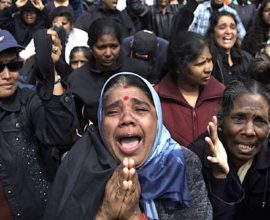
Archive for the ‘International Relations’

The Geneva Debacle of March 2012: The lessons not learnt

6934853965_7295234e19_b

Photo courtesy Vikalpa The outcome in Geneva last year (March 2011) of the voting on Sri Lanka’s conduct of the war and related human rights record was very clearly in favour of the Sri Lankan government. The line up in the voting and the scale of the majority were such that is appeared that this year too the outcome would be similar, despite some recent wavering by India. But the conduct of the Sri Lankan government in the mean time was so counter- productive that it precipitated the debacle of March 2012. We should have anticipated the disaster but it seems to have taken the Sri Lankan government by surprise. If the Sri Lankan government had learnt at least the main lessons that it had opportunities to learn in recent years, the voting would have been very different – perhaps even more favourable to the Sri Lankan government than last year. Apart from mindlessly deflecting votes that could have come…

Continue reading »

Reflections on Sri Lanka’s Post-Geneva Irrationality

68428136

Photo courtesy ISHARA S.KODIKARA, AFP/Getty Images via Chicago Tribune News One can understand to a certain extent the angst of some Sri Lankans over the injury caused to national pride by the ‘Geneva Resolution’ of March 2012. One can also understand the sense of frustration of certain others who hold the view that the Resolution does not go far enough to hold Sri Lanka’s feet closer to the fire. The effort of the present essay is to look for a way in between the two  above  points of view and explore a means by which Sri Lanka could salvage something from the wreck before all of us Sri Lankans go down. A brief look backwards to understand the way forward might be useful and helpful. So let us begin by doing so. If one avoids the pitfall of blind political loyalty or jingoism in surveying the mood of our country both in the run up to and after the Resolution No…

Continue reading »

The questions unanswered by Ass. Sec. Robert Blake: Mapping US engagement in and concerns over Sri Lanka (UPDATED)

mahinda-oblake

Image courtesy Colombo Page From around 5pm to 5.30pm today, Ass. Sec. Blake took questions from those on Twitter in South and Central Asia. Ass. Sec. Blake is the Assistant Secretary, South And Central Asian Affairs at the US State Department and former Ambassador to Sri Lanka. South and Central Asia is a large swathe of physical as well as ideological terrain. Fearful that Sri Lanka would be forgotten in the deluge of tweets under the hashtag #AskSCA, we published a story on Groundviews flagging our own questions, and what at the time were a few other questions to Ass. Sec. Blake posed by others on Twitter. The session didn’t see Ass. Sec. Blake answer many questions. It started by his office noting that, https://twitter.com/state_sca/status/192565222714777600 This was followed by a few tweets on Nepal, and a congratulatory tweet on the new US Ambassador in New Delhi. The first tweet responded to was on the Maldives, followed by one US foreign…

Continue reading »

Ask Ass. Sec. Robert Blake a question on Sri Lanka over Twitter

mahinda-oblake

Image courtesy Colombo Page Robert Blake is the Assistant Secretary, South And Central Asian Affairs at the US State Department and former Ambassador to Sri Lanka. The man likes cricket and our own Murali, and given his current portfolio, is a key figure in US-Sri Lanka relations post-war. He is currently taking questions on Twitter on US relations with South Asia. https://twitter.com/usembsl/status/192098700833726465 Through the hashtag #AskSCA, there are already a number of questions from India, Pakistan and Bangladesh, but very few from Sri Lanka. We have posed four, based on the US Senate’s Committee On Foreign Relations report on Sri Lanka (SRI LANKA: RECHARTING U.S. STRATEGY AFTER THE WAR), published in December 2009, which has a number of important recommendations we’ve not heard about since. https://twitter.com/groundviews/status/192447985777520643 https://twitter.com/groundviews/status/192447995483140096 https://twitter.com/groundviews/status/192448006493192193 https://twitter.com/groundviews/status/192448015359934465 In addition to ours, @Apelankawe and @thrishantha have posed some interesting questions. https://twitter.com/thrishantha/status/190067440342933506 https://twitter.com/apelankawe/status/191882256841846786 https://twitter.com/apelankawe/status/191883208256790531 Till now, not a single mainstream media Twitter account in Sri Lanka, or even full time…

Continue reading »

Whose Arms Will Embrace You? The United States and the Beijing Consensus

China's President Hu shakes hands with Sri Lanka's President Mahinda Rajapaksa in Sanya

China’s President Hu Jintao shakes hands with Sri Lanka’s President Mahinda Rajapaksa in Sanya, Hainan province, April 10, 2008. Image by Reuters, courtesy Transcurrents. The United States is increasingly playing a game of subtle communication in the international arena. I suspect we had a passing glimpse of this at the 19th Session of the Human Rights Council, which gathered in Geneva last month. The question is: who is the United States talking to and what is it trying to say? There has been much discussion about President Obama’s “Return to Asia” strategy, arising out of a 2009 speech during which he declared that as an Asia Pacific nation, the United States will seek to be more involved in the issues affecting the region. There has been an equally vibrant discussion in policy and scholarly circles about the so-called Beijing Consensus, a term used to describe the Chinese government’s embrace of capitalism, while remaining autocratic. It is to these nations who have…

Continue reading »

Restoring Government in Sri Lanka

sri-lanka-27feb12

Image courtesy Transcurrents If Sri Lanka is fast becoming a pariah state in the eyes of the world, it has nothing to do with the recent UNHRC Resolution. The writing has long been on the wall. As a nation, we are ruled by a group of men who seem to have nothing but contempt for the rule of law, let alone for truth in the public sphere. Violence and threats of violence against critics, the suppression of media freedom, extra-judicial killings, misplaced economic priorities and corruption on a scale that made even previous governments look clean, have become the order of the day. The minimal definition of government has to do with the rule of law: namely, that as a people we should be governed not by arbitrary fiat but by a system of laws to which the law-makers and law-enforcers themselves are accountable. The opposite of government is sovereign will, where the King/President decides what is “good for the…

Continue reading »

In conversation with Dr. Paikiasothy Saravanamuttu: The resolution in Geneva and its discontents

Screen Shot 2012-03-29 at 7.12.13 AM

Dr. Paikiasothy Saravanamuttu is the Executive Director of the Centre for Policy Alternatives, the institutional anchor of Groundviews. He is today one of three human rights defenders senior government ministers consider traitors and would like to, as in ancient times, kill, and, inter alia, break the limbs of. Though Sri Lanka’s foreign minister distanced himself from these remarks, the President and his brother, the all-powerful Secretary of Defence, have not expressed a single word of condemnation, or distanced themselves from the minister’s comments, who has openly and repeatedly said he derives his legitimacy from the Rajapaksa’s. Much of this hate and harm directed against Dr. Saravanamuttu and other key human rights defenders of late has been on account of their participation at the recently concluded 19th Session of the UN Human Rights Council, and in particular, supporting a US sponsored resolution on Sri Lanka. There hasn’t been much informed debate and discussion within Sri Lanka on the contents and genesis…

Continue reading »

The Geneva II debacle

6934830975_dafae4e928_b

Photo courtesy Vikalpa, from protest against US resolution in Colombo, 27 February 2012 The US-sponsored resolution at the UNHRC had to be defeated. It was not. 24 in favour, 15 against, 8 abstained. Hearts are broken, glasses are shattered, the ‘gods’ have ignored our prayers, there is madness surrounding us; 2012, we are now sure, is when the world comes to an end. But that was yesterday. Today, the morning after, is once again cold; we need to pick up the pieces, mend our hearts, move on. And there are questions too: what is this resolution? How did we perform? Is it all India’s fault? Where did we go wrong? Are we to be blamed? What now? Resolution L.2: From US, with love The resolution titled ‘Promoting reconciliation and accountability in Sri Lanka’ has, during the process of the UNHRC session, undergone considerable change. From being an intrusive and arrogant one sponsored by the US, it now appears rather soft,…

Continue reading »

Geneva 2012: The signs missed, lessons unlearnt

geneva_sri lankans

Photo courtesy JDS Let’s learn the right lessons from the Geneva outcome, not the wrong ones. It is not the case that a small country such as Sri Lanka cannot fight a diplomatic battle with the mighty USA and win.  Minutes after the Sri Lanka vote at the HRC this time, the Cubans moved a resolution on the composition of the staff of the Office of the UN High Commissioner for Human Rights, the opacity (code-named independence) of which the West regards as a holy of holies. The USA opposed the resolution. The Cuban resolution won with a massive 33 votes. Last year the USA invested far more effort and political capital at a far higher political level than in the case of the Sri Lanka resolution in Geneva, to prevent Palestine from being granted full membership of the UNESCO in Paris. The US lost that battle, and besieged Palestine, an embryonic or proto-state (unlike Sri Lanka) won a two…

Continue reading »

India’s Volte-Face: Winners and Losers

Image courtesy LankaStandard

  India’s hasty decision to support the United States of America led Resolution on Sri Lanka came as a big surprise. While a few rumours flagged the possibility of an India “for” vote a couple of days before the actual announcement by the Prime Minister, they were largely ignored. The prevailing orthodoxy was that India would likely abstain, and that the vote would carry with a narrow majority. That orthodoxy has now been questioned, and with India coming on board, the possibility of a landslide victory for the US is more likely. This brief piece sets out to identify the political “winners” and “losers” from the fallout of India’s decision, barring last minute twists in the tale. The merits of the Resolution are not discussed in this article. Its aspirations are rather more modest, and only seeks to identify the manner in which coming events will contribute to the image of specific political personalities and entities. Winners The United States…

Continue reading »

Sri Lanka and the UNHRC: Implications for India and for Human Rights

Mumbai on March 5, 2012_2

Image courtesy India Ink blog by New York Times/Rajanish Kakade, Associated Press As the 19th session of the Human Rights Council progresses, the discourse on Sri Lanka with reference to Human Rights is reaching its annual climax. It is annual in the sense that it has been reaching the said level of climax each year ever since the United Nations Human Rights Commission took up the issue after the completion of war in Sri Lanka. In the first two sessions Sri Lanka managed to defeat the Resolutions forwarded by the Western countries with the support of its allies from various quarters of the world, most prominently from China and Russia. India, a part of Sri Lanka’s support system, continued to assist Sri Lanka beyond the platform of the UNHRC despite the opposition from its South Indian Tamil constituency[1].  However, India’s silence amidst the mounting protests by Tamil Nadu MPs has created sense of uncertainty for Sri Lanka which is more…

Continue reading »

THE BIG LIE ABOUT THE US RESOLUTION

1937e92fe6e374fad96065dfaf6eb069_XL

Image from The Nation It is almost a crime to lie to the people and mislead them on a matter of vital national interest. When it is committed by politicians it is an act of unconscionable opportunism. When it is perpetrated by so-called intellectuals belonging to civil society, it is a counterfeiting of the currency of the intellect and the function of the educated, which is to educate the public. One of the rankest untruths in the public domain today is that the US resolution is innocuous and unobjectionable because it only seeks to commit the government of Sri Lanka to implement its own LLRC report within a reasonable time frame. This untruth is perpetrated by the dominant elements of the UNP, the TNA and the civil society commentariat. The utter falsehood of this assertion is instantly provable by a mere glance at the Resolution itself. Far from limiting itself to the harmless and arguably even constructive pursuit of merely…

Continue reading »

The Geopolitical Matrix of Sri Lanka’s Conflict

flags

Image courtesy South Asia Monitor I am appreciative of the fact that this is a seminar on geopolitics. I think geopolitics has been underestimated; perhaps overestimated earlier and then there was a reaction, the pendulum swung too far in the other direction. I am not a geopolitical determinist. I do not believe that geography is destiny. If we look at the case of Cuba for instance, it is very clearly a dramatic rupture from any notion of geopolitical determinism. However, if we have a notion of long term history as recommended by Braudel, Marc Bloch and Lucien Febvre, then we understand the importance of place. We are materially and psychologically constituted at least in part by where we are. Though I would not say that who we are is determined in a monocausal sense by where we are, it is certainly one of the decisive and perhaps one of the determinant factors. So Sri Lanka, as most of us know…

Continue reading »

How bad is the crisis for Mahinda Rajapaksa?

mahinda-angry2-e1329484673797

Photo courtesy Lanka Standard “Although certain foreign powers have attempted to conspire against and oust me from the presidency, I will not leave this position before completing my duties” – President Mahinda Rajapaksa (Ada Derana Online / February 19, 2012 01:27 am) That perhaps is the easiest of the answers possible for any Head of State under pressure from his own people who voted him to power and from the international community, to explain his own dilemma. The Resolution proposed to the UN Human Rights Council’s19 Session will pressure the Rajapaksa regime to honour it’s own Commission’s Recommendations, while Chilaw now, after Katunayake FTZ workers’ agitations on May 24 and 30 last year, followed by local vendors and rural farmer protests against plastic container rule, turns a wholly new militant page on protests against this Rajapaksa regime, albeit glib talk about foreign conspiracies. Anthony Fernando from “Wella” fishing village, a protester in Chilaw died of police shooting on Tuesday while three…

Continue reading »

The Island Abstains

The decision by the Democratic Socialist Republic of Sri Lanka to abstain from the General Assembly vote calling for an end to violence in Syria, and stepping down of its president, cannot be accused of inconsistency, given the island republic’s wish to continue importing Iranian oil, serve tea at official Syrian garden parties, and its pummel- the- minority most successful bombing strategy, that just three years ago seemed to be the talk of Colombo town. Unfortunately, the government faces a resolution of its own, upcoming in Geneva, and perhaps the abstaining route indicates a not unsubtle wish that it may go unperceived in the noise of those who said yes or no. Some of us noticed, however, the way Lankan diplomats exercised the popular will and we present evidence here in the court of poetry.

Continue reading »
Page 1 of 512345

About Groundviews

Located at the Centre for Policy Alternatives in Colombo, Sri Lanka, Groundviews is a citizen journalism website that uses a range of genres and media to highlight critical perspectives on governance, reconciliation, human rights, the arts and literature, democracy and other issues. The site has won two international awards, including the prestigious Manthan Award South Asia in 2009. The grand jury's evaluation of the site noted, "What no media dares to report, Groundviews publicly exposes. It's a new age media for a new Sri Lanka... Free media at it's very best!"

cezarneaga.eu
canakkale canakkale canakkale balik tutma search canakkale vergi mevzuati bagimsiz denetim vergi mevzuati ozurlu engelliler