

In early December 2010, I made a short visit to Sri Lanka, spending two days in Colombo and three in Jaffna.
Sunday: A day of perfect rest. My cousin and nephew visit. She had brought string hoppers and fish curry, cooked in perfect Sri Lankan style. No, it was perfect Jaffna style. No, no, it was perfect Karainagar style. I could remember the taste from over 40 years ago when she would insist that I eat up the fish curry and string hoppers before running off to play hide and seek behind coconut palms. It was the very same taste, I am certain. That is nostalgia you see, in driving up neural resonances, it is far more powerful than fine wine and loving sex.
I call my friend and ask her to book my Jaffna bus ticket.
Monday: Spent the day at the University of Colombo, School of Computing (UCSC). We discuss difficulties in automatic translation between natural languages.
Tuesday: Morning, again at UCSC. We discuss the four undergraduate projects that I support remotely – how to predict if two proteins interact, how to calculate if a small molecule might bind to a protein, on interactions of genes in the rice genome and on building a Sinhala-English translation system. It is great to work with these bright kids!
At lunchtime, my friend brings me the bus tickets. She explains the intricacies of how buses with bubble shock absorbers offset the effect of bumpy rides. “Beyond Vavuniya, roads are still very bad, no?”
Fine night bus ride to Jaffna; I was sitting close enough to eavesdrop on the conversation between the driver and his gOlaya [apprentice], from which I learn much. Half way between Puththalam and Vavuniya he calls the driver of the bus behind him “paaththu vaa machchaan yaanai oNdu nikkuthu [watch out there is an elephant]” ; a bus coming from the other direction makes a Morse code signal which warns him of a traffic police patrol ahead; a random policeman stops the bus near Mankulam and the driver says “maathayaa anthuran naedhdha, ethaa apE bus ekE aavE [Sir, don’t you recognize us, you travelled by our bus the other day?],” and we are waved through — a corrupt cop whose bribe has been pre-paid.
Omanthai still has a border. Locals (holders of national identity cards) stay in the bus, foreigners like me have to get down and obtain clearance. The soldier photocopies my passport. “What is the reason for going to Jaffna?” he asks. “I am a don, doing what dons do.” “Contact number please?” I tell him. “That is a Colombo number, no? Give me mobile number.” Embarrassing – I do not know it. He gives me a funny look. “What kind of a don are you?” is written all over his smile. He asks me to call his phone, and gets my number from the missed call. Military intelligence is no longer an oxymoron to me.
Something else is interesting. I spoke in Sinhala, and the soldier spoke in English. Contrast this to an experience from HillTop many years ago where I had a disagreement with a member of clerical staff. After a brief argument, I complained to the clerk’s boss. In the three-way conversation that followed, the boss and I spoke to each other in English, but we both spoke to the clerk in Sinhala. The direction of power flow thus established, even though the clerk was technically right, I won.
Wednesday: Going into Jaffna University, I see the name of a building: “Kurushestra.” My friend Aachcharya works here I remember. I go in and speak to a helpful young lady. “Where is Aachcharya?” “He has gone to teach.” No surprise there. We find him and go to their common room for a cup of tea and general gossip.
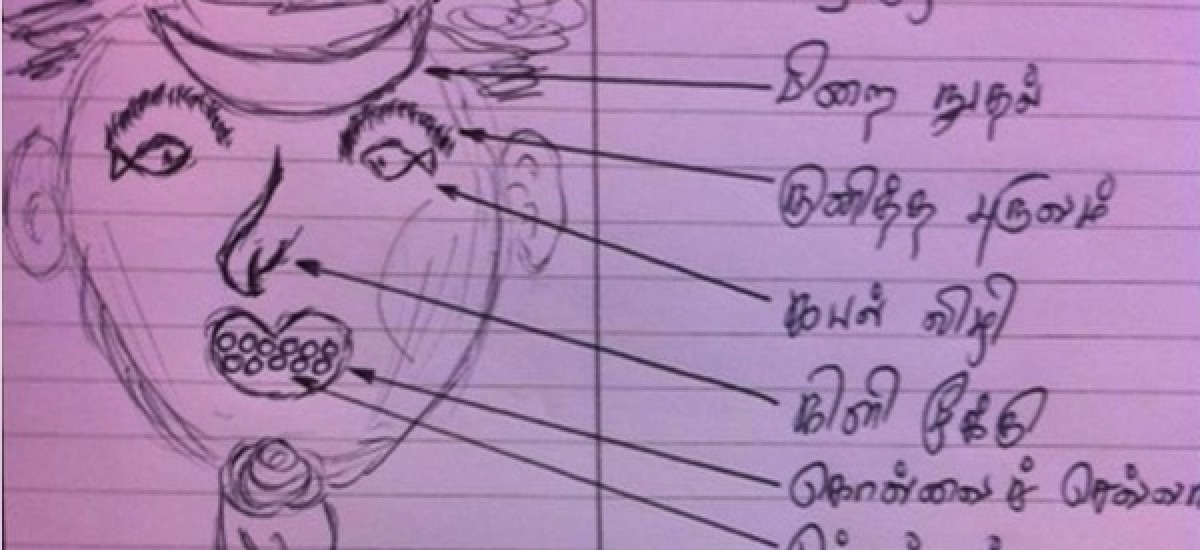
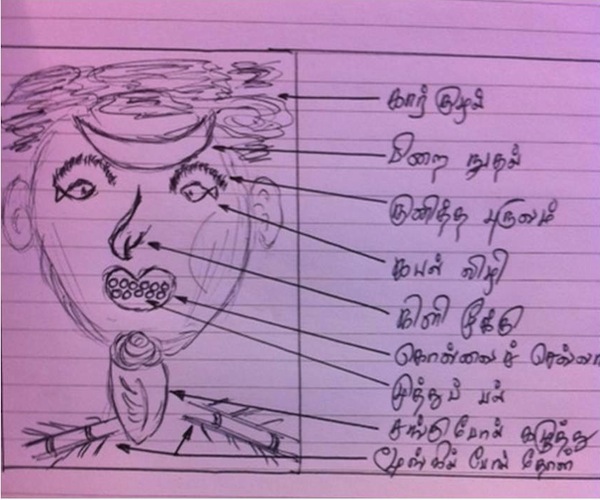
Something about that lady bugs me. She seemed to be everything that Tamil poets had declared how pretty women ought to look like (hair – clouds, forehead – crescent, eyebrows – concave, eyes – fish and so on). I could not bluntly ask her for her email or facebook account. That could hurt cultural sentiments of the place. But I still need to track her down later. Coming out of Kurushestra, I make a quick sketch of the lady in my diary.
Thursday: An enjoyable workshop, with several good talks and an effective poster session. The hosts have done a brilliant job – great lunch, too. I learn a lot from the Dean about the challenges they face. Readers can see some pictures from the workshop here.
Friday: The new Vice Chancellor is gracious enough to spare some time and talk to me about the University’s plans to set up engineering education at Kilinochchi. Conversation with her tempts me to think of investing in a retirement hut next to the Iranaimadu tank.
Late afternoon I go to the Rio ice cream shop near the Nallur temple, now a prominent tourist attraction, and bump into my friend, Accuratus Numeratus, greedily eating a very large ice cream. He is sweating a lot and is eating the ice cream very fast, as though he purposefully wants to cool down. “What’s up, mate?” I enquire.
He was at the Parameswara junction, taking a photograph, when a soldier had threateningly challenged him: “You, you… photo taking?” A young soldier was expressing suspicion at Numeratus over the use of a camera. Numeratus bursts out in anger: “I am a don doing my don job, returning to my country after 22 years, what is the harm in me taking a photograph? It is not written anywhere this is not allowed, is it?” He shows his Dolphin identity card, making sure his thumb partially covers his name, but clearly exposing his job title. That outburst, Numeratus managed to do in fluent Sinhala, with perfect intonation superposed on his phonetics. The soldier backs off, and says “sorry, sir”. Numeratus puts his hand on the young man’s shoulder and says “Oh kaman nae, malli [It’s OK, brother]”.
When the soldier walks away, Numeratus quickly gets into the nearest tuk-tuk and gets himself driven to the ice cream parlour.
“So what is the problem, eh?” I tease him. “There is peace in the country. There is nothing called minority. Everyone is equal. The soldier was curious, you told him off, you called him malli – in fact, my friend, given your age, you should have called him putha [son] — so what exactly is your problem?”
“I will be gone tomorrow,” he explains, “I had the skill to talk my way out of that situation. Just think about people having to go through with such intimidation day in, day out. No wonder these people feel like living in an open prison, don’t you see? Every visitor to Jaffna reports unfilled pot-holes on the roads, but they don’t notice that just beneath the surface, you find much unhealed wounds. Wounds kept open so that salt may be rubbed into them.”
“You are reading too much into this,” I try to calm him down.
“But it also brings memories, man,” he went on, and told me a true incident that happened nearly three decades ago. “Do you know the place Punchi Borella?” In my young days, I used to take the 103 bus from Maradana to Borella a lot — to the YMBA, where chess tournaments were held. “Yes, I know,” I replied.
“One day, long ago, a young man, twenty years of age, was sitting in this 103 bus and a thug got in, drunk and smelling of arrack. The thug is of blood type S, and the young fellow is of type T. The thug holds the young man by his collar and shouts, `You are type T aren’t you? I am going to kill you, and teach your people a lesson.’”
“The young fellow had the presence of mind and amazing courage to shout back at the thug: `beepuhaama aes penen naedhdha?’ [can’t you see properly when you are drunk?] Do I look like a T, what an idiot you are?’ The young fellow’s outburst came out with perfect intonation, superposed on fluent Sinhala phonetics, just as Numeratus had done half an hour ago in Jaffna. The thug seems convinced and leaves the bus. `hary yung [OK, let’s go],’ shouts the conductor and the bus moves. The young man sweats profusely and trembles, thanking for his survival the Gods he never believed in.”
“And then, this is the punch line,” Numeratus continues after a brief pause, “the conductor walks up to the young man.” “With his hand on the young fellow’s shoulder, the conductor quietly says into his ears: `bErunaa nE, hondhai? [escaped, no? good]’”
Postscript: In my return journey to Colombo one of the bubble shock absorbers broke and I had to hitch a ride in a far less comfortable bus. At Pettah, getting into a local bus, sleep deprived and with a severe back ache, my Sinhala fails me.
I ask to go to Biththaramalla (instead of Baththaramulla).
This 103 conductor and I share a hearty laugh.
[Author’s note: Part I of this diary, of a visit mainly to Peradeniya just over a year ago, can be read by clicking here]