
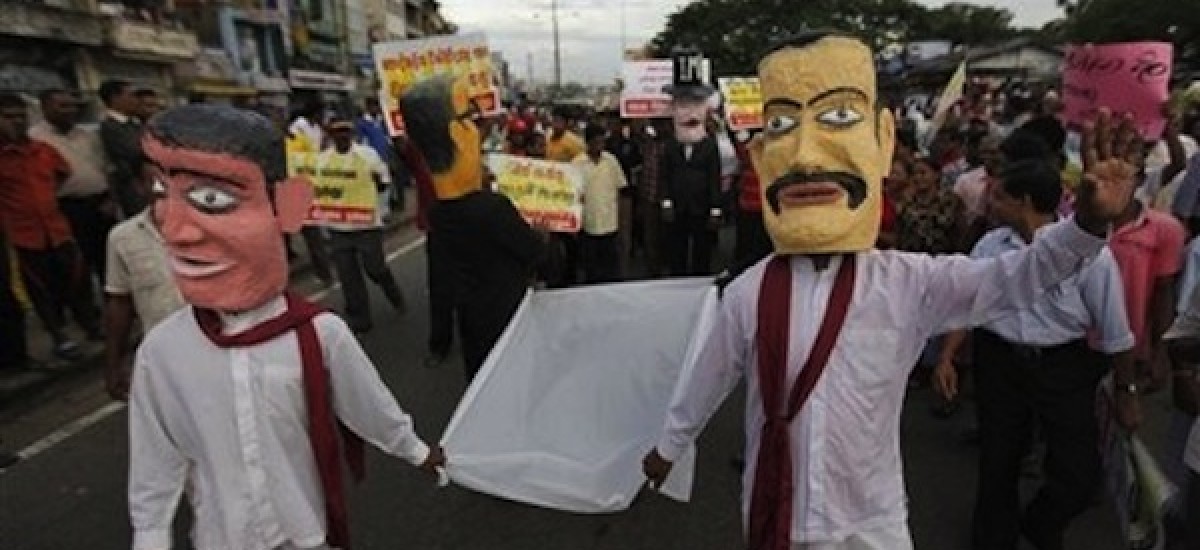

Photo courtesy Daylife. Activists of Sri Lanka’s opposition Marxist People’s Liberation Front, wearing masks that represent President Mahinda Rajapaksa and his brothers, walk in a protest against the government in Colombo, Sri Lanka, Wednesday, Dec. 2011.
###
Michael Colin Cooke titles his response to my response “Once more into the breach”. If I may be permitted a quibble at the commencement, shouldn’t that read “unto” the breach?
As Rooney Mara playing Lisbeth Salander in ‘Millennium’ says by way of greeting, “hey hey!” Let’s see what we have here. Having accused me of “idealisation of the current government of Sri Lanka” and in response to my challenge to come up with any evidence, MCC’s devastating riposte is that “By idealisation I mean Dr Jayatilleka’s exalting of President Rajapaksa above the normal run of Sri Lankan politicians.” So, that’s MCC’s definition of idealisation. Now I just don’t have the time to ask him for examples of ‘exalting’ because he is bound to repeat the exercise. His evidence encompasses the title of an article by me, and the accompanying photograph. MCC obviously has the strangest idea of how the media work. I couldn’t have cared less if my article had been illustrated by an Andy Warhol print, a Calvin cartoon or a photograph of Amy Winehouse. That choice is made by the editor or one of the editors. As for the title of my article, MCC’s theoretical literacy does not obviously extend to the category of ‘moment’, in contradistinction to a more durable and protracted slice of history such as stage or phase. A ‘moment’ is conjunctural, and the echo was of the ‘uni-polar moment’ in post-cold war world politics, which proved to be just that, a moment, and not a long, durable stage of history. Such is the nature of ‘exaltation’ in MCC’s lexicon.
What I have said of Mahinda Rajapaksa is no more or less than this. He inherited a serious challenge that he did not create. It was the main challenge to the Sri Lankan state and its citizenry taken as a whole. Several previous leaders, strong personalities all had failed to overcome that challenge. Mahinda Rajapksa did. In respect of the most serious challenge—of defeating a formidable terrorist army, restoring territorial unity and integrity and national sovereignty – that puts him ahead of JR Jayewardene, Ranasinghe Premadasa, DB Wijetunga, Chandrika Kumaratunga and Ranil Wickremesinghe. That does not put him ahead of any of them in any other respect. Now if this is ‘idealisation’ or ‘exaltation’, all of us university teachers do it every time we grade a student higher than the others in the class, in one or another subject.
What I have also said is that when a leader wins a protracted war against a hated enemy, is felt to have liberated the great multitude of people from the threat of weekly terror bombings, and has reunified the territory of a country and a state, he or she dominates the political history of that country for a period. Sri Lanka still inhabits that slice of historical time. Whether that time will be long or short depends on whether the masses of people perceive that some variant of the threat remains or a new yet similar one has appeared; whether it is the pre-eminent concern; and crucially, whether the existing leadership is the best of the actually available choices to deal with it. The arc of the ‘Mahinda moment’, defined as the moment of Mahinda’s hegemony, is past its asymptote or zenith, but has far from hit the ground and flat-lined.
The passage that MCC flourishes with a triumphant air, as would a conjurer who has pulled a rabbit out of a hat, is clear in its intent, which is transparently not that which MCC attributes to it. If anything it has manifestly the opposite intent since it warns of pressures “resulting in a more hawkish, less flexible, less intuitively smart, more brittle and therefore more vulnerable Sri Lankan state.” Plainly, I refer here to neoconservative or radical Rightwing pressures, including those emanating from the ‘deep state’. I see nothing in such a warning that is contrary to a left perspective. Currently we see that several caucuses are openly critical of Mahinda Rajapaksa’s re-stated commitment to 13th amendment plus. Whatever one thinks of that reported reiteration, it is more significant that there is criticism of it from the radical Right and the social chauvinist Left.
What I have gone on to suggest is that from a political analyst’s perspective, it is exceedingly unlikely that Mahinda can be superseded, and from a Left or progressive perspective, it is undesirable that Mahinda be superseded, by any project or personality who would roll back the positive achievements of Mahinda Rajapaksa, which are those associated with the classic tasks of the bourgeois democratic revolution. To illustrate: I do not think that Vladimir Putin could or should be replaced by a project that would take Russia back to the Yelstin era, which is where imperialism wants it to go. I would prefer a coalition between Putin and Zyuganov’s Communists, and/or an eventual electoral succession by that Communist party, but certainly not by the pro-western liberals.
In short, it is my understanding of the left and progressive project in the post Cold war era, that a strong state is necessary and worthy of defence as is a strong reassertion of state sovereignty. This alone is not enough, and in many places it is not even the primary task, but it is an essential factor and condition. It must be fused with a pro-people socioeconomic programme and advanced forms of democratic representation and participation. Concretely, my understanding of a progressive model, a model for the Left, is Lula’s Brazil. However, in many cases, such a ‘new social democracy’ is unfortunately not an option or not yet one. Sri Lanka is one such place. In cases such as this, a ‘national-popular’ option, or a close nationalist–populist approximation, with a commitment to a strong state and state sovereignty, is as good as it gets, and that which any leftist must support, though far from unconditionally or uncritically, and often on an issue-by-issue basis.
MCC says that “Dr Jayatilleka’s support of the Rajapaksa government is not selective; it is touchingly uncritical”. He contradicts himself in a plain, simple and quite un-dialectical fashion when he precedes that with “in fairness I must say he is kinder to the son of his former political patron Premadasa” and quotes me as writing that “Today President Rajapaksa is the best representative of National Democracy and the UNP reformists identified with young Premadasa, the best bet for (pluralist) Social democracy.” Now, given that the government has tilted explicitly against Mr Premadasa’s Reformist faction and in favour of Mr Wickremesinghe who MCC correctly identifies as “part of the status quo”, an ‘uncritical’ support of the government on my part could not possibly be compatible with a long standing and quite public critique of Mr Wickremesinghe and equally undisguised support for young Mr Premadasa. This stance, taken together with my open support of provincial level devolution, comprises precisely a stance of selective support.
MCC says that “The most important issue, and one on which the good doctor is silent, is how to best harvest the peace dividend. The government and its charismatic President should use the euphoria of victory to enlarge the democratic space instead of closing it.” He (Michael, that is, not Mahinda) should read GV more. That is precisely that which I have argued in this and other forums. The rest of what MCC suggests I should do is already done by opposition parties of the right and Left. My main focus at the moment is the struggle to protect Sri Lanka’s sovereignty as that of other states of the global South, and to fight for a multi-polar world. As for his long digression on Serbia and Kosovo, he will forgive me if I prefer Fidel’s unambiguous interpretation over his, as exemplifying the correct Left reading.
“The heart of Dr Jayatilleka’s polemic concerns the alignment of Lanka with the countries he deems anti-imperialist” writes MCC. The countries I “deem anti-imperialist”? C’mon Michel, how else would you deem, or suggest I deem, Cuba, Venezuela, Nicaragua, Ecuador, Uruguay, Bolivia and Iran?
MCC also gets things a little confused. I did lecture by invitation every year round, at the joint training programme of Sri Lankan and US Special Forces, but these were in Sri Lanka — never the USA — with my host, the iconic special operations warrior and gentlemen-soldier, Gen Gamini Hettiaarachchi, insisting on sending Commandos of the VIP protection group to escort me, to my mild embarrassment, because, in his words, “we have our own assessment of the LTTE’s assessment of you”. Now MCC thinks that this somehow does not befit someone who considers himself on the left, but my strong settled conviction – and I was hardly alone in this internationally– of the LTTE as a fascist force, dictated the broadest possible cross-class, cross-ideological alliance of forces, local, regional and global, to defeat the main enemy and resolve the principal contradiction. (This rested on my reading of Dmitrov, Togliatti, Mao and Ho).
I note that MCC uses the term radical within inverted commas, when he refers to Cuba. If Cuba’s is not a radical regime, whose is? If Cuba isn’t radical enough for MCC, what about the other, newer radical regimes of the ALBA group in Latin America, all of which support Sri Lanka in its defence of its sovereignty? If Fidel and Raul Castro, Daniel Ortega and Evo Morales, Hugo Chavez and Rafael Correa are not radical in MCC’s book, who is, apart from Lionel Bopage?
MCC then goes on to an exposition of economics. My point is that these anti-imperialist states support Sri Lanka because they rightly privilege the defence of national/state sovereignty, territorial unity and integrity, deriving both from their political ideologies and projects (which they are well aware, are not the same as Mahinda Rajapaksa’s) as well as their reading of the post-Cold war world. They take sovereignty seriously, resist notions of ‘humanitarian interventionism’ and formulae of ‘international inquiry mechanisms’, and strive for a multi-polar world. Their authentic leftism takes politics and the political resistance to imperialist hegemony seriously, while MCC’s vulgar ‘economistic’ deviation is pre-Gramscian, pre-Leninist and fits snugly into the category that Lenin termed ‘imperialist economism’.
I support Mahinda Rajapaksa for the same reason and to the same extent that these regimes do and I urge all progressives in Sri Lanka to do so too, while not implying for a moment that such support should not be supplemented or even superseded by trenchant criticism from a more advanced standpoint– hence my advocacy of a social democratic alternative with a national democratic dimension.
MCC exclaims that “Lanka’s proper title is: The Democratic Socialist Republic of Sri Lanka, but very clearly its economy is capitalist and its parliamentary system bourgeois”. Yeah, so, this is news? Who contested that? Have I ever made a claim that it was something other or more than that? Is Brazil’s economy other than capitalist? The progressive objective today should be to transform Sri Lanka’s economy into one more closely resembling Brazil’s social democratic capitalism, and I remain proud that I was part of a project which antedated and anticipated Lula’s, to achieve this—that of President Premadasa, martyred by the fascist Tigers. That achievement proved ephemeral, and the episodic character of the Premadasa experiment demonstrated that any real social advance in Sri Lanka required as prerequisite the decisive defeat of the LTTE. Mahinda Rajapaksa’s achievement was a necessary but insufficient condition for building a multiethnic nation at peace with itself. His achievement can be surpassed only by a project that is a synthesis between that which is positive in what he has achieved by way of national unification, and that which he has not and probably cannot.
MCC’s finale is touching indeed. He cautions that “Dr Jayatilleka would do well to remember that his idealisation of his paymaster compromises his ambition to be an independent public commentator and intellectual. His many articles and comments in Groundviews show his position all too clearly: he is visibly damned by his history.” Oh, no, we’re back to “idealisation”. His words of wisdom are a trifle ill-timed anyway. I have just been sent a fascinating theoretical essay by Colin Wright, entitled ‘The violence of the new: Badiou’s subtractive destruction and Gandhi’s Satyagraha’, published in the journal Subjectivity Vol 4, 1 (2011, Palgrave journals, Macmillan). The essay includes a passage on my work and lists at the end of the text the following authors as references: Agamben, Badiou, Balibar, Fanon, Feltham, Gandhi, Godard, Hallward, Jayatilleka, Lenin, May, Sartre, Weber, Wright, Zizek. And that’s the full list.
So it looks like my intellectual ‘ambitions’, such as they are, are doing ok for now. As for ‘history’, I don’t claim to be clairvoyant as does MCC, so it perfectly possible that history will treat someone who wrote a book on Fidel Castro, reviewed in Radical Philosophy as in the journal of the Royal Institute of international Affairs (Chatham House), far less kindly than one who wrote a book on Lionel Bopage. Oh by the way, the Bibliography on Ethics of the US Army War College also lists my book on Fidel. All seasons, eh, Michael?