

Photo courtesy JDS
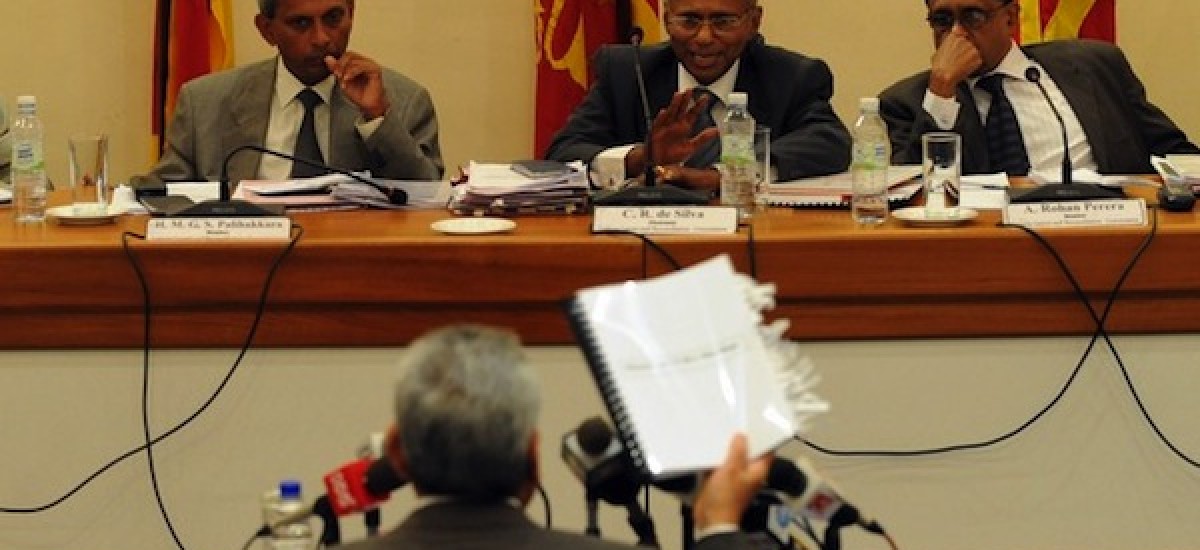
The concluding report of Sri Lanka’s Lessons Learnt and Reconciliation Commission (LLRC) was finally made public in mid-December, after multiple delays and an interim report that went mostly unnoticed.
The Commission’s report has sparked considerable debate within an increasingly stifled public sphere, rejuvenating conversations in Sri Lanka about governance, human rights, and a permanent political settlement. Unfortunately, because the Report was only released publicly in English, a substantial number of Sri Lankans are excluded from these conversations. We also note that in a true democracy, a free press holds government to account: Sri Lanka needs—and clearly does not have—a strong fourth estate to track the Government’s implementation of LLRC recommendations.
We welcome the Report’s contributions to political discourse, but even its most critical conclusions reveal its irredeemable limitations: like the many commissions of inquiry before it, it is neither a truly investigative body, nor empowered to hold political elites to account. Nevertheless, the Report, which contains the testimony of thousands of citizens and surveys the political challenges confronting Sri Lanka, invites further discussion and debate.
1. The Report contains useful recommendations for the country’s ongoing political, social, and economic development, as well as honest assessments of historic failures by Sinhalese and Tamil political leaders. We welcome especially the clear statement that to move forward, Sri Lanka’s citizens must acknowledge and mourn all losses from all communities. This is an important rebuke to unspoken post-war policy: the Government honors the military while refusing to acknowledge the thousands of Tamil civilians killed at the end of the war, and the traumatic impact of those final months on those who survived.
2. The Report effectively marks its own limitations throughout. The Commission was never equipped to meet the post-war needs of the public, and indeed, was formed largely without its input. However, in several instances, the Commission sought to go beyond the weak mandate granted it by the Government. Thus, certain sections of the Report exceed the Commission’s original scope. We note particularly the decision to quote at length numerous citizen testimonies, especially those related to disappearances, as well as a certain flexibility with regard to permitted timelines and histories. The resulting document presents a more expansive and critical view of Sri Lanka’s human rights situation than the Government might have initially contemplated.
3. The Report also addresses the ongoing hardships Sri Lankans face two and a half years after the war’s conclusion. These include militarization of the North and East, the challenges of post-war return and resettlement, and diminishing prospects for national reconciliation. The Commission advocates for a political solution so that the conflict may not continue by other means, and foregrounds the need for the devolution of power as an issue “of national importance, affecting the people of the entire country.” We welcome the urgency with which the Commission seeks to promote democracy—specifically, power-sharing between all communities and accountability from their political leaders.
ACCOUNTABILITY
4. The Government has repeatedly promoted the LLRC as an adequate response to the demands of post-war justice and accountability, resisting calls for international war crimes investigations. Of critical importance, therefore, is the Report’s treatment of war crimes, crimes against humanity, and other serious violations of international law allegedly committed in the final phases of the war. The U.N. Panel of Experts, noting civilian casualties in the tens of thousands, deemed these allegations substantial enough to warrant an international investigation of war crimes committed by both LTTE and Government security forces. International reporting, notably Channel 4’s documentary, “Sri Lanka’s Killing Fields,” alleged the same.
5. However, the Commission’s response to these allegations is stunningly inadequate. The Report arbitrarily invokes the principle of proportionality to justify some deaths and attributes others to “bad apples,” peremptorily concluding that there was no systematic or large-scale targeting of civilians, and that civilian deaths were neither intended nor recklessly disregarded. We acknowledge the many reports that individual members of Sri Lankan security forces acted compassionately and bravely in aiding civilians escaping the No-Fire Zones. However, this does not preclude the possibility of larger-scale war crimes sanctioned, implicitly or otherwise, by the military hierarchy. These allegations call for more than the Commission’s cursory treatment; they require the scrutiny of an independent body.
DIASPORA
6. Considering our own positions abroad, we also note especially the Report’s comments on the Sri Lankan diaspora.
7. The Commission wisely advises the Government to liberalize its policies with regard to its diaspora communities, and to make space even for those it counts as adversaries. We appreciate particularly its comments about easing travel, obtaining dual nationality status, and effecting remittances, particularly as these measures disproportionately affect minority communities.
8. Lanka Solidarity also notes the Report’s references to “hostile diaspora groups.” These are identified solely as being Tamil nationalist and separatist groups, some of which have been described as supporting the LTTE. Through their uncritical support of the LTTE, a number of these groups have overshadowed genuine reconciliation efforts and substantially harmed the welfare of many Tamils living in Sri Lanka.
9. However, criticism of diaspora actors should doubtless include Sinhala nationalist groups, which have also polarized discussions of Sri Lanka’s future by acting as the Rajapakse regime’s rump abroad, labeling any criticism of the government as pro-LTTE, and advancing Sinhala Buddhist chauvinism and political fantasies.
WOMEN
10. Despite the conflict’s disproportionate impact on women and children, the Commission included only one woman.
11. There were consistent and serious allegations of sexual abuse and violence during the end of the war and in its aftermath; however, the Report only mentions sexual violence briefly in relation to the Channel 4 documentary, and then focuses mostly on the need to authenticate the footage. Elsewhere, the Commission only makes oblique references to gender violence, and fails to address with sufficient urgency and specificity the particular vulnerability of women in a heavily militarized post-war environment.
RECOMMENDATIONS FOR FUTURE ENGAGEMENT
12. The Report should be offered in Sinhala and Tamil so that it is accessible to the citizens whose response to its content is paramount. This is in keeping with the Commission’s own emphasis on national language policy as key to political reconciliation.
13. An independent investigative process with international participation must immediately be initiated. The inclusion of international actors in an investigative process regarding state actions provides a measure of accountability, especially in light of the centralization of state power in Sri Lanka. Thousands of civilians were killed in the final months of the war, and allegations of war crimes have been made consistently and credibly ever since. The failure to investigate these allegations denies these victims justice; reflects more pervasive crises of accountability, rule of law, and governance in post-war Sri Lanka; and sets a dangerous precedent for other arenas of armed conflict.
14. Witnesses for any further commissions of inquiry or investigation should receive adequate protection, as the witnesses for the LLRC did not.
15. The Government must demilitarize the North and East so that civil society in those areas can rebuild. A sizable military presence currently encroaches on key aspects of civilian life, such as education and trade. The Government must directly address a climate of fear and political culture of violence. Its actions on the ground must match public commitments.
16. In particular, we note that violence against women is growing in the North and East. Such incidents must be investigated and prosecuted swiftly. Law enforcement must be sensitized to violence against women. Tamil-speaking police and other civil authorities must be available for women to seek redress. Demilitarization is vital to women’s security.
17. Reconstruction efforts in the North and East should be consultative and provide affected civilian populations with emotional and financial security in their resident lands. This requires, at a minimum, the enforcement of land rights and the equitable resolution of land disputes and issues surrounding the return and resettlement of displaced persons. However, instead of confronting the complex of economic, psycho-social, and reconstruction needs of those living in the North and East, the Government is relentlessly pushing forward with its economic vision of turning Sri Lanka into a cabana republic.
18. We note the commission’s post-report recommendation to remove ethnic classifications on Sri Lankan identity cards. To the extent that this limits discrimination, this would be a welcome move. However, where such discrimination is widespread, identifying differentiating factors provides an important tool by which to track the treatment of minorities. Advancing the concept of a Sri Lankan identity is a commendable goal—as long as it is not merely a guise for Sinhala Buddhist nationalism. The rhetoric to rebuild Sri Lanka’s pluralistic identity must include rather than obliterate minority difference.
19. Leaders from all communities and across the political spectrum in Sri Lanka should prioritize a fairly negotiated political settlement. In doing so, they should recognise and engage with the broad range of perspectives within the diaspora. Indeed, as the Commission itself acknowledges, the Government has much to gain by recognizing “the untapped potential of the expatriate community . . . and [engaging] them constructively with the Government and other stakeholders involved in the reconciliation process.”
20. In turn, the most vocal factions of the Tamil diaspora, which have long been uncritical of the LTTE, must reconsider and reject exclusivist nationalism and political intolerance. Calls for war crimes investigations originating in the diaspora will resonate more strongly in Sri Lanka and the international community if they acknowledge human rights abuses committed by the LTTE. Sri Lankan diaspora communities must consider their own responsibility for the present situation, participate in processes of honest reflection, and better appreciate the myriad challenges confronting minorities—not just Tamils—in Sri Lanka.
21. A sizable portion of the Tamil diaspora was silenced by the LTTE’s overseas proxies during this long conflict. It is time for this silent majority to voice its views, to engage with conversations like those begun by the LLRC, and to participate, critically and constructively, in Sri Lanka’s future.