Archive for November, 2011

  • 30 Nov, 2011
  • 31 Comments
  • Colombo,
    Development,
    Features,
    Galle,
    Post-War

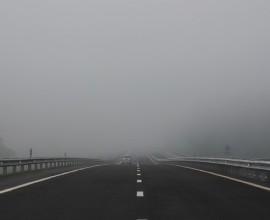
E01: The spectacular beauty & life-threatening dangers of Sri Lanka’s Southern Expressway

IMG_0289

We drove down to Galle today on the newly opened E01 road, more commonly known as the Southern Highway / Expressway. Setting off at 6.33am, we were in Galle at 7.45am, and setting off after a leisurely breakfast at around 9.45am, we were back in Kottawa around 10.45am. Many will take this same journey in the days and weeks ahead just to experience the road, Sri Lanka’s first highway. To be able to go to Galle and return in such a short time is, for those used to the 3 – 4 hours it takes along Galle Road, nothing short of incredible. Our impressions of the journey follow along with some photos of E01. The drive just before sunrise, weaving through countryside as day breaks is nothing short of spectacular. It is beautiful to the point of distraction, since though driving at over one hundred kilometres an hour demands complete attention on road conditions, the eyes are in constant competition…

Continue reading »

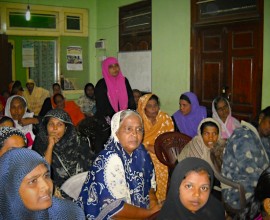
Sri Lankan Women Human Rights Defenders: Linking Past and Present Challenges

Photo by Eranga Jayawardena

  As another year begins to draw to a close on post-war Sri Lanka, we can take stock of which changes, or the lack of change, we see around us. The full scope of human rights are still not available to civilians living in areas formerly controlled by the Liberation Tigers of Tamil Eelam (LTTE), which are now tightly controlled by the Sri Lankan armed forces, with strong restrictions prevailing on their right to move freely and their right to assemble, amongst other fundamental rights. Pressing issues such as hundreds of unsolved cases of disappearances, and the rights of detainees and ex-detainees – particularly those of former LTTE cadres – remain unresolved since 2009, which marked ‘the end’ of the civil war in Sri Lanka. The cost of living has nearly crippled much of the population, and yet, highways, new roads, and bridges are blossoming all over the island with unprecedented speed and efficiency. Sri Lanka remains teetering on the…

Continue reading »

Reply to the Rebuttal of my article by the SJC87 Initiative

9781742694146c_9781742694146

I welcome the statement by the SJC87 Initiative rebutting my aspersions about this charity. The primary focus of my research note was the contents and the publicity material of the book by Niromi de Soyza (nom de guerre). The SJC87 Initiative came into scrutiny because of the claim by the author of the Tamil Tigress that this is a charity of her “alma mater”. I stand by my claim and some of the attendees at the literary festival where Niromi made that statement are willing to testify to the truthfulness of my claim. Therefore, if SJC87 Initiative has been brought into disrepute by my writing, then it is solely due to the blatant lie of Niromi de Soyza. The fact that Niromi de Soyza has not personally disputed what I have written about the claim by her in Melbourne itself is sufficient proof of the truthfulness of my writing. Besides, the rebuttal by SJC87 Initiative has not cleared my suspicions…

Continue reading »

Separating Fact from Fantasy on the ‘Research Note’ by ‘the Principal Researcher’ Mr. Muttukrishna Sarvananthan

Screen Shot 2011-11-29 at 12.25.37 AM

Editors note: Also read Reply to the Rebuttal of my article by the SJC87 Initiative by Muttukrishna Sarvananthan. ### A Response by the SJC87 Working committee to Mr. M. Sarvananthan’s ‘research note,’ titled Outing a Counterfeit Guerrilla: A tale of lies by Tamil Tigress by Niromi de Soyza published on Groundviews (19 Nov, 2011) and Sunday Leader (20 Nov 2011). Mr. Sarvananthan’s so called ‘research note’ has seriously undermined the reputation of the SJC87 initiative and its ability to function as a non-political, non-profit charity organization purely involved in humanitarian efforts. His baseless accusations have compelled us to bring to the attention of your readers and the public the facts about the SJC87 initiative and defend the name and work of our organization against this defamation. History of the SJC87 Scholarship Initiative In the early 1990s several like minded old boys of Jaffna St. John’s College class of 1987 (SJC87) who were scattered across the world came together to form the SJC87…

Continue reading »

Rebellion, Repression and the Struggle for Justice in Sri Lanka: The Lionel Bopage story

Book Cover 500-700 - 0.7

This is a book that documents the life story of Lionel Bopage, who was one of the highest ranking leaders of the Janatha Vimukthi Peramuna (JVP- the Peoples’ Liberation Front) and a major figure in the JVP led youth insurrection of 1971 in Sri Lanka, drawing on a series of personal interviews with him. After migrating to Australia two decades ago, he has remained active not only in Sri Lanka related political activities but in the broader Australian political movements for social justice. The book tracks Lionel’s personal and political evolution over the subsequent four decades, placed in the wider socio-political context of this tumultuous period in Sri Lanka. In many ways this is a deeply personal and richly detailed memoir, as Lionel looks back over the years and attempts to analyse how and why the party to which he committed himself, and under whose banner thousands of heroic youth fought and died, ended up in as the ardent supporter…

Continue reading »

Response to Michael Roberts’ ‘Turning Former LTTE Personnel into Sri Lankan Citizens?’

Camp

Photo courtesy Lankapuvath Michael Roberts’ recent Groundviews piece on the government’s rehabilitation programme of alleged former LTTE combatants is generally approving of that programme, not only directly but also indirectly in making the kinds of criticisms that actually add to the approbation. Professor Roberts has added his distinguished academic authority to a set of circumstances that perhaps justifies a more discriminating analysis. His uncritical and at times inaccurate and misleading observations therefore require a response, providing also the opportunity to critique, both the policy and legal perspectives involved. In this article I will attempt to remedy the lacunae in my previous piece on this issue, published here[1] in late 2010, which did not discuss the legal dimensions nor use testimonies of persons released from rehabilitation centres[2] to substantiate certain assertions made in that article. Statistics: Do we know how many persons have been rehabilitated? In a section titled ‘Numbers’ Roberts discusses the number of persons who were held at rehabilitation…

Continue reading »

A Commissioner’s Perspective: Citizens’ Commission on the Expulsion of Muslims from the Northern Province by the LTTE

DSCN0274

As one of the members of the Citizens’ Commission on the Expulsion of Muslims from the Northern Province by the LTTE in October 1990 (Citizens’ Commission), it is my privilege and pleasure to say a few brief words on behalf of all the Commissioners on the occasion of the launch of our Report. The Citizen’s Commission was an initiative of the Law and Society Trust (LST) and its partners’ in the absence of an official government inquiry into the expulsion of Muslims from the Northern districts by the LTTE. Our mandate was to document comprehensively  and in depth the experiences of the expulsion, the subsequent two decades of displacement and resettlement of the Northern Muslims as well as their expectations of the state and civil society. The fact that this was conceived of as a ‘Commission’, I think has important methodological as well as conceptual implications. A commission of inquiry (CoI) is generally appointed by the Executive Branch to inquire…

Continue reading »

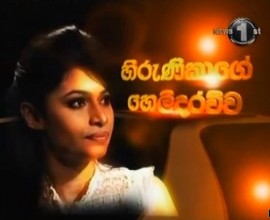
Lessons from a TV interview on the state of political resistance in Sri Lanka

Screen Shot 2011-11-23 at 4.48.48 PM

These are revolutionary days, days of resistance. Especially in Egypt. Not in Sri Lanka. In Sri Lanka, the situation is different; the general practice, nowadays, is to hold placards with ‘SHAME’ written on them. Seeing such placards, however, cause confusion in our minds; because ‘SHAME’ seems to be encapsulating one of the principal feelings that runs through us when we think of the Government, and of those holding the placards as well. Therein lies the problem. A Killing   The brutal assassination of Baratha Lakshman Premachandra was a most unfortunate incident. The manner in which the relevant authorities initially handled the investigation was deplorable. His daughter, Hirunika Premachandra, has led the campaign which is aimed at raising greater awareness of her father’s brutal killing, exposing the politician who is alleged to be involved in the planning and execution of the killing. One sincerely hopes that Hirunika’s desire of seeing the law being properly enforced is realized, especially so after watching…

Continue reading »

Sri Lanka For Sale: Wealth Creation by Dispossession

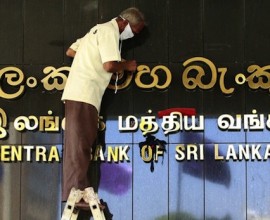
A man cleans the main board of the Central Bank of Sri Lanka in Colombo.

“You are horrified at our intending to do away with private property. But in your existing society, private property is already done away with for nine-tenths of the population; its existence for the few is solely due to its non-existence in the hands of those nine-tenths.” Karl Marx No one knows how far the government is planning to go to gain control over nation’s wealth and sell it to those who patronize its economic and political agenda. The controversial expropriation bill that plans to grab 37 properties is likely to be followed by another proposal to amend the Town and Country Planning Ordinance to acquire lands for economic, social, historical, environmental and religious purposes within municipal and urban areas. It will also end taxes and restrictions on foreigners buying and developing land anywhere in the country. The opposition’s parochial politics and ideological bankruptcy prevent constructive engagement with the procedural and substantive issues pertains to these the new property laws that…

Continue reading »

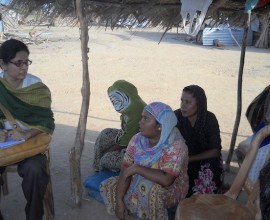
Some observations on the Final Report of the Commission on the Expulsion of Muslims from the Northern Province by the LTTE in October 1990

Picture 039

This report provides what will be the definitive account of the story of the Northern Muslims following on their expulsion from the Northern Province by the LTTE in October 1990. Faithful throughout to the narrative of the affected, and respectful in its well- nuanced references to earlier writings- Hasbullah, Thiranagama and others- its approach earns the reader’s respect and trust. Commencing with accounts of pre- existing relations between co –existing Muslim and Tamil communities, the Report tightly states that. “October 1990 was a water-shed in terms of both Muslim identity and Tamil identity in the North due to the horror of the expulsion. By driving the Muslims out of their homes, the LTTE finally created a mono-ethnic North.” While the affected people’s  narrative uses terms such as “People from Batticaloa have come” it is clearly orders  from  the top that was responsible for this instance of  “Tamil Turning Terrorist” against Muslims, to use the report’s words. The creation of a…

Continue reading »

The Citizens’ Commission on the Expulsion of the Muslims from the Northern Province by the LTTE in October 1990

Picture 066

In October 1990, the Liberation Tigers of Tamil Eelam (LTTE) expelled the entire Muslim population of the Northern Province of Sri Lanka. Within a period of 2 weeks the LTTE systematically chased out close to 75,000 Muslims residing in the districts of Kilinochchi, Mullaiteewu, Jaffna, Mannar and parts of Vavuniya. The LTTE expulsion of Muslims has not been adequately integrated into any mainstream historical narrative in Sri Lanka. Most commentators routinely get the date of the expulsion wrong and few give it the status of a highly significant historical event that it warrants. This is unfortunately true of most events involving Sri Lanka’s Muslim community. The Law and Society Trust (LST) in partnership with the Rural Development Foundation (RDF), the Community Trust Fund (CTF) and the Peoples’ Secretariat (PS) and an advisory group of prominent Muslim civil society actors conducted a two year long truth seeking initiative in the form of a Citizens’ Commission. The objective of this exercise has…

Continue reading »

The Sri Lanka Reader: History, Culture and Politics

Screen Shot 2011-11-20 at 2.49.06 PM

Duke University Press( Durham and London) has published this superb anthology edited by that most perceptive and shrewd observer of Sri Lanka and its complex social, economic and political history, John Clifford Holt who is William R. Kenan, Jr., Professor of Humanities in Religion and Asian Studies at Bowdoin College in Brunswick, Maine in the United States.  He has written several books and, of those, the ones I am familiar with and profited from reading are The Buddhist Visnu: Religious Transformation, Politics and Culture(2004), The Religious World of Kirti Sri: Buddhism, Art and Politics in Late Medieval Sri Lanka(1996), Discipline: the Canonical Buddhism of the Vinayapitaka(1981), and Buddha in the Crown: Avalokiteswara in the Buddhist Traditions of Sri Lanka(1991), for which he received an American Academy of Religion Book Award for Excellence.  Prof. Holt is the recipient of an honorary Doctor of Letters from the University of Peradeniya and, in 2007, was selected by the University of Chicago Divinity School…

Continue reading »

THE NORWEGIAN STUDY: A CRITIQUE

Screen Shot 2011-11-17 at 7.35.07 AM

The Norwegian (NORAD) commissioned study ‘Pawns of Peace: Evaluation of Norwegian peace efforts in Sri Lanka, 1997-2009’, is useful and good, but analytically flawed at its very core. It is useful because it shows us how the ‘liberal peace’ discourse goes and how that constituency views the conflict in retrospect. This does not mean that this perspective has it all wrong. Indeed the study has quite a few things right. In any case it is crucial that the Sri Lankan readership sees how our contemporary history is perceived and reconstructed. It is useful to look into a mirror, while being conscious as to whether it is a slightly or greatly distorting one. Taken as a whole, the Norwegian study is a valuable and welcome addition to the growing literature on the war and our times—with the strongest part being the analysis of the International Dimension in Chapter 7. In the interest of transparency I should add that I am one…

Continue reading »

Outing a Counterfeit Guerrilla: A tale of lies by Tamil Tigress Niromi de Soyza

9781742694146c_9781742694146

The objective of this research note is not only to uncover the truth or otherwise of the “memoir” by Niromi de Soyza (nom de guerre) titled Tamil Tigress: My story as a child soldier in Sri Lanka’s bloody civil war, but to go beyond and investigate the purpose/s of publication of her “personal story” and reason/s for hiding her real name and identity. This research note is based on the reading of the book under scrutiny in its entirety, promotional blurbs and reviews of the book by journalists in Australia, critical reviews of the book by two persons of Sri Lankan origin living in Australia, listening to the author of Tamil Tigress at a literary festival, and discussions with few people among the Tamil diaspora in Melbourne and Sydney. In addition, I sought an interview with Niromi de Soyza, in order to afford her an opportunity to respond to my doubts, which she tried to postpone for two months (but…

Continue reading »

Addressing Greg Sheridan’s Review of the Tamil Lobby and Australia

tamils_574484a

Greg Sheridan’s articles on the Tamil lobby in Australia and the workings of the Australian state are something of a breakthrough because the media coverage of the Sri Lankan conflict has been chequered and influenced by the naïve perspectives driven by the liberal ideologies which dominate some sectors of the fourth estate. Sheridan, in contrast, is on the conservative far right, so readers must attend to this circumstance when evaluating his reportage.[i] However, this orientation and his senior position as Foreign Policy Editor for The Australian render his intervention significant. There are two areas addressed by his article, “Criticism of Sri Lanka ignores Tiger threat.” One relates to his clarification of the reasons why the Howard government did not follow other Western countries in proscribing the LTTE in 2005. In sum, his amplification is quite revelatory. But one governmental consideration is astonishing: “the bureaucracy was hesitant about designating the Tigers as a terrorist organisation because it might lead to retaliation…

Continue reading »
Page 1 of 3123

About Groundviews

Located at the Centre for Policy Alternatives in Colombo, Sri Lanka, Groundviews is a citizen journalism website that uses a range of genres and media to highlight critical perspectives on governance, reconciliation, human rights, the arts and literature, democracy and other issues. The site has won two international awards, including the prestigious Manthan Award South Asia in 2009. The grand jury's evaluation of the site noted, "What no media dares to report, Groundviews publicly exposes. It's a new age media for a new Sri Lanka... Free media at it's very best!"

cezarneaga.eu