
How can society protect vulnerable women from post war atrocities?
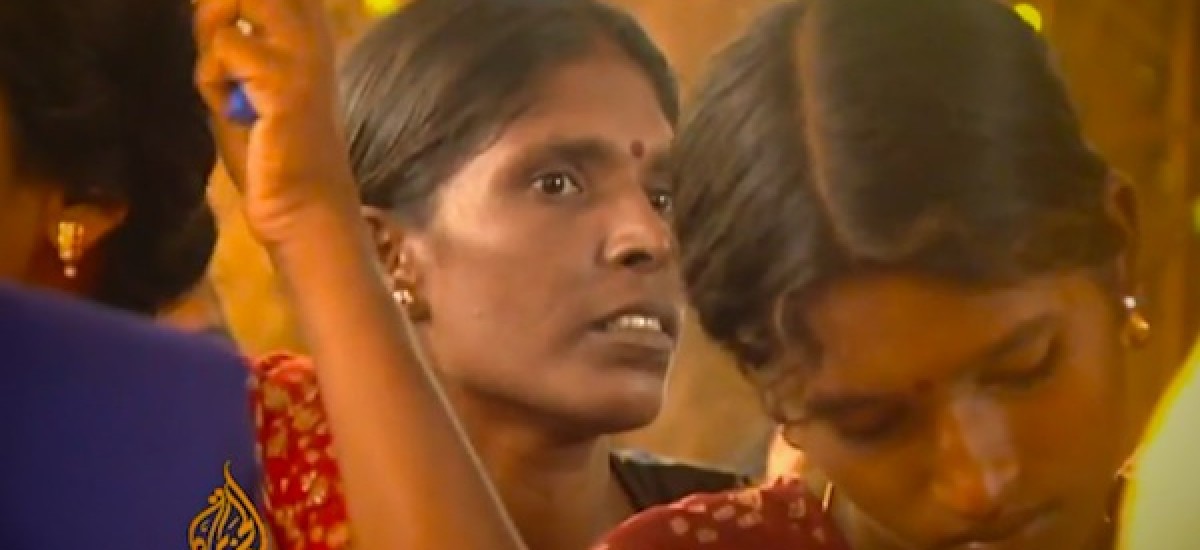
I just viewed a documentary produced recently by Al Jazeera titled ‘Civil war leaves Sri Lankan women vulnerable’. The film has left me deeply disturbed, shocked and ashamed particularly because as a woman, I am not doing my duty in protesting vociferously against such atrocities. Some sections of the documentary appear to have been deliberately blocked for apparent reasons.
We cannot continue to turn a blind eye against the neglect of vulnerable women who are struggling to rehabilitate themselves and their families, post war. Why is there a lack of concern by the state as well as society towards these war victims?
Many households in the north and east are headed by women as most males have died, been incapacitated or gone missing after the war. Several families have been located in areas that do not yet have the basic amenities and continue to live in flimsy shelters as they do not have the resources, income or capability to build secure houses for themselves. This poses the question of how many houses have been built utilising the grant provided by India expressly for this purpose soon after the end of the conflict.
In addition to destitution and neglect, many women and children suffer from post traumatic stress disorders due to the immense suffering experienced as a consequence of the ethnic conflict over the last thirty years and, particularly, during the final stages of the war.
The state has to be accountable for the safety and security of vulnerable women and children from stalkers of all types. However, the unnaturally extensive militarization strategy of the north and east maybe the cause for the breakdown in normal ethical and moral conduct. Also, the heavy concentration of power in the hands of those in authority in contrast to the financially, psychologically and emotionally affected majority of civilians leaves ample room for the abuse of power particularly towards the most vulnerable sections.
It is a disgrace to our nation that international media organizations should point out such atrocities to the entire world while we remain totally disinterested or in a state of denial.
The state and society need to act urgently to address the problem and restore our credibility to the world as a nation that cares and protects its citizens irrespective of their gender, social status or ethnic origin.
Repost This Article


Al Jazeera, Headlines today, CH4, many other international print and electronic media all reported many similar stories unfortunately SL Govt. dismissed all reports as biased, anti govt propaganda, work of LTTE rump, etc I felt very sad to hear such news reports, how many Sinhala and English news medias carried such news reports, except few courageous journalists all others hell bent on Govt. shame on them, there is an urgent need to start “save the vulnerable women” and that organisation should have govt support in terms of finance, legality and Authority. Future for these woman looks very dark and dangerous, Some thing should be done protect these war victims. De Militarisation is a must for a peaceful environment, we can see each and every function is attended by military personnel, we need a good policing, We don’t want to see guns in our neighbourhood, Good civil service without interference of Military. There are thousands of women struggling to live, after the war she lost the family support, they are traumatized, many suicides taking place, now the sex offenders (grease devil) on rampage, these poor women are let down by every one, Why this government is so unhumane, arrogant, poor governance? because these womes are tamils? I don’t know
Thank you for writing this. A few Sinhalese journalists and Christian (Of different denominations) clergy have been reporting on their visits to the Northeast but the Southern society has not been paying much attention or ignoring them: Chandra Jayaratne summarised the atrocities in his submission to LLRC:
http://groundviews.org/2010/09/23/submissions-before-lessons-learnt-reconciliation-committee-llrc-by-chandra-jayaratne/
Submission before Lessons Learnt & Reconciliation Committee (LLRC) by Chandra Jayaratne, 23 September 2010: ‘’…….. IDP’s being denied access to their former places of residence
Challenging the right to title of the properties traditionally owned and /or occupied persons living in conflict affected areas
Large tracts of previously occupied lands being demarcated as high security zones
Unjustified land acquisitions on security considerations but allocated for non security related purposes
The publicly announced resettlement benefits to internally displaced persons not being distributed equitably and in line with the announced scheme
Lack of basic amenities like water, sanitation, power and proper housing for the newly resettled families
Resource allocation not determined on community priorities and allocated without consultation and outside the need base and at times missing the most vulnerable and in need, possibly due to identity based biases
Some areas like Jaffna receiving more than necessary resource allocations and peripheral areas lacking in even basic allocations
Preventing willing and capable NGO’s/INGO’s, international community and Diaspora from helping people in need at their most vulnerable moment of need
Building of new permanent military cantonments with residential facilities for military personnel and their families
Plans to settle majority community families in order to change the traditional area demography otherwise than by natural development oriented migration
Arbitrary arrests and detention in the post war period as well
Continuing active engagement of unauthorized armed groups
Continuing disappearances of civilians
List of persons in custody, camps and detention centres not being made public
Failure to assist families in tracing missing persons
Negative impact on civilians during the conflict due military excesses
Unease of single women headed families fearing for their safety in the presence of large number of armed personnel of the forces
Removal of burial sites of persons affected by the conflict
Some important cultural, religious and remembrance sites being damaged and destroyed
Disrespect shown by visitors to holy sites and sites held in high esteem by resident communities
Free availability of liquor, cigarettes and narcotics
Emerging consumerism promoted by business houses who fail to participate in adding value to the civilian communities
Savings of the region being channelled to other areas whilst unmet needs of area community remain
Decision making in the hands of the military or officials from the Central Government. .…’’
Better late than never.
The author must be thanked for reminding us of our utter disregard for those in the Northeast under heavy militarisation. These women and their families have been driven around by thirty years of aerial bombing, intense shelling, economic embargo, etc.
Many of their problems are related to each other and are the consequence of the high militarisation.
Northern Provincial Council elections must be held as soon as possible and the elected councillors should be allowed to plan social and economic programmes for their people. They must also have helpful police force.
Civil societies in the South must be vociferous towards this.
completely agree with almost everything you say Rohan. But almost all the the activities done to protect women shown on the video are done by government departments. In one part of the video the coat of arms is shown on video
Southern society is busy making money and have very little time to be concerned about the rest of society or those who are less fortunate.
This trend has accelerated since the end of the war.