
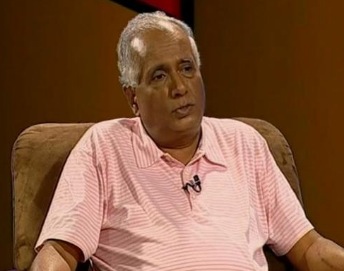
LLRC: Submission by Manik de Silva, President of the Editors Guild

Manik de Silva is the most senior and longest-serving Editor of an English newspaper in Sri Lanka. Presently the Editor of the Sunday Island, Manik was also a former Editor of the Daily News and is currently the President of the Editors Guild.

Manik’s testimony to the Lessons Learnt and Reconciliation Commission (LLRC) on 13th September 2010 covers, inter alia, the nature of media censorship during the war, the deliberate targeting of independent journalists by both the Government and the LTTE, the problems arising from the lack of access to war zones by independent media and views on the media and the ceasefire agreement in general.

Audio clip: Adobe Flash Player (version 9 or above) is required to play this audio clip. Download the latest version here. You also need to have JavaScript enabled in your browser.

This recording is best listened with headphones and is around 47 minutes long.

Unsurprisingly, no State media in Sri Lanka gave any coverage to Manik’s condemnation of the war time censorship of media, or references to the retribution journalists faced if they reported in a manner perceived to be ‘unhelpful’ by the military.

For an in-depth video interview with Manik conducted two months after the end of war in 2009, click here.

Print This Post Print This Post

3,652 views

9 Comments

  1. Manik

    Thank you for need for freedom for unbiased reporting, ‘tax for victims’, etc.

    People need to distinguish between persoanl/individual friends across comminities and the use by politicians of the ”differences” between communities – Sri Lankan politicians are the masters of ethnic outbidding.

    It’s a pity that even people like you have to say that Tamils are brainwashed by LTTE to think that Sinhalese are demons as though what the successive governments have been doing cannot be understood by anybody with a minimum of social intelligence – what the government departments do, what the armed forces do, reports by international organisations(ICJ, IBA, AI, UN Human Rights Committee,), writings by conscientious Sinhalese, etc. – ie open for anyone to see. Please have alook at the school textbooks.

    http://papers.ssrn.com/sol3/papers.cfm?abstract_id=1682133

  2. oops,
    ”the use by politicians” should read
    the MALICIOUS use by politicians

  3. Groundviews, Thanks for publishing this which enriches the current discussion and introspection.

    But Manik de Silva is not some dispassionate, objective observer of the Lankan conflict or of our recent political upheavals. As the Editor of fully state-owned and state-controlled Daily News in the 1980s and well into the 1990s, Manik de Silva was the lap-dog of his political masters. He shamelessly and unquestioningly justified the years of misrule of the UNP regimes of JRJ and Premadasa. When Premadasa was impeached, the Editor of Daily News sank to new depths to defend His Lord and Master.

    Before and after, Manik de Silva’s professional conduct in journalism is distinguished only by his complete servility to the ruling political party — then to the Greens, and now to the Blues. To his credit, he has cleverly disguised this under a thin veneer of respectability which fools nobody.

    People like Manik de Silva cheered (or worse, defended) when the political system and culture of Sri Lanka was being raped and pillaged. They have no moral right to now offer words of wisdom. If he now wants to repent nearly 50 years of servility, he must first apologize and then admit to his own culpability. Is he large enough to do this?

  4. The media freedom is not only peculiar to Sri Lanka; it prevails in other parts of the world in various forms and degrees and operating secretly and with the consent of journalists. I came to know that during the 2nd IRAQ war only selected media groups have been allowed to cover the operations, also subjected to censorships. But the irony is that in Sri Lanka the Journalist fabricated their own stories without from the scanty of information they received from third parties without proper due diligence and verification. LTTE have also bribed journalists to write stories to their favour and to gain international sympathy. I see this whole saga as a result of no sound Journalism charter operating in Sri Lanka and also government interference.

  5. There has been no international sympathy for six decades – internal colonialism in an island in a geopolitically strategic location is going to be safe(Austin Fernando’s Submission: many senior government politicians were silent when the Opposition parliamentarians were sabbotaging ”the thing”) when population and pollution explode forcing ”sovereign” countries to scramble for insufficient reources – ethnic majorities are much safer than ethnic minorities till such time as when the resources get to a critical scarcity.

    Who wants to be bribed to hide this?

  6. Inclusion the way to real peace by Howard Debenham(a former Australian Ambassador to Sri Lanka), 6 March 2009: ‘’When a small group of uniquely qualified Americans and a former Australian high commissioner quietly tried, working with the highest levels of the Sri Lankan Government, to build capacity for statesmanship and progress before peace talks with the LTTE scheduled for Geneva in October of that year, Sri Lanka’s leaders only pretended to listen, and so doomed a country and a people once so full of promise to more mindless death and destruction, the worst of which may yet be to come.”

  7. It will be helpful if the transcript is also given -for those who have hearing problems.

  8. The service given by the Groundviews is very much appreciated.

    Mhhh… shortage of resources… noted.

Leave a Reply

This is a moderated forum. Comments are the sole responsibility of the person posting them. Please do not post comments that are off topic, defamatory, abusive, threatening or an invasion of privacy. Comments are automatically scanned for spam and obscenity.

Comments are only approved if they are in line with the site guidelines. Those that do not will be edited or deleted without prior intimation. Comment approval may take up to 24 hours.

Thanks in advance for your civil and constructive engagement.


two + = 4

About Groundviews

Located at the Centre for Policy Alternatives in Colombo, Sri Lanka, Groundviews is a citizen journalism website that uses a range of genres and media to highlight critical perspectives on governance, reconciliation, human rights, the arts and literature, democracy and other issues. The site has won two international awards, including the prestigious Manthan Award South Asia in 2009. The grand jury's evaluation of the site noted, "What no media dares to report, Groundviews publicly exposes. It's a new age media for a new Sri Lanka... Free media at it's very best!"

cezarneaga.eu