Archive for the ‘Remember’

An Archive of Memories: Viewing War Footage Critically

Screen Shot 2012-06-26 at 9.02.11 AM

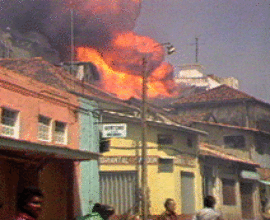
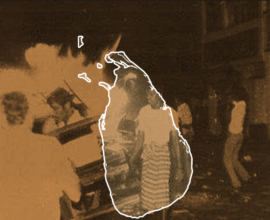
Image courtesy Ron Haviv’s photo essay The Fires Within: The Sri Lankan Civil War For many in Sri Lanka and around the globe, war is generic. Images of war victims are anonymous and nonspecific. If the caption on a photograph of a child war victim is altered, the meaning of the image can be changed and the photo reused in different contexts and by different parties – by LTTE advocates, different political factions, or by the Sri Lankan government. Do photographs of war victims necessarily vivify the condemnation of war? No. The same photograph that can be used as a call for peace can be used as a cry for revenge, as exaltation of a warring party, as acknowledgement that terrible things happen, or even as intimation that terrible things will continue to happen. The uses of the same Sri Lankan war footage can be diverse, from the promotion of the military, to appeals for peace, to ammunition for Human…

Continue reading »

Fr. Jim Brown and Mr. Vimalathas: Five years after disappearance, where are they and what has happened to the investigation?

Fr. Tiruchelvam Nihal Jim Brown | Image courtesy of www.transcurrents.com

  Fr. Jim Brown, a Catholic Priest from diocese of Jaffna in Northern Sri Lanka and his associate, Mr. Vimalathas, a father of five people, seem to be just two names and statistics in the long list of disappeared in Sri Lanka, particularly after the escalation of violence and war in the North since 2006. I didn’t know either before they disappeared, but had got to know about them and the families after they disappeared. I remember the empty and distraught looks on the children of Vimalathas in their small house, who had not realized they will not see and hear from their father again for so long. I remember the hope the parents of Fr. Jim Brown always shares whenever I meet them that their beloved son will return. Background to the disappearance: Fr Jim Brown and Vimalathas went missing on 20 August 2006 amid escalated warfare between the security forces and separatist Liberation Tigers of Tamil Eelam (LTTE)….

Continue reading »

30 years ago: A time for reflection

burned_library

Image taken from Jaffna Photo Gallery I write this as a response to Concerned Citizen’s comments on the public lecture and discussion  on the Burning of the Jaffna Public Library led by  Silan Kadirgamar held at ICES a few days ago, recounting those pre-’83 days days of terror and terrorism. In order to break the silence that concerned citizen her/himself is propagating, I will write in one of my many names. Concerned Citizen says that the discussion was paltry and diverted attention from any comparison with current political developments being drawn; one of them obviously is the issue of accountability as regards the last phase of the war. I had a very different experience sitting through the event. And that experience I would say is theoretically registered through a critical phenomenological mode. For me the most important aspect of the lecture and discussion was what was unstated, but nevertheless poignantly implicit. It was not one of your regular forums full…

Continue reading »

Black July – My Story

It was July ’83. I was seventeen, which you’ll be surprised about if you’ve seen my youthful appearance and I was in Sri Lanka on one of those “extended” studenty type of holidays that we all wish we could have now. It was the summer between the first and second year of my ‘A’ levels and my parents had paid for me to go there and stay with my Uncle and his Australian wife for a couple of months. My mother is Tamil, as were her parents, an incredible coincidence I know. I went to stay with her brother who was working for a couple of years in Lanka. He had left the country as a child with my Mother’s family, had subsequently settled in Australia, then gone to Sri Lanka with his wife as an expat worker. He was an Australian citizen, but still a Sri Lankan and still a Tamil. I went with my maternal grandmother, a proud…

Continue reading »

‘Baaldhiya’ or ‘Vaaldhiya’: Two Wor(l)ds Separated by a Consonant

I don’t think I had the slightest inkling of a problem between the sinhala and tamil people in Sri Lanka, until July 1983. But I should have. In the heady days of the 1977 election, a good 13 years before I could vote, I remember my father quite nonchalantly relating a story: at some time and place in Sri Lanka, strangers accosted people on the street and forced them to pronounce the sinhala word Baaldhiya (meaning “bucket”). The tamil language wasn’t familiar with the “B” sound as a starting consonant. So a tamil person would say Vaaldhiya. Tamils, thus identified, were beaten or killed. They were, literally, condemned by the difference of a consonant. What I don’t understand, even now, is why I have no memory of being shocked or distressed by this story and why it didn’t make me acutely conscious of a deep malaise in Sri Lankan society – in my world. The story of an LTTE landmine…

Continue reading »

Memories of a Black Moon – the 1983 riots in Sri Lanka

More than two and a half decades later, one of my friends has asked to interview me about the ’83 riots. I was ten years old. My family was from the Sinhala majority, with relatives who were strong figures in politics and the military. How could I reply? July 1983 My mind goes back to how thrilled we were when our teachers suddenly told us that school was going to be closed immediately. There was no explanation; we had no understanding of why this might be and no reason to wonder. We were happy that we would not have to wait till August for our holidays. I was even more excited because my father had just given me a fantastic present: a Kodak 110 camera and three rolls of film. I didn’t want to photograph my school or the hostel where I was staying. I wanted to do something interesting. So I had been hassling my father to know where…

Continue reading »

Mano Ganesan on his experience of the anti-Tamil riots in July 1983

Member of Parliament and Convener of the Civil Monitoring Committee, Mano Ganeshan, speaks about his experiences during the anti-Tamil riots in July 1983. For more articles on July 1983, please click here. Repost This Article

Continue reading »

Some Reflections arising from Ethnic Riots

by Somapala Gunadheera Off and on, I write short stories, never anecdotes. But now I have to oblige Sanjana. He wants stories about our ethnic riots, the one that raged before he was born and the other when he was at school. Therapists say that anecdotes have a healing effect on ethnic wounds. My experience about the 1983 riot was brief. Then I was the Chairman of the Ceylon Steel Corporation at Athurugiriya. Towards mid-day, I heard that Tigers had invaded Colombo and people were running away helter-skelter. The Aturugiriya Police had blocked the road opposite their station and were in battle array. Later it transpired that the beginning of the turmoil was the sighting of a Tamil victim of the riot hiding on the roof of a building in the Pettah, reminiscent of the fable in which the entire animal kingdom took to its heels as the story spread that the world was crashing, as reported by a chick…

Continue reading »

Some Gruesome Experiences: Memories of July 1983 by DEW Gunasekara, Minister of Constitutional Affairs and National Integration

From my Diary Notes written in Cell No.1, Negombo Remand Prison, (July 31st-Sept 24th 1983)   I had my own gruesome experience of the Black July. It was 29th July at midnight that I received a telephone call from my friend and party comrade AJMO Dr. Indra Kumar of his father’s sudden death by a heart attack. By then, Dr. Indra Kumar’s wife was in the Thurstan College Refugee camp – the family was scattered – Dr. Indra Kumar was hiding in a private nursing home. Father and mother were isolated in a house at Kotahena. He was so desperate and helpless. He was unable to see the dead body of his father who died in Kotahena. The situation was so dreadful, the entire Colombo and suburbs were in flames. In the mean time, I got news that the son-in-law of the founding leader of our party, A. Vaithalingam was burnt alive together with an Assessor of Inland Revenue, a colleague of…

Continue reading »

Pricking the conscience on reminiscences of ‘Black July’

by Austin Fernando In July 1983, my Accountant Mr. Vallipuram at the Cooperative Department lived off Castle Street where his neighbour was a notorious Sinhalese thug. Until ‘Black July’ Vallipuram once told me that, that thug was the ‘assailant select’ in his mind, whenever he feared a racial riot. When violent crowds ‘visited’ him early morning on the Day of ‘Black July’ around 3.30 a.m. he, his wife and son escaped through the back door in to the premises of the thug, as it was the safest. They hid behind some banana trees until the ‘Sinhalese nationalist friends’ disappeared. Suddenly, who appeared in front of them? It was the nasty thug, the intended killer. They thought that that was the last of their breaths. To their utter surprise, the thug invited Vallipuram and family in to his smoky slum for a plain tea, shelter and security. Vallipuram thought that the instantaneous death was postponed. Yes, they were in the slum…

Continue reading »

July 1983: Looking back in anger and despair 25 years on

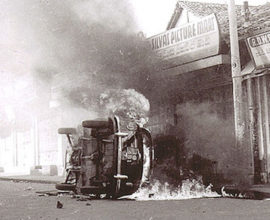
1983-borella-rioters-burning

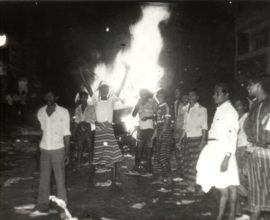
Photo by Chandragupta Amarasinghe ONE What happened in mid-1983 and in the last week of July 1983 was obscene, a monumental atrocity, a disaster for Sri Lanka. In a context marked by the push for self-determination by the principal forces representing the Sri Lankan Tamils and an armed underground insurgency involving restive youth in the extreme north, government functionaries and elements of the ordinary populace took it upon themselves to unleash punitive attacks on Tamils living in the Sinhala-majority areas in the south. In both the towns and in several parts of the supposedly idyllic countryside Tamils were killed, assailed, maimed, terrorized and forced to flee or hide. It was not an ethnic “riot,” a term left over from the British Raj and one that covers a wide array of affrays (inadequately, of course, because of its wide sweep). Nor was it a holocaust. It was something in between in the lexicon of assaults: a pogrom. Apart from the immorality…

Continue reading »

My name is Cedric. Do you remember me?

July usually passes me by without too much notice, beyond the vague worry that there might be a Tiger attack on Colombo, and a few flashbacks to that weekend in 1983. But this time it’s been a bit different. I’ve found myself reliving that day a lot more this year. It isn’t the fact that this is the 25th anniversary of the carnage which most people see as the starting point of our war, though that has been the focus of a lot of attention. What did it was a phone call a couple of weeks ago. My mobile rang with an unfamiliar number, and an equally unidentifiable male voice asked for me. When I confirmed that it was indeed yours truly, the voice asked whether I was an old boy of Wesley College. I groaned inwardly, and confirmed this too, expecting to be hit by my school’s OBU for a donation or offer of membership of some committee or…

Continue reading »

TNA MP Mr. R. Sampanthan remembers the events of July 1983

Tamil National Alliance MP Mr. R. Sampanthan speaks of the anti-Tamil riots of July 1983. Speaking of the “terrible experience for all Tamil people in Sri Lanka” he says that the riot was “premeditated pogrom… largely believed to be with the support of very influential forces within the then government”. He notes that there were Sinhalese friends who helped Tamil friends in distress and says that the riots were a “determined effort by some forces within the majority community with the support of the government to teach the Tamil people a lesson.” Mr. Sampanthan ends by stating that only a political solution, not violence, will bring about an end to the conflict. For more videos remembering the events of July 1983, please visit the the Remember 1983 playlist on Vikalpa YouTube Video. For more articles on July 1983, please click here. Repost This Article

Continue reading »

AFLAME – Remembering Black July, 1983

AFLAME – Remembering Black July, 1983 What is a poem to a man hiding in the cellar of his neighbor’s house, breathing the way his hostess spices lentils and mutton, while son and daughter keep quiet, not one word allowed in the mother tongue, and wife strokes her neck, the golden wings of her thali, and across the lane a mob, ruffians, tontons macoutes, lynch squad, a few holy men, politicians in white vershtis, light rage and sew pestilence in summer fires that turn houses to foundation stones and stoke residents out to shelter at  neighbors, St. Peter’s College, the police station near Bambalapitya Flats, before three days voyage on a ship hungry to Kankesanthurai where soldiers have been swinging cricket bats and teenage boys have stopped playing cricket, disappeared, coerced into resistance: this war, these flames burning every day since, and even before, 50 years ago, 1958, when mobs first enforced what was deemed the people’s will. by unleashing…

Continue reading »

Plus 25: Things we can’t do because of “National Security” in Sri Lanka

25 years after Black July, the term “National Security” is used to thwart lot of things. V from the movie ‘V for Vendetta’ said “I do, like many of you, appreciate the comforts of the everyday routine, the security of the familiar, the tranquility of repetition”. At least he had that. We don’t. We can’t nikang sit, walk around at night, carry our CDMA phones, visit TamilNet, buy remote controlled toys, visit Galle Face Greens, nikang stand, wear full-face helmets, fix crash-guards to our SUVs, take photos, talk about cessation of violence and a host of other things because they might supposedly impede upon the national security and the sovereignty of the country. The country the (proud) Sinhalese stole from the native tribes. The supposed “our” country. Unlike V, we have to suffer road closures, road blocks, naggy and rude cops, frustrating bodyguards, numerous checkpoints, humiliating body searches, annoying experiences of trying to explain to retarded policemen why the light…

Continue reading »
Page 1 of 212

About Groundviews

Located at the Centre for Policy Alternatives in Colombo, Sri Lanka, Groundviews is a citizen journalism website that uses a range of genres and media to highlight critical perspectives on governance, reconciliation, human rights, the arts and literature, democracy and other issues. The site has won two international awards, including the prestigious Manthan Award South Asia in 2009. The grand jury's evaluation of the site noted, "What no media dares to report, Groundviews publicly exposes. It's a new age media for a new Sri Lanka... Free media at it's very best!"

cezarneaga.eu