Archive for the ‘Reconciliation’

The leaked UN war crimes report: Key points and context

UN_panel_on_sri-lanka

The Island newspaper published today sections of what appears to be a large excerpt from the report of the UN Panel of Experts looking into allegations of war crimes and crimes against humanity in Sri Lanka. Inner City Press followed up with a report suggesting that the text was authentic, and that the UN deeply regretted the leak to the mainstream media. It also noted that the UN would publish the report in full next week, along with a response from the Sri Lankan government. Groundviews flags below some highlights of this damning report, and places it alongside some other news article for context. Follow our tweets on this breaking story here. Our Facebook fan page will also carry highlights, and features discussions amongst the 6,000+ people already on it. Some key highlights from the leaked report as published in The Island: “In stark contrast, the Panel found credible allegations, which if proven, indicate that a wide range of serious…

Continue reading »

ACCOUNTABILITY, RECONCILIATION, DEMOCRACY

Photo credit: Eranga Jayawardena / AP, taken from Christian Science Monitor At a recent seminar at the Acadamie DiplomatiqueInternationale in Paris, a team from the National University of Singapore’s Institute of South Asian Studies (ISAS), on a Paris-London visit, presented on ‘Developments in the Arab World and the Impact on Asia: an Asian Perspective’. I attended eagerly, not only because of the subject’s salience but because these were my recent colleagues and friends. The team’s presentation differentiated the domestically driven developments, most importantly but not exclusively in Tunisia and Egypt, from external military intervention in Libya’s armed civil conflict or civil war. Prof Tan Tai Yong, the Vice Provost of the National University of Singapore (with which Yale has just signed a deal to establish a liberal arts college) and Executive Director of the Institute pointed out that while Asian opinion agreed that the intentional killing of unarmed civilian protestors de-legitimised any regime and constituted a new ‘red line’ for the international…

Continue reading »

Is it worth the wait for international support after the UN Secretary General’s report?

UN_panel_on_sri-lanka

Photo courtesy Inner City Press Finally, yes finally, one big phase of the game came to a close with just a whimper. Now, its the next phase of the game. On 12 April, just before the South (wouldn’t know how the Hindu Tamils in the North would celebrate new year) gathers into their culturally colourful Sinhala New Year on 14th April, the UN Panel of Advisers on the Sri Lankan conflict (?) handed over their report to the UN Secretary General, Ban Ki-moon. Very little is officially said about, it being made public, but, a copy was immediately despatched to President Rajapaksa. Ban’s media spokesperson said, its just “courtesy”. A very curt news release in the UN news web says, the UN SG “will study the report carefully and will determine his next steps in the coming days.” What went into this report writing and how, is now history. Yet that would give an indication to what would finally turn out…

Continue reading »

A review of (Un)making Time: ‘My Other History’ and ‘Rondo’

Screen shot 2011-04-13 at 12.34.44 PM

Image from ‘Rondo’ Image from ‘My Other History’ “We are all capable of believing things which we know to be untrue… And then, when we are finally proved wrong, impudently twisting the facts so as to show that we were right. Intellectually, it is possible to carry on this process for an indefinite time: the only check on it is that sooner or later a false belief bumps up against solid reality, usually on a battlefield.” George Orwell, In Front of Your Nose In early 2011, Tracy Holsinger of Mind Adventures Theatre Company and Jake Oorloff of Floating Space Theatre Company were awarded a grant from the Sunethra Bandaranaike Trust to interrogate, through theatre, the idea and theme of reconciliation. The resulting plays were staged in April under the title (Un)making Time and featured two compelling productions – ‘Rondo’ directed by Tracy Holsinger and Arun Welandawe-Prematilleke and ‘My Other History’, written and directed by Jake Oorloff. Though bound by a…

Continue reading »

A brief impression of ‘Rondo’

Screen shot 2011-04-11 at 7.11.30 AM

Original photo courtesy Mind Adventures Rondo is a devised theatre play, based on the theme of reconciliation, says the programme note for the production of RONDO by Tracy Holsinger and the Mind Adventures Theatre Company. The structure of the play is episodic, with an unraveling of a series of seemingly unrelated incidents taking place between blackouts. A ‘Watcher’ watches over it all, standing on a small lighthouse like structure at the back of the stage, occasionally scanning the horizon with a spyglass and flashing a torch at the face on the ‘Visitor’, the only contemporary figure in the piece. As the Watcher rambles on in verse, at times comic and at other times obtusely philosophical, one hoped, the audience has a brief moment to ponder on what they have just seen and what it means in relation to the rest of what has been already performed. Rondo is a play that demands your complete attention. A brief moment to nod…

Continue reading »
  • 10 Apr, 2011
  • 6 Comments
  • Colombo,
    Identity,
    Reconciliation,
    Sport

World Cup Cricket and Football: Nationalism in France and Sri Lanka

Muhrali

Photo credits: 888 Sport Zone and Daily Info Picks I know absolutely nothing about cricket and honestly would not have paid attention to the Cricket World Cup, had I not been in Sri Lanka the week its team made it to the final. Although the Sri Lankan team lost in the end, it was an electrifying moment to live, even as a foreigner. World Cup fever is universal, whatever the game, whatever the continent. The tension was so palpable, emotion and excitement at its highest on Galle Face Green where I went to watch the game amid a crowd of 8000 cricket fans. People seemed proud to be Sri Lankan, waving the flag, faces painted and broad smiles. An entire country behind its team. This was particularly interesting, as Sri Lanka will be soon celebrating two years since the end of the war and mostly reconciliation between the different ethnicities remains a theory. Being Sri Lankan still largely means belonging…

Continue reading »

Proud to be Sri Lankan?

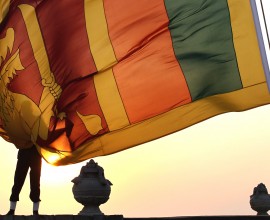
Flag_of_Sri_Lanka

Citizenship, as I know it, is a means by which citizens of a particular country are recognized as entities of that country. I feel that citizenship gives each of us a sense of “belonging” and “responsibility” towards our motherland, and also a sense of “security,” that as holders of this particular citizenship, we’re ensured of our protection and wellbeing. At least, that’s what one would hope a citizen of a country is entitled to. I guess we were called a “Land like no other” for a reason. That being, that we truly are like no other. The concept of “citizenship” as I mentioned above, is nothing but an illusion in our fair land. As citizens of one country, we hold no sense of camaraderie with one another. We’re told that a “good citizen of the State” obeys the State. That they should not question the State. That they should accept that the State only acts with their wellbeing at heart,…

Continue reading »

In conversation with Dr. Paikiasothy Saravanamuttu

Screen shot 2011-03-21 at 1.33.45 PM

Almost one year ago, Groundviews first featured an interview with Dr. Paikiasothy Saravanamuttu. At the time, just after the parliamentary elections leading from the decisive presidential election, the government was riding a wave of popular support. In the year that passed, from the reprehensible 18th Amendment and grotesque examples of the government’s wastefulness, democratic governance that instead of improvement and progress, shows decline and decrepitude. The recipient of the first Citizens Peace Award, Dr. Saravanamuttu (Sara), the Executive Director of the Centre for Policy Alternatives (the institutional base of this site), in this interview speaks about the enduring challenges facing democracy and human rights in Sri Lanka, nearly two years after the end of war. The conversation begins with an excerpt from Sara’s acceptance speech at the Citizens Peace Award, and a question as to why so very few listen to him in Sri Lanka today, and worse, care to know about that which he flags. Going beyond a simplistic championing of…

Continue reading »

How Decent a Society are we?

Rape1

Editors’ note: This article was first published in the Daily Mirror on the 18th of March 2011. Groundviews invites its readers for further discussion and debate. Avishai Margalit the Israeli philosopher wrote a treatise on the Decent Society from which I have quoted often. In it he defines a civilized society as one in which people do not humiliate each other and a decent society as one in which institutions do not humiliate people.  My reason for frequently citing this is that throughout the yet to be resolved conflict in Sri Lanka and in parts of the country that were not direct theatres of armed conflict, issues of human dignity and decency abounded and yet do so be it on the basis of ethnicity, religion, class and dissent from the prevailing orthodoxy.  Now as we are faced with the challenge of moving beyond the post-war to the post-conflict and with it an unprecedented opportunity to forge reconciliation and unity, Margalit’s…

Continue reading »

Caste in Sri Lanka and India

jaffna_high_caste_tamil_women

There was an interesting work shop on ‘Conceptualizing Caste in Sri Lanka’ at the ICES on Tuesday 15th March 2011. It was noted that caste is a tabooed and under-researched subject in Sri Lanka, unlike in India, Nepal and elsewhere in South Asia. We tend to dismiss caste as insignificant and irrelevant, except perhaps in remote rural areas. In consequence, caste related problems are evaded and not addressed. It was noted by Prof. Tudor Silva that the British brought sanitary labourers from South India into selected Urban centres, and these then constituted the underclass of those towns, doubly despised on account of ethnicity and caste. Prof. Ranweera Banda, based on his research in Panama in Ampara district, found that the people of that locality were of mixed Sinhalese –Tamil origin at all social and caste levels. However, the social and caste elite opted to identify with the Sinhalese upper castes, embracing the appropriate cultural practices needed for such identification. This…

Continue reading »

Jaffna and the Vanni today: The reality beneath the rhetoric

4671791672_d87e631ed7_b

Photo credit: Indi Samarajiva, 2010 The drive along the A9 from Vavuniya to Killinochchi is brought to a temporary halt at the ‘exit-entry point’ at what used to be the forward defence line at Omanthai. On the side of the dusty dirt road, in a series of sheds, military personnel are stationed with the sole purpose of ensuring that both locals and international staff members of non-governmental and international non-governmental organisations and even UN agencies, possess the required clearances issued by the Ministry of Defence (MOD) to cross into the North. All foreigners, that is those holding non-Sri Lankan passports, even tourists, have to obtain a MOD clearance to pass through Omanthai. One could be excused for thinking this was 2002, when entering the Vanni was much like entering a foreign territory. Yet it is 2011, more than a year and a half since the end of the war between the government and the LTTE. In 2011, more so than…

Continue reading »

The desecration of graves in Jaffna: Path to reconciliation?

Uthayan Article

The following article was published in the Uthayan newspaper on 5 March 2011. The translation to English is based on a Sinhala translation published in Vikalpa. Not a single Sinhala newspaper to date has published a similar account, though many reported on the opening of the new Army Headquarters in Jaffna. Of the English media, only the Daily Mirror quotes a BBC report on the desecration of the graves. As well-known blogger Guruparan notes in a succinct tweet, “This is really sad. A local newspaper has to quote an international media to report on a local story.” No other English media online or in print have covered this story. Readers on our Facebook page have expressed grave concern and outrage over this action by the Army. Sadly, this is not the first time the Army has desecrated LTTE graves. An interview with Prof. Michael Roberts conducted in December 2010 explores this issue in detail, and why it is so damning to…

Continue reading »

What few care to know: Challenges and opportunities in post-war Sri Lanka

Screen shot 2011-03-08 at 12.13.22 PM

Transcript of speech delivered by Dr. Paikiasothy Saravanamuttu accepting the first Citizens Peace Award, 28 February 2011. Video of speech below. Members of the Head Table, Venerable Sirs, Your Excellency President Kumaratunga and Friends, Let me begin by thanking the National Peace Council for this inaugural Citizens’ Peace Award, which I accept in all humility. I am acutely conscious that the objective of peace, securing human rights protection and good governance cannot be achieved by the singular efforts of a single individual or similar acts by many – it is a continuous process, it is a struggle and it goes on and on, irrespective of the few high moments we celebrate. We have to recommit ourselves and steel ourselves to the challenge that lies ahead. But before I say anymore, thanks are in order. First and foremost, to my parents and to my family for the values of public service and public interest that they have instilled in me. Next,…

Continue reading »

Peace and Reconciliation in Sri Lanka

0202-OTAMIL-Sri-Lanka-Reconciliation-600_full_600

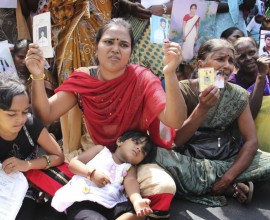
Photo credit: Eranga Jayawardena / AP, taken from Christian Science Monitor Peace in our country cannot last long without reconciliation. And there can be no reconciliation until the people in the North and East and all those who were affected by the war come to terms with their losses, and pick up the threads, with hopes of a better future. No matter how many highways and bridges are put up, no matter how many houses are built until and unless the grievances of the war affected minorities are looked into, there will be no lasting peace. The grievances of these people are not limited to food, clothing and shelter only. The 30 year civil war was not fought merely to get these basic needs. First and foremost they need to be free of fear and humiliation. Even today, twenty one months after the war a man or woman can be harassed by the police on mere suspicion, if he or she…

Continue reading »

The Duplicitous Disclaimer: GOSL, the UN and Accountability

In consideration of the vague exposition on the reasons behind the meeting between Ban Ki-moon and representatives of the Sri Lankan Government in New York on the 23rd of February 2011, as well as the Government’s own disclaimer on the meeting, it is clear that there has been a concerted effort to disclose as little information as possible on this ‘eleventh hour’ attempt by the Government at back-door diplomacy in order to address the UN’s ‘panel on accountability.’ It is rather obvious that suspicions will arise when there are contradictory statements provided by both sides on the content of the discussions, which differed considerably as Ban Ki-moon’s spokesman, Martin Nesirky, stated that it was a ‘courtesy call’ on ‘reconciliation and reconstruction efforts,’ while the Secretary of the Ministry of External Affairs, Romesh Jayasinghe, stated that the meeting was about ‘legal issues.’ It was also interesting to note Deputy Minister Neomal Perera’s statement, which denied that there was an official visit…

Continue reading »
Page 13 of 19« First...1112131415...Last »

About Groundviews

Located at the Centre for Policy Alternatives in Colombo, Sri Lanka, Groundviews is a citizen journalism website that uses a range of genres and media to highlight critical perspectives on governance, reconciliation, human rights, the arts and literature, democracy and other issues. The site has won two international awards, including the prestigious Manthan Award South Asia in 2009. The grand jury's evaluation of the site noted, "What no media dares to report, Groundviews publicly exposes. It's a new age media for a new Sri Lanka... Free media at it's very best!"

cezarneaga.eu