Archive for the ‘18th Amendment’

Resource book for historians, researchers and media: A year of tweeting from Groundviews

groundviews-followers-small

Visualisation of our Twitter followers. See larger version here. We used the web service Tweet Book to capture all our tweets over the past year in a single PDF. We’ve tweeted thousands of times over the past twelve months and have covered, The media fallout of the farcical fast of senior government Minister Wimal Weerawansa in front of the UN HQ in Colombo. Praise for our model of journalism on C-SPAN video in the US, captured from an event at the United States Institute of Peace. Key statements by world leaders like Desmond Tutu on post-war reconciliation and accountability for war crimes Bell Pottinger’s sickening relationship with the incumbent government, largely hidden from public scrutiny Key reports on Sri Lanka from, inter alia, HRW, AI, ICG and the US State Department, including responses from senior Ministers and the Foreign Ministry Foreign relations and the tussle in Sri Lanka between India and China The court proceedings on Sarath Fonseka The UNP’s perennial…

Continue reading »

Months after the 18th Amendment: Is the Executive really more accountable to Parliament?

Mahinda-in-Parliament

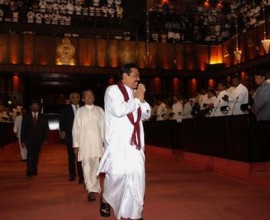
Image credit Sunday Leader The 18th Amendment, we were told, would make the President more accountable to Parliament. The Editorial of the Sunday Observer noted back in the day, By making it mandatory for the President to attend Parliament at least once in three months to answer questions by MPs, the 18th Amendment has not only made a vital link between the Executive and the Legislature, but has also made the President answerable to Parliament. Had President Rajapaksa given thought to dictatorship even in his wildest dreams, he would never have decided to attend Parliament once in three months. Despite being elected twice to the high office, President Rajapaksa strongly believes in parliamentary democracy and is keen to attend Parliament and follow proceedings whenever time permits. Isn’t this characteristic of a truly people’s leader who firmly believes in the power of the ballot? Emphasis ours. But has the President in fact entertained any questions from MPs in Parliament since the…

Continue reading »

In conversation with Dr. Paikiasothy Saravanamuttu

Screen shot 2011-03-21 at 1.33.45 PM

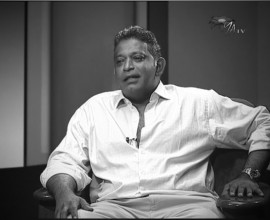
Almost one year ago, Groundviews first featured an interview with Dr. Paikiasothy Saravanamuttu. At the time, just after the parliamentary elections leading from the decisive presidential election, the government was riding a wave of popular support. In the year that passed, from the reprehensible 18th Amendment and grotesque examples of the government’s wastefulness, democratic governance that instead of improvement and progress, shows decline and decrepitude. The recipient of the first Citizens Peace Award, Dr. Saravanamuttu (Sara), the Executive Director of the Centre for Policy Alternatives (the institutional base of this site), in this interview speaks about the enduring challenges facing democracy and human rights in Sri Lanka, nearly two years after the end of war. The conversation begins with an excerpt from Sara’s acceptance speech at the Citizens Peace Award, and a question as to why so very few listen to him in Sri Lanka today, and worse, care to know about that which he flags. Going beyond a simplistic championing of…

Continue reading »

How Decent a Society are we?

Rape1

Editors’ note: This article was first published in the Daily Mirror on the 18th of March 2011. Groundviews invites its readers for further discussion and debate. Avishai Margalit the Israeli philosopher wrote a treatise on the Decent Society from which I have quoted often. In it he defines a civilized society as one in which people do not humiliate each other and a decent society as one in which institutions do not humiliate people.  My reason for frequently citing this is that throughout the yet to be resolved conflict in Sri Lanka and in parts of the country that were not direct theatres of armed conflict, issues of human dignity and decency abounded and yet do so be it on the basis of ethnicity, religion, class and dissent from the prevailing orthodoxy.  Now as we are faced with the challenge of moving beyond the post-war to the post-conflict and with it an unprecedented opportunity to forge reconciliation and unity, Margalit’s…

Continue reading »

What few care to know: Challenges and opportunities in post-war Sri Lanka

Screen shot 2011-03-08 at 12.13.22 PM

Transcript of speech delivered by Dr. Paikiasothy Saravanamuttu accepting the first Citizens Peace Award, 28 February 2011. Video of speech below. Members of the Head Table, Venerable Sirs, Your Excellency President Kumaratunga and Friends, Let me begin by thanking the National Peace Council for this inaugural Citizens’ Peace Award, which I accept in all humility. I am acutely conscious that the objective of peace, securing human rights protection and good governance cannot be achieved by the singular efforts of a single individual or similar acts by many – it is a continuous process, it is a struggle and it goes on and on, irrespective of the few high moments we celebrate. We have to recommit ourselves and steel ourselves to the challenge that lies ahead. But before I say anymore, thanks are in order. First and foremost, to my parents and to my family for the values of public service and public interest that they have instilled in me. Next,…

Continue reading »

The Cost of Defying Political Authority

Reams have been written on the two main topics widely discussed in Sri Lanka today. One is the fate of the army commander who chose to defy the authority of the Rajapakse brothers and the other is the 18th amendment that was passed with a large majority in parliament (161 for and 17 against) on September 8, 2010. It gives the president absolute power. In an article published on the 43rd death anniversary of Che Guevera (October 9th) the writer says Che was not an anarchist but he wanted a strong handed moral government. He felt compelled to obey moral laws; finally sacrificing even his life in the struggle as in the Greek tragedy “Antigone”. “Antigone’s revolt stemmed not from a rejection of authority, but on the contrary from obedience to a moral law, than to an arbitrary edict. Antigone lost her life trying to protect human rights which are really moral rights while defying political authority. Sarath Fonseka is…

Continue reading »

Inquiry into a Sri Lankan Man’s Stolen Bicycle

stolenbikepicture

On a beautiful late summer day, the eighth of September 2010 to be precise, outside the railway station in the historic university city of Bridgetown, England, I found this Sri Lankan chap, Sivapuranam Thevaram, of whom we have read a bit in these pages recently: the structure of his name, his debt to his father and the sorrow of Sivahamy, his mother. Thevaram has been crying at the railway station when I caught up with him — crying over his bicycle which had just been stolen. Grownups don’t cry, we are told. Thevaram has made several exceptions to this in his adult life. Watching Nelson Mandela’s release from prison on television was one such occasion. As the former prisoner walked past the gates with his raised arm and clenched fist, Thevaram could not hold back his tears. That’s odd, we might think. It should be a happy event and why does one cry when faced with such good news? The…

Continue reading »

In conversation with Dr. Jayampathy Wickramaratne

Screen shot 2010-09-30 at 3.05.19 AM

Dr. Jayampathy Wickramaratne is a President’s Counsel in Sri Lanka and has also served with the Sri Lankan government in various capacities as Senior Adviser to the Ministry of Constitutional Affairs and member of the Sri Lankan Law Commission. He holds a PhD in Human rights and a Master of Public Administration from University of Peradeniya, Sri Lanka. His areas of expertise include Constitutional law, Human Rights, Administrative and Criminal law. We began our conversation on the need for a political solution after the end of war and the ignominious fate of the APRC (read the APRC’s final report, released exclusively on Groundviews). Jayampathy categorically notes that the political leadership today hasn’t shown any progressive movement towards a political solution. I then asked him to juxtapose and critique public apathy over the passing of the 18th amendment to what he had observed from 1994 to 2004 – a high-degree of support for power-sharing by as much as 50% of the…

Continue reading »

COLOMBO MUNICIPAL CORPORATISATION PROPOSAL

I support power sharing. Therefore, my attention is drawn to this proposal, irrespective of  the unacceptability or denial by any government authority of this purported proposal. In the last few weeks, the mainstream media have reported that a Development Authority is to be established for the City of Colombo, with the concurrent move to abolish the Colombo Municipal Council (CMC) and vest its functions to this Authority and consequentially scrap the elected Council. Past performance On many an occasion, the Colombo Municipal Council’s performance has been criticised as inefficient, ineffective, uneconomic, politicised, corrupt, lethargic and inadequate. The lack of a reponse and inaction to the large piles of solid waste, the dengue epidemic, environmental degradation and illegal constructions were the areas mostly criticised. Hence, this revelation may be welcome news to rate payers and citizens interacting with the CMC. Additionally, there was publicity that the proposed Corporation will function under the Secretary of the Ministry of Defence, which, no doubt,…

Continue reading »

Hansard on 18th Amendment debate, 8 September 2010

Exclusive video: Parliamentary debate and objections to 18th Amendment, “Sound is no substitute for argument”: Exclusive video of TNA MP M.A. Sumanthiran’s speech in parliament against 18th Amendment and Final text of TNA MP M.A. Sumanthiran’s speech in Parliament opposing the 18th Amendment published exclusively on Groundviews capture the chaos that reigned during the parliamentary ‘debates’ on the 18th Amendment Bill on 7th and in particular, 8th September 2010. We publish below the Hansard of the ‘debate’ on the 8th. To view this document full-screen, click here. To download the Hansard as a PDF, click here. Repost This Article

Continue reading »

Urgent questions to pose to the Leader of the Opposition

The opposition leader and party leader of the UNP, Mr. Ranil Wickremesinghe,  appears to be play acting before the public, playing the two key roles of Dr. Jekyll and Mr. Hyde. An e-mail invitation that went out to leaders of Civil Society and Human Rights Non-Profit Organisations on Monday, September 13, 2010 from the Secretary to the Leader of the Opposition stated that the “Leader of the Opposition would like to see you at a meeting to discuss Media Freedom and Democracy on Tuesday 14 September 2010 at 10.00 am at Committee Room 2, Parliament Complex”. It is urged that the invitees to the above, prior to the commencement of the meeting, should ask the Leader of the Opposition to clarify the following issues relevant to the discussions to follow; His definition of the role, responsibility, scope and accountability of the office of the Leader of the Opposition in relation to protection of Media Freedom and Democracy. What effective steps…

Continue reading »

WHERE IS THE VIABLE ALTERNATIVE POLITICAL PROJECT IN SRI LANKA?

“In other words it now becomes evident that (to quote Marx) people do not treat somebody as a king because he is a king in himself; he is a king because and as long as people treat him as one.” (Slavoj Zizek, ‘The Ticklish Subject’, p192, italics in the original). ****** If God is dead, everything is permitted, said Dostoevsky, part echoed by Nietzsche who exclaimed “God is dead, and we have killed him”. The danger of announcing the death of democracy, when it isn’t dead, is precisely that ‘everything is permitted’. It permits dictatorial practices on the part of the authorities who no longer feel fettered by democracy. It permits violent protest by those who believe that there are no longer any democratic methods of change – which in turn permits greater violence on the part of the authorities which directs it also against peaceful protest. The placing of an obituary of democracy is even more pernicious because it…

Continue reading »

Final text of TNA MP M.A. Sumanthiran’s speech in Parliament opposing the 18th Amendment

Though the text of TNA MP M.A. Sumanthiran’s speech was published earlier on the Internet, Groundviews was sent today the final version of the text, approved by the MP, which incorporates into the text his responses to interruptions during its delivery in Parliament on 8 September 2010. This text needs to be read in conjunction with “Sound is no substitute for argument”: Exclusive video of TNA MP M.A. Sumanthiran’s speech in parliament against 18th Amendment. View in full-screen here. Download as a PDF here. Repost This Article

Continue reading »

“Sound is no substitute for argument”: Exclusive video of TNA MP M.A. Sumanthiran’s speech in parliament against 18th Amendment

This video complements Exclusive video: Parliamentary debate and objections to 18th Amendment published on Groundviews. The reasoned, well-argued full text of the speech made by TNA MP M.A. Sumanthiran against the 18th amendment bill is published elsewhere on the Internet. However this video, procured exclusively by Groundviews, captures much more than the TNA MP’s own submission to Parliament on 8th September 2010. For example, responding to opposition by Government MPs, Mr. Sumanthiran makes two points, That the proposed 18th Amendment Bill was not even able to MPs until he had raised a point of order the day before in parliament. (See Exclusive video: Parliamentary debate and objections to 18th Amendment). That even the copy of the Bill discussed and approved in Cabinet was different to the one referred to the Supreme Court for its judgement. Revoltingly, Mr. Sumanthiran is called ‘kotiya‘ (tiger/terrorist) at around 1.26 minutes into his submission by a member of parliament who can only be from Government. Admirably…

Continue reading »

Exclusive video: Parliamentary debate and objections to 18th Amendment

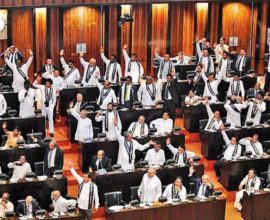
Groundviews was able to procure exclusive video with highlights from the parliamentary debates on the 18th Amendment Bill. This video was recorded on 7th September 2010. This one hour video begins with the point of order raised by TNA MP M.A. Sumanthiran, the synopsis of which can be read here. Inter alia, a salient point made by the MP is that this significant Bill was not at the time of the debate gazetted or even tabled in Parliament – the MP even expresses his doubt as to whether the Speaker himself has a copy of the Bill. The fact is that the President did not even consider it important to have the proposed bill available to members of parliament in what were, ironically, debates on its key provisions and implications. Clearly, this was not a problem for MPs with the government. So much for the Executive being accountable to Parliament, and a Parliament able and willing to hold the Executive…

Continue reading »
Page 1 of 3123

About Groundviews

Located at the Centre for Policy Alternatives in Colombo, Sri Lanka, Groundviews is a citizen journalism website that uses a range of genres and media to highlight critical perspectives on governance, reconciliation, human rights, the arts and literature, democracy and other issues. The site has won two international awards, including the prestigious Manthan Award South Asia in 2009. The grand jury's evaluation of the site noted, "What no media dares to report, Groundviews publicly exposes. It's a new age media for a new Sri Lanka... Free media at it's very best!"

cezarneaga.eu