Archive for May, 2012

On the (Non)sense of Being ‘United’ and/nor/or ‘Unitary’

R__sampanthan_1095707f

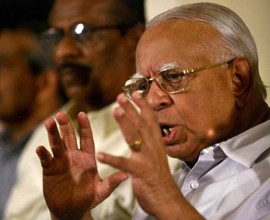
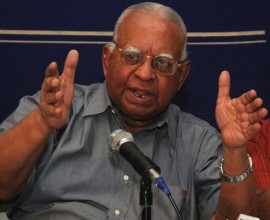
Image courtesy The Hindu I must admit that reading Dr. Dayan Jayatilleke’s (DJ) recent piece, on Groundviews and elsewhere, on Mr. R. Sampathan’s (RS) speech at the ITAK convention, left me very disturbed. In his piece, DJ draws attention to one statement in the speech in particular, which he notes is central to revealing that the RS/ITAK are separatists in disguise. The statement in question reads thus: “To put it more strongly, the international community must realize through its own experience, without us having to tell them, that the racist Sri Lankan government will never come forward and give political power to the Tamil people in a united Sri Lanka” (emphasis added). Indeed what RS said was that “the racist government”—note, he did not just say “Sri Lankan government” but qualified it with “the racist”—will never come forward to grant political power to Tamils. And this is true; forget about a racist Sri Lankan government, does anyone think that any…

Continue reading »

Review of ‘Kandy at War’ by Channa Wickremesekera

DSCF5675

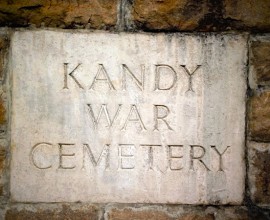
Image courtesy Sri Lanka Travel Guide “When we think of it, we see at once what the confusion of thought was to which the Western poet [i.e. Rudyard Kipling], dwelling upon the difference between East and West, referred when he said, ‘Never the twain shall meet.’ It is true that they are not yet showing any real sign of meeting. But the reason is because the West has not sent out its humanity to meet the man in the East, but only its machine. Therefore the poet’s line has to be changed into something like this: Man is a man, machine is machine, And never the twain shall meet.” Rabindranath Tagore[1] This is what the Portuguese unleashed in 1505 in Lanka, the machine of plunder. They were followed by the Dutch and ultimately the British in the late 18th century. They were able to control, exploit and plunder most of island except the Kandyan kingdom. The kingdom successfully resisted colonisation…

Continue reading »

Reconciliation in Sri Lanka: What? Why? How?

2011815143557728734_8

Photo courtesy: Steve Chao /Al Jazeera via JDS With our Government busy defending itself from war crime allegations, protecting the sovereignty of the country and advising the common man to say ‘no’ to Google, the Tamil leadership and, of course, the Tamil Diaspora dreaming of some mode of foreign intervention and drooling over the latest Channel 4 documentary, the Muslim Community deeply wounded by the recent developments in Dambulla, and the common man constantly worried over the ever increasing fuel price, it’s understandable why the journey towards achieving true and authentic reconciliation has become such  a tricky business in our country. With so many external factors coming into the equation (of achieving reconciliation) even Albert Einstein would have had trouble sorting things out and moving forward. The intention of this article is to look at reconciliation from a different angle; an angle that helps simplify the equation – eliminate as many external factors and make the concept as practically attainable…

Continue reading »

Where brevity cripples and distorts reportage

article-new-ehow-images-a05-87-jn-write-word-essay-800x800

Image courtesy eHow Once upon a time, after I presented a public talk in Oslo courtesy of Kumar Rupesinghe, a Norwegian journalist provided me with a refreshing insight into the difference between academic essays and journalese. There is, to be sure, a considerable overlap between the two fields; but the lesson he taught me was that journalists usually place their conclusions and punch lines at the very start of their essay. Academic authors, in contrast, tend to end with a BANG so that they build up to a conclusion. Journalists, my friend told me, adopt this course partly because it enables them to face editorial demands for a shorter piece by simply lopping off the end. So it is also time-saving. Given the demands on their time arising from the hop-skip-and-jump character of journalist duties in diverse arenas, this tactic is quite pragmatic. Short reports also enable the story to be kept simple. Where the tale is sensational, the shorter…

Continue reading »

ITAK’S PLAN OF ATTACK: THE BREAKOUT STRATEGY

r_sampanthan

The keynote speech by Mr. R Sampanthan, the leader of the main Tamil parliamentary party at the recent congress of that organization is in many respects a landmark event. It sheds light on a number of key strategic issues and should make clear to the international community that the matter of political dialogue leading to ethnic reconciliation is, has become or is becoming rather more complex and fraught than is customarily thought. The senior political leader of the Tamil community in the island’s strategically sensitive Northern Province reconfirms the political aim and goal of his party. Perhaps more importantly he clarifies the international strategy that is being, and is to be, adopted in furtherance of that political project, as well as the interconnection between the international strategy and domestic tactics in support of the project. It is not so much a strategy for breakthrough as for ‘breakout’. Mr. Sampanthan’s speech not only states clearly that the political project lies outside the…

Continue reading »

Parama Weera: What it takes, and what it means

AFP/Getty 510928028

Image credit Ishara S.Kodikara/AFP/Getty Images via The Baltimore Sun The eyes stared expressionlessly back at me from the fifteen small pictures, some clear, and some blurred; reflections that only hinted at the men behind those eyes. But sharp or soft, they all looked so innocuous, so devoid of any indication of what they had once seen. So normal. To look into those fifteen pairs of eyes, to read their names on the Wall that held thousands of similar names, was to gain no hint of the impossible acts of bravery that their owners had committed. Acts that would now see them join the eight who had gone before. Twenty-three names for twenty-three men. Twenty-three individual acts of supreme courage, selected out of twenty-eight years of war. The faces were tucked away in the second page of the Sunday Times, and I stared back at them for awhile before reading the short paragraph beneath each. The words were trite, cliched, dry;…

Continue reading »

Operation Liberation: 25 years on

secfield20061201

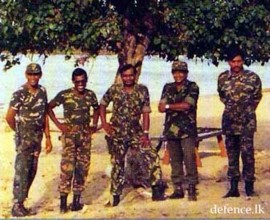
The commanders of “Operation Liberation” commonly known as “Vadamarachchi Operation”. From left to right: Lt Col. Vipul Boteju, Lt Col. Sarath Jayawardane, Col. Wijaya Wimalaratne, Brig. Denzil Kobbekaduwa and Maj Gotabaya Rajapakse [1987, Jaffna] Image courtesy Defence.lk Twenty five years ago, on May 26th 1987, the Sri Lankan military forces launched ‘Operation Liberation’, which, at the time, was the biggest military operation in Sri Lanka since independence. At least 5,000 troops broke out of their bases in Jaffna in a bid to take the battle to the rebel Tamil Tigers who had kept the soldiers confined to the barracks for more than a year. The operation met with significant success. Within a week the Vadamarachchi sector of the peninsula was brought under government’s control, and scores of rebels killed or captured and some of their munitions factories destroyed. However, any ambitions the Sri Lankan government had about widening the operation to cover the entire Jaffna peninsula had to come to…

Continue reading »

Cast as mother: A review of a work in progress

nadie and dil - letter to doc - Small

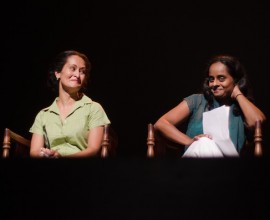
[Editors' note: All photos courtesy of Ruvin de Silva] Cast as mother – A reading produced by Stages Theatre Company is a work in progress and therefore poses a unique challenge to the reviewer. How does one review a piece of theatre which is a fragment and when we as an audience are told that this is only a prelude to the actual play? But this might well be one of the fundamental features (and strengths) of this project. It is a metaphor for the processes through which this piece of theatre has evolved and is evolving—for the women involved in this project time is a precious commodity and they take what they can when they can and wherever they can. The reading at the Wendt on 24th evening staged selected parts of a multi-author, bi-lingual script writing exercise that took place over one and a half years and sought, in part, to inform the audience of how this entire…

Continue reading »

The Disappeared in Sri Lanka’s War in the Recent Past: What is missing in those “Missing”?

sri-lanka-missing-1

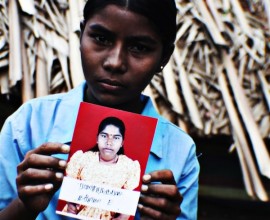
IRIN has recently highlighted the fact that “thousands of people are still missing” in Sri Lanka and presented an UNOHCR report that states that there are “5,671 reported cases of wartime-related disappearance in Sri Lanka” – even without taking note of the numbers that went missing in the final stages of the war in 2008/09.[i] In effect the statement implies that the figure for the DISAPPEARED could even spill over the five figure mark of 10,000. From IRIN Presented at this stage of a propaganda war involving a combination of Tamil activists and Rajapaksa-haters vociferously accusing the government of genocide and extra-judicial killings the implication of such single-track news items are several. They imply, or can be read to imply, that the government is responsible for MOST of the disappearances. This was the implication when news agencies eagerly pounced on Saroja Devi’s allegation that her son had disappeared[ii] after he was one of those ex-Tigers’ released following a government tamasha…

Continue reading »

THE SRI LANKAN REPUBLIC AT FORTY: REFLECTIONS ON THE CONSTITUTIONAL PAST AND PRESENT

z_page-36-Ceylon-became

Image courtesy Daily News Forty years ago this week, at the auspicious time of 12:34 p.m. at the Navarangahala on 22nd May 1972, a new constitution was signed into law, creating the Republic of Sri Lanka. This was the first time in the history of the island that the republican form of state was established, discounting the period under which parts of the littoral were controlled by the Dutch East India Company during the time the Netherlands were a confederated republic. Given that the political history of the island spans over two millennia from its mytho-historical origins, four decades might not seem like a long time. But looking back to 1970-72, the country and the world in which the first republican constitution was created seems very different from the present, although the continuing resonance of many of the dominant themes of that era are still felt in today’s Sri Lanka. In the Third World, it was the epoch of anti-colonialism…

Continue reading »

What’s next for General Fonseka?

120521102321-sarath-fonseka-story-top

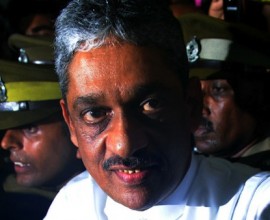
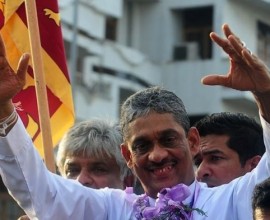
Image courtesy CNN It has been a couple of days since the former military commander of Sri Lankan Army and common opposition’s presidential candidate General Sarath Fonseka was released from the prisons and I can’t think of a better timing than this for me to express some of my thoughts related to these developments, which I am sure many here would share with me, at yet another crucial time for our nation. First of all, many have correctly pointed out to me about the technicality of the use of the rank General when referring to Mr. Fonseka and it is my personal belief that it is one way for me to demonstrate my suspicion as to whether the so-called court martial was really working in a fair, transparent manner contrary how it would have been through a civilian court, while at the same time joining thousands of fellow Sri Lankans who aren’t ready to forget the existence of the first-ever…

Continue reading »

Reconciliation: The Symbolic and the Substantive

rajapaksa_llrc_report

Photo courtesy JDS Against the backdrop of grave planetary changes, Sarath Fonseka’s release, G.L. Peiris’s visit to Washington DC and the third anniversary of the defeat of the LTTE, an evaluation of the requirements of reconciliation are in order.  There is a need to distinguish between the symbolic and the substantive – both in turn playing their part in the journey beyond conflict. The consequences of Sarath Fonseka’s release are yet to be registered, as are the causes for it to be ascertained.  Speculation abounds about it as the grand symbolic act of reconciliation, which will distract attention from the lack of or tardiness in the implementation of the more substantive measures that need to be undertaken.  There are those who maintain that it is a great meritorious act, which will vitiate malefic planetary effects, others cite Fonseka’s health and there are the more prosaic and “unpatriotic” explanations of international pressure.  Finally there is the explanation that it is a…

Continue reading »

Transcript of first one-to-one interview with Sarath Fonseka after release from prison

fonseka_free_000_del6120967_595

Image courtesy the Economist GV editors note: In the transcript below and the video of it available on the BBC online, the BBC correspondent in Sri Lanka Charles Haviland asks “Are the terms of your release unconditional – will you be allowed to go  back to politics?” Sarath Fonseka responds by noting that “As yet I have not seen this legal document.  Unless they have remitted the prison sentence which I have completed already, unless they do that I can’t do politics.  I can do politics but I can’t vote or contest.  So as it is, we don’t know exactly what is there in the document but we’ll come to know.” In this regard, we reproduce below the letter sent by the Ministry of Justice to the Commissioner General of Prisons. Download as PDF here. Start of transcript The BBC met Sarath Fonseka on Tuesday morning at the rented house where the family now stays on the outskirts of Colombo. …

Continue reading »

Interview with Dr. Farzana Haniffa: The eviction of Northern Muslims in Sri Lanka

Screen Shot 2012-05-21 at 11.07.46 AM

First interviewed in 2010, Dr. Farzana Haniffa appears again on Groundviews to talk about the Citizens’ Commission on the Expulsion of Muslims from the Northern Province by the LTTE. As the Commission’s website notes, in October 1990, the Liberation Tigers of Tamil Eelam (LTTE) expelled the entire Muslim population of the Northern Province of Sri Lanka. Within a period of 48 hours the LTTE systematically chased out close to 75,000 Muslims residing in the districts of Kilinochchi Mulaitiwu, Jaffna, Mannar and parts of Vavuniya. The Quest for Redemption: The Story of the Northern Muslims is the report by the Commission, release late 2011 and available for purchase online. As one of the Commissioner’s, Dr. Haniffa justifies why the Commission and its findings are an invaluable record of a chapter in Sri Lanka’s history that is often undervalued and glossed over. We talk about how the publication of the report has served to heighten interest over the complex dynamics regarding the Northern Muslims, and…

Continue reading »

Reloading General Sarath Fonseka for a post-paid Sinhala package

Sri Lanka's ex-army chief General Sarath

Photo via JDS. AFP PHOTO/Lakruwan WANNIARACHCHI. The V-Day celebrations were on, as this piece was written. A military victory being commemorated at the Galle face esplanade, celebrated as the 3rd anniversary of defeating the LTTE “terrorism”. President Rajapaksa bragged about what positives the military victory brought to this country. No more barricades on the Galle Road, he says. Fishermen can now go out fishing, civil administration has been established in all parts of the country and the LLRC was appointed to help achieve reconciliation, said the President. “Already”, he says, “recommendations that could be accepted (by whom ?) are being implemented, not because others want us to do so”. The government has a commitment for reconciliation, he stresses. Then he says, the LLRC can not be allowed to be used to create racial tensions again. For he believes, there is now good and cordial relations growing between North and South, he says. People find new relations across North – South, while…

Continue reading »
Page 1 of 3123

About Groundviews

Located at the Centre for Policy Alternatives in Colombo, Sri Lanka, Groundviews is a citizen journalism website that uses a range of genres and media to highlight critical perspectives on governance, reconciliation, human rights, the arts and literature, democracy and other issues. The site has won two international awards, including the prestigious Manthan Award South Asia in 2009. The grand jury's evaluation of the site noted, "What no media dares to report, Groundviews publicly exposes. It's a new age media for a new Sri Lanka... Free media at it's very best!"

cezarneaga.eu