

In any conflict environment, the audio-visual medium, in particular cinema, is utilized as a dominant tool of propaganda. In the Sri Lankan context, both the State and the LTTE have used the audio visual medium to differing degrees to propagate their ideologies, and to project themselves in a positive light. Cinema that is directly sponsored by the State invariably bears the voice of the State. Likewise, the ‘independent’ cinema, if it is in line with the State ideology, is more likely to garner accolade at State Awards ceremonies, receive promotion in the State media, and be ‘officially recommended’ for public viewing. Some cinematic works, however, are denounced by the State, especially when they tend to refute the State ideology.
Cinema’s role does not end with the finale of a war. Notably, it can play a powerful role in post-war endeavours, due to its ability to reach wider audiences irrespective of age, gender, religious and racial boundaries. Cinema’s potential as an effective tool of reconciliation is often given much attention in post-war scenarios.
In the current Sri Lankan post-war phase since the official end to the war reconciliation looms large among the socio-political endeavours by the State as well as non-State actors. The present Government formed the Lessons Learnt and Reconciliation Commission (LLRC) highlighting the necessity to “reflect on the conflict phase and the sufferings the country has gone through as a whole and learn from this recent history lessons that would ensure that there will be no recurrence of any internecine conflict in the future and assure an era of peace, harmony and prosperity for the people”. Reconciliation is also a main concern in the mandate of other NGOs and INGOs operating in the country at present.
Reconciliation can be viewed in a religious sense and a socio-political sense. From the perspective of Buddhism, it is “a return to amicability” that requires “more than forgiveness”, and “the reestablishing of trust”. In a similar note, Christianity endorses the view that one needs to inculcate a willingness to listen and forgive in reconciliation. A socio-political interpretation is presented by John Paul Lederach who defines reconciliation as “the restoring and healing of torn-apart relationships”, in “a journey to be taken” and “place to be reached”. He says: “Reconciliation is a place where different interdependent social energies of Truth, Mercy, Justice and Peace are brought together and given voice in a dynamic social space… Reconciliation is a journey to a place where Truth, Justice, Peace and Mercy meet”.
In the light of these views, it will be interesting to observe the role played by the post-war Sri Lankan cinema in reconciliation of the conflicted communities.
Post-conflict Sri Lankan cinema
The post-war phase of Sri Lanka saw the production of several films. Even though a significant number of ‘anti-war’ films were produced during the period of the conflict, the post-war era saw only one Sri Lankan film of that genre, Vimukthi Jayasundara’s Ahasin Wetei (Between Two Worlds). A surrealistic and abstract treatment of the post-war milieu where anarchy is the order of the day, the film denounces events in the annals of the Sri Lankan ancient and recent history that uphold violence. It was screened at the 2009 Venice Film Festival, and premiered in Sri Lanka on June 25, 2011 at the Kandy International Film Festival. However it was never screened to the Sri Lankan audience. As a result, its impact on the public is understandably, minimal.
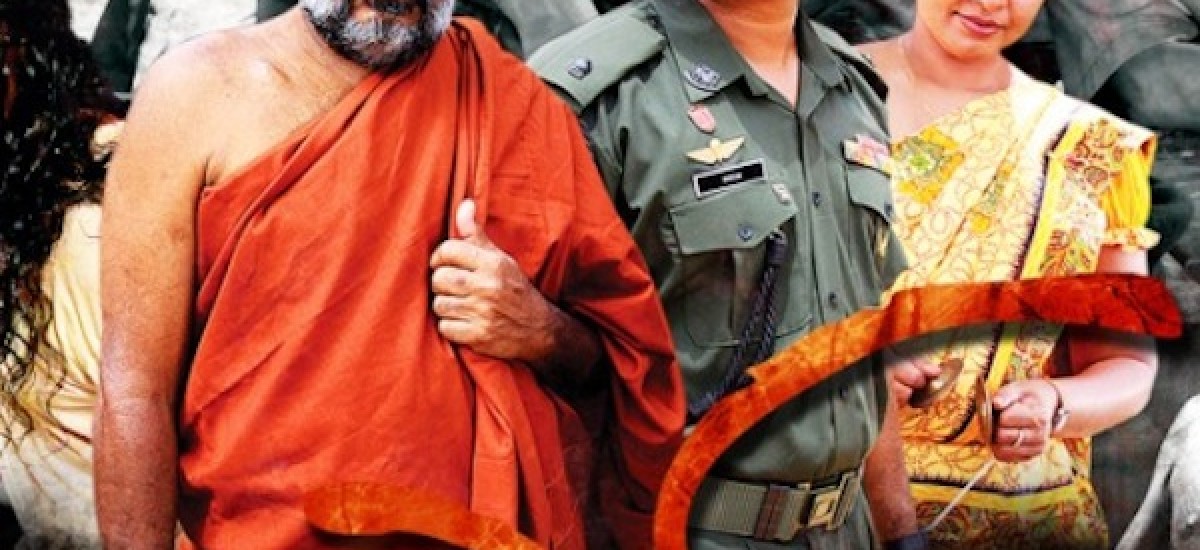
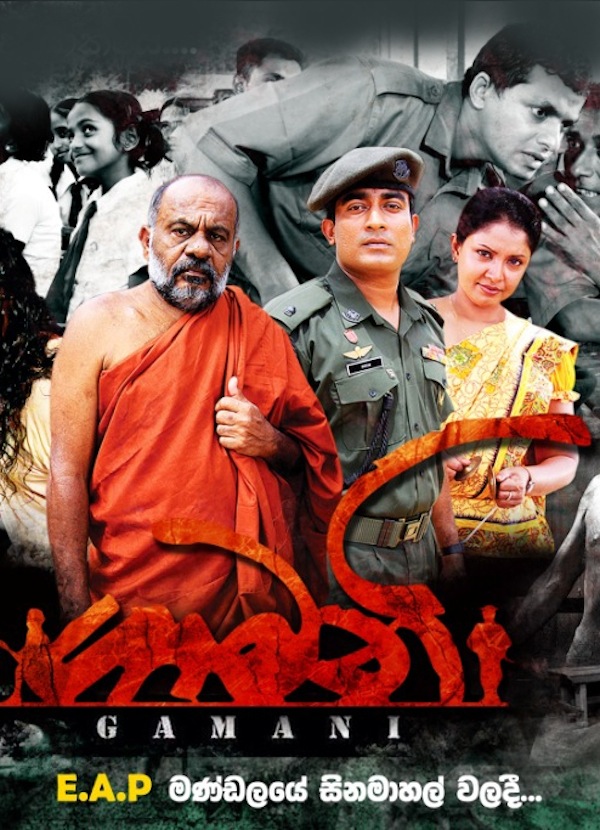
Conversely, there are five other films which had substantial access to the public. Sthuthii Newatha Enna (Anticipating Re-arrival) by Sumith Rohana Thiththawella, released on June 24, 2010; Ira, Handa Yata (Under the Sun and Moon) by Bennet Ratnayake, released on September 02, 2010; Sinhawalokanaya (Lion’s Retrospection) by Suneth Malinga Lokuhewa, released on January 14, 2011, Mahindagamanaya (Arrival of Mahinda Thero) by Sanath Abeysekara, released on May 18, 2011; and Gamani (Village Protector) by Sarath Weerasekera, released on August 19, 2011 became commercial successes as they were screened widely across the country including very remote areas. The last two films are still in theatre (by October 2011), with Mahindagamanaya passing the landmark of 100 days of screening and Gamani, 50 days. Maatha (Mother) by Boodee Keerthisena that is scheduled to be released on January 2012, follows a cinematic tradition similar to that of Gamani. However, since this film has not yet been released for public viewing, it is excluded from this discussion.
Despite the fact that in our view, all the films screened so far have been failures in a cinematic and artistic sense, they were ‘made popular’ (instead of ‘becoming popular’) by various means. Mahindagamanaya and Gamani were promoted by the State media. Sinhawalokanaya received free publicity by virtue of the 2011 Cricket World Cup while Ira, Handa Yata got promotion with its claim that it was an internationally-acclaimed film.
Subtext
Except for Sthuthii Newatha Enna, all the other four films are engaged in promoting Sinhala nationalistic sentiments to differing degrees. It is obvious that Sthuthii Newatha Enna is visual-wise based on Vimukthi Jayasundara’s 2005 Cannes-winning movie Sulanga Enu Pinisa (The Forsaken Land). However, ideologically, the film holds different views. While depicting the disillusionment of a group of people living in a border village, affected by the conflict, the film reiterates that the characters are awaiting a future that is positive and productive. Ira, Handa Yata centres on a meeting between a soldier and a critically wounded army officer in the battlefield. Following the officer’s death, the soldier ventures on a sacrificial journey to bring justice to the dead man. Sinahawalokanaya, located in pre-independent Sri Lanka, features a challenge undertaken by a band of locals to defeat an English cricket team in a bid to gain independence. They travel across time, and come to 2009, are trained by Sri Lankan professional cricketers, go back in time, and win the match, stressing the collective nationalistic strength against the British colonizer. Mahindagamanaya, subtitled as “Deshayaka Pibidiima” (Awakening of a Nation), is woven around the happenings during the reign of King Devanampiyatissa (307-267 BC). The film received a wider promotion from State channels as its release coincided with the 2600 Sambuddhathwajayanthi celebrations. Likewise, the screening of Gamani is being buttressed by State media. Based on the killing of fifty seven civilians by the LTTE in Gonagala, Ampara, the film claims to be “Esin dutuwange harda Saakshiya” (Conscience of the Eyewitnesses).
While romanticizing the conflict between the Sinhala and Tamil communities, underlying each film (except for Sthuthii Newatha Enna) is a heightened nationalistic agenda. Ira, Handa Yata and Gamani which graphically illustrate the war are altogether silent about the impact of the war on the Tamil community, and give prominence to the dilemma/sufferings of the Sinhala community. Sinahawalokanaya, positioning itself as “the First Cricket Film”, brings Sinhala Buddhist nationalism to the foreground.
Mission failed
In this manner, the films endorse Sinhala Buddhist nationalism, patriotism, and the construction of a hegemonic memory in a masculine history. In this context, cinema’s potential as a tool of reconciliation dissolves. In Lederach’s view, reconciliation fails when we create our enemy in our hearts and minds by separating ourselves from others, seeing ourselves superior to them, and dehumanizing them. To say that a similar situation prevails in the post-war Sri Lankan cinema is not an understatement. The films further widen the gap between the communities instead of creating a common platform for them to share and listen to each other’s grievances. This is similar to the 1980s Hollywood representations of America’s war in Vietnam in which, as Grainge argues, “Hollywood produced a particular ‘regime of truth’”.
As Lederach points out, an effective reconciliation process involves direct engagement with the conflicted person towards finding a solution rather than moving away from it, the involvement of a broader group of people as witnesses to create space for transparency and accountability, and most importantly, the maintenance of a relationship with the other party even when it is not possible to reconcile. Sri Lanka’s post-war cinema does not encourage the involvement of the conflicted communities with a determination to level out differences, but rather the communities are drawn away from each other. Nor does it involve a broader group of people representing both communities.
In these terms, the post-war Sri Lankan cinema plays a role that contradicts the essence of reconciliation. It fails the noble objectives stipulated in the LLRC, and fails to restore and heal the torn-apart relationships between the Sinhala and Tamil communities. This necessitates the emergence of an alternative cinema that is committed to propagating justice, truth and reconciliation.
References
- “Concern of His Excellency the President”. <http://www.llrc.lk/> Accessed on 14 Oct 2011.
- Lederach, John Paul. “Book Summary of The Journey Towards Reconciliation”. <http://www.crinfo.org/booksummary/10739/> Accessed on 9 Oct 2011.
- “Matha– A Film on the Sri Lankan Conflict.” <http://www.defence.lk/new.asp?fname=20091009_12> Accessed on 9 Oct 2011.
- Thanissaro Bhikkhu. “Reconciliation, Right & Wrong”. Access to Insight, 18 July 2011. <http://www.accesstoinsight.org/lib/authors/thanissaro/reconciliation.html> Accessed on 17 October 2011.
###
This essay is part of a series on the theme of post war reconciliation, justice and development initiated by the International Center for Ethnic Studies, (ICES). Colombo. The views expressed are the author’s own and does not necessarily represent the views of the ICES.