
World Cup cricket aiding reconciliation in Sri Lanka: Fact or fiction?

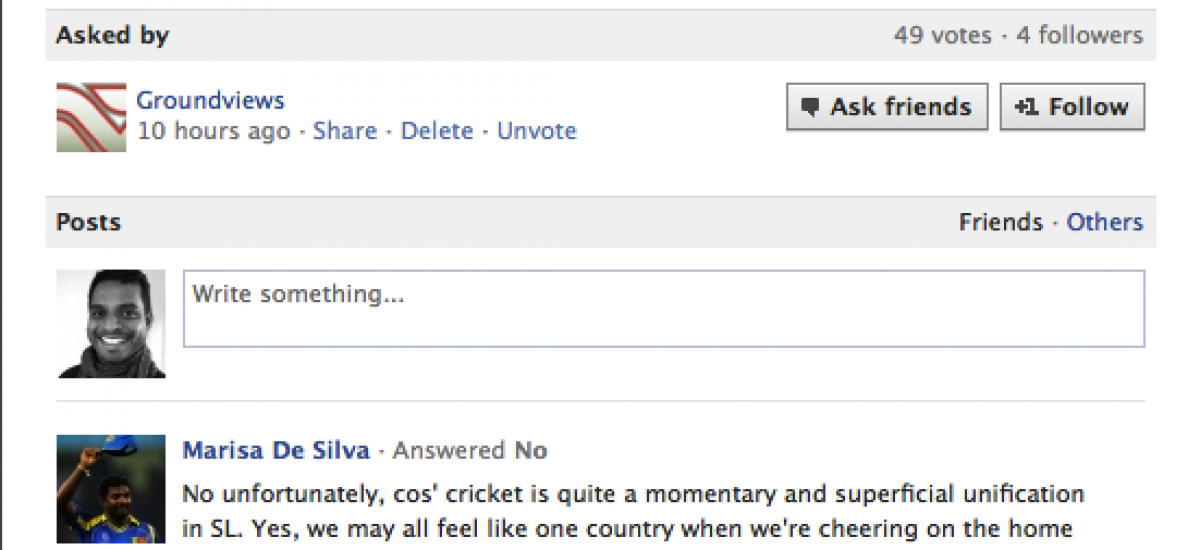
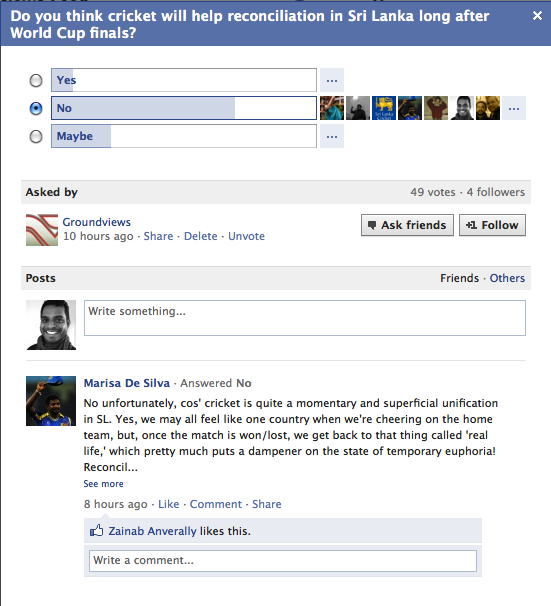
Groundviews is running a poll on its Facebook page (direct link to poll here) on whether its readers feel that the current interest in cricket can help reconciliation in Sri Lanka over the long-term. The visit of the Sri Lankan cricket captain, our beloved spin-bowler Murali and Ian Botham to areas most ravaged by the North was heavily covered by the media. Kumar Sangakkara’s statement after visiting the North resonated with many and was very widely featured across Facebook and Twitter,

“[The people of the north] have been deprived for 30 years of everything that we’ve taken for granted in Colombo. Sometimes Colombo seemed a world away from the war. We’ve never felt it as much as the communities in the North and East did. And sometimes we have to understand that we owe them our very lives and all the comforts we enjoy,” said Sangakkara.”

As was noted at the last World Cup, Sri Lanka’s cricket team is “…is a microcosm of what we should be and ought to be – a multi ethnic and religious group based on merit and performance and working together successfully as a team. It is something of which we can be justifiably proud of as a country.” Indeed, the Sri Lankan team’s performance in the 2011 World Cup has rekindled interest in the sport as a powerful unifying force in what, even post-war, remains a country with deep ethnic and political divisions.

Our poll, which readers can feature on their Facebook profiles, share via  Twitter or just email around is not meant to question the team’s current popularity or performance, of which there can be no doubt. It seeks to interrogate what is often an unquestioned belief in the ability of the sport itself, long after the euphoria of the World Cup is over, to foster reconciliation in Sri Lanka. The problems of reconciliation are systemic. Cricket offers a happy, episodic escape, yet may not address these underlying problems. Cricket has little or no presence in some parts of the country, especially in the North and East. If you don’t have grounds to play or facilities to train and practice, you won’t see cricket, or any national sport for that matter, as a healing or inspirational.

But what do you think? Can a sport that will bring a country to a standstill during the final match on Saturday be leveraged over the long-term to push for the real political and social reforms that we need for meaningful reconciliation?

Please cast a vote and drop us a note on Facebook.

Print this post

11,673 views

53 Comments

  1. It is to the credit of Kumar Sangakkara whose liberal upbringing and education at an Anglican institution that propels him to look at plight of these people with a humanist perspective.
    Unfortunately multiculturism is on defensive from UK to Sri Lanka . Even western liberal politicians now concede that it is not working.

  2. Re: Lakshan’s – “Unfortunately multiculturism is on defensive from UK to Sri Lanka . Even western liberal politicians now concede that it is not working.”

    From UK to Sri Lanka is only a very tiny slice of the world & world history – multiculturalism (ultimately getting several tribes to work together under a single national framework) has always worked very well (or i should say it is one political thing that has produced some of the most significant results, far better than single tribes attempting to compete against nations) – from the glory days of Greeks/Alexander, to the Romans, to pretty much every other significant empire or nation that had to make multiple tribes work together, to now the US. Only people to whom multiculturalism does not work are people who are too strongly attached to tribal identities & or the past – basically most conservatives (people who are generally afraid of the present & the future & thus seek comfort in an imagined past & an imagined comfortable identity that arises out of a tribal myth).

    But, all that aside :) , !go SL cricket team! – congrats on the recent win over NZ & good luck against India.

    - Sujewa

  3. I think we are asking the wrong questions here. You can’t ask for a ‘yes’ or ‘no’ answer to a question like “Can you build a house with sand?” or “Do rain drops cause a flood?” and expect an acurate answer. Surely our teams journey through the world cup has created many potent opportunities for reconcilliation in Sri Lanka. The question is have the thought-leaders, artists and social activists in our society made use of those opportunities.

    If we are actually interested in finding out for sure, why not perform an experiment. Let’s set up a large screen and projector (together with some light nibbles and soft drinks) at a child-soldier rehabilitation camp (or whatever PC name we use to call them) on 2nd April and organise ex-child combatants to watch the game together with and some Sinhalese kids… See whether or not “World Cup cricket [is] aiding reconciliation in Sri Lanka”.

    While we are at it, why not set up traditional Cricket fixtures between schools in the north and east and the rest to scientifically establish what sport in general and Cricket in particular can and cannot help us achieve…

  4. 1. Destroying the cemetries of the war dead and building Sinhala army camps on top of the buried

    2. Shooting dead the deputy director of education for objecting to Tamil children being forced to sing the Sri Lankan national anthem in Sinhala

    3. Tamil peoples land being plundered by the Sinhalese for their Sinhala / Buddhist expansionist programme.

    4. Destroying the Tamil peoples heritage sites and building Buddhist temples at those sites.

    5. Winning a cricket match by the Sri Lankan team.

    Of the above, which ones are etched for ever in The Tamil people’s mind? There lies the answer to the question whether cricket match will heal the division.

    Yes, it COULD be a healer IF other conditions are right. The chances of the other conditions being right is zero as long as the Tamil peoples land is occupied by the Sinhala armed forces and they are under the ruled of the Sinhalese whose ultimate aim is to rid the island of Tamils.

    • [1. Destroying the cemetries of the war dead and building Sinhala army camps on top of the buried] – There are no one buried in these “cemeteries”. They are just monuments erected for the propaganda of LTTE. Don’t lie

      2. Shooting dead the deputy director of education for objecting to Tamil children being forced to sing the Sri Lankan national anthem in Sinhala – Sure?

      3. Tamil peoples land being plundered by the Sinhalese for their Sinhala / Buddhist expansionist programme.- Land of N & E which belongs to the state, they can do what they want. It’s unjust and greedy for 7% of people to occupy 25% of the island.

      4. Destroying the Tamil peoples heritage sites and building Buddhist temples at those sites. – Another lie through teeth. Can you prove with evidence?

      The thinking pattern of separatists are quite clear here. They want a Tamil_only, ethnically cleanesed N & E. That’s why these people oppose Muslim and SInhalsese settlements.

      Of the above, which ones are etched for ever in The Tamil people’s mind? There lies the answer to the question whether cricket match will heal the division.

      “Sinhalese whose ultimate aim is to rid the island of Tamils.” -The well known Tamil Eelam myth. My arse! island of Tamils! this is island of everybody.

  5. “The people of the north] have been deprived for 30 years of everything that we’ve taken for granted in Colombo”

    Sangakkara, pl learn what has been happening in the last 22 months. You can leran about what happenend 1948- 1976 later.

    What an education system we have – opening to the eyes of the reaction of the oppressed and not the action of the oppressor.

  6. Sangakkara

    Pl take off your coloured glasses and put on clear glasses – some colours cut off some others from view.

  7. http://transcurrents.com/tc/2011/02/what_our_country_consequently.html
    Independence Day Message from the Rt. Rev. Duleep de Chickera, Metropolitan’s Commissary and Vicar General of the Diocese of Colombo, 2 February 2011:
    ‘’…. The end of the war provided an excellent opportunity for healing the wounds of the past.
    …. We have failed to address the pressing crises of displacement and poverty, corruption and waste, good governance and national integration.
    …. The old order is either incapable of, or reluctant to replace unjust systems and discriminatory trends with a more just order for the good of all our people.
    What our country consequently needs is a new political will that will restore the sovereignty of the people and bring about true national integration. .…’’

  8. Sangakkara

    http://transcurrents.com/tc/2010/06/vanni_northern_sri_lanka_where.html
    Vanni, northern Sri Lanka, where war has never ended, 1 June 2010:
    ”The area is still actually in the hands of the military, which allowed the return of the population but force them to live in absolute poverty. The military blocks any attempts to improve their lives, but does not stop abuse and violence.…. Permission has been rejected for counselling, capacity building and empowerment activities.”

    http://transcurrents.com/tc/2009/10/integrity_with_compassion_the.html
    Integrity with compassion: The destiny of Sri Lankans in IDP Camps
    Statement by the Rt. Revd. Duleep de Chickera. Bishop of Colombo, 24 September 2009:
    The Government’s decision to release persons in the camps was well received when first announced. If persons said to be released are in fact being transferred to camps in different Regions, this is misleading and must stop.

    http://transcurrents.com/tc/2010/04/four_new_sinhala_doctors_condu.html
    Four “New” Sinhala Doctors Conduct a Medical Camp in Mandaitheevu
    by Rev Fr.Lasantha de Abrew s.j., 18 April 2010:
    ‘’…For the past twenty years, the Sri Lankan Navy has captured the Mandaitivu village with these peoples’ houses and made it a High Security Zone. The people were displaced several times in different places and have last come back but they are staying outside of the naval camp in huts just gazing at their own homes occupied by the Navy. The doctors spoke to the people and observed their utter poverty. ….’’

  9. Wishful thinking!
    When the euphoria of the event and the ephemera of the 2 innings are done with, it will be back to hell again. It is an affront to the indigenous Tamils in Sri Lanka to expect them to live on crickets- may be in other countries

  10. Cricket like any other sports bring people together to enjoy competing and watching the best performers in that sport, Sports does not have any effect in pacification of people after the war or in conflict. It does have a role in reconciling and bringing people together after the causes of the conflict are resolved. Nobel Laureate Konrad Lorenz has said that, “Sports is redirected aggression.” This is true for sportspersons and sports lovers, with exceptions that sometimes lead to direct aggression.

    During the ceasefire, cricket, football, track and field, volleyball, and netball officials and sportspersons of past and present came to Kilinochchi, and other districts in the North and East to help in training sportspersons and officials and sports administrators. It had no political or reconciliation agenda, It is sportspersons of all communities in Sri Lanka getting together and improve sports in the region. After the tsunami, SL cricket and football, with the help of their international governing bodies and Mr. Football, Manilal Fernando, gave much funds and expertise to improve sports participation and performance, and they used sports as a therapy for those affected by the tsunami and the war to cope with daily life. They continued their valiant efforts until 2007 when the embargo of the North was re-instituted and the war resumed.

    I have the video I took of the SL cricket mission lead by Hashan Thilakaratne – who read his address in Tamil to an overflowing crowd of people – and SL officials and players presenting the monthly donation of Rs1,000 to 200 of the children who lost their parents to the tsunami. It was a touching ceremony and we all hoped that from the common tragedy and the humanitarian response of SL cricket and Football federations would usher in resolution of the conflict and peace. But the waring parties did not take the goodwill prevailing at that time. With the change of government, the war erased all the goodwill. The lesson we learned is that sports does not resolve political conflicts. But, like Rugby in Mandela’s South Africa, it can help to make people bond and heal the wounds of war after the causes of the conflict are resolved.

    Muralitharan in his interview with the BBC reporter (http://www.bbc.co.uk/sinhala/news/story/2011/03/110329_cricketcharity.shtml)
    has said, “… that if he, as a Tamil, worked with a Sinhalese person playing or arranging matches, it would be a good sign of reconciliation. But if such initiatives didn’t come, he said, there might be a danger of young people in the north taking up arms again.”
    Murali, Arnold, Aravinda and others have visited the North before the tsunami. After their visit the SL cricket has done much to improve cricket in the North, but it did not usher in peace nor reconciliation of the communities in conflict.

    With these reservations I do hope Sangakara and the team that visited the Vanni to build a sports village in Mankulam continue their efforts, in cooperation with other sportsperson without letting politicians hijacking the project to enhance their own fame and policies in lieu of a political solution to the conflict. I wish Sangakara and his valiant World Cup team all the best against the formidable opposition, India. Win or loose the people in Sri Lanka will admire your attempt and humanity.

  11. Ethir
    How many Tamil cricketers were in the Sri Lankan team in the last fifty years please?

    • Eureka,
      I can only start from Sathasivam, Sathi Cumarasamy, Chandra Schafter, Shanmugam and so on. Michael Roberts have given all the Tamils who played for SL. You may wish to refer to back issues of groundviews. There are many Tamils who have played in first class cricket. If you are hinting that there is discrimination in selecting national teams that compete internationally, I would say yes. If your question implies that the Tamil sports persons did not have equal opportunities to train and compete with teams in the South, since the seventies, you will be right. But there are other factors that determine sports performance and this forum is not the place to discuss them. But suffice to say that we should also ask, why is it that no Sinhalese, Tamil or Muslim men have won a medal at the Olympic Games after Duncan White did in 1948. A second question is whether there are any potential women athletes who can win a Silver medal at the Olympics, like Susanthika did in 2000 Sydney Games, for at least another 10 years.
      It has been more than 50 years since I won the first Gold in the high jump at the 1958 Asian Games – ironically on the same day the 1958 Pogrom against the Tamils took place in Ceylon. To date no Tamil, Sinhalese or Muslim has won a medal in the high jump at the Asian Games. I can offer theories. One of them is that Tamil and Muslim school children attend after school tuition classes for 25 to 28 hours per week in addition to 25 to 27 hours per week of school. None of my immediate family, except for my brothers wanted me to go to the Helsinki Olympics in 1952, because they said I will miss the SSC exam!!! Need I say more.

    • Thanks for this note Mr Ethirveerasingam — puts quite a lot in context!

  12. 1. we have made 18A
    2. elected members of PCs can be vetoed by the governor appointed by the President
    3. army controls everything in Northeast

    cricketers and music festivals can be sent to the North to obfuscate the people in the North, the people in the South and people outside the shores of the island.

  13. On a note aside, Murali is a gentleman but has he ever spoke up about the ethnic violence, including the burning down of the biscuit factory that his father owned, that led to armed resistance and subsequent loss of several generation of Tamils and constant displacement both inside and outside the country? He may be the ideal Tamil, who would know his place in the country.

    Assuming that sporting events would aid reconciliation, how meaningful it would be with the absence of truth and justice is questionable.

    • ya Murali is a real gentleman. coz he has not spoken about 83 riots as well as “peace full attacks on tooth relic temple” which also happened in his hometown, was not giving any tamil a problem. because he knows the meaning of reconciliation! that MV fails to understand

  14. “But while many in the Tamil community will be cheering for a Sri Lankan victory on Saturday, few buy into the president’s claim that it will help usher in a new era of ethnic unanimity.

    “We enjoy good cricket, but I don’t think a World Cup victory will make it any better for us,” said opposition Tamil legislator Marvai Senathirajah.”

    From Cup final reprieve from S.Lanka tensions, http://www.google.com/hostednews/afp/article/ALeqM5hF-MyzHAzOsXt-RmP-o13r-nQEkQ?docId=CNG.aecc32d05117083937e1ddc1b7482bef.541

  15. Ethir

    I’m NOT arguing against justice, reconciliation and peace.
    I’m only saying there is no sign that there is any change in the rulers’ heart for the last six decades.

    This thread is NOT about the performance of Sri Lankans in Olympics.
    This is about how cricket will bring about peace.
    Pl tell us about your ordeal in going to the Olympics.
    When aid agents have been prevented from helping the IDPs since 18 May 2009, what hope is there please? It is exactly the way tsunami funding was obstructed to the Tamils and Muslims:
    Approaches to equity in post-Tsunami assistance. Sri Lanka: A case study, Mandeep Kaur Grewal(DfID), 2006

    It is how Northeast has been denied economic development and making the people of the Northeast leave the Northeast for the South after independence. As a teacher in the 60s/70s/80s I know how technical colleges in the South have been far superior to the one in the North and tamils had problems getting into the ‘national’ – type colleges, leave alone universities. Government employment has been nearly nil.

    Will the government publish the statistics of ethnic composition of its workforce in the last six decades. I’ve been trying to scour the internet but the dept of statistics doen’t say much about it. They have stopped giving the data.

    When the government tells TNA to go and look up the database in a certain govet dept for those in its custody and the police tells the relatives that no such data is there and that’s the election gimmick of TNA, what hope is there? Tamils are waiting(NOT struggling to get out of the boots. If they ‘struggle’, the boots will go sturdier.) for the trampling boots to move away so that they can first of all breathe.

  16. (Quit facebook ages ago, so my comments will have to go here. I’d have loved to have seen the facebook page’s discussion, though; I’m guessing there’ll be much more comments there.)

    On the poll itself. I feel the discussion that the poll generates, will be far more useful than the poll itself. Because I feel the question can be interpreted quite widely and differently by different people, thus reducing the poll results’ value. E.g., some will think the question means
    -”The way cricket (and our interest in it) is NOW, do you think that it can in the long term help……”;
    -others will think it means “Is there any way we can HARNESS cricket (and interest) so that in the long term it can help……..”.
    - Other may think it refers to the way that some “high ups” NOW seem to be trying to “use” cricket for a un-genuine effort towards this goal.

    E.g., my answer to the 1st interpretation is NO; but to the 2nd: “maybe.. it depends…”; to the third: NO NO NO.

  17. I’ve many thoughts on this matter; but a bit hard to articulate, so I’m glad to be able to piggy back :-) on some others’ similar viewpoints: briefly:

    - similar to what N K Ratnam pointed out:
    the idea that there are great many other wrongdoings (past and present) which have greater impact on the victims than whatever good (if any) cricket can do.

    - Similar to what Nagalingam Ethirveerasingam (“after the causes of the conflict are resolved”) and MV (“how meaningful it would be with the absence of truth and justice is questionable”) said:
    I think there are “OTHER things” that need to be done first (or at least, in parallel) I’d guess.

    - Worse, about such “other” things: I feel the “interest in Cricket” CAN (not saying it IS, just saying CAN) be made use of by crafty clever higher ups, to distract attention away from those other important things that need to be done. Whitewash, I would say; or better: “obfuscate”, as eureka neatly and succinctly expressed.

    - Several commenters seem to think that Sanga’s/others’ statements don’t capture the full picture?
    I think so too, although I do NOT think that any of the CRICKETERS themselves are INTENTIONALLY “helping” anyone to whitewash/cover-up the true picture. Whether that’s because of wearing “coloured glasses”, or fear to speak out, or what, I don’t know.

    I also have some thoughts on this cricket-and-reconciliation issue, looking at it from some DIFFERENT angles. But finding those even harder to articulate, unsure if I’ll manage to type that, hopefully will do so later; anyway very briefly, those are about:

    1. the way that the present interest in cricket has (sometimes; or too often?) an unhealthy aspect of making our fervor for it be at the detriment of other important things. That will NOT help the “big picture” of the reconciliation issue.

    2. the way that cricket — sometimes (too often?) — has become TOO much a part of our perceived “Identity” (not sure if “identity” capture exactly what I mean) — that is, almost like religious fervor; which rings alarm bells, since it sounds to me JUST like how the entire “ethnic problem” has also been been impacted a lot by another kind of distorted concept of “identity” (e.g., some people’s cultural/ethnic identity becoming associated in their minds — wrongly — too strongly with the country’s national identity.)
    The reason I see such “too much” cricket in our “identity” sometimes, is best illustrated by examples: by our (over) reaction to AI’s campaign; and by the sometimes absurd levels of anti-Australia sentiment.

    • @ Sohan

      “the way that the present interest in cricket has (sometimes; or too often?) an unhealthy aspect of making our fervor for it be at the detriment of other important things. That will NOT help the “big picture” of the reconciliation issue.”

      Good point. I don’t know about reconciliation neither do I follow cricket but for few days, the hungry masses will forget that they are hungry – you can of course deduce who will benefit.

      Who needs cricket by the way, when His Majesty is ruling the whole country under his iron grip like the great Dutugemunu?

  18. Eureka,
    What is most important is to get the people in the Vanni to become economically independent, improve the education of their children, help them to cope with the trauma of war and displacement and help them to help themselves through their own local democratic organizations. That is what the people in the Vanni told me during my work with them the last six months of 2010.
    Einstein had said, in reference to the environment problems, that the thinking that brought us to the present situation cannot take us out of it. This would apply to our ethnic conflict. Unfortunately I hear no new thinking to solve the problem yet. It is important to get cricketers and other sportspersons to help in the Vanni so that they can be the Ambassadors of the Tamils to convince the Southern voters the need for a just solution. A people to people dialogue is necessary. If that fails I shudder to think of the consequence.

  19. Ethir

    That’s exactly what we all like to see. But what has been happening? If journalists are severely restricted into the Northeast what does that mean? If aid agents are restricted from helping the war-ravaged IDPs what does that mean? If abductions and killings continue and a minister tells the parliament that there is fear psychosis in Jaffna what does that mean? Have the cricketers ever spoken on these unspeakable injustice to those in the Northeast? If cricketers say “[The people of the north] have been deprived for 30 years of everything that we’ve taken for granted in Colombo” the problem will never be solved because the ”30 years”(meaning LTTE) is no more there.
    Why can’t he say what has been happening in the last 22 months in the Northeast is unacceptable even if he was only born 25 yrs ago and doesn’t know what happened before he was born? Is it because he doesn’t ”see” it or is he prevented from seeing it – some people have not been allowed to go down A9 but only allowed flights into Jaffna with no cameras?

    Pl let me point out the following though they have been discussed here umpteen times and pointed out to LLRC by many eminent Sinhalese:

    1. ”…become economically independent, improve the education of their children, help them to cope with the trauma of war and displacement and help them to help themselves through their own local democratic organizations …” have been blocked in many ways by the government.

    ii. ”…thinking that brought us to the present situation cannot take us out of it…” is put in a different way:

    http://transcurrents.com/tc/2011/02/what_our_country_consequently.html
    Independence Day Message from the Rt. Rev. Duleep de Chickera, Metropolitan’s Commissary and Vicar General of the Diocese of Colombo, 2 February 2011:
    ‘’…. The end of the war provided an excellent opportunity for healing the wounds of the past.
    …. We have failed to address the pressing crises of displacement and poverty, corruption and waste, good governance and national integration.
    …. The old order is either incapable of, or reluctant to replace unjust systems and discriminatory trends with a more just order for the good of all our people.
    What our country consequently needs is a new political will that will restore the sovereignty of the people and bring about true national integration. .…’’

  20. luxmy
    thanks.

    ”I shudder to think of the consequence.”

    Ethir, I’ve been shuddering since:

    http://news.bbc.co.uk/1/hi/8142550.stm
    Sri Lanka orders cuts in aid work, 9 July 2009: ‘’The Sri Lankan government has told international relief agencies to cut back their activities in the country. … But it(ICRC) says an estimated 300,000 displaced people still need food, medicine and help to return home.’’

    http://transcurrents.com/tc/2010/03/no_funds_to_meet_needs_of_near.html/
    No funds to meet needs of nearly 200,000 Northern IDPs due to govt refusal to endorse 2010 action plan, 13 March 2010: ”The funding crisis follows the government’s refusal to endorse the 2010 Common Humanitarian Action Plan (CHAP)…. The UN and other humanitarian agencies are running out of resources to meet the urgent needs of internally displaced persons in the North. …”

    http://www.asianews.it/news-en/Vanni,-northern-Sri-Lanka,-where-war-has-never-ended-18558.html
    Vanni, northern Sri Lanka, where war has never ended, 1 June 2010:
    ”The area is still actually in the hands of the military, which allowed the return of the population but force them to live in absolute poverty. The military blocks any attempts to improve their lives, but does not stop abuse and violence. …. Permission has been rejected for counselling, capacity building and empowerment activities.”

    ………….
    ……………..

    http://www.minorityrights.org/10458/reports/no-war-no-peace-the-denial-of-minority-rights-and-justice-in-sri-lanka.html
    No war, no peace: the denial of minority rights and justice in Sri Lanka, Report by Minority Rights Group International, 19 January 2011

    http://www.island.lk/index.php?page_cat=article-details&page=article-details&code_title=14340
    A publication of the Institute for Constitutional Studies, ‘Twenty Two Years of Devolution – An Evaluation of the Working of Provincial Councils(PCs) in Sri Lanka’, launched on 21 December 2010

    ……………………………..

  21. Ethir

    We all like to see the IDPs ”cope with the trauma of war”.

    But what is the ground reality?

    http://www.llrc.lk/images/stories/Fr._Shelton_Fernando.pdf
    ”…. The Counseling process is denied to the victims of war. It was reported by the authorities of a figure of 89,000 war widows, there in severe trauma and stress. However, in such instances counseling is denied to them …. the Presidential Task Force (PTF) has denied these facilities for healing and reconciliation. ….’’

  22. ”What is most important is to get the people in the Vanni to become economically independent, improve the education of their children, help them to cope with the trauma of war and displacement and help them to help themselves through their own local democratic organizations. That is what the people in the Vanni told me during my work with them the last six months of 2010.”

    That is what many conscientious and learned Sinhalese have recommended to LLRC. They have also expressed their anguish at the painfully slow speed of work. How is LLRC going to take the recommendations forward?
    The following is alarming:

    http://www.tamilnet.com/art.html?catid=13&artid=33754
    Rajapaksa’s LLRC seeks Buddhist Prelates guidance to prepare final report

  23. @Sujewa, I think you are mistaken in assuming that the US follows a policy of multi-culturalism. The US tries to assimilate people towards a common national identity in a similar way to China and, arguably, our own government. Canada and the UK are better examples of multiculturalism, but, of course, David Cameron’s coalition has recently taken the decision to abandon this policy, having labelled it a failure. You can see the same trend away from multiculturalism happening in France (banning of face veils, eviction of Roma gypsies), and Switzerland (banning of minarets).

    • @Ravana

      Neither Canada nor UK actively pursue ‘multi-culturalism’ as a policy. In fact, multicultural policy was introduced in the context of French-English relations in Canada – little to do with visible minorities, who are mostly recent immigrants concentrated in metropolitan centers. This makes them no different from the US ‘melting pot’ assimilation model. Which is why, the concept of ‘multi-culturalism’ is regarded as a failure.

      Anyway, this poses the question of whether ‘multi-culturalism’ could work in SL unless maybe actively pursued as a policy by the gov’t – however, history has it different i.e. Sinhala Only, colonization, gradual assimilation of coastal belt (Negombo) Tamils.

  24. Ward,
    I admit that I am “innocent.” It is something that I am born with I think. I have read the references quoted by all and more and I have lived the conflict and heard much. But I am yet to here or read any concrete action plan that will help the Tamil people in the North, East and the South gain their dignity let alone political rights.

    World cups are not won by just talking about techniques, strategies and statistics. My advice to GSL is to replace the Government appointed Interim Committee and let the Cricket Association hold their elections and make decisions democratically to promote cricket, and prepare for the next World Cup in 2015.

    May be at the same time the GSL could let the NorthEast hold their elections so that the elected representatives can write a proposal that could form the basis for negotiations for a just solution to the conflict. Now I am being naive.

    • Ethir
      Your sporstmanship is unassailable and venerable.

      ”… yet to hear or read any concrete action plan ….”?

      Many conscientious and learned Sinhalese(retired judge, professors, retired diplomats, researchers and administrators) spent a great deal of time to submit recommendations to LLRC. Alas! what did we hear/read?
      The Lessons Learnt and Reconciliation Commission (LLRC) members met the Chief Incumbents of the Malwathu and Asgiri Chapters last week to seek guidance(Lakbima, 3 April 2011) !!

      Guidance ??

      Then what were these highly-respected Sinhalese wasting their time for??

      I have just found this:
      http://www.equinoxjournals.com/ROSA/article/view/3519/2212
      ‘’ …. Chandra R. de Silva implies that Buddhist monastic opposition to a non-unitary state has contributed to the conflict. He appreciates the reasons for this, but pleads for a system of monastic education that would expose monks to other religions and cultures. ….. I have no hesitation in recommending this volume as a serious contribution to the understanding of one of the most complex and intractable conflicts in the world’’, Dr Elizabeth Harris(Liverpool Hope University), Review(2007) of Buddhism, Conflict and Violence in Modern Sri Lanka(2006)

      Sri Lankan version of peace and prosperity !!!!

      • Really I was referring to the link given in this article.

        Thanks, ward for the valuable link provided.


  25. SL cannot address Tamil concerns alone. It must address concerns of all people. Tamils don’t make sufficient effort towards reconciliation. They find everything lacking, insufficient, etc. for reconciliation.

    The truth is Tamils need reconciliation more than the others!

    The winners (of war) can and will get things done the way they want, but the losers (of the war) will not.

    Peace, war and ceasefire had 2 versions.

    1. SL version
    2. Tamil version

    So does reconciliation.

    SL should ONLY concern about the SL version and nothing else. It includes Tamils to the extent Tamils are PART of unitary SL and that’s all. Tamils (as a nation or a nationality) certainly don’t and shouldn’t get equal status as Sri Lanka (the nation or the nationality). Don’t even expect it. Tamils of SL are only Sri Lankans, nothing more.

    Of course the president is day dreaming! The only long term, lasting solution is changing the ethnic composition of the north. That will achieve SL version of reconciliation right through out the island nation. This way, those who don’t agree with the SL version of reconciliation will be outnumbered and overpowered throughout the country so their IRRECONCILABLE HATE will not matter at all.

    • @TT:
      TT said:
      “Peace, war and ceasefire had 2 versions.
      1. SL version
      2. Tamil version

      So does reconciliation.”

      Firstly, I think for a more accurate representation one must also clearly state and accept that:
      - the 1. SL version (of peace, war, ceasefire and “reconciliation”)
      in reality consisted (and continues to) too much of a “Sinhala”, and sometimes “Sinhala Buddhist” version;
      - and that this is and was (and seemingly will continue to be) a large part of the problem.
      It seems to me, it’s being unfairly one sided to blame ONLY the (SOME) Tamils who are demanding too much and/or who have — to use TT’s words — “IRRECONCILABLE HATE”.

      Secondly, TT said:
      “…
      It includes Tamils to the extent Tamils are PART of unitary SL and that’s all. Tamils (as a nation or a nationality) certainly don’t and shouldn’t get equal status as Sri Lanka (the nation or the nationality). Don’t even expect it. Tamils of SL are only Sri Lankans, nothing more.”

      … and in that perspective, I feel that statement might be alright… but ONLY IF it is qualified by and kept in correct perspective by ALSO unambiguously clarifying that:
      Also, It (should) include Sinhalese to the extent Sinhalese are [also, only] PART of unitary SL and that’s all. Sinhalese (as a nation or a nationality) certainly don’t and shouldn’t get equal status as Sri Lanka (the nation or the nationality). Don’t even expect it. Sinhalese of SL are only Sri Lankans, nothing more.”

      … and such clarification IS especially needed because one must realize that, the reality is too many people would wrongly take the name “Sri Lanka” (even in TT’s context above) as being synonymous with “the Sinhala nation” or “Sinhale” or “Sihala Deshaya” or “the Sinhalese”, etc.

      Seems to me that people all too often are willing to state ONLY what TT stated, or only what I stated; whereas both are ground realities than need to be faced and addressed.

      Finally, re TT’s comment overall: I strongly feel the way you’ve put it may be taken as (hopefully unintended?) an over generalization, i.e., seemingly blaming “Tamils” (which I read as meaning ALL Tamils) for not making “sufficient effort” etc.

      And, like I said, it seems unfair to point out such a failing in (even if it were only “some”) Tamils, without also clarifying that an equal failing is present in (“some”) Sinhalese.

      And while I can see that changing ethnic composition in North might reduce the ability of — e.g., my example — separatists from getting support and becoming violent again, it seems crystal clear to me that this solution will NOT do anything towards “teaching” the large subset of Sinhalese (neither in the North nor elsewhere) who need to learn and accept that the “Sinhalese” identity is NOT “synonymous” with/ same as/ on the same level as a true Sri Lankan identity (neither, for that matter, does it teach this to any Tamils or others, which might become a problem at some future time).

      IF we had a genuine understanding and acceptance (and “implementation”, so to speak) of the truly Sri Lankan identity, AND of how ethnic identities should play (only) “contributory” and “cooperative” (for lack of better phrases?) roles towards the NATION’S “larger” identity, then it would not matter if parts of the island had a huge majority of one ethnicity or religion or other categories. Whereas, “solutions” such as this ethnic “dilution”, are simply stop gap solutions which IGNORE (and possibly even leave room for future fermentation of) the root problems.

      • SF,

        “Also, It (should) include Sinhalese to the extent Sinhalese are [also, only] PART of unitary SL and that’s all. Sinhalese (as a nation or a nationality) certainly don’t and shouldn’t get equal status as Sri Lanka (the nation or the nationality). Don’t even expect it. Sinhalese of SL are only Sri Lankans, nothing more.” …”

        100% agree!

        It is natural that 74% of the Sri Lankan version is driven by the Sinhalese and 18% by Tamils and 8% by Muslims. It must be accepted.

        “IF we had a genuine understanding and acceptance (and “implementation”, so to speak) of the truly Sri Lankan identity, AND of how ethnic identities should play (only) “contributory” and “cooperative” (for lack of better phrases?) roles towards the NATION’S “larger” identity, then it would not matter if parts of the island had a huge majority of one ethnicity or religion or other categories.”

        I understand what you say.

        But it does not work. There are Tamils who support the SL identity. They are part of the solution which means they need no further solutions. There are those Tamils and ALL Tamil political parties (TNA, TULF, ACTC, etc.) of the north-east that want a seperate identity like the SL identity. They are the ones needing a “solution”. Diluting or liquidating this “Tamil National” identity is the ONLY way to build an island-wide SL identity.

        This identity problem is not the creation of “Sinhala” majority politics. Tamil seperatists point out that until 1833, even the colonialists managed the north seperately from the south! Tamil seperatists also believe there was a Tamil homelands in the island. IF these beliefs stay, there is no way they are going to genuinely agree to a SL identity. (IF the Tamil homeland came into being in 1956, no problem because that means it is not historical! If anyone believes in it, it must have been their – in their version of history – for a long time.)

        Diluting the Tamil majority in the north will not have any seperatism stemming from it! :) Absolutely not! It may have defence challenges but that is why the 250,000 security forces are there with a US$1.6 billion budget, largely stationed in the north-east. This is what the ITAK/TULF/LTTE fear/ed most and they hastily “cleansed” the north of Muslims and Sinhalese.

        Basically the 2 reconciliation versions are contradictory. SL reconciliation model and Tamil reconciliation model are IRRECONCILABLE!!!

        You can arrive at a conciliatory solution when it is the target of both groups. Not otherwise.


      • Let me add this.

        You don’t need ANY reconciliation for Tamils to play in the SL cricket team!!!! :) They play without any reconciliation! Mutual respect is sufficient. Just look at the team and the squad!

        Those who cannot reconcile or say they are unable due to some clumsy reasons should learn from the Tamils in the team how to reconcile.

        If they still don’t want to or unable to reconcile, be my guest. They gain nothing and will lose more which is actually good. Weakening the people who won’t or can’t reconcile with the SL version of reconciliation is part of the reconciliation process! I mean the SL version.


  26. However trying to use cricket victories for political aggrandizement is another idiosyncratic South Asian phenomenon

  27. One of my friends was watching the final at Galle Face and after SL lost to India, he heard some people saying ‘we should hammer the Tamils’ – does that answer the question?

    • Let us not delay, National Institute of Education:

      http://www.llrc.lk/images/stories/docs/LLRC_-_9.11_-_Prof._Laxman_Jayathilaka.pdf
      ”First of all about education because that I see is a key to some of these difficult situations;
      to get into them and to understand them and to do something constructive.”

    • Disgusting!

      But the good news is most people don’t think this way and most people who think this way don’t put it to practice for fear of the military.

      There is no need for paniky solutions for the foul mouths of a few.

      • Which ‘most people’? Perhaps ‘most people’ don’t think Tamils need to be hammered because SL lost to India but surely that comment was a symptom of something deeper and more far-reaching?


      • And for how long is the military going to scare people into not expressing or ‘putting into practice’ their prejudices? Surely the military is made up of the same people who make up society and share similar prejudices too?


      • What happens in other countries?

        Perpetual military presence!!

        A strong military ready for action is needed to deter any form of violence. When people with violent tendancies are deterred for long periods of time, non-violent conduct becomes their norm!

        On the other hand there is no need to exaggerate. In every society there are undesirable elements and cunning elements trying to make political advantage out of them. Both are one and the same. One need other to abuse/extort.


  28. I got this mail from someone:
    “First: It was a great game and India were the better team at the final, and during the tournament. I mean to take nothing away from such an epic victory, which I believe is something the entire subcontinent can be proud of. My gladness for Sri Lanka’s loss stems not from anything to do with India or their win.

    Before and during the game I supported Sri Lanka and hoped for a victory. Being an unsinkable optimist down to the very last ball I continued to believe that there was hope. But then we lost. We clapped for Dhoni, Gambhir, Zaheer and most of all for Tendulkar (Few Sri Lankans like Yuvraj or Harbajan).

    It was only when I was on my way home that I understood the full implications of what a World Cup victory would have turned Sri Lanka into. Perhaps I should have known this all along. Perhaps I was just blinded by a possible World Cup victory. Perhaps I’m not always as aware of what’s going on around me as I would like to think.

    As we drove past the offices of Sri Lanka Cricket we saw them with the gates wide open for the first time in a long time, ready for an all-night party. Their walls and gate decorated and their officials dressed to the nines. I felt sorry for them not getting to throw their big bash. But then I remembered… this is the same Sri Lanka Cricket who fucked fans who queued up overnight to buy tickets for the games in Sri Lanka by selling almost all the tickets to scalpers. This is the same Sri Lanka Cricket who orchestrated a vicious smear campaign against former captain Arjuna Ranatunge through the vernacular electronic media in the days leading up to the final. This is a governing body that does not care about the fans or the players. And I’m glad they didn’t get to party all night with my money.

    Then we drove past Independence Square where giant awnings had been erected in preparation for a national celebration. This was to be an event that was to be attended by the president where he would confer special honors upon the players. This was to be an event where the President and his sons basked in the glow of a victorious cricket team and used the team’s win to add further veneer to the regime’s pseudo nation-building program. This is the same President that fucked the whole country by raising fuel prices on the eve of the World Cup final, when they knew everyone would be distracted. This is the same President who’s pork-barreled almost all of Sri Lanka’s development funding into a semi-arid sparsely populated district in the South-East, and then built a cricket stadium there to please his son. This is the same President who’s responsible for the deaths of over three dozen journalists and media people, and the exile of many more. A win last night would have been very easily interpreted/hijacked as a validation of his rule.

    It was only when I woke up this morning and heard of all the other state sponsored events in Colombo which have been cancelled because of the loss that I fully understood why I must’ve been bat-shit crazy to hope for a win. This would’ve been an unprecedented public relations coup for the regime. All the glory of winning something awesome, minus the having-to-kill-your-own-civilians part.

    Have no fear. Sri Lanka will win the World Cup again someday. But I hope it’s in a time when we have a leader we can all stand behind, a government that we all trust, a flag that we can unite under, an anthem we can sing in whatever language we want to sing in and a nation that we can all be proud of.

    That victory will be epic, and it will be ours”

    • The author of that missive is Sanjay Senanayake.

    • Making the most of both victory and defeat, the Lankan style! :)

      I have heard the other side of the story too. It goes it is good SL team didn’t win because had it won, an outstanding cricketer from the hills who is fluent in 3 languages with a strong affiliation to certain political views would have made use of it to enter politics which would have been detrimental to the other group. Along with him, another very senior player with similar political views would have entered politics from the same party which has a higher number of popular personalities (outside politics) in parliament.

      At least 4 players from the 1996 world cup winning team entered politics. 3 of them are/were active in politics from the opposition while one is in the ruling party.

      All in all Lankans know how to take it positively!!

Leave a Reply

This is a moderated forum. Comments are the sole responsibility of the person posting them. Please do not post comments that are off topic, defamatory, abusive, threatening or an invasion of privacy. Comments are automatically scanned for spam and obscenity.

Comments are only approved if they are in line with the site guidelines. Those that do not will be edited or deleted without prior intimation. Comment approval may take up to 24 hours.

Thanks in advance for your civil and constructive engagement.

Spam protection by WP Captcha-Free

About Groundviews

Located at the Centre for Policy Alternatives in Colombo, Sri Lanka, Groundviews is a citizen journalism website that uses a range of genres and media to highlight critical perspectives on governance, reconciliation, human rights, the arts and literature, democracy and other issues. The site has won two international awards, including the prestigious Manthan Award South Asia in 2009. The grand jury's evaluation of the site noted, "What no media dares to report, Groundviews publicly exposes. It's a new age media for a new Sri Lanka... Free media at it's very best!"

cezarneaga.eu
canakkale canakkale canakkale balik tutma search canakkale vergi mevzuati bagimsiz denetim vergi mevzuati ozurlu engelliler