Responding to Geneva by Exemplary Restitution

rajapaksa_llrc_report

Robert O. Blake has once said, “International mechanisms can become appropriate in cases where states are either unable or unwilling to meet their obligations.” After Geneva March 2013, US officials have reiterated this in stricter terms. TNA MP Suresh Premachandran has said the final Geneva Resolution will not relieve the affected Tamils and reminded the UNHRC wish (2012) to implement the LLRC recommendations, which allegedly has been defaulted. TNA Leader R Sampanthan has said that if Government of Sri Lanka (GOSL) complied by implementing the LLRC recommendations, a second resolution could have been avoided. However, Japan’s Yasushi Akashi has made a favourable statement for Sri Lanka, quoting his visits to North Sri Lanka and how “the whole country coped with the challenges” In Geneva Minister Mahinda Samarasinghe described positive developments.  Later, Minister Wimal Weerawansa exhorted that Sri Lanka is unshaken by Geneva resolutions, while Minister DEW Gunasekara feared worse befalling by government defaulting. Is this confusion due to different viewer notions?…

Continue reading »

A Missing Person in Sri Lanka: Heartfelt Issues & Ground Realities

sri-lanka-missing-people.jpeg-620x412

Image courtesy Salon / AP Photo by Eranga Jayawardena When I was in Sri Lanka from mid-April to early June 2009 I was on holiday with my wife and not able to pursue investigations in any depth. In contrast my sojourn in May-June 2010 focused on a range of studies and travels. One gem of a life-story surfaced near my second home in Wellawatte when I was able to chat with a domestic servant at a Tamil house nearby, a lady who had been through the crucible of Eelam War in the Vanni Pocket. I shall call her Sambandhi. She was a wizened wiry soul who had survived the war together with husband, but (1) had one daughter killed by shrapnel; (2) one son (who was then aged c. 21) hospitalized in mid-2009 with the loss of one eye and injuries to face and other eye;[i] and (3) was wracked with pain because one of her sons had been conscripted…

Continue reading »

#unlk: Archive and visualisation of tweets on Sri Lanka at HRC’s 22nd Session

Screen Shot 2013-03-27 at 11.00.11 AM

The 22nd regular session of the Human Rights Council was held from 25 February to 22 March 2013 at the United Nations in Geneva, Switzerland. As Groundviews did with conversations on Twitter over Sri Lanka during the UPR sessions last year, we archived every single tweet from Thursday, 21st February 2013 to Tuesday, 26th March 2013 with the #unlk hashtag. After tossing around several options for a good hashtag over email, #unlk was circulated globally by leading websites, activists, local and international HR organisations, journalists and others before the start of the HRC’s 22nd Session, to facilitate the creation of this archive. We used Martin Hawskey’s new TAGS v5 template with Twitter’s Developer API and Google Docs to archive every single #unlk tweet. There are 6056 tweets in the archive, which include retweets as well. The peaks correspond to the times and dates which either the #unlk hashtag was promoted globally as a means to capture conversations around sri Lanka…

Continue reading »
  • 26 Mar, 2013
  • 1 Comment
  • Colombo,
    Education,
    Features,
    Peace and Conflict,
    Youth

The State of the Free Education System in Sri Lanka: Confessions of a Disgruntled Student

8f404a5113d9222f44c259f4260d3a93_XL

Image courtesy The Nation I am one of the 243,876 lucky students who sat for the Advanced Level Examinations in 2011. It has been almost one-and-a-half-years since then, and I received my university registration form only yesterday (6 – 4 – 2012). I was privileged enough to receive A/L results four times in the space of ten months. For this, I am eternally indebted to the Examinations Department. The possibilities for further delay, once I start university are endless: the FUTA might decide to call for another trade union action; minor-staff may decide their wages are insufficient; fellow students may decide to oppose private universities by boycotting classes; and so on. The thought of how old I will be when I graduate is not entertaining[1]. Grand Promises and Disconcerting Realities All state school textbooks carry an excerpt from a speech made by President Rajapaksa in 2010: “Beloved Sons and Daughters, Many countries that lagged behind us at the time we…

Continue reading »

Interview with Nimalka Fernando: The UN HRC resolution and beyond

NF 2

Nimalka, now we’ve seen that the council voted for the resolution on Sri Lanka. What is your initial impression? It’s a serious voting pattern. Because if you look at the resolution, the resolution has very substantial  concerns raised by civil society for a period of time. From holding elections in the North, addressing issues of impunity, collapse of rule of law, the unaddressed issues of accountability, the failure of Sri Lankan Government to address issues of reconciliation for a long time, and also the selective manner in which the LLRC action plan has been constructed and also the inadequacies in the national human rights action plan. So if you take all those subjects one by one, if you look at the voting pattern one by one, I feel very serious in terms of the resolution. If you take for instance the statement made by Thailand; Thailand voted against the resolution. But Thailand made a very significant statement calling on to…

Continue reading »

Inter-Religious Integration in Sri Lanka—Inclusion not Intrusion

Halaal head

Image courtesy Maliban Biscuit Over the past months Sri Lankans have been educated on two Arabic words: halal and haram (that which is permissible and not permissible). Unfortunately the circumstances of learning have been an unprecedented antagonism towards the Muslim community much deeper than the halal issue. This trend must be addressed without delay by the government and all religions before it spirals into a much wider conflict, which the country can ill afford. The government’s responsibility is to do what all governments are mandated to do: ensure the prompt implementation of law and order without fear or favour to any. This should include steps to curb the provocation of religious animosity and ensure the security and dignity of the Muslim community; an intrinsic part of the nation from well before the Ninth Century. That this has not happened is worrying since the government is more than capable of restoring order. It consequently suggests that there is an anticipation of…

Continue reading »

Geneva and Bodu Bala Sena: Two Dimensions of a Crisis

BDS-cn9CIAA8kBU

  Original image by Azzam Ameen, on Twitter There are tensions and schisms erupting, there is a crisis in the making. One dimension of this crisis is the unfolding diplomatic debacle: the Geneva-crisis. The group Bodu Bala Sena (BBS) represents, and gives expression to, another dimension. The emergence of both was to be expected; both, however, were avoidable. Geneva-crisis After Sri Lanka’s sui generis performance in 2009, the Geneva-story has been a depressing one to a lot of people. Sri Lanka’s support-base has dwindled drastically. India which, in 2009, opposed a Western-sponsored resolution against Sri Lanka, stood up to remind the UN High Commissioner for Human Rights, Navi Pillai, where to get off. Today, India is endorsing Western or US-sponsored resolutions, and acknowledging in the process reports produced by Ms. Pillai. The contrast couldn’t have been more damaging than this. In the face of such developments, Sri Lanka’s message (articulated especially by her political envoys), both at the UNHRC as…

Continue reading »

UN HRC 22nd Session | Resolution ‘Promoting reconciliation and accountability in Sri Lanka’

Screen Shot 2013-03-21 at 6.17.22 PM

An archive of material around the Resolution titled ‘Promoting reconciliation and accountability in Sri Lanka’ passed at the UN Human Rights Council today. Final text below, and available as PDF here, and as Word document here. ### Human Rights Council Twenty-second session Agenda item 2 Annual report of the United Nations High Commissioner for Human Rights and reports of the Office of the High Commissioner and the Secretary-General Austria, Belgium*, Bulgaria*, Canada*, Croatia*, Denmark*, Estonia, Finland*, France*, Georgia*, Germany, Greece*, Hungary*, Iceland*, Ireland, Italy, Liechtenstein*, Lithuania*, Malta*, Monaco*, Montenegro, Norway*, Poland, Portugal*, Romania, Saint Kitts and Nevis*, Slovakia*, Slovenia*, Spain, Sweden*, Switzerland, United Kingdom of Great Britain and Northern Ireland*, United States of America: draft resolution 22/… Promoting reconciliation and accountability in Sri Lanka The Human Rights Council, Reaffirming the purposes and principles of the Charter of the United Nations, Guided by the Universal Declaration of Human Rights, the International Covenants on Human Rights and other relevant instruments, Bearing in…

Continue reading »

Nepotism visualised: The Rajapaksa tentacles in Sri Lanka

Nepotism in Sri Lanka - Imgur

Sri Lanka Campaign came out today with this extremely revealing and useful infographic about the Rajapaksa regime’s nepotism in Sri Lanka. Worth sharing widely. For high resolution version, click here. Repost This Article

Continue reading »

The Political Economy of Prejudice: Islam, Muslims and Sinhala-Buddhist Nationalism in Sri Lanka Today: Some Reflections

886754_172273599586541_590199195_o

From the Say No to Halaal Facebook group Sri Lanka’s Muslim minority is increasingly finding itself the target of Sinhala-Buddhist nationalists: a campaign against halal, attacks on mosques, boycott of their businesses, hate speech, intimidation and threats. Many concerned social activists, researchers and commentators have attempted to grapple with current manifestations of this phenomenon with a view to shaping meaningful and effective responses by furthering our understanding of its socio-political and economic dimensions.  This reflection is shared in the same spirit. I focus on two related aspects. Firstly, I highlight why it is important to term (and view) the spate of recent acts not just as anti-Muslim, as many tend to do, but also as anti-Islam. Viewing Sinhala-Buddhist extremist rhetoric only as ‘anti-Muslim’ actually overlooks the underlying prejudice against Islam itself that fuels this campaign. Secondly, the piece simultaneously argues for going beyond a mass-appeal-centred view of Sinhala-Buddhist nationalism to account for its links with currently dominant political economic configurations…

Continue reading »

Pope Francis: Options for the poor, disappearances, dirty wars, dictatorships in Argentina, Sri Lanka and elsewhere

Pope Francies

Image courtesy New York Times, Alessandro Bianchi/Reuters The new Pope has been hailed as someone known for his simple life style, identification and sympathy to the poor, proclaiming “how I wish for a Church that is poor and for the poor”. In his homily at the Mass that formally installed him as the Pope today at the Vatican, he referred to the Church’s mission as one that has to show love, concern, and protect all people, particularly those in need, and also the environment. Several heads of states and the US Vice President was reported to have been present, and in their presence, the new Pope called on the “those who have positions of responsibility in economic, political and social life, and all men and women of goodwill” to be “protectors of one another and of the environment”. Amongst the heads of state present was Zimbabwean President Robert Mugabe, who faces a travel ban by the European Union for alleged…

Continue reading »

Bodu Bala Sena: A Threat To Sri Lanka’s Future

GRMS031013-600x399

Goatabaya Rajapaksa ceremonially declaring open a Buddhist Leadership Academy of the Bodhu Bala Sena in Galle, via dbsjeyaraj.com Sri Lanka’s fragile attempt of reconciliation, following the end of the thirty-year civil war, faces a potentially backbreaking obstacle. The growing Sinhala Buddhist nationalism that is the Bodu Bala Sena (BBS) movement is threatening to divide an already a fractious society. On the basis of protecting Sinhalese businessmen from the rising prices allegedly caused by Muslim businesses, the BBS movement has taken to the streets targeting the Muslim community. Having started last year with the unsubstantiated accusations against Muslims for illegally building mosques on “temple land”, Buddhist priests banded together in an attempt to demolish these structures. The authorities chose to stand idly by, and when finally forced to address the issue have to still to make a firm decision. The anti-Muslim issue has now progressed to the BBS calling for the ban of all Halal products. According to the organisation the…

Continue reading »

A-Z of Sri Lankan English: Z is for Z-score and zipperman

real meaning of education z

Image via Sri Lanka Guardian There are only two Z-words that I have come across in SLE: Z-score and zipperman. Both are terms which are found in standard English, but which have particular meanings and associations in a Sri Lankan context. The Z-score is the controversial system used to determine university entrance based on average A-level marks for each subject adjusted according to regional quotas. Z-score, or standard score, is a mathematical term referring to the calculation of the standard deviation from the mean. (There is also the “Altman Z-score” which is used to predict whether a firm will go bankrupt.) Here in Sri Lanka, the Z-score has become an emotive issue, with repeated accusations that the system is unfair, arbitrary and non-transparent. The issue has been reported on Groundviews, including under the headline “The Z-score imbroglio”. Zippermen are men who expose themselves in public – ‘exhibitionists’ or ‘flashers’ in standard English. This meaning of the term seems to be…

Continue reading »

Gratitude for Life

Sunrise Sri Pada

While the word biodiversity is gaining currency worldwide as a result of the Convention on Biological Diversity (CBD) an internationally binding set of agreements. Whose articles are legally binding and used today to address some or other aspect of nature. Thus it is critical to appreciate the true nature of biodiversity and what role it has in our future. Biodiversity is the measure of the variability of living organisms at any spatio-temporal point i.e. the number of different species at anyplace at any given time.   It does not mean wild, endemic, rare or even native, it is merely a measure of diversity.  This measure has various meanings, from indicating a potential for conservation to indicating changes in the environment.  It also signifies the way natural cycles work, cycling  substances such as carbon, oxygen  or water.  The conservation of biodiversity refers to the conservation of this diversity of actions. The variability of our living world, has been the source of human…

Continue reading »

Sons and daughters missing, missed, forgotten: LLRC’s failure in Sri Lanka

"My daughter has been missing since 15th of May 2009 from Valaijarmadam" ~ Vasanthathevi Kathirkamanathan from Ananthapuram, Puthukkudiyiruppu in Mullaithivu District

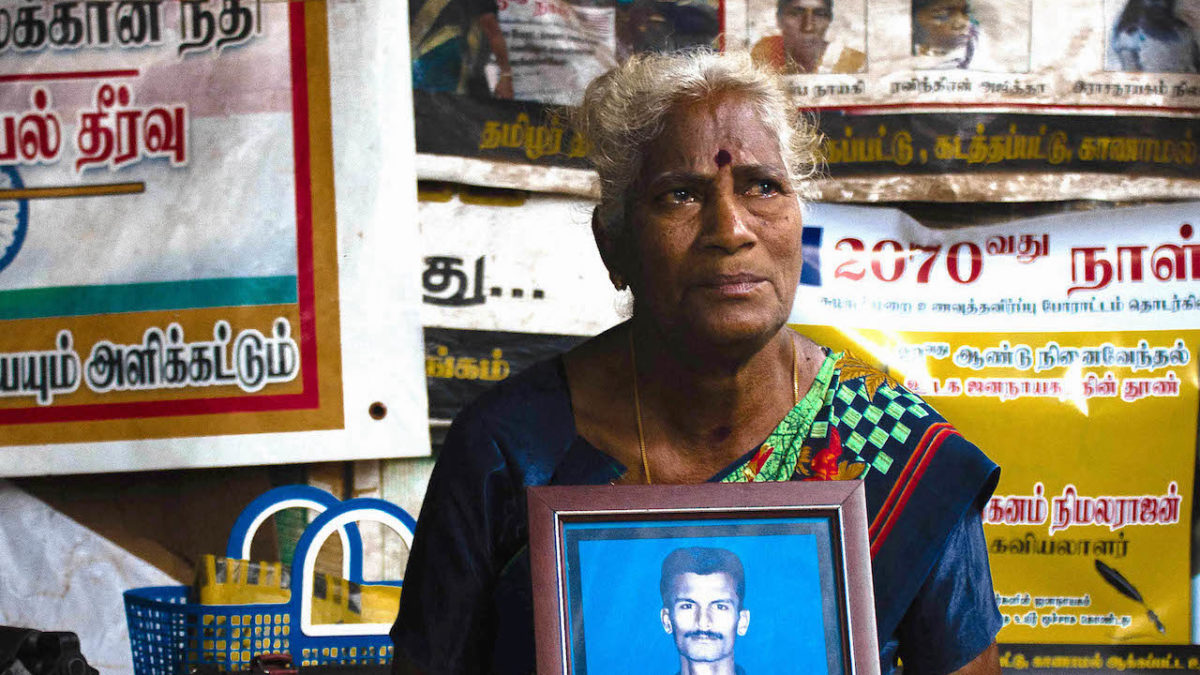
Tamil mothers, sisters, wives and daughters have not yet given up their hopes to find their disappeared sons, brothers, husbands and fathers. The tragedy of endless search continues for them. Some Tamil women have more than one tragedy to digest. Vasanthathevi Kathirkamanathan is still searching for her missing daughter. And, her husband has been missing since May 2009. “I don’t know whether he is alive or dead. My relatives want me to believe that he was hit by a shell during the heavy fighting in May 2009, and died on the spot. But, he was with me till the last moment on 18th May 2009. If he was hit by a shell, and died on the spot, I must have seen his dead body. Since, I have not seen his dead body, I am unable to believe that he was killed. I strongly feel he was made to disappear. My life is in limbo” says tearful Vasanthathevi Kathirkamanathan from Ananthapuram,…

Continue reading »
Page 6 of 172« First...45678...203040...Last »

About Groundviews

Located at the Centre for Policy Alternatives in Colombo, Sri Lanka, Groundviews is a citizen journalism website that uses a range of genres and media to highlight critical perspectives on governance, reconciliation, human rights, the arts and literature, democracy and other issues. The site has won two international awards, including the prestigious Manthan Award South Asia in 2009. The grand jury's evaluation of the site noted, "What no media dares to report, Groundviews publicly exposes. It's a new age media for a new Sri Lanka... Free media at it's very best!"

cezarneaga.eu