Archive for the ‘Politics and Governance’

Restrictions and intimidation on journalists covering resettlement process in the Vanni

Sri Lanka Media Freedom

From Lines Magazine “The Government should ensure the freedom of movement of media personnel in the North and East, as it would help in the exchange of information contributing to reconciliation” (Lessons Learnt and Reconciliation Commission, recommendation 9.115-d) After more than 11 months of the LLRC report being handed over to the President, the above recommendation remains far from reality, despite the National Action Plan to Implement Recommendations of the LLRC reaffirming it by committing to identify and remove impediments to free movement of media personnel in the North and East. A few days ago, I accompanied a crew from a local TV station to the Mullativu district to do a story on the life of the last batches of people who left Menik Farm before its closure in late September 2012. First, our team met the Government Agent for Mullativu, who told us we could go and film the resettlement and relocation areas, and in fact, encouraged us to…

Continue reading »

Socialism?

01

Photo courtesy socialistworld.net Over the past months there has been a debate in some newspapers regarding socialism and/or socialism vs. capitalism. It is a great thing to see happening, especially as the globalised economic downturn intensifies and is sure to be a long-lasting one. In this debate, however, it is sometimes hard to see what is exactly meant by the word ‘socialism.’ For example, many people term the policies of the Bandaranaike governments as socialist – because there was a tendency to have the government run certain industries, such as transportation, steel and insurance, or to have state welfare programmes. If such is the definition, then most European countries and even the United States would qualify as socialist on some ground or another. Others seem to define socialism as being what existed in the Soviet Union and Eastern European countries: this involved a heavy state hand in not only industrial and agricultural production, but in controlling dissent and thought via…

Continue reading »

In conversation with Shashi Tharoor: India, literature, politics and South Asia

Screen Shot 2012-10-06 at 11.29.14 AM

Having moderated a session with Shashi Tharoor earlier this year at the Galle Literary Festival, we met up again in Colombo last week to talk about the writer-politician’s new book, and his views on literature, politics, the freedom of expression and our region. Shashi Tharoor is a well known writer, speaker and politician. From Riot to Bookless in Baghdad, Shashi’s books, whether fiction or non-fiction, are fulfilling to read. In Galle we spoke about The Elephant, the Tiger and the Cellphone: Reflections on India in the 21st Century, published first five years ago. He’s just published his latest, Pax Indica: India and the World of the Twenty-first Century, which at the time of writing, isn’t yet available in Sri Lanka. This placed me at a disadvantage in speaking about the book in detail, though we did start our conversation by going into what the tome addressed. We go on to talk about Shashi’s writing, and how he manages to do…

Continue reading »

A Review of Quotas in University Admissions

Screen Shot 2012-10-02 at 3.17.01 PM

Photo courtesy Vikalpa My good friend Somapala Gunadheera has made some thoughtful observations (The Island, 10 Sept 2012) on the problems of University admissions, and noted that in my “ Tamil Language Rights in Sri Lanka”( CPA, April 2012) I had not suggested ways and means of solving them. My analysis and suggestions were expressed in some publications way back in the 90s, and that is why I chose not to repeat them. But since my friend has raised the question, I will( belatedly) retrace some of what I had written then, supplemented with an outline of the historical back ground. Jaffna youth have traditionally depended on education for employment since other avenues have been lacking in comparison with other districts. Since Sinhala Only in 1956, Tamil speakers have had even more problems than previously in finding employment. They have responded with even greater focus on education and on acquiring superior academic and professional qualifications, especially in fields such as…

Continue reading »

“Nothing to call our own…” – The plight of the recently returned, resettled and landless IDPs in Sri Lanka’s North

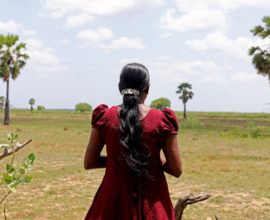
A returnee settlement in Puthumathalan4

Photo by author Recently returned to Puthumathalan “As you drive past pile upon pile of corroding vehicles stacked one above the other, past pots, pans, sarees, slippers and plates (that once belonged to the people here), strewn all over the ground, and past the bullet and shrapnel splattered walls of homes ravaged by the war, on either side of the dusty, gravel roads of Puthukkudiyiruppu (PTK), you cannot help but feel the deep sadness and hopelessness that pervades the air around us.” According to the government, Menik Farm has been closed and all it’s inmates resettled. Having visited some of the most recently resettled, this seems to be the case, except for the fact that many have been relocated and not allowed to their places of origin due to military occupation of their lands[1], whilst others who have been returned to their places of origin, have been left without proper shelter, income or basic infrastructure and resources, to fend for…

Continue reading »

FUTA and Free Education in Sri Lanka: Question of Social Justice and Democracy in an Oligarchy

Screen Shot 2012-10-03 at 6.27.08 AM

Photo courtesy Vikalpa The results of the so-called ‘mother’s examination’, or the year five scholarship examination of this year, have once again sturdily testified for the importance and significance of preservation and continuation of the free education system of this country. The two students who have achieved the first places hail from two divergently opposing social classes, but the duo being educated in the same, state sponsored, free education system. When the boy student from socially affluent strata, attending a high ranked school scored the highest marks, the girl student attending a low ranked, poorly facilitated rural school could produce the same result under more difficult conditions than the conditions the boy student had to face. Both of them have made their schools proud and won the hearts and mind of the people equally; but if it weren’t for the free education would the underprivileged rural student ever have got that opportunity to be equal among unequal? I have just…

Continue reading »

LONG READ | Beyond History, Against the Present: Preliminary Thoughts on Re-imagining ‘South Asia

z_p44-Trade

Original graphic from The Sunday Observer Keynote address delivered at the conference, ‘Connecting South Asia’ organized by the Theertha International Artists’ Collective and the Colombo Institute at the Post Graduate Institute of Archeology, Colombo, 28th September 2012. The speaker is Chair and Professor at Department of Sociology and Dean, Faculty of Social Sciences, South Asian University, New Delhi. In my mind, delivering a keynote address in a conference that has as its theme the stated objective of ‘connecting South Asia and dynamics of art and culture in the region’ poses significant challenges. This emanates from a number of anxieties: though we flippantly use the term South Asia and I work in an entity that calls itself South Asian University and numerous cartographic renditions of this supposed reality exists, I am not too sure what it means when situated in the context of the region’s past as well as its present. If I remember right, it is not by accident that…

Continue reading »

Menik Farm: The tragic end of a bitter saga, from detention to forced relocation

DSC00071

“Why can’t the Army go to the jungles instead of taking our lands and sending us to jungles?” “When will we be allowed to re-start cultivation of our lands?” “When can we have access to the sea we were fishing before and will we get back the boats and fishing equipment we left behind in our village when we were displaced?” “Why is there a check point at the entrance to this place? “Why are there soldiers and intelligence officers all around us, why can’t we still have the freedom other people in this county have?” “Why are visitors not allowed to come and freely talk to us and take photos?” “Why have we been sent to another camp? What is different here from Menik Farm?” “Why didn’t the authorities clean up the jungles before they sent us here?” “When can we have a Kovil and Church?” These were some of the questions that people who had fallen victim to…

Continue reading »

Comprehensive archive of tweets: 8 May to 1 October 2012

Screen Shot 2012-10-01 at 12.13.36 PM

Given that Groundviews is extremely active on Twitter, covering, inter alia, unique updates after eventful Presidential Elections, alerting and real time information curation during tsunami warnings and the international fallout over Twitter of media content published domestically, it’s been a real challenge to record our conversations and updates for posterity. This is especially important in a country that remains extremely censorious of any narrative that runs counter to or questions official propaganda and where mainstream media, though increasingly embracing new media, do not yet demonstrate any real understanding of how it can be used to further investigative journalism and holding accountable public institutions and officials. Over a year ago, we published Resource book for historians, researchers and media: A year of tweeting from Groundviews. At the time we used a web service called Tweetbook. Using the same service, we have created a PDF capturing all tweets published by Groundviews from 05/08/2012 till 10/01/2012. However, since Tweetbook’s data is locked into the PDF format,…

Continue reading »

Putting paid to the Government’s false claims: The new IDPs in Sri Lanka

DSCF2029

Editors note: On the day Menik Farm was officially closed, an urgent memo was circulated widely on the fate of the IDPs from Keppapilavu. The memo adds vital context to the following story, which also needs to be read in light of Government and Ministry of Defence claims that, there are no longer any IDPs in Sri Lanka. that they have all been resettled. that phrases like “Internally displaced people, relief camps & refugee camps” will not be there in Sri Lankan dictionary in future Urgent and disturbing | SOS: Memo from Keappapulavu displaced people cl.ly/2T1y2E0K170W @unocha @7piliers @lankasol #lka #srilanka — Groundviews (@groundviews) September 24, 2012 Also read Relocated to nowhere by the author, appearing in Ceylon Today. ### The war displaced community in Seeniyamottai in the Mullaitivu District have a story that is different to others. Unlike other internally displaced persons (IDPs) living within the confines of Menik Farm, Sri Lanka’s largest internment facility as well as the…

Continue reading »

FUTA’s “6 percent for Education” in Sri Lanka: Sensible or Sensational?

Screen Shot 2012-09-28 at 1.32.21 PM

Original photo courtesy Vikalpa “It was mainly symbolic”, is how FUTA President Dr. Ranjith Dewaisiri characterized the group’s demand of “6 percent of GDP for education”, which has now gained national attention. This was in response to a question posed by an audience member during ‘THE FORUM with Eran’ held this week (26th) featuring Dr. Ranjith Dewasiri, Prof. Rajiva Wijesinha (M.P.) and Eran Wickramaratne (M.P.). The FUTA President’s comments were quite revealing, and in a sense alarming. Much has been written already about the strike action of the FUTA and the trade union’s demands of wage hikes but also higher government spending on education (i.e., “6 percent of GDP”, according to FUTA). Questions were raised from Dewasiri on, “how did you come up with the 6 percent number, and what are FUTA’s thoughts on how to spend it?”. For both, the answer was quite non-specific and non-committal and this is disconcerting. It is clear that FUTA has now assumed moral…

Continue reading »

Higher Education and its Disjunctures: An Interview with Professor Sasanka Perera

sasanka_perera_1294682340_55

The following is an interview with Professor Sasanka Perera of the South Asian University conducted by Mr. Ranjit Perera of the Social Scientists Association of Sri Lanka via Skype on 18th August 2012. Ranjit Perera: Cyberspace and virtual reality are intertwined in the context of today’s communication technology; this came to my mind while conducting this interview. Any thoughts on that before we get down to more serious issues? Sasanka Perera: Well, I am hesitant to get into a philosophical discussion on these matters in an interview meant for popular consumption. I guess we can have this chat separately. But briefly, yes. This interview would not have taken place across national borders if not for the internet and the fact that technology within it is accessible, cheap and democratic in its reach. But this is not virtual; you are there asking questions. I am here trying to answer them. The only issue is that the physical distance between us have…

Continue reading »

Elections in the East, reconciliation and politics: In conversation with Javid Yusuf

Screen Shot 2012-09-23 at 6.28.09 PM

Javid Yusuf is an Attorney-at-Law and former diplomat. Groundviews last featured him over two years ago, just after the Presidential Election in early 2010. In this programme, we talked about the recently concluded elections in the North Central, Sabaragamuwa and Eastern Provinces in Sri Lanka and more generally, on politics and reconciliation in post-war Sri Lanka. We begin by looking at why this election and voting in the Eastern Province in particular was perceived to be so significant. Javid responds by noting the election was, in general, a barometer of the government’s popularity and in the Eastern Province, a barometer of how minority thinking. We talk about the very different narratives from government, the opposition and other independent political analysts after the results of the election, and what could be read into these divergent viewpoints. Javid notes that the government did quite well in getting the votes it did in the North Central Province and Sabaragamuwa, and said that there…

Continue reading »

Sri Lanka’s forgotten mass graves: Google Earth and remembering the dead in Nandikadal

Screen Shot 2012-09-18 at 2.41.58 PM

The end of war in Sri Lanka, captured for posterity by Google Earth published last week by Groundviews was the first look at the end of the war in Sri Lanka through historical satellite imagery freely accessible via Google Earth. The article was an open invitation for those using Google Earth to scan for and alert others over areas and artefacts of interest, that in turn could strengthen discussions around the hellish final weeks of war in Sri Lanka. Given the nature of imagery from around this period and centred on Nandikadal, the article explicitly noted, What Google Maps and Earth does NOT enable one to do, given (1) the quality of some of the historical imagery (which sometimes features extensive cloud cover of vast regions) and (2) the large gaps between the available historical imagery (mid March, late May, after the official end of the war and killing of the LTTE’s leader, then mid-June and early August) is any…

Continue reading »

Eastern Province election: The big lie about shared power in Sri Lanka

460x

Photo courtesy AP/Eranga Jayawardena Justice Minister Hakeem was reported to have told during campaigning, he should not be made to look like a man taken hostage. Ministers Rambukwella and Premjayantha, invited TNA to form a “National” alliance for the Council in the East. Senior Minister and Communist Party leader DEW Gunasekera says he wrote to President Rajapaksa proposing a “National Council” that includes the TNA, for the East. Senior Minister and LSSP leader, Prof Tissa Vitharana backs a “non racial”, all included Council for East. A week gone by and the claim by President Rajapaksa – that his leadership paved for ten successive victories for the UPFA which by itself is a historic feat – is being severely challenged in the East. People are strangling the conscience of the SLMC leadership and the SLMC shopping list is being ignored by President Rajapaksa. To begin with, the PC elections were NOT free and fair in any way. After many violent clashes, two…

Continue reading »
Page 11 of 96« First...910111213...203040...Last »

About Groundviews

Located at the Centre for Policy Alternatives in Colombo, Sri Lanka, Groundviews is a citizen journalism website that uses a range of genres and media to highlight critical perspectives on governance, reconciliation, human rights, the arts and literature, democracy and other issues. The site has won two international awards, including the prestigious Manthan Award South Asia in 2009. The grand jury's evaluation of the site noted, "What no media dares to report, Groundviews publicly exposes. It's a new age media for a new Sri Lanka... Free media at it's very best!"

cezarneaga.eu