Archive for the ‘Development’

The end of war and Sri Lanka’s future: Videos from Vikalpa in Sinhala and English

Vikalpa, the sister site of Groundviews with citizen journalism in Sinhala, produced this mini-documentary on Jaffna a year after the war ended. Vikalpa also produced a series of interviews in Tamil, Sinhala and English on the end of war, that will be progressively made available on its YouTube channel, embedded below. Please leave your comments on Vikalpa’s post යුද්ධය අවසන් – ලංකාවේ අනාගතය (The war is over: Sri Lanka’s future).

Continue reading »

Images from a flooded capital

IMG_4026

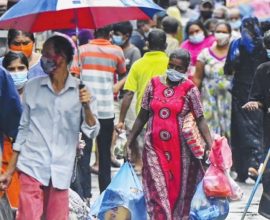
After reading Colombo goes under water, and not for the first time, Deshan Tennekoon sent these images of Colombo’s flooding yesterday.

Continue reading »

Colombo goes under water, and not for the first time

Colombo Lady trying to make it through floods.JPG

These pictures were taken between 10.00am and 11.30am on the 14th of May 2010 after Colombo experienced rains for about 2 hours. It speaks volumes of the continued failure of the CMC to deal with drainage and flooding issues for the last 20 – 30 years. Furthermore, I was trying to get from my house to work and the following roads were blocked due to flooding, Duplication Road Reid Avenue Horton Place Both Viharamahadevi – Museum Roundabouts Thurstan Road Thunmulla Junction It continues to rain and Colombo continues to flood! View Colombo flooding in a larger map Update, 15 May 2010: Taken by Deshan Tennekoon, more photos of the flooding published on Groundviews here.

Continue reading »

After the Elections: Demilitarize Development for Sustainable Peace

“Counter-terrorism is terrorism’s best ally.” –Joseba Zulaika in “Terrorism: The Self-Fulfilling Prophesy” (2009) On April 12, 2010 the majority of citizens of the island’s two main linguistic communities celebrated the “Sinhala and Tamil New Year” and the categorical end of war and terrorism with considerable optimism, despite lack of a clear political solution to the ‘ethnic conflict’. The New Year celebrations, the first since the end of the State’s 30 year war with the Liberation Tigers of Tamil Eelam (LTTE), were in the wake of recently concluded parliamentary elections that returned the ruling party to power. President Rajapaksa, who in January had already won the Presidential elections for another 6 year term, noted that the New Year brings into focus shared culture and kinship ties between the Sinhala and Tamil speaking communities in the island. There was not talk of ‘human rights violations’ or ‘war crimes’ or the UN Secretary General, Ban Ki Moon’s plan to set up an Advisory…

Continue reading »

Jaffna after the war: Observations by a visitor

Large crowds rush to Jaffna every day. Some of them have never been there before. The 30 years war is over and thanks to president Rajapakse, (General Fonseka is already forgotten), they are now at last free to visit those territories the Tigers once claimed as theirs. They are eager to visit the many places of worship including a few recently discovered ones. They are genuinely happy to be there, moving from Nallur to Mavattapuram, Keerimalai, Nagadeepa, Dambakola Pattuna and   Kandarodai. Dambakola Pattuna in Madagal is where Theri Sangamitha is said to have landed with the sacred Bo sapling. A new dagoba has been built there and a statue of bikkuni  Sangamitha has been installed in December 2009, by the first lady herself. Kandarodai where the mini dagobas are found has acquired a new Sinhala name. In all these places name boards and notices are found in Sinhala. Therefore the visitors from the South feel very homely and comfortable. The…

Continue reading »

The future of tourism in Sri Lanka: A conversation with Renton de Alwis

Renton de Alwis was one time Chairman for Sri Lanka Tourism Promotion Bureau. As noted on this website, he has over 35 years experience in marketing, communications and tourism related areas, having worked in an international environment covering over 30 countries. In this interview we talk about the future of tourism in Sri Lanka. Renton comes out strongly in favour of the greening of Sri Lanka and eco-tourism in line with our traditions and culture. I asked him about the Akon incident, but he said he didn’t know enough to comment. After speaking at length about the environment, Renton in the last minutes of the interview went on to ardently support the commercial use of land in Kalpitiya, owned by the State, for tourism purposes. He noted that the best use for this land would be to turn it into a gambling centre, modelled on the lines of Macau. Details about the proposed developments in Kalpitiya can be found on…

Continue reading »

Smarter investing in Science and Higher Education

I experienced three disturbing scenarios within the last 5 months. In no particular order they are as follows. I recently visited Sri Lanka after seven years. End of it I was overwhelmed by nostalgia and wanting to go back home. When I left my country for higher studies I had plans to come back. Right after the PhD, I wanted to stay a little longer and get some more research experience. So I took a postdoctoral position at a prestigious university. Of course I had to give up my probationary lecturer position and pay back the bond. After coming back from the recent visit, I searched for suitable jobs with enough chance to do scientific research in Sri Lanka. I actually sent my resume (CV) out. I am still waiting to hear. No vacancies! I also looked into becoming a lecturer at a university. That is the only viable option for science graduates. Starting salaries of a senior lecture positions…

Continue reading »

Should we sacrifice progress for tradition?

Are we Sri Lankans laid back as a nation? I have a sneaky feeling that we are, particularly, during New Year celebrations. No doubt, it is a wonderful tradition for family and friends to get together and celebrate. But aren’t the celebrations carried too far, in terms of time! In fact, it has become an excuse for dragging the holiday period further by several more days on account of transport issues and fuel shortages. In our ancient past, life moved at an easy pace. There was adequate time for fulfilling customs and rituals according to astrological times such as ceasing work, ceasing cooking, lighting the hearth, partaking of meals, bathing, anointing with oil and starting work. Isn’t it a little anachronistic for us to continue celebrating New Year in an identical manner in this modern era when our economic and social patterns have drastically changed from a largely pastoral to an industrial setting?  – When the pace of life has…

Continue reading »

A Reply to Tissa Devendra on Rebuilding Sri Lanka

[Editor's note: Devanesan Nesiah provides a rejoinder to Tissa Devendra's vehement response to his article 'Rebuilding Sri Lanka' that was published first on Groundviews and then later in the Island.] The venomous response of Devendra in the Island of 16th March does not merit a reply but I need to set the record straight. As I said in my original entry, “The primary fault is with neither the visitors nor the locals” which is very different to what Devendra seeks to imply. He takes offence over my citing the critical observations of a very distinguished Sinhalese. Rebuilding Sri Lanka requires self-critical acknowledgement of the damage done to the Sri Lankan nation over the decades by the racist policies of Sinhalese, Tamil and Muslim leaders and by insensitive conduct and practices. It also requires a willingness to engage in corrective action. The corrective action includes not only political reforms but also sensitizing the population and lowering the barriers to inter ethnic communication. The…

Continue reading »

Rebuilding Sri Lanka

A perceptive and sensitive Sri Lankan has noted; “It is reported that the people of the North, especially in the Jaffna district, have developed a feeling of dissatisfaction, disaffection and contempt towards the people of the South, who post the end of the war are now engaging in pilgrimage and sightseeing related visits to the North in large numbers, and in the process totally disregarding the need for privacy, encroaching on meagre infrastructure resources and services of the district, causing significant negative impact on the environment/cleanliness and pollution in the area, and behaving in a manner unacceptable by the cultural and religious values of the Northerners. These negative feelings are expressed in relation to the following issues highlighted in support of the claim; 1. Large and unrestricted numbers of pilgrims are traveling from the South to the Jaffna District especially to visit Naghadhipa, Nallur Kovil, Madhu Church and other places of religious worship and there are no adequate infrastructure facilities…

Continue reading »

Interview with Prof. Kumar David

Prof. Kumar David, an electrical engineer by training, regular columnist in traditional print media and a frequent commentator on Groundviews, talks about what’s left of leftist politics in Sri Lanka, the end of war and its impact on Tamil diaspora juxtaposed against th autocratic and essentially one-party rule in Sri Lanka. I also asked him about the growing web and Internet censorship, which in a recent column he had referred to as a disturbing retrogression into a Lanka Internet Dark Age (LIDA).

Continue reading »

Going beyond Sarath Fonseka in achieving democracy for people

A visibly shaken wife in tears, Anoma Fonseka told the media “this is the gift my husband got for finishing a 30 year war”. Gen Sarath Fonseka was arrested, or detained, or taken into custody or may have been even abducted by a military group late in the evening on Monday from his office, in Colombo. What ever label one gives for such exercises, they eventually end up as legal arrests in Sri Lanka, as was earlier proved in the case of Uthayan and Sudar Oli editor N. Vidyadaran’s abduction, on 26 February, 2009 while the war was on and Gen Fonseka was the army commander. Apparently the end of the war has not changed it to be any better. As for what’s now happening, the reading was on the wall. Quite plain and clear while the two opposing candidates fought their battle for presidency with rhetoric sans politics. Accusing each other, of plotting to kill each other. The presidential…

Continue reading »

Challenges of Development: The Next Phase

It is over. We have a winner, and we have a loser. The margin of victory has many messages. In mature democracies, play leading up to the climax is performed in a slightly different way, and it is customary for the loser to telephone and congratulate the winner on the morning after. We saw none of that here. The night before we saw the rise of a special tribe, whose characteristics were identified by their motto declared the morning after, if you met any of them at breakfast: “I don’t particularly like the guy who won, but I like even less the guy who lost”. That declaration is usually followed by the obligatory joke about “military intelligence” being an oxymoron. What a fool-proof way in which our countrymen demonstrated the truth in it? Permit me to give you a break and entertain you with stories about my travels and childhood memories. After doing a lot of travel in Sri Lanka…

Continue reading »

THE RAJAPAKSE REGIME: BRICKBATS, PLAUDITS

[Editors note: This article complements The Rajapakse Regime and the Fourth Estate, also by the same author.] This is a disjointed exercise that does not claim comprehensiveness. That is impossible in a short essay, the more so because I write without ethnographic exposure to the experiential subjectivities of either the Tamil people in Sri Lanka or the poor people from every community struggling with the cost of living. Terrible Record In a recent essay I have briefly annotated the government’s failure to prevent a series of killings and intimidations directed against media personnel and the widespread belief that elements in its sprawling establishment had a hand in many of these acts of injustice.[i] In step with this record the Rajapakse Regime has consolidated the long tradition of overcentralised decision-making and authoritarianism at the top that has been a feature of Sri Lanka’s so-called democratic institutions for many decades.[ii] It is not surprising, therefore, that little or nothing has been done…

Continue reading »
  • 8 Dec, 2009
  • 1 Comment
  • Colombo,
    Development

SRI LANKA MAY WANT – AN ECONOMIC VISION 2030

The risks and rewards of a Development Plan for Sri Lanka Sri Lanka today is in the category of a poor country status, listed in the “Institutional Investor”, September 2009 Country Credit Survey. It ranks No. 122 among 178 nations, behind Vanuatu and just ahead of Kiribati. This is no fault of its strategic position as an island nation in the Indian Ocean, or of its people, who are one of the most literate in South Asia. There is no doubt that the potential is there for sustainable development. THE SRI LANKA MASTERPLAN 2030 The Sri Lanka Master Plan 2030 is designed to manage this development of the new Sri Lanka through a long term vision. It represents a unique opportunity to create an authentic, sustainable, modern Sri Lanka, managing existing resources and exploring alternatives for future demand. At the heart of this Master Plan is sustainability and diversity maintaining our cultural heritage, whilst making capital use of our strategic…

Continue reading »
Page 7 of 7« First...34567

About Groundviews

Located at the Centre for Policy Alternatives in Colombo, Sri Lanka, Groundviews is a citizen journalism website that uses a range of genres and media to highlight critical perspectives on governance, reconciliation, human rights, the arts and literature, democracy and other issues. The site has won two international awards, including the prestigious Manthan Award South Asia in 2009. The grand jury's evaluation of the site noted, "What no media dares to report, Groundviews publicly exposes. It's a new age media for a new Sri Lanka... Free media at it's very best!"

cezarneaga.eu
canakkale canakkale canakkale balik tutma search canakkale vergi mevzuati bagimsiz denetim vergi mevzuati ozurlu engelliler