Archive for the ‘Constitutional Reform’

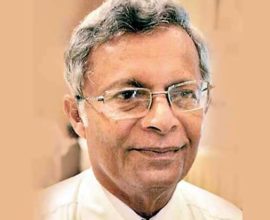
Statement by Chrishmal Warnasuriya, Bar Association of Sri Lanka on the Eighteenth Amendment

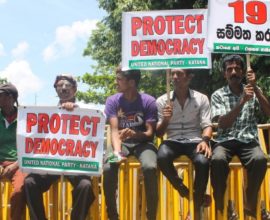
Chrishmal Warnasuriya, Attorney-at-Law and member of the Bar Association of Sri Lanka speaking to media today during a protest held by lawyers near the Supreme Court around half past noon.

Continue reading »

University academics: Statement on the Proposed 18th Amendment to the Constitution

We, the undersigned academics attached to different universities in Sri Lanka, call upon the government to re-consider the proposed 18th Amendment to the Constitution for the reasons set out below. Constitutional reforms, like elections, go to the heart of what it means to be a democracy in the modern-day world. Any changes that are introduced to a country’s constitution should be undertaken after due deliberation and consultation while having at its centre, the will of the People. In a pluralistic society such as Sri Lanka, ascertaining the will of the People can be a time-consuming and complex exercise. While the will of the People must be given due consideration, the essential features of a democracy, such as the rule of law, accountability of the government and transparency must be preserved and promoted through any constitutional reform. By choosing to amend the constitution through an urgent bill the entire process of reform has been expedited, if not short-circuited, and no room has been…

Continue reading »

THE JUDGMENT OF HISTORY

All MPs as well as Supreme Court judges of Sri Lanka should watch Stanley Kramer’s 1961 film ‘Judgment at Nuremberg’ before the vote on the 18th Amendment. It tells the story of the trial of four German judges guilty of complicity with the Nazi regime. One of them, Ernst Janning, was once a champion of justice, yet played a major role in turning the German legal system into an instrument of Nazism. How could these eminent and apparently decent men have been complicit in the ghastly atrocities committed by the Nazi regime? The mystery is solved only when Janning makes a statement, showing how actions which at first seemed trivial and innocuous – like swearing an oath of allegiance to the Nazis – lead to deeper and deeper entanglement with the regime. Even when the full horror of Hitler’s agenda became clear to them, they justified staying at their posts with the argument that they were trying to prevent matters…

Continue reading »

The pathetic capitulation of the organised Left in Sri Lanka (Updated with statement from Leftist leaders)

Organised Left parties in 2005, “THE Group of Five Left Parties (Lanka Sama Samaja Party, Communist Party of Sri Lanka, Sri Lanka Mahajana Party, Desha Vimukthi Janatha Party and Democratic Left Front) consider that the Manifesto of Presidential Candidate – Prime Minister Mahinda Rajapakse titled “Mahinda Chinthana” a pro-people manifesto, although these parties have certain reservations in regard to some of its contents, the parties said in a statement issued yesterday. The statement said: “The Five Left Parties are specially appreciative of the pledges contained in the “Mahinda Chinthana” in respect of strengthening democracy. The commitment to abolish the executive presidential system and to draft a new constitution is one of its important aspects.” Emphasis ours. Vasudeva Nanayakkara in May 2010, “The socialist parties are opposed to the rescinding of the constitutional restriction for an incumbent president to contest for more than two terms. The Common Left Front comprising the Lanka Sama Samaja Party (LSSP), Sri Lanka Communist Party (SLCP) and…

Continue reading »

Resisting the Loss of Citizenship in Sri Lanka

The 18th Amendment I don’t know whether I’m more angry or sad at the way in which patently undemocratic constitutional amendments are being rushed into law. I feel as if I’m watching my country being strangled, slowly, in the grip of self-serving and short-sighted men who have little love for Sri Lanka or its people. I don’t believe that the changes to the constitution will immediately make themselves felt in our daily lives. In some ways, the will simply legalize many unconstitutional practices that are currently in place. However, the changes in law will solidify these and establish new, even lower norms for the way Sri Lanka is governed. My fear is that by the time the implications of the proposed 18th Amendment will become fully apparent, it is likely that many of our fellow-citizens, our friends, co-workers, relative and frighteningly perhaps our children may have come to have such low expectations of their rights as citizens that they can’t…

Continue reading »

What are we waiting for?

There is no doubt that the proposed constitutional amendment is merely a means of consolidating the dynastic ambitions of the Rajapakses. And clearly, the largest opposition, the UNP is quietly imploding and incapable of fulfilling its responsibilities and it is futile to hope that the amendment will be defeated in parliament. At this moment, probably the most crucial moment in Sri Lanka’s contemporary history, the Leader of the Opposition is out of the country on a ‘private visit’! This surely underscores his utter lack of concern for the good of this country, his political ineptitude and his callousness. Certainly, we cannot look to him for inspiration. Mahinda Rajapakse could not have asked for a better Leader of the Opposition. And Rauf Hakeem’s pathetic defence of his capitulation, that he was facing ‘reality’ and taking a ‘pragmatic political decision’ seems to reflect the views of the majority of politicians in this country who have defended this amendment or worse still stayed…

Continue reading »

A timeline of duplicity: Promises to abolish the Executive Presidency

Groundviews created this timeline to highlight various promises and statements made by the President and government over abolishing the office of the Executive President. Click and drag the slider at the bottom of the timeline above to adjust the time scale. Click here to view larger version of this timeline, where you can also view it as a list of events / stories. Click on any pop-up / event to get a URL link to the full news story. This timeline only records select statements and news stories after October 2009. A Google search of news stories from 2005 to 2008 reveals a number of instances where the incumbent President promises to abolish the office of the Executive Presidency, in line with his Mahinda Chintanaya manifesto of 2005 (e.g. President pledges Constitutional reforms). And even before, in 2003, Mahinda Rajapaksa, as leader of the opposition noted that, “As a party we still stand for the abolition of the executive presidency. Until…

Continue reading »

The 18th Amendment: Constitutional Reform as the Consolidation of Power

Politics is about power and the constitution is about protection of the people against the excessive concentration and exercise of that power.  Politicians need power to govern and people need government to establish the framework, which facilitates the exercise and enjoyment of their fundamental rights and freedoms.  Whilst it may well be a done deal by the time this gets into print, it is worth still raising the question of as to whether the 18th Amendment to the Constitution protects the people or privileges those in power to the extent that the people’s exercise and enjoyment of their rights could be imperiled. The key features of the 18th Amendment sent to the Supreme Court for its scrutiny as urgent in the national interest are the removal of the term restrictions on an incumbent contesting the presidency and the abandonment of the Seventeenth Amendment.  The former means that we now move from two terms to any number of times for the…

Continue reading »

The 18th Amendment to the Constitution: Process and Substance

1

The President has proposed to make changes to the constitution via an urgent bill.  The changes known as the 18th Amendment to the Constitution, seek to remove the two term limit on being elected to the office of the President and the Constitutional Council under the 17th Amendment.  As required under the Constitution, the President has referred the urgent bill to the Supreme Court.  Supreme Court heard the Government’s arguments and the arguments of six intervening petitioners on Tuesday 1 September 2010.  These changes have not been discussed in the public domain and they are sought to be made in secret.  It is important to note that even at the Supreme Court hearing the intervening petitioners were only given copies of the proposed changes after the government started making its submissions.  This article explains how the Constitution can be amended, what the key changes are and the legal arguments advanced in favor of and against the changes. Procedure for changing…

Continue reading »

Outrageous process and substance: The proposed 18th Amendment to the Constitution

Rohan Edrisinha lectures at the Law Faculty, University of Colombo and is also a Director at the Centre for Policy Alternatives. In this succinct interview conducted by Vikalpa today, Rohan flags serious concerns over the government’s proposed 18th Amendment to the Constitution. Salient points made by Rohan are, Significant problems with the process through which the Amendment was introduced – it was rushed, not consultative and couched in secrecy. Few outside government even had access to the proposed Amendment before it was sent to the Supreme Court. The Amendment goes against the promises in the President’s own Mahinda Chintanaya in 2005 and 2010. Completely undermines the 17th Amendment, with severe implications for, inter alia, the conduct of democratic elections. Cumulative effect of the proposal totally undermines the depoliticisation of democratic institutions. Hopes the Supreme Court will say  a referendum is needed before such a fundamental change to the Constitution is introduced. In Strange proposals and broken promises: Constitutional reform in Sri…

Continue reading »

Strange proposals and broken promises: Constitutional reform in Sri Lanka

We last featured Rohan Edrisinha in February, just after the Presidential election on 26th January. Rohan, who lectures at the Law Faculty, University of Colombo and also a Director at the Centre for Policy Alternatives, at the time flagged serious concerns over the implementation of the 13th and 17th Amendments, as well as the tragic irrelevance of the APRC in the process of constitutional reform. These are also issues flagged in this video, where Rohan expresses his impatience with ideas such as the post of an Executive Prime Minister, which he notes is not just confusing, but dangerous to boot since it actually enhances the powers of the President. Lamenting the inability of the UNP to come up with any viable constitutional reform proposals, Rohan also flags the dilemma of Tamil political parties in parliament and the future of power-sharing in Sri Lanka. The ‘final report’ of the APRC, first published on Groundviews, is also discussed. Rohan ends on a…

Continue reading »

Radical Reforms in Sri Lanka: Realities we are afraid of?

Enough conceptual theories are produced and articulated on the need and urgency of the political power sharing in Sri Lanka. Avoiding the torturous repetition and gauging the current diminishing appreciation for any theoretical discourse or appetite for challenging conceptual explanations, we suggest the following five points abstract as a summary of recommendation for a new constitutional re-arrangement for a stable/unitary, yet democratic and modern Sri Lanka Democratic Republic of Sri Lanka 2015 Structure of Administration Confirm the State of Sri Lanka as a unitary state Constitutionalize the devolution of political and administration powers to 5 recognised Provinces Northern Province Eastern Province Central Province Southern Western (From Puttalam to Kalutara) Southern Province and 3 Special Zones ( under direct Prime Minister rule) Colombo District Kandy District (Total rule under Buddhist laws and Sangha leadership) Kalmunai/Sammanturai (with special emphasis on Muslim rights) Nature of the governance Return to an executive Prime Minister system reporting to the parliament for a 5 year term…

Continue reading »

Final report of All Party Representative Committee (APRC)

Screen shot 2010-07-21 at 9.00.47 PM

Released exclusively on Groundviews, this is a composite document compiled by Yogarajan and Kariapper and made public by them (read the full background to this document in their introduction). Please note that as Nizam Kariapper pointed out to Groundviews, there is a mistake in the first page of this version of the report – the reference to June 2010 should read as June 2009. Download the complete report here. Download the executive summary of the report here.

Continue reading »

All Party Representative Committee (APRC) Final Report: Executive Summary

Groundviews received the executive summary of the APRC’s final report today. Download the report here. Salient features covered in the Executive Summary include: Nature of the State Form of Government Status of Buddhism Official languages and national languages Use of the English language Supremacy of the constitution Safeguards against secession Electoral system Power sharing Senate Community Council Distribution of powers between central and provincial National and provincial higher appointments council Amendment procedure

Continue reading »

Interview with Dr. A. C. Visvalingam, President, CIMOGG

This interview features Dr. A. C. Visvalingam, President, Citizen’s Movement for Good Governance. I ask him about his advocacy and activism in Sri Lanka, both during war and post-war. Mr. Visvalingam bemoans the fact that a number of articles, despite close ties to Editors and journalists, did not appear in the newspapers, and also speaks of the corporate sector’s risk averse nature especially around content produced that is critical of government and governance. He also speak about the need to introduce civic education in schools to bring about a greater awareness over the role and responsibilities of citizens. He goes on to articulate how he feels a change in Sri Lanka’s structures of governance can be brought about, what urgent constitutional reforms are necessary and what CIMOGG is doing in this regard.

Continue reading »
Page 5 of 16« First...34567...10...Last »

About Groundviews

Located at the Centre for Policy Alternatives in Colombo, Sri Lanka, Groundviews is a citizen journalism website that uses a range of genres and media to highlight critical perspectives on governance, reconciliation, human rights, the arts and literature, democracy and other issues. The site has won two international awards, including the prestigious Manthan Award South Asia in 2009. The grand jury's evaluation of the site noted, "What no media dares to report, Groundviews publicly exposes. It's a new age media for a new Sri Lanka... Free media at it's very best!"

cezarneaga.eu
canakkale canakkale canakkale balik tutma search canakkale vergi mevzuati bagimsiz denetim vergi mevzuati ozurlu engelliler