Archive for the ‘Features’

Bridging Sri Lanka’s Deficit of Hope

Machan movie poster

The opening scene in the German-Sri Lanka feature film Machan (2008) unfolds at a garbage-strewn Colombo street, somewhere in the city’s underbelly. Three young men are putting up political posters, playing hide and seek with policemen on night patrol. Conversation reveals that the men are doing this to earn a few rupees. Soon, the inevitable question comes up. “Why don’t we get the hell out of this country?” asks one. The ‘patriotic’ one replies, “Nothing like Sri Lanka. Abroad they treat you like second class citizens.” At which point, lead character Stanley points to himself – his dirty clothes dripping wet in sweat, paappa (paste) and dog urine — and says, “So what are we now? First class?” That, to me, was the most revealing moment in the perceptive film, ostensibly a comedy. An able-bodied young man, clearly willing to work hard, sees no hope of doing well in his own country. The rest of the story revolves around a…

Continue reading »

Racing Tanks with Bicycles: A Parable of ‘Reconciliation’ in Sri Lanka

SLU

Photo via Facebook photo set by Akiy Photography, direct link here. Note that original photo does not blur the face of the child. Some photographs of ‘aid’ being provided to Sri Lankan Tamils in Keppapilavu were recently posted online. The Keppapilavu community were the last to be released from the Menik Farm Camp, but were not allowed to return home, and instead were forcibly re-displaced into the wilderness. The aid was being provided by a youth group called ‘Sri Lanka Unites’ – whose objective is to promote reconciliation in Sri Lanka, in collaboration with the ‘Foundation of Goodness’ – a charity set up by a few Sri Lankan cricketers. Four thoughts came to mind while browsing the pictures: The scenes depicted were reminiscent of aid campaigns that characterised Africa in the ‘80s and ‘90s. Benevolent philanthropists extending a charitable arm to needy and helpless victims. Affluence meeting impoverishment, with the brash arrogance of those who have – that those who…

Continue reading »

The almost forgotten LLRC report and the Sri Lankan psyche

rajapaksa_llrc_report

Publicity shot from late-2011, depicting the President of Sri Lanka ‘reading’ the LLRC’s Final Report. Comprehension and cognition remain suspect.  Some years ago while on a visit from abroad, my niece was entertained and perhaps a little shocked when she overheard comments broadcast over the loudspeaker from a nearby school. It was the day of their annual sports meet and a teacher, obviously short – tempered, screamed into the microphone at some hapless students, “Magay yakaawe aussande epaa”. When translated into English, “Don’t rouse the devil in me” it loses colour and pith but in its original Sinhala form, her words and tone of voice, packed quite a punch. Reading the newspapers today, I am reminded of the words of that teacher. It seems that it takes very little to raise the sleeping devil in the Sri Lankan psyche. Any hint of criticism directed at our fragile egos and we are ready and willing to take umbrage. Is this part…

Continue reading »
  • 13 Dec, 2012
  • 36 Comments
  • Colombo,
    Features,
    Politics and Governance

The Parliamentary Select Committee is a mistrial: Annul the impeachment report

TH05-SRI_LANKA_CHI_1288127f

Photo courtesy The Hindu “Bonaparte throws the whole bourgeois economy into confusion, violates everything that seemed inviolable to the Revolution of 1848, makes some tolerant of revolution and makes others lust for it, and produces anarchy in the name of order, while at the same time stripping the entire state machinery of its halo, profaning it and making it at once loathsome and ridiculous.”   (Karl Marx in Eighteenth Brumaire of Napoleon Bonaparte, 1852) We need an independent committee or a panel of judges not to evaluate the report of the Parliamentary Select Committee report but to examine whether its conduct is consistent with the law and the accepted national and international norms about impeaching judges. The impeachment proceedings so far should be declared a mistrial (i.e. a trial rendered invalid through improper and prejudicial errors in the proceedings leading to a leading to the impossibility of an impartial resolution) because in any civilized society a person cannot be tried twice…

Continue reading »

Updates on ground situation in Jaffna

gtn3

After the violent unrest that started late November in Jaffna, (for photos and background, read The death of Freedom of Assembly, Expression and Religion in the North of Sri Lanka), Groundviews has continuously received updates on the ground situation. In addition to forwarding these updates via email, we have decided to post them on the site for increased awareness and greater public debate on the disturbing situation in and around post-war Jaffna today. The updates are posted as we received them and as accounts open t0 contestation. We also strongly welcome further verification and corroboration by readers in the area or familiar with what’s going on. We will continue to update this blog post as we receive new updates. Please follow @groundviews on Twitter for notifications and also see our Facebook page. Situation Update as at 3.55pm, 12 February, 2013 President Mahinda Rajapaksa, who is currently on an official visit to Jaffna, is reported to have ordered the release of the…

Continue reading »

The ICG Report on Tamil Politics and the Quest for a Political Solution: The Blind Spot

534467_10151328106168126_1112659045_n

Image courtesy ICG Facebook page The recently released report “Sri Lanka: Tamil Politics and the Quest for a Political Solution” by the International Crisis Group [ICG] is a timely contribution to the international community’s understanding of current Tamil politics, and reiterates a number of useful recommendations for all parties concerned. Its prescient analysis of the prevailing tensions within Tamil politics; its recounting of the failure on the part of the government to reciprocate the Tamil National Alliance’s reasonable demands; and its description of the military juggernaut unleashed in the North and East of the country point to the urgent nature of the problem at hand. Yet, the ICG sound caution where caution is due, urging Tamil leaders to speak directly to the Sinhala and Muslims people and find common cause with them. These are good, meaningful and sensible observations. Despite the unfortunate timing of the release, which coincided with the impeachment saga, the report will eagerly be read by Sri…

Continue reading »

Destiny of a Weerawansa referendum (Abolishing the 13th Amendment)

PIC-2.jpg

Photo courtesy Business Today Minister Wimal Weerawansa, nicknamed as the ‘eldest son of the President’, during the 2010 presidential election campaign, came up with a rather serious proposal some two months back: To have a referendum to abolish the 13th Amendment to the Constitution, the constitutional chapter that deals with devolution of power. Sinhala extremist parties and groups immediately expressed their support to the proposition, and some Colombo-based media still write editorials emphasizing the need for the abolition of 13 A. The suggestion does not merely convey the removal of 13th Amendment; but also means the elimination of devolution of powers, as a concept, from Sri Lankan politics. For now the abolishing campaign has receded mainly because of the political upheaval created by the impeachment against the chief justice.  After the removal of CJ using the parliamentary majority anti 13 A alliances will get back on the streets with force.  The campaign mobilization will be based on war triumphalism and…

Continue reading »

Whose beaches in Sri Lanka?

sri-lanka-tourisam-2011-12-13-9-41-7

Photo by AP Photo/Gemunu Amarasinghe, via Sulekha Tourism will bring millions to Sri Lanka but will we see any of it? During the last week of October this year, the BBC Sinhala Sandeshaya service featured a story about Sri Lankan tourism, which was in turn aired by the Sri Lanka Broadcasting Corporation. The piece drew particular attention to irregularities in development and other environmental concerns caused by the tourism industry in Sri Lanka. In the same dialogue, a civil society organization (CSO) representative raised the issue of poor environmental management, referring to the establishment of camp sites within the country’s nature reserves. This action is illegal under the provisions stipulated in the Flora and Fauna Act of Sri Lanka. The Deputy Minister Laxman Yapa Abeywardena responded to these allegations by slinging mud against the CSO engagements on various aspects of the issue: “When there is a tourism project proposed by an investor, we follow all the rules and regulations according…

Continue reading »

Re-imagining development in Sri Lanka: In conversation with Nilakshi De Silva

Screen Shot 2012-11-20 at 7.42.25 AM

Nilakshi De Silva is a Senior Research Professional at the Centre for Poverty Analysis (CEPA), and in this interview, talks about the multi-faceted challenges facing development in Sri Lanka post-war, including the nature and extent of poverty in the country. She is the second interviewee from CEPA featured on Groundviews this year, the first being CEPA’s Executive Director, Priyanthi Fernando. The interview with Nilakshi is anchored to Re-imagining Development? An Exchange of Ideas based on the Sri Lankan Experience, the title of CEPA’s 2012 Symposium looking at equitable, sustainable, inclusive development in Sri Lanka. Though the Symposium’s dedicated site features a lot of interesting content but no real conversation around some of the ideas flagged in this interview, CEPA’s institutional output has for years focussed on development as more than just economic prosperity or year on year GDP growth. Early on in the conversation, Nilakshi flags the importance of looking at poverty not just as something that afflicts the poor,…

Continue reading »

Borella turned into Pudumathalan and the re-appearance of Niemöller

121110072022-sri-lanka-prison-riot-story-top

Photo courtesy CNN The photos of prisoners, like thugs, holding a few machine guns on the roof of Welikada Prison, challenging a government which is capable of terrorizing an entire country, what do they tell us? The news of the mass murder which was a response to that challenge, what does that tell us? The photos and the news are two sides of the same coin. And the coin reflects the reality of Sri Lanka. It shows that intimidation, violence and murder have replaced humanity. Sri Lanka’s prisons are lawless. And today, there is no rule of law in the whole country. The recent dreadful massacre by the Government’s security forces is a crime symbolic of the violence resulted from the fusion of the lawlessness of prisons and the lack of law and order in the country. There are reports revealing that several of these prisoners were killed while they were still in handcuffs and that the search mission soon…

Continue reading »

The Vanni: Depicting the end of Sri Lanka’s war through a graphic novel

vanni_20

Groundviews interviewed via email Benjamin Dix, who along with Lindsay Pollock are producing The Vanni, a multimedia graphic novel based on the hellish denouement of Sri Lanka’s 27 year old war in the first half of 2009. A preview can be viewed here. Since the live web version requires a modern browser with very good broadband, we’ve embedded just part of the preview as a video below. Benjamin Dix and Lindsay Pollock have launched a campaign on KickStarter to support the production of The Vanni. You can read about and choose to support the campaign here. The following video is taken off the project’s KickStarter page. Why you are producing The Vanni? After working in Vanni for nearly four years, I had made many close friends within the communities in Kilinochchi, PTK and Mullaitivu. Working and living there was a real privilege; it was politically fascinating, environmentally stunning and culturally rich. The main thing that struck me was the decency and friendliness…

Continue reading »

On Critiquing of UN Failures: Missing the Wood for the Trees

534439-ki-moon

Secretary-General Ban Ki-moon receives Independent Review Panel on Sri Lanka report from ASG Charles Petrie. UN Photo/Eskinder Debebe. Courtesy UN News Centre. The BBC’s revelation on the leaked “penultimate” draft report of an internal UN review on UN’s handling of humanitarian crisis during the last stages of Vanni war in 2009, has justifiably invoked immense interest – on its content and implications – among Sri Lanka watchers and Tamil activists globally. Charles Petrie, former UN employee, led the review panel and he is expected to handover the final report to the UN Secretary General (UNSG) Ban Ki-Moon, in next few days. Despite the widespread excitement about this report, in this note, I would like to draw a rather depressing and different picture about UN’s legacy in peacekeeping and peacemaking, since the end of Cold War. That will demonstrate that the UN’s failure in Sri Lanka was not the first-one and definitely not the last-one, in the bloody history of UN….

Continue reading »

The Challenge of Opposing the Impeachment Motion

Opposition activists hold up placards during a protest in Colombo

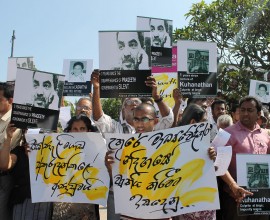
Photo courtesy Euronews The clash between President Mahinda Rajapaksa and Chief Justice Shirani Bandaranayake, popularly (and wrongly) perceived as a battle between the executive/legislature and the judiciary, does not provide much hope for the latter. Both parties are presently engaged in a drive to convince the people of their narrative, their case. President Rajapaksa’s publicity campaign, as well as the manner in which some of the charges against CJ Bandaranayake have been framed (with prominence given to matters of financial impropriety) has had an effect among the people. That CJ Bandaranayake has understood this is reflected in the response issued by her through her lawyers, denying these serious charges; implying further that the rest of the charges are so flimsy that the trouble need not be taken to even refute them. The immediate outcome of this personal rift may not be surprising. 14 ‘impeachable’ charges have been leveled, with a minimum of 1 charge being needed to be proved. 11…

Continue reading »

Many Shades of Accountability: The UN and Sri Lanka

532172mahinda

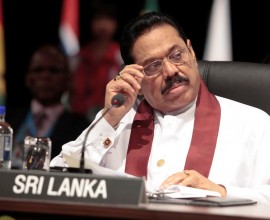
Photo courtesy United Nations In the last stages of the war in Sri Lanka tens of thousands of civilians were killed and no one has been held to account to date. This article though is not about the accountability of the Government of Sri Lanka(GoSL) for the killings. Hundreds, if not thousands, have already discussed, written and produced documentaries demanding GoSL for action on this count.  The UN Secretary General’s Panel of Experts (PoE) put GoSL on the dock and recommended independent and credible investigations. Though little has changed in Government’s position on the issue, ‘accountability’ has continued to remain a thorn and has forced the Rajapakses to steer away from the ludicrous defense of ‘zero casualty’, ‘gun in one hand and human rights charter in the next’ and other such denial theatrics. It has compelled the Government to appoint ‘Lessons Learnt Commission’ (LLRC) and Military inquiry panels to buy time and to hope that things will fade away. But…

Continue reading »

Which way forward in post-conflict Sri Lanka? Lessons from the so-called ‘powerless’ women of the North

forgottenrefugees

Image courtesy Sri Lanka Brief Introduction Before the war, we were all together. Now, we are widows with no security, and no one sees what we have to live through. But we go on, try to find some money to get us through the day…we have to eat, no? The cooking and cleaning needs to be done, the children have to go to school…that’s how life goes.[1] What must have seemed to 36-year old Rina[2] like nothing more than a statement of unavoidable realities is laden with meaning for social scientists studying representations in postwar contexts of‘vulnerability’ and ‘marginalisation’ – and perhaps even more interestingly, the meanings of‘survival’and‘endurance’ in such settings. Tragically, although an intriguing subject for study, Rina’s circumstances are relatively ‘ordinary’ in the north of Sri Lanka: she is one of the estimated 40,000 female heads of households (“FHHs”) in that region[3], most of them born from the three decades of civil war. Given the oppressive environment of…

Continue reading »
Page 4 of 21« First...23456...1020...Last »

About Groundviews

Located at the Centre for Policy Alternatives in Colombo, Sri Lanka, Groundviews is a citizen journalism website that uses a range of genres and media to highlight critical perspectives on governance, reconciliation, human rights, the arts and literature, democracy and other issues. The site has won two international awards, including the prestigious Manthan Award South Asia in 2009. The grand jury's evaluation of the site noted, "What no media dares to report, Groundviews publicly exposes. It's a new age media for a new Sri Lanka... Free media at it's very best!"

cezarneaga.eu