Archive for the ‘Vavuniya’

Is the war crimes video confirmed by UN as authentic “unrepresentative and irrelevant”?

5F4A18ADD57A0F339B09213AC557831A

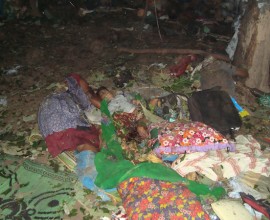
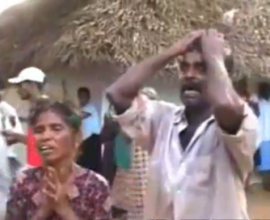
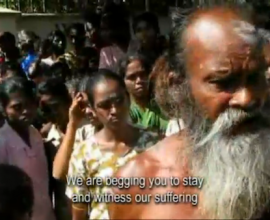
The Report of the Special Rapporteur on extrajudicial summary or arbitrary executions, Christof Heyns, presented at the 17th Session of the United Nations Human Rights Council sessions in Geneva today found, after digital forensic investigations, new footage from the final days of Sri Lanka’s civil war as authentic and proving that war crimes took place there. As noted in this AFP report, “What is reflected in the extended video are crimes of the highest order — definitive war crimes,” the U.N. investigator, South African law professor Christof Heyns, said in a report released Monday to the global body’s Human Rights Council. Heyns said he reviewed the footage showing the apparent execution of unarmed men and women with technical and forensic experts. “The overall conclusion reached by the experts is that the video is authentic and the events reflected in the video footage occurred as depicted,” he told the council. Sri Lanka’s government has maintained that the video is not real.”…

Continue reading »

A robust debate on No Fire Zones (NFZs) and International Humanitarian Law: Artful dodging of war crimes in Sri Lanka?

s16_18765259

Original image courtesy PEDRO UGARTE/AFP/Getty Images A central challenge of curating content on Groundviews is that some of the most interesting discussions which occur on comment threads get obscured over time, and are less visible than the primary material published here. A case in point is the recent thrust and parry of wit over the establishment of the No Fire Zones towards the end of war in Sri Lanka. The debate was between two leading voices on this site and the Sri Lankan new media landscape, Aachcharya and David Blacker, in response to a review of The Cage, the explosive new book on the end of war by former UN spokesperson Gordon Weiss. What follows are key excerpts from this comment thread. To read the exchange in full, click here and scroll down to see the nested comments. In all of the following excerpts, points in bold are by us and not in the original. The debate began with a…

Continue reading »

A review of ‘The Cage: The Fight for Sri Lankan & The Last Days of the Tamil Tigers’

Screen shot 2011-05-24 at 3.55.26 PM

I was elated to take delivery of my copy of The Cage by Gordon Weiss yesterday. Having pre-ordered it off Amazon UK, I fully expected it to be held up by Customs officials in Sri Lanka, given the incendiary issues the book is anchored to and its author, an erstwhile employee of the United Nations (UN) in Sri Lanka. As a friend quipped, they probably thought it had something to do with the Dehiwela Zoo. This may be true for now, but it is highly unlikely, in a country that has repeatedly even blocked issues of The Economist with articles perceived to be against the incumbent government, that this tome will be freely sold in bookstores. The publication and release of The Cage comes soon after the hugely controversial and deeply distressing report by the UN Secretary General’s Panel of Experts, which found credible allegations of war crimes and crimes against humanity by both the LTTE and government armed forces…

Continue reading »

V-Day 2nd Anniversary: Peace Under Pressure

15lanka-600

Original image by J. Adam Huggins for The New York Times Every mayoralty in Paris has tablets on which are inscribed the names of those from that locality who died in the many wars which France fought. Many are the works of art in the glorious buildings in Paris, which depict these battles, from Jeanne d’Arc (Joan of Arc) onward. Many are the military parades in remembrance. This is so of most countries, not merely the hub of Enlightenment thinking. Russia recently celebrated with its parade in the Red Square, the victory over Nazi fascism. Thus we must be suspicious of the argument that Sri Lanka must not commemorate its victory over the terrorist separatist army of the LTTE. It is our legitimate entitlement which we must continue over the generations. Is the war worth commemorating with celebration? The answer to that question resides in the answer to another: how many citizens of all ages are dying violently each week,…

Continue reading »

Reconciliation without Truth in Sri Lanka?

Truth

South Africa had a Truth and Reconciliation commission presided over by Desmond Tutu. Human Rights activists who looked forward to Reconciliation and peace at the end of the civil war in 2009, expected the LLRC (The Lessons learnt and reconciliation commission) to play the same role. But it did not due to various reasons. The main obstacle being that witnesses who came forward to give evidence before the commission were not given protection. There can be no peace or national unity without reconciliation and reconciliation has to be based on Truth and Accountability. When the parents and relatives of those who disappeared during the war, want to know what happened to their loved ones, they need to be told the truth, however painful if may be.  Instead, telling them “The war is over. Now don’t dig up the past and ask useless questions. What’s the point in revealing what happened, it will only lead to anger, hatred and division. Therefore…

Continue reading »

From draft to official text: Wikileaks reveals the US response to the end of war in Sri Lanka

Final

The Norwegian newspaper Afterposten published on 7th May a cable from the Wikileaks tranche of US diplomatic cables (confidential briefings) dealing the US government’s response to the end of war in Sri Lanka. Wikileaks on Sri Lanka: A breakdown and implications was an in-depth account we exclusively published last year exploring the fallout of the so-called ‘Cablegate’ on issues related to Sri Lanka, read to date by well over 20,000. As a BBC news report flagging this latest cable on Sri Lanka notes, “The Sri Lankan government rejected a surrender offer by Tamil Tiger rebels at the end of the war, reports released through the Wikileaks website say. They say that Defence Secretary Gothabaya Rajapaksa dismissed US pressure to allow a mediated surrender with the words “we’re beyond that now”. The leaked US cables suggest requests for the International Red Cross to go into the war zone were refused. Sri Lanka’s government has repeatedly denied all these accusations.” In light of…

Continue reading »

On Sinhalese Nationalists, Tamil Diaspora and the War Crimes Saga

819871-110426-sri-lanka

Photo from The Australian A couple of days ago I was watching a political talk show in the Derana TV Channel attended by prominent nationalists including Professor Nalin de Silva of the Sinhalatva School of thinking. One needs no special introduction to this nationalist ideologue cum academic. The focus of discussion was Report by the UN Experts Panel baptized by the government as the “Darusman Report”. I was curious when Nalin de Silva said something along following lines “There was no war in this country and whatever the pundits ( pandiyo) say this is not the Post War period. In fact this is pre-war period and there will be a real war within next six to seven months!” then came the thunderbolt if ever there was one as Nalin de Silva went on to explain that this report would be a preliminary towards a more damning report which would be taken as justification for NATO to do a Libya or…

Continue reading »

Sinhala and Tamil translations of UN Panel’s report on accountability

UN-Sri-Lanka-feature

Original image from TNL The official version of the report published by the panel constituted by the UN Secretary General to look into issues of accountability in Sri Lanka was released on 26th April 2011. It is highly unlikely the UN itself will produce Sinhala and Tamil translations of the report. Given the near complete absence of reporting in Sinhala media over the issues flagged in the UN Panel’s report, readers have only got to read commentary based on sections of the report, which is almost always virulently in opposition with very little reasoned debate. Groundviews through Vikalpa commissioned a translation of the Executive Summary of the official version of the report. We received another translation done by a third party today. We also received today a translation of the report into Tamil. We give below links to the three documents – two in Sinhala and one in Tamil. The translation into Sinhala published on Vikalpa can be read online…

Continue reading »

Violence and accountability

amnesty 1

Cartoon by Albert Ashok As conflict raged, the United Nations Commissioner for Human Rights had stern words for those on both sides. “All violations of international humanitarian law and human rights law must be investigated and those responsible for breaches – including deliberate targeting of civilians, indiscriminate and disproportionate attacks, the killing of injured persons and the use of human shields – must be brought to justice,” her spokesman told reporters. The year was 2004, and fighting in Fallujah in Iraq was taking an ongoing toll on ordinary people. The UN Commission on Human Rights special rapporteur on the right to health had earlier listed “extremely serious allegations” against the US-led coalition that had taken control of Iraq and called for an independent inquiry. UN investigators continued to keep a close watch on Iraq. Just last year, special rapporteur on torture Manfred Nowak – who in 2006 had condemned the US detention centre in Guantanamo Bay as a “torture camp”…

Continue reading »

Much ado about nothing: Is Sri Lanka in danger of being held accountable by the International Criminal Court?

sri-lanka_375004a

Image from Joe Klamar/AFP/GETTY Early last year I set about examining, as a recent graduate, the feasibility of any citizen of Sri Lanka being tried in the International Criminal Court (ICC) over the alleged war crimes and crimes against humanity that were committed in the last phases of the war between the government of Sri Lanka and the LTTE. I concluded that there is no real danger of any case being brought against the members of Sri Lankan Military or the current administration. Such fears are simply unfounded. I wish to revisit the question of if in fact any citizen in Sri Lanka can be held accountable under the ICC within the current context. There has been much discussion about the issue of war crimes in Sri Lanka in the past week.  The current government and all major political parties have recently commented at many capacities on United Nations panel investigations and its leaked report. Since many commentators have written, and…

Continue reading »

The cynical manipulation of international law: Murdering civilians in No Fire Zones and other war crimes allegations

UN_panel_on_sri-lanka11-1111

The Island newspaper continues to publish leaks from the report produced by the Panel appointed by the UN Secretary General to look into post-war accountability in Sri Lanka. Groundviews has contextualised in detail the Executive Summary and Parts 1, 2, 3, 4, 5 and 6 of the leaks. The Island published today Part 7 which deals with credible allegations of war crimes by the Sri Lankan Government and its armed forces that include the deliberate targeting of civilians in the so-called No Fire Zones (NFZs) and wholly inadequate measures to protect civilians from shelling. As the Panel succinctly notes, “… the Government’s instructions for civilians to move into the NFZs, only to be subsequently shelled by the SLA, disregarded this rule and in fact amounted to a cynical manipulation of it.” As before, we provide context and background information to frame these highlights. Much of the context in this story is actually part of that which was given in previous stories covering other aspects of the leaked UN report….

Continue reading »

‘National security’ in post-war Sri Lanka: Women’s (In) security in the North

JalajakumariSelvarasa

Photo from Hear My VOICE: Jalajakumari Selvarasa ~ “I could often feel the nostalgia” Resurrecting the ‘undead Tiger’[1] to secure the citizen: How the situation of women belie the dominant security narrative ‘The world should appreciate our successful anti-terrorist effort. But today we are being hounded by those who turned a blind eye to LTTE atrocities over the years, particularly its widespread use of child combatants in war against the security forces. Children are no longer at the risk of being abducted on their way to school or back. Girls are no longer forced to wear suicide jackets and throw themselves at military and civilian targets.’- President Mahinda Rajapakse in an interview to The Island, 18 April 2011. ‘We should not have to feel afraid. We should have the freedom to travel freely without fear.’-woman from Vadamaraatchi in Northern Sri Lanka The state of emergency remains in place nearly two years after the end of the war. It is renewed every…

Continue reading »

The Darusman Report: Reflections on the real challenges ahead for Sri Lanka

r-SRI-LANKA-WAR-CRIMES-large570

In less than two weeks since the Darusman Report (hereinafter referred to as the Report) was handed over to the United Nations Secretary General (hereinafter referred to as UNSG), a large number of articles have been written about the report, its motivations and on its impact on Sri Lanka. Except in several exceptions, the majority of these renderings seem to have lost the plot, in their failure to provide adequate attention to several key issues surrounding the report, or the ‘leaked’ version of it published in the Sri Lankan newspaper The Island. Public reactions to the leaked sections of the Report are best glimpsed from Groundviews, where comments made by readers include rather heated debates on issues such as the number of Eelam War IV casualties raised in the Report. One such key factor is that the Report is critical of both adversaries of Eelam War IV, the Government of Sri Lanka (GoSL) and the Liberation Tigers of Tamil Eelam…

Continue reading »

UNSG Panel Report on Sri Lanka: Revisiting ‘Accountability’

Displaced Tamil civilians watch

Original photo from JDS Ensuring ‘accountability’ is important, but doing so is a complex task. Who is to ensure accountability, when, where, how? – are questions which have always aroused serious debate, and will do, in the future. While there may be no ‘independent/internal’ investigations, one need not be starry-eyed about ‘independent/international’ investigations. For example, ‘Nuremburg’ was an important start, but was never a suitable model. What, for instance, is ‘international’ and who decides the form and nature of this mechanism? Can we go with Chinese/Russian investigators, and if so, would they be independent? Can we go with US/UK investigators, and would they be independent? Also, can we simply investigate the ‘last stages’ of the armed conflict? What about India’s role in the conflict, and are we to forget the manner in which India nurtured armed groups hostile to Sri Lanka? Are we to investigate only the leaders (of the present regime) who defeated the LTTE, but not those of…

Continue reading »
  • 23 Apr, 2011
  • 22 Comments
  • Peace and Conflict,
    UN Panel Report,
    Vavuniya,
    War Crimes

Cluster munitions, inhumane IDP camp conditions and the White Flag incident: More disturbing leaks from UN report

UN_panel_on_sri-lanka11-111

The Island newspaper continues to publish leaks from the report produced by the Panel appointed by the UN Secretary General to look into post-war accountability in Sri Lanka. Groundviews has contextualised in detail the Executive Summary and Parts 1, 2, 3, 4 and 5 of the leaks. The Island published today Part 6, which focusses on, inter alia, the conditions faced by IDPs interned in camps after the end of war, allegations of the use of cluster munitions or white phosphorus and torture in detention of suspected LTTE cadre. As before, we provide context and background information to frame these highlights. “Civilians emerging from the conflicts zone were initially housed in a network of 21 IDP sites spread across Jaffna, Mannar, Trincomalee and Vavuniya districts. Most were eventually sent to Menik Farm near Vavuniya, which at its peak, housed around 250,000 IDPs, making it one of the largest IDP sites in the world and one of the largest population centres in Sri Lanka.” “Menik Farm and…

Continue reading »
Page 5 of 13« First...34567...10...Last »

About Groundviews

Located at the Centre for Policy Alternatives in Colombo, Sri Lanka, Groundviews is a citizen journalism website that uses a range of genres and media to highlight critical perspectives on governance, reconciliation, human rights, the arts and literature, democracy and other issues. The site has won two international awards, including the prestigious Manthan Award South Asia in 2009. The grand jury's evaluation of the site noted, "What no media dares to report, Groundviews publicly exposes. It's a new age media for a new Sri Lanka... Free media at it's very best!"

cezarneaga.eu