Archive for the ‘Vavuniya’

Putting paid to the Government’s false claims: The new IDPs in Sri Lanka

DSCF2029

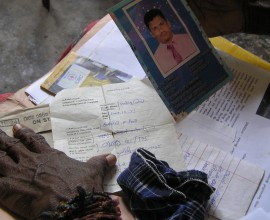
Editors note: On the day Menik Farm was officially closed, an urgent memo was circulated widely on the fate of the IDPs from Keppapilavu. The memo adds vital context to the following story, which also needs to be read in light of Government and Ministry of Defence claims that, there are no longer any IDPs in Sri Lanka. that they have all been resettled. that phrases like “Internally displaced people, relief camps & refugee camps” will not be there in Sri Lankan dictionary in future Urgent and disturbing | SOS: Memo from Keappapulavu displaced people cl.ly/2T1y2E0K170W @unocha @7piliers @lankasol #lka #srilanka — Groundviews (@groundviews) September 24, 2012 Also read Relocated to nowhere by the author, appearing in Ceylon Today. ### The war displaced community in Seeniyamottai in the Mullaitivu District have a story that is different to others. Unlike other internally displaced persons (IDPs) living within the confines of Menik Farm, Sri Lanka’s largest internment facility as well as the…

Continue reading »

Sri Lanka’s forgotten mass graves: Google Earth and remembering the dead in Nandikadal

Screen Shot 2012-09-18 at 2.41.58 PM

The end of war in Sri Lanka, captured for posterity by Google Earth published last week by Groundviews was the first look at the end of the war in Sri Lanka through historical satellite imagery freely accessible via Google Earth. The article was an open invitation for those using Google Earth to scan for and alert others over areas and artefacts of interest, that in turn could strengthen discussions around the hellish final weeks of war in Sri Lanka. Given the nature of imagery from around this period and centred on Nandikadal, the article explicitly noted, What Google Maps and Earth does NOT enable one to do, given (1) the quality of some of the historical imagery (which sometimes features extensive cloud cover of vast regions) and (2) the large gaps between the available historical imagery (mid March, late May, after the official end of the war and killing of the LTTE’s leader, then mid-June and early August) is any…

Continue reading »

The struggle to go home in post war Sri Lanka: The story of Puthukudiruppu

Taking-home-the-wood-from-UNHCR

Rajini (pseudonym) was amongst the ten women we met in a church in Vavuniya district about a week ago. At the time she and two of her children were living in Kadirgama camp in Menik Farm. The women and their families were displaced since 2008 and were prevented from going home to Puthukudiruppu. Some of us had known this community for several years and their yearning was always to go home to their villages despite the uncertainties about the remains of their houses and property. Rajini’s husband was killed on April 17th 2009 during the last phase of the war between the Government of Sri Lanka and the Liberation Tigers of Tamil Eelam (LTTE). Her eldest son, now 23, was forcibly recruited by the LTTE in 2007. Two years later, at the end of the war, he and other former LTTE combatants were detained by the police and moved to the Boossa detention Centre in the Galle District. Rajini has…

Continue reading »

Ganesan Nimalaruban: A damning murder, funeral and silence

IMG_0434

Photo credit: Vikalpa It is very likely readers of Sinhala mainstream print media have no clue who Ganesan Nimalaruban was, or exactly how he died. A simple Google news or general web search suffices to highlight how poor even English mainstream media coverage has been over the controversy surrounding his death. Vikalpa was present at the funeral of Nimalaruban. They note that aside from a few provincial journalists (whose news reports don’t make it to the actual print editions on the best of days) there were no other seasoned journalists from any mainstream newspaper present. Recall that the courts didn’t want Nimalaruban’s body to be released to his parents, citing that, “his funeral arrangements could result in a violent situation in his home town of Vavuniya.” Before his body was released, in an open letter to the President, senior Tamil politicians and civil society activists noted, Your Excellency, we have been informed by the eye witnesses on the inhuman merciless…

Continue reading »

Surrendering and Disappearing: Where are they now?

Image from WSWS

“Disappearance is far worse than death, because when a person dies, when I know that, so and so is dead, the story ends and somehow or other we close the chapter. But when a person has disappeared, it is an eternal suffering.”                                                                          (A.Santhipali, before the LLRC at Jaffna on 12th November 2010) In the controversial Commission of Inquiry on Lessons Learnt and Reconciliation, 53 LTTE cadres who surrendered during the final days of the war in May 2009 are alleged to have been disappeared and are reported to be under the category of ‘missing’. What happened to these 53 people? Their relatives and close kith and kin say that they were last seen and heard surrendering to the Sri Lankan Army. In the LLRC report, many family members of former LTTE cadres have complained that their husbands, wives, sisters, brothers, sons and daughters have disappeared after they surrendered to the Sri Lankan security forces. These family members still await…

Continue reading »

Cluster bombs in Sri Lanka: From denial to discovery

Sudar Oli - 06.03.2012

Ravi Nessman from Associated Press has broken what’s perhaps the most important story on the war, since it ended three years ago. In a story published by AP a few hours ago, he notes, The Associated Press obtained a copy Thursday of an email written by a U.N. land mine expert that said unexploded cluster bomblets were discovered in the Puthukudiyiruppu area of northern Sri Lanka, where a boy was killed last month and his sister injured as they tried to pry apart an explosive device they had found to sell for scrap metal. The email was written by Allan Poston, the technical adviser for the U.N. Development Program’s mine action group in Sri Lanka. “After reviewing additional photographs from the investigation teams, I have determined that there are cluster sub-munitions in the area where the children were collecting scrap metal and in the house where the accident occurred. This is the first time that there has been confirmed unexploded…

Continue reading »

The futility that is Omanthai: Post-war Sri Lanka’s reconciliation shortfalls

colombo_check_point

Image courtesy JDS Omanthai Checkpoint, 12.30am: As the conductor switches on the bright florescent lights inside the bus, the bus comes to an abrupt halt, jolting awake blurry-eyed passengers travelling from Jaffna to Colombo, who, in response to the instruction “okkomala bag arung eliyata bahinna…” (“Everyone, take all your bags and get off the bus…”), scramble around in search of their respective bags, still half asleep. Once having located their individual items of luggage, young and old alike, stumble out of the bus one after another and walk towards the takarung (metal sheet) shed, where males and females follow separate queues to have their bags checked by male and female army personnel, respectively. The checking too has now become so superficial and lackadaisical that it’s obvious it’s being conducted purely out of protocol, rather than as an actual security measure. Omanthai, having been one of the, if not, ‘the’ largest Government controlled checkpoint throughout the war, remains to date, more…

Continue reading »

Menik Farm after the cyclone: The continuing misery of IDPs

Menik Farm3

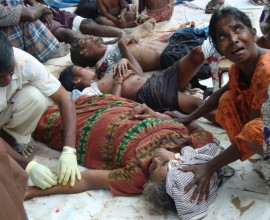
After a punishingly hot day, the skies seemed to provide some relief to the residents of Chettikulam as they opened to release heavy showers during the early evening of Saturday, March 31st. However, what was welcomed as a break from the unending heat by those ensconced in sturdy houses simultaneously proved to be a torment for the 6,022[1] residents in the Menik Farm IDP camps a few kilometres outside of town. Reports of injuries and the destruction of homes in the camps started coming in shortly after the 30 minute shower dissipated. We rushed to the Chettikulam hospital in the Vavuniya district and were greeted with the sight of ambulance after ambulance pulling in, unloading an unfortunate array of patients: an elderly man too weak to walk who has to be taken in with a wheelchair, another woman in a blue nightgown with two young children and another who has been cut on the head. She told us that the…

Continue reading »

Arbitrary Detention in Sri Lanka: Internment, Rehabilitation, and Surrenderees in the Prison System

93b38436c6_107612

Photo courtesy GlobalPost. Stephen Hird/Reuters. In January 2012 I traveled to Sri Lanka with a group of fellow students from the University Virginia School of Law.[1] We wanted to learn about legal issues in other countries, and we arrived in Sri Lanka eager to hear views from government officials, NGO workers, and local citizens. I chose to focus on arbitrary detention in a number of settings including the internment of IDPs from May to December 2009, the rehabilitation of former LTTE members, and the labyrinth of Sri Lanka’s prison system, including many who have disappeared while in custody or are being held without charge. The following is a brief summary of the testimony gathered from nearly three weeks of interviews in Sri Lanka. My interviews took place primarily in Colombo and the Vanni. A more in-depth exploration of arbitrary detention in Sri Lanka based on these interviews, including a substantial examination of Sri Lanka’s obligations under Article 9 of the International…

Continue reading »

The End of War in Sri Lanka: Reflections and Challenges released as iBook

Screen Shot 2012-02-07 at 9.46.02 AM

From 19 – 27 May 2010, Groundviews ran a special edition on the end of war in Sri Lanka. Over this week alone, the site received over forty-thousand readers and exclusively featured over eighty-thousand words of original content, one video premiere, over a dozen photos, generating over one hundred and fifty-thousand words of commentary. By popular request, The End of War in Sri Lanka: Reflections and Challenges, a compilation of content that appeared online in PDF form, was first released in May 2010. In mid-2010, it was published in print form. Today, we are relaunching the book as a free iBook on Apple iTunes. It is available as a direct download in 32 countries and regions, and readable on both the iPad 1 and 2 using iBooks. Ironically, Apple’s Sri Lankan iTunes store does not list the book, but you can easily download it to your Mac or PC using this link (138Mb iBook). Once downloaded, importing it to iTunes and synchronising it with your iPad…

Continue reading »

Optics and politics of grief

SRI_LANKA_(F)_0423_-_Vescovo_di_Chennai

Photo courtesy asianews.it “I was on my motorcycle going through this area behind a couple on a motorcycle. The woman was pregnant and they were out probably to do some shopping. The couple was coming fast. They signalled to me and I moved aside to let them overtake. I suddenly saw the couple fall down for no discernible reason and the man writhing in agony. He had been hit by a bullet from the army’s side. I stopped and the pregnant woman pleaded with me to take her husband to the hospital. Most people passed us by engrossed in their own problems and such things had become a daily occurrence. The man whose lower jaw had been blown off was vomiting blood and the situation looked hopeless. What had happened was that when we passed that area on motorbikes, it was our custom to dip our heads as low as possible to minimise our chances of being hit by an army…

Continue reading »

LLRC REPORT: REASON, REFORM, ROADMAP

rajapaksa_llrc report

Photo, courtesy JDS, is of Sri Lanka’s President reading the LLRC report on a ‘haansi putuwa‘ at his official residence. Though not without flaws and lacuna, the long awaited LLRC report does not disappoint, and reaches high standards, ranking with the best reports emanating over the decades from official and semi-official/autonomous Sri Lankan commissions, reviews and probes. It is a serious, thoughtful, carefully written and constructed text, striking in its fair-mindedness and balance. It deserves constructive engagement with, by all concerned Sri Lankan citizens and those in the world community who are concerned about and with Sri Lanka. Let us first dispense with the flaws and gaps, of which there are chiefly two. Firstly, the Report echoes the conventional wisdom, as does the Norwegian (NORAD) post-mortem, that the CFA was the result and in the context of the military weakness of the Sri Lankan state. This is factually incorrect since it ignores the chronology of events, in which the deadly LRP missions…

Continue reading »

The LLRC report and ‘accountability’ in Sri Lanka

Sri Lanka Civil War

Readers will find no big surprises after reading the final report of Sri Lanka’s Lessons Learnt and Reconciliation Commission (LLRC). It is very much what most people were expecting. A document that looks to the future, exonerates the military, does not touch on the question of accountability and includes some touchy-feely language about the country’s need to move forward, celebrate its diversity and be grateful for the defeat of terrorism. Essentially, all civilian casualties were the result of people caught in the crossfire or were the LTTE’s fault. “The protection of the civilian population was given the highest priority” by the Sri Lankan armed forces, the Commission has determined. The report also claims that military operations moved at a “deliberately slow” pace because Sri Lanka’s military personnel were so careful and cognizant of the dangers to civilian life during the final phases of the conflict. While the LTTE deliberately targeted civilians, it appears that Sri Lanka’s military did not, according to the LLRC…

Continue reading »

Measuring (After Nandikadal)

An embarrassment, to forget over short eats, ignore the bundle on his back, that sloshed set of poetry he cannot avoid carrying, an appendix, reptilian brain, fascination with naming elements of the crime, breadth of carpet strafing of civilians in tents on banks of the lagoon, while tails for the ball are rented and we sit down to quail and goose, although elements of the meal have no political meaning. They are foods for festive or special occasions: here fundraising, so ordinary citizens can travel to see the miscreant dictatorship, dressed in civvies, mixed in with the crowd, not in a killing field, drawn up in advance, but the larger and harder-to-manage masses of the post-war streets, and report what they find before the police visit. Repost This Article

Continue reading »

Response to Michael Roberts’ ‘Turning Former LTTE Personnel into Sri Lankan Citizens?’

Camp

Photo courtesy Lankapuvath Michael Roberts’ recent Groundviews piece on the government’s rehabilitation programme of alleged former LTTE combatants is generally approving of that programme, not only directly but also indirectly in making the kinds of criticisms that actually add to the approbation. Professor Roberts has added his distinguished academic authority to a set of circumstances that perhaps justifies a more discriminating analysis. His uncritical and at times inaccurate and misleading observations therefore require a response, providing also the opportunity to critique, both the policy and legal perspectives involved. In this article I will attempt to remedy the lacunae in my previous piece on this issue, published here[1] in late 2010, which did not discuss the legal dimensions nor use testimonies of persons released from rehabilitation centres[2] to substantiate certain assertions made in that article. Statistics: Do we know how many persons have been rehabilitated? In a section titled ‘Numbers’ Roberts discusses the number of persons who were held at rehabilitation…

Continue reading »
Page 2 of 1312345...10...Last »

About Groundviews

Located at the Centre for Policy Alternatives in Colombo, Sri Lanka, Groundviews is a citizen journalism website that uses a range of genres and media to highlight critical perspectives on governance, reconciliation, human rights, the arts and literature, democracy and other issues. The site has won two international awards, including the prestigious Manthan Award South Asia in 2009. The grand jury's evaluation of the site noted, "What no media dares to report, Groundviews publicly exposes. It's a new age media for a new Sri Lanka... Free media at it's very best!"

cezarneaga.eu