Archive for the ‘Colombo’

Pillars of deception a future leader from the opposition may want to address

ranil-wickramasinghe-2-colombo-telegraph1

Image from AsiaNews.It I enjoyed reading several articles written by Dayan Jayatilleka and Laksiri Fernando, on the future form of a democratic struggle launched by the people of Sri Lanka, to rise above the current political catastrophe. This is a complementary note as a Sri Lankan voter that maybe of some use to a future leader from the opposition who would give leadership to such a struggle. President Rajapaksa himself made the remark “the intellectuals in a country hear the first footsteps of a dictator”. He tried to give the impression that the loud sounds of a dictator’s footsteps we hear are not coming from his boots.  In fact, with the 18th amendment, Divi Neguma Act, and the sacred areas act, Rajapaksa’s have already claimed victory in their path towards a dictatorship above a republican democracy. Any democratic struggle to save the country from a corrupt dictatorship in the league of Suharto’s in Indonesia, should therefore account for the pillars…

Continue reading »

Sri Lanka’s 65th Anniversary of Independence

84c318bfe21411a38243e8a30f44cb2a

Photo via NowPublic Greetings Lanka! Today marks the 65th Anniversary of Independence of our country. This year would also mark the fourth year anniversary of ‘defeating terrorism’. But, little has changed, and there is little to celebrate this year. The country is treading a catastrophic path and our future is a disaster waiting to happen. For the one who hath his eyes open, it would be obvious that we are gradually plunging into an abyss from which there will be no return. Even though we have been treading this path for quite a while now, over the course of last few months we have taken gigantic leaps in our journey. How did we get here? It would seem that the common attitude that binds the different peoples of this land is stupidity. The stupidity that gave life to three violent armed struggles; the stupidity that made the Tamils remain silent when thousands of Muslims were evicted from the North; the…

Continue reading »

Conflict dynamics and Islamic values from Mindanao to Sri Lanka: In conversation with Mehmet Rizal Derindag

Screen Shot 2013-02-03 at 5.13.03 PM

Mehmet Rizal is a UN Ambassador For Peace and presently based in the Philippines. As noted in his biography, Rizal played a key role in bringing the Philippines government and Moro Islamic Liberation Front (MILF) together for a landmark peace agreement, and also brought OIC and Turkish foreign ministry into the negotiations process. Turkish by birth we talked about the history of violence in Mindanao, and in particular how Islamic principles can practically contribute for inter-communal harmony and nation building. We begin by looking at how 9/11 shaped Rizal’s worldview, and led to his taking up studies as well as travel to represent Islam in a better way, and redefine its enemies, as more violently and popularly portrayed by extremists and fringe elements. We then go into the conflict dynamics of Mindanao, and its historical roots. Rizal then goes on to explain why he entered the complex and fractured conflict, and why he believes that true change must come not…

Continue reading »

AN ARAB SPRING OR A BARACK OBAMA?

srilanka_0

Image courtesy RFI [Remarks delivered at the discussion on the Separation of Powers in the series "Ideas for Constitutional Reform" organized by the Liberal Party of Sri Lanka] While I see the need for constitutional reform, I do not see a need for a replacement of the Constitution. My stance remains that which I took during the Liberal Party’s discussions contained in the volume of 1991, namely, that the Constitution of ’78 was an advance over the Constitution of ’72. The Constitution of ’72 was in some way in advance over the Soulbury Constitution in as much as we became a Republic, but in many other ways it was a retrogression, in terms of the divisive privileging of a single language and religion in a multilingual, multi religious society and the abolition of the safeguards for minorities. So I do believe that the Constitution of ’78 should be reformed. I support the reform that took place in terms of the…

Continue reading »

Towards an Inclusive Constitution for Natural Justice

Police take up position behind a metal barrier as students from a group of universities hold a puppet of Sri Lanka's President Rajapaksa over the barrier during a protest in Colombo

Image from Wall Street Journal The period that we have before us comprises the most motley mixture of crying contradictions: constitutionalists who conspire openly against the constitution; revolutionists who are confessedly constitutional; a national assembly that always wants to be omnipotent and always remains parliamentary; an executive power that finds its strength in its very weakness and its respectability in the contempt that it calls forth…Thus so long as the name of freedom was respected and only its actual realization prevented, of course in a legal way, the constitutional existence of liberty remained intact, inviolate, however mortal the blows dealt to its existence in actual life. (Karl Marx, Eighteenth Brumaire of Napoleon) We should cautiously welcome and proactively engage with the Sri Lankan Government’s latest interest in creating a new Constitution to address the pressing needs of today’s society.  Sri Lanka’s governments since 1972, have been infamous for enacting constitutional reforms, both during and immediately after economic and political crises,…

Continue reading »

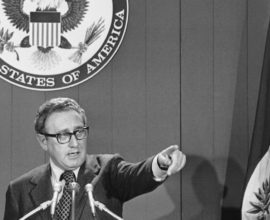
Another US Resolution on Sri Lanka: The Road to Nowhere?

Mahinda-Samarasinghe

Photo courtesy JDS So it looks like the US will bring another resolution on Sri Lanka at the next session of the UN’s Human Rights Council (HRC) in Geneva this March. Quite frankly – I am shocked. US foreign policy as it relates to Sri Lanka has been confusing and is replete with complications and contradictions. One can’t help but wonder: Where is all of this heading? Is this a road to nowhere? I really wish I knew. But at this point, I’m not sure that anybody does. If the US goes ahead with another (weak) resolution, what would be the point? It would accomplish nothing. And what does that mean for US foreign policy in Sri Lanka, or – more broadly – what might that mean for American foreign policy in the region? The US didn’t seem to be that concerned about human rights here when people were being slaughtered in 2009. Make no mistake about it: Washington knew…

Continue reading »

Sri Lanka’s tryst with reconciliation: Where are we today?

rajapaksa_llrc_report

Image courtesy Centre for Human Rights The dominating narrative is dichotomous: at one end of the spectrum is the view that reconciliation has been achieved with the conclusion of the armed struggle and at the other end is the contention that reconciliation has not even begun to take place since the end of the war. The perceptions are equally remarkable. International interest in the imperative is in no small measure. The impact on domestic stability remains uncontested. Whichever viewpoint is adopted, consensus can be achieved only on the limited. The danger of such a scenario does not augur well for Sri Lanka, a nation in transition having emerged from the throes of a three-decade conflict. Post-war efforts at reconciliation are undoubtedly taking place through both organized and natural processes; however the importance of the endeavour being state-led cannot be overstated. THE LLRC The final report of the Lessons Learnt and Reconciliation Commission (LLRC) calls upon the Government, among other things, to…

Continue reading »

Implementing LLRC recommendations in Sri Lanka: Progress?

rajapaksa_llrc_report

Image via Sri Lanka Brief Sri Lanka has achieved considerable progress in implementing the recommendations made by the Lessons Learnt and Reconciliation Commission (LLRC) and ready to defend its record at the next session in Geneva, Foreign Secretary Karunathilaka Amunugama said. So says the President’s Media Unit. We are a tad less sanguine. Even a cursory reading of the latest LLRC NAP Monitoring Report, updated on 2013.01.22, indicates significant gaps between propaganda and reality. As we tweeted a few days ago, 1. @presrajapaksa‘s Govt report says no media restrictions in N/E cl.ly/image/0O20173m… But reality groundviews.org/2012/10/02/men… #lka #srilanka — Groundviews (@groundviews) January 27, 2013 2. ZERO movement on LLRC recommendation for RTI/FOI cl.ly/image/1h1s2F1v… What is @presrajapaksa hiding and scared of? #lka #srilanka #media — Groundviews (@groundviews) January 27, 2013 3. Utter lack of independence in independent judiciary after CJ impeachment by @presrajapaksa. Army CoI useless cl.ly/image/3o0P470F… #lka — Groundviews (@groundviews) January 27, 2013 4. Another lie by @presrajapaksa‘s Govt. Armed thugs do roam…

Continue reading »

Real and Phantom Per Capita Income in Sri Lanka

Screen Shot 2013-01-30 at 7.42.25 AM

Image courtesy Colombo Gazette The Per Capita Income (PCI – average annual income per person) is derived by dividing the Gross National Product/Income (GNP/I) of a country by the total population of a country during a given period of time. It is a commonly used yardstick for practical and analytical purposes. However, it is important to understand that the per capita income of a country does not necessarily indicate the level of development of that country. For example, according to the World Development Indicators 2012 of the World Bank, while the Per Capita Income of Cuba was $5,520, PCI of India was $1,270, PCI of Timor-Leste was $2,220, and Sri Lanka’s Per Capita Income was $2,240 in the year 2010. The foregoing figures do not imply that Cuba is economically better-off than India or Sri Lanka; similarly it does not imply that Sri Lanka is economically better-off than India, and Sri Lanka and Timor-Leste are on par in terms of…

Continue reading »

On Dengue Fever and Other Observations

Colombo 2012 Mosquitoes, bites, blood, pain, even death. I take absolutely no precautions when it comes to Dengue fever, except that I try to surround myself with air conditioning whenever possible. I’ve seen stories about Dengue in the newspapers – in the Daily Mirror and elsewhere. I thought it was probably just the flu, but I decided to go get my blood drawn anyway. Two hours later I’m back at my apartment, reading The Beautiful and the Damned and wishing that I was with Fitzgerald in Paris. My cell phone starts to ring. “Hello, sir?” “Yes…..” “Yes, right, well, we got your test back from the lab and….where are you now?” “I am at my house. Is there a problem?” “Would you be able to come back to the hospital to meet with one of our doctors? There is a problem with your blood; something is out of order.” I drop my book and head to the hospital immediately; it’s…

Continue reading »

‘Black January’ demonstration 2013: Protesting a perfect record of impunity

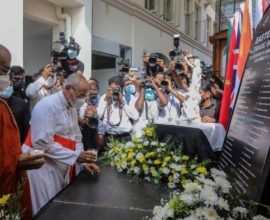
Since 2005, in the month of January alone, the list of violent attacks on media personnel and journalists across Sri Lanka is mind-boggling. There is a very long yet still incomplete list of the attacks by Sunanda Deshapriya published on Groundviews. As he notes, “Not a single case of killing, assault or arson listed here has been investigated to completion nor have the culprits been brought to book.” Vikalpa took the photos below from the demonstration in Colombo. As the Committee to Protect Journalists avers, Black January commemorations in Colombo have become an annual event. Tuesday’s demonstration was the second. The protest aims to recall the series of killings and attacks on journalists in Sri Lanka in recent years, many of them occurring in Januaries past. All of them have gone untried and unpunished, sustaining the country’s perfect record of impunity for those who want to silence media by murder. Repost This Article

Continue reading »

Black January: Ceaseless media suppression in Sri Lanka, with total impunity

sri_lanka_press_freedom2

Image via RNW The month of January is coming to an end and yet again it has been filled with a number of major attacks on media freedom in Sri Lanka. For this reason the month is often referred to as the ‘Black January’ of media suppression. This year too, journalists’ and organisations in the country are commemorating Black January as an event to mark continued suppression of independent media and journalists in Sri Lanka. The war against the LTTE was accompanied by another war, the war against independent media in Sri Lanka. The war against the LTTE came to an end in 2009 however the war against free media in Sri Lanka has not. It is a war that can not be won. Freedom of speech is an inherent right which can not be suppressed forever. The commemoration of Black January is itself a vivid example of the vitality of free speech, in desperate circumstances. What follows is an…

Continue reading »

A-Z of Sri Lankan English: Y is for y’all

Yall-Spoken-Here_3985-l

Image from Neato Shop Many languages have singular and plural forms of the second person pronoun you, including Sinhala and Tamil. English doesn’t, except in certain dialects: yous or youse is heard mainly in Scotland, Ireland and Australia; and y’all is common in the US, as in the expression “Y’all have a nice day!” Y’all is also common in colloquial Sri Lankan English (“When did y’all come?”), as well as the possessive form y’all’s (“Where are y’all’s books?”). The all is just a plural marker, so it could just mean some of you, not necessarily all of you, which becomes y’all all, or all of y’all, as in these quotes: “So y’all all came together? Like going on a pilgrimage?” (Monsoons and Potholes, by Manuka Wijesinghe, page 22) “Ah? Then what’re all’f y’all doing here?” (A Cause Untrue, by David Blacker, page 557) I often see this contraction of you all spelt as you’ll (“Nice to hear that you’ll enjoyed…

Continue reading »

The Tamil Factor: A Semantic Approach

Tamil

The Tamil factor is best viewed in terms of its impact on language, culture and social institutions in the country.  It is more interesting and rewarding when seen in this perspective than in its political dimension, and less controversial too. One of the Sinhalese terms that has interested me is ‘walauwa’ which refers both to a place as well as to a social institution.  It comes from the Tamil word ‘valavu’ which denotes a compound or garden, and, by implication, a large house with aristocratic connotations.  My dear friend, the late Mr. Wimaladharma Ellepola lived in his ancestral residence, the Maha Walauwa, Matale and my father’s dear friend, the late Mr. S. Kathiravetpillai, Attorney-at-Law and M.P. Kopay, lived in his ancestral residence, the Maha Valavu, Kopay, thereby metaphorically fusing the nobility of Kandy and Jaffna in a single lofty tradition of semantic and architectural unity in diversity.  The acme of walauwas in the Sinhala social stratum is the ‘wasala walauwa’. …

Continue reading »

Prageeth Ekneligoda: A 3 year struggle to find husband, father, cartoonist and journalist

6755709949_8bf5e23abb_o

Image courtesy Vikalpa I had never met Prageeth Ekneligoda. But after he disappeared, on 24th Jan. 2010, I read some of his articles. I found them to be thought provoking and cover many issues related to freedom of expression, human rights in general, democracy etc. But what struck me most was some of his cartoons. I was first shown the cartoons at his house, by his wife Sandya, just a few days after he had disappeared. Amongst the cartoons that made a lasting impression on me was one that showed about ten men abusing a single woman. It was titled “if the will of the majority identifies as democracy”. I found it very powerful in it’s meaning and simple to understand. Subsequently, I had regularly used this cartoon in making presentations and conducting trainings, on issues related to minority rights and majority – minority relations in a democracy. It had always proved to be provocative, from international audiences to teenaged…

Continue reading »
Page 7 of 125« First...56789...203040...Last »

About Groundviews

Located at the Centre for Policy Alternatives in Colombo, Sri Lanka, Groundviews is a citizen journalism website that uses a range of genres and media to highlight critical perspectives on governance, reconciliation, human rights, the arts and literature, democracy and other issues. The site has won two international awards, including the prestigious Manthan Award South Asia in 2009. The grand jury's evaluation of the site noted, "What no media dares to report, Groundviews publicly exposes. It's a new age media for a new Sri Lanka... Free media at it's very best!"

cezarneaga.eu