Archive for the ‘Colombo’

How to Deal with Racism

Racism

Photo courtesy The Platform/Raashid Riza The Lord Buddha once said “When someone fires an arrow into you, you don’t try and find out who fired the arrow and what they are all about. You concentrate on getting that arrow out.” What do we do to combat against racism and stereotyping we see so much of in our society? We think that those who spew such hate are a minority and that their opinions and actions are not representative of the majority that wants to co-exist and live in peace. So do we let things be or fight back? What is the best way to deal with racism? By thinking that we cannot change things, that certain situations in life are beyond us and that we must leave that to elected officials, we do what we unfortunately do best. We let people (usually with hidden interests) manipulate our emotions and pull wool over our eyes. So we react. Reacting requires less…

Continue reading »

The Sinhalese…

Untitled2

[The triple gem of Anuradhapura; Abhayagiriya facing north and its synthesis of Theravada and Mahayana represents the spiritual values of balance and integration; Ruvanweliseya in the western corner symbolizes caution, orthodoxy and conservatism; Jethavanaramaya in the eastern corner symbolizes optimism and progress – the mentality of the rising sun. To the south is materialism into whose clutches the sinhalese walked innocently without any of the safeguards afforded by this ancient Trinity.] The Sinhalese… Left their unity and security at Anuradhapura. They have not been safe or secure in any of the subsequent capitals. This chronic insecurity has something to do with their narrow version of domesticated Buddhism and a Sangha that enjoys entrenched privilege upon a notion of an exclusive Sinhala Buddhist identity. The original sense of brotherhood upon which the Indian invaders and natives finally settled, sealing their compact with the Ruvanweliseya and Gamani Kingship was whittled down in stages into a sharp hierarchy where the Sangha and king…

Continue reading »

Travails of the Women in the Vanni

Screen Shot 2013-03-14 at 6.45.25 AM

Photo courtesy Amantha Perera / Perambara (Following is a copy of  a presentation made by the author at a side event at the UNHRC in Geneva on 11th March, 2013 organised by the Co-operative Society of Netherlands in collaboration with the International Movement Against Discrimination and Racism)     All of us remember the day the war ended in Sri Lanka. While those in the rest of the country rejoiced, to  the Tamils, many of whom had friends and relations living in the war zones, it was a very sad day.    Thousands of persons had been killed in the final days of the war.  Thousands of others  walked  into the hands of the army waiting  to receive them and send them to the hurriedly established camps which they called welfare centres. The  292,000 odd persons who escaped death during  the war,  had to spend  nearly three years  in  refugee camps in which they were imprisoned till they were re-settled or re-located in…

Continue reading »

‘Kerosene’ by Kannan Arunasalam wins international documentary award

Kannan - Kerosene

Groundviews is extremely pleased to recognise that Kannan Arunasalam has won the 2013 South Asian International Documentary Festival’s Prism Short Award for ‘Kerosene’. This short film was one of three produced by Kannan with utilising a small grant by Groundviews in 2011. First screened in Colombo and subsequently featured on the critically acclaimed Moving Images website, ‘Kerosene’ and his two other short films generated the most feedback and engagement given their unique, deeply sensitive and compelling interrogation of life in the North of Sri Lanka, post-war. You can view the full film below. Kerosene from Kannan Arunasalam on Vimeo. Go to Moving Images to see his two other films, as well as other productions on Sri Lanka. A trailer for all three productions can be viewed below. Trailer: Koothu, kerosene and paper from Kannan Arunasalam on Vimeo. Repost This Article

Continue reading »

Impeachment of Sri Lanka’s Chief Justice and its impact: What do you think?

Opposition activists hold up placards during a protest in Colombo

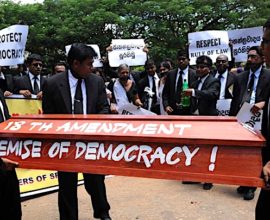
Photo courtesy Euronews Just a few weeks since the impeachment of Sri Lanka’s Chief Justice Shirani Bandaranayake, no one is really talking about it anymore. Interviews conducted by and featured on Groundviews at the time impeachment proceedings were on clearly flagged serious fears over the independence of the judiciary. In order to ascertain the lasting impact of the impeachment in the manner it was conducted as well as to understand better the dynamics of public opposition or support towards it, Groundviews has created a brief online questionnaire. The questionnaire will be open for responses from today until 21 March 2013. Depending on the feedback, results of the questionnaire, along with suitable data visualisations, will be posted on this site. To answer the questionnaire, please click the button below OR click here to fill it out in a new browser window. Answer Questionnaire Please pass it on to friends and colleagues. Repost This Article

Continue reading »

An Allegory For Sri Lanka’s Sad Communalism

439709577_36c208d561_b

Photo by Aufidius, via The untold story of a child The recent debate around the anti-halal movement, with its echoes of anti-Tamil sentiment of the post-independence period (‘Tamils get more government jobs,’ ‘Tamils have access to better education than Sinhalese’), is on the surface a conflation of religion, nationalism, class and various other factors. Beneath the complexity of the rhetoric, at least to me, are feelings of disaffection, great sadness, loss of meaning of what we stand for, of what we are as a nation, as a people. To attempt to make sense of it let’s scale down the scenario to a manageable, personal level. Consider this hypothetical situation: I am school age. I have a friend who, at least for now, we will call Sam ­– a facile Western name to free your image of him from Sri Lankan race/religion/caste and other cultural trappings that further complicate the issue. Sam is a huge cricket fan. On most days he…

Continue reading »

Lies, Damn Lies and Mahinda Samarasinghe at the UN HRC

Mahinda-Samarasinghe

Image courtesy JDS Sri Lanka Campaign has just released a very good compilation of rebuttals to points made by Min Mahinda Samarasinghe’s address to the UN Human Rights Council yesterday, which can be read and viewed here. Here Sri Lankan civil society responding to Mahinda Samarasinghe’s speech @groundviews @cfhaviland #HRC22 #UNlk scribd.com/fullscreen/127… — Sri Lanka Campaign (@SLcampaign) February 28, 2013 In addition to the content, the production of this document, and its publication online, is itself an interesting development which flags the growing influence of web and social media in countering the wily terminological inexactitudes of the Rajapakse regime and its leading apologists. Civil Society Collective by Repost This Article

Continue reading »

A Lenten Reflection by Bishop Duleep de Chickera

EVOLUTIONARY DECLINE AND THE ASCENT OF HUMAN RESILIENCE The weeks leading to Independence Day on February 4 were filled with intense debate on the legality and morality of the impeachment of the Chief Justice (CJ). The debate centred on the interpretation of the law and the political motives behind it. The government finally had its way and the CJ was impeached. The beginning of Lent, (Ash Wednesday, Feb. 13) followed close on these events. Since Lent is a time for inner scrutiny, repentance and a return to integrity amidst the harsh realities of life, any realistic preparation to celebrate Easter as the Festival of Ascent, is called to wrestle with these events. Evolutionary decline The episode of the impeachment of CJ Bandaranayake is not to be seen as an isolated incident. It is part of a wider design in governance, strong and predictable enough to be identified as evolutionary decline. Evolutionary because it grows on us; decline because it pulls…

Continue reading »

The state of media in Sri Lanka: In conversation with Dilrukshi Handunnetti

Screen Shot 2013-02-25 at 7.09.28 AM

Dilrukshi Handunnetti is currently Senior Deputy Editor, Ceylon Today and was, before Lasantha Wickrematunge’s murder, lead investigative journalist at the Sunday Leader. We begin by going into why after years as a journalist, Dilrukshi joined Transparency International for a few years to advocacy for many of the same issues that she had written about in the media. She is also asked whether in her current position at Ceylon Today – geared more to the oversight and curation of content others produce – she missed actually writing investigative articles herself. We then talk about how, even after the end of the way years ago, Sri Lanka’s media freedom and space for critical dissent remains abysmal, and by some global indicators, ironically getting worse post-war. She explain why she is still interested in writing as a journalist in this context. We go into this in more detail given the pushback from the Sri Lankan armed forces she got when writing a path-breaking…

Continue reading »

The Numbers Never Lie: A Quick Look at Sri Lanka’s LLRC Progress

Untitled2

The administration of President Mahinda Rajapaksa won the ethnic war, but Sri Lanka’s protracted conflict is more alive than ever. There is a lot of talk about how the situation in the North and East has improved, but most of these assertions are misleading. The rebuilding of physical infrastructure alone is not a very helpful indicator when it comes to reconciliation. The dearth of psychosocial assistance being provided, the thousands of disappeared who remain missing and the continued erosion of the rule of law contradict the Government of Sri Lanka’s (GoSL) assertion that the country has made meaningful progress on the reconciliation front. At this point, national reconciliation is not just illusory; it is a fantasy and will be as long as the present regime maintains its antipathetic stance towards human rights, devolution and the implementation of the LLRC recommendations. As the 22nd session of the UN’s Human Rights Council (HRC) comes to the attention of both domestic and international…

Continue reading »

Dead men do tell tales

lead-Massgrave

Photo courtesy Sri Lanka Guardian Watching the current commentary on the mass grave in Matale “There are allegations that the bodies are those of victims of a small pox outbreak from a hundred years ago, while others believe they may be those killed by a flood some years ago.
” Makes one wonder if we are all suffering from a collective amnesia. The suppression of the JVP insurgency by the government was not just vicious in action, a sort of tit-for-tat killing for ‘their’ viciousness, it was a time when the sadists of our nation were given free reign to enjoy themselves before killing countless innocents. ‘Innocents’?, one may ask. Many people still consider all the dead of that time as hard core revolutionaries who were on a killing spree, but having been a witness at a dinner, to the response of a ‘brave’ leader of the time defended the criticism of ‘excessive force, with the answer “You fellows just don’t…

Continue reading »

Issues of Divergence and Contestation: Some Reflections on the Concept of Halal

4524508-3x2-700x467

Photo by AFP’s Ishara S Kodikara, via ABC “Do not go upon what has been acquired by repeated hearing; nor upon tradition; nor upon rumour; nor upon what is in a scripture; nor upon surmise; nor upon an axiom; nor upon specious reasoning; nor upon a bias towards a notion that has been pondered over; nor upon another’s seeming ability; nor upon the consideration, ‘The monk is our teacher.’ Kalamas, when you yourselves know: ‘These things are bad; these things are blameable; these things are censured by the wise; undertaken and observed, these things lead to harm and ill,’ abandon them.”- Kalama Sutta: The Buddha’s Charter of Free Inquiry Introduction Violence in the name of religion has become the predominant model for politics in the modern world. In the present context, has increased in its frequency, scale of violence, and national reach in Sri Lanka.  Too much emphasis is wrongly placed among the majority on various aspects on the practice of…

Continue reading »

Why do Sri Lankan ‘patriots’ love Social Polarisation?

ALeqM5hAsbptnPPlV4qYQxTKia02jcu6aA

Photo by AFP, via Sri Lanka Brief Since the end of war in 2009, Sri Lanka has become a country full of zealots and patriots singing the song of country first, religion first and race first. Imponderably, the result that reaped due to this zealotry and patriotism is a fragmenting country along religious and racial lines, religions being hijacked by extremists and rising racial discriminations destabilising a once homogenous nation built on centuries of religious, ethnic & social harmony and pluralism. Sri Lankan society is homogenous though religious and ethnic diversities are present. This is due to the centuries of cohabitation of the Sinhalese, Tamils and Muslims contributed to by cross pollination of values and ethos that homogenised heterogeneous grouping as Sri Lankans. Ethnocentric identifications as prevalent now or identity as homogenous Sri Lankan were non-existent prior to the advent of the colonialists. In the pre-colonial Sri Lanka, identity did not matter for recognition but allegiances in the feudal setup…

Continue reading »

A Tale of Two Countries

srilankabuddhistprotestpic2

Image from Niti Central “It was the best of times, it was the worst of times, it was the age of wisdom, it was the age of foolishness, it was the epoch of belief, it was the epoch of incredulity, it was the season of Light, it was the season of Darkness, it was the spring of hope, it was the winter of despair, we had everything before us, we had nothing before us, we were all going direct to Heaven, we were all going direct the other way….” Charles Dickens, A Tale of Two Cities Over the past year, one can be forgiven if one thought that in fact that there were two countries called Sri Lanka or at least two visions for a country called Sri Lanka.  Both have seemingly emerged out of the shadows of the end of the bloody 26 year old conflict when Sri Lanka faced a cross roads in terms of moving forward cleansed…

Continue reading »

Urban wetlands park plays host to Army tank

Israeli Tank In Palestine-2

Urban Development Authority (UDA) has seen fit to place a used army tank there for everyone to see. Every evening, as the park fills up, people clamour to get an up close look at the vehicle. While such objects naturally attract the attention of most people, it is surprising that the authorities have chosen to place this in a “child friendly” environment. In fact, the image of the people crowding a tank in a public place is not too dissimilar to those images seen of people in the West Bank in Palestine crowding around abandoned Israeli tanks (see attached photos). The only difference between the situations is Palestine is a war zone, the Urban Wetlands Park is exactly what the name suggests, a park. Officials have claimed that the tank was one that was used during the war and they wanted to give the public an opportunity to see it up close. As to why they chose to put it…

Continue reading »
Page 5 of 125« First...34567...102030...Last »

About Groundviews

Located at the Centre for Policy Alternatives in Colombo, Sri Lanka, Groundviews is a citizen journalism website that uses a range of genres and media to highlight critical perspectives on governance, reconciliation, human rights, the arts and literature, democracy and other issues. The site has won two international awards, including the prestigious Manthan Award South Asia in 2009. The grand jury's evaluation of the site noted, "What no media dares to report, Groundviews publicly exposes. It's a new age media for a new Sri Lanka... Free media at it's very best!"

cezarneaga.eu