Archive for the ‘Colombo’

The brutality of our times: After the Delgoda massacre

The recent massacre of a family in Delgoda gripped the attention of the media recently. Reports today indicate that several houses of those suspected to be behind the massacre were torched by the local community. I link this senseless violence and brutality to society that is no longer moved by these events. Sensationalism aside, do we really care? The Delgoda incident, the numbers of those killed in the battlefield, criminals shot by the Police, those abducted and murdered by persons unknown – we seem to be drawn to the events themselves, but are unable to see the clear erosion of a larger humanity. All this, I argue, at a time when religious fervour is at unprecedented heights. This is a sombre reflection, that I toiled on for hours this morning – because it is difficult to really capture the loss of a humane, civil society and what it is today – a traumatised society where we are all aggressors, and…

Continue reading »

I am an enemy of the State

The full title should have read, “I am an enemy of the State as defined by the Rajapaksa administration”. Truncation was not meant for sensational optics alone. The accusation is increasingly made by those in government that civil society and rights activists who question its bona fides are enemies of the State. Branded traitors and pariahs, activists have over the past year alone faced not just a hostile government, but an increasingly hostile public in the South, who starved of information in the public domain on the actions of this government that have seriously eroded the democratic fabric, do not understand why we stand in opposition to it. To be an enemy of the State is clearly not the easiest case to advocate. However, the more this government uses a regressive Chintanaya to define and control the limits of what we should believe and how we should think and act, the more vital it becomes to resist self-serving narratives and…

Continue reading »

Journalist Pakkiyanathan Vijayashanthan who went missing reported to Badulla Police station

Update to the story published earlier. FMM is relieved to report that former Journalist Pakkiyanathan Vijayashanthan who went mission yesterday noon, reported to Badulla Police station some 200 KM away from Colombo. He had phoned his wife around 4.00 am this morning to say that he is at Badulla bus stand and colleagues who were waiting for nay news had advised him to report to the closest police station when he called again around 6.00 am. According to our information he had been abducted by a group of people in a van, but how he found himself at Badulla bus stand is not yet known to the FMM. FMM thanks government ministers, human rights organization here and abroad and especially media for their immediate response to the news of the abduction. FMM believes that quick a response saved the life of Pakkiyanathan Vijayashanthan. FMM hopes that open and transparent investigating into this incident will pave the way towards preventing this…

Continue reading »

Another abduction in Colombo

From a Free Media Movement statement released last night: Pakkiyanathan Vijayashanthan alias Vijayan, who had been a journalist and actor was reported missing today, 18th may 2007. He worked for a Tamil daily as a Trincomalee correspondent and later edited Samaadana Nokku, Tamil edition of Peace Monitor, a publication of the Centre for Policy Alternatives up to 2004. He was a part time actor, played a lead role in Tamil political drama. He left the country because of threatening environment and came back few months ago. Vijayan (32) is married and father of two children. FMM is shocked and dismayed that Vijayan who is a peaceful citizen, who was never involved in politics of violence, has been abducted in the broad daylight in the heart of Colombo city. He was last seen by a friend at Borella (Colombo 08) near YMBA bookstore. He told the friend he would go to YMBA then return to Law and Society Trust, which is…

Continue reading »

The New Terrorism

“But time is always guilty. Someone must pay for Our loss of happiness, our happiness itself.” (W.H. Auden, from ‘Detective Story’ in Collected Poems, 1991) It would be interesting to ask W.H. Auden, who called the 20th Century ‘the age of anxiety’ how he would have seen the first years of the 21st Century. While the possibility of a World War is remote, the world remains a very different place to what visioned as recently as 1992, in the UN’s Agenda for Peace. Today, fighting against terrorism has become the facetious couture of a seemingly bi-polar world which is either “with terrorists or against them”. Rhetoric and actions that claim to wipe and root out terrorism often disguise a vacuity in some of anti-terrorism’s greatest exponents, who, like weathervanes in a storm, like to self-importantly spin and rattle largely in a world of their own imagination. Root causes of terrorism are often ignored in the ‘wars’ against its manifestations. Parochial…

Continue reading »

Pressing for change

The general consensus at this year’s World Press Freedom Day celebrations was that there was, in fact, very little to celebrate. Instead, it was brought home once again how reporters, journalists and media personnel in this country continue to be assassinated and abducted and how not only individuals, but entire institutions are subjected to intimidation far too frequently. Four days before World Press Freedom Day 2007, at a time when journalists should have been reflecting upon achievements of the past year, Selvarajah Rajivarman, a journalist who joined the Jaffna based Uthayan newspaper four months ago as a reporter, was ruthlessly gunned down in the street. He had previously worked for Nawadu Eelanadu, which had to be closed down after its Editor in Chief, Sinnathamby Sivamaharajah, was shot dead in August last year. Media freedom is a concept which goes far beyond simply opening one’s mouth to speak, but refers to the structures making up an industry that provides a platform…

Continue reading »

Political solution or political illusion?

Pradeep Peiris, Anupama Ranawana, May 2007 The much awaited political proposal of the Sri Lanka Freedom Party (SLFP) in now out. Even before the ink has dried it has attracted fierce criticism from every corner including the party’s past and present allies. Interestingly, and quite strategically, the government has attempted to present the proposal as something formulated only by the party – thereby distancing the administration from any kind of responsibility and/or blame. However, the JVP’s firebrand, Wimal Weerawansa has pointed out the pertinent fact that it is not only the SLFP’s proposal but also of that of the government as Rajapakse is the leader of both the party and the government. Some political analysts say that it reminds them of the LTTE’s ISGA proposal. In 2003, having walked out of direct negotiations with the Sri Lankan government, the LTTE put forward their ISGA proposal as a basis for future talks. This exemplified the LTTE’s totalitarian political mind set and…

Continue reading »

War, Religion and liberal values

By R.M.B Senanayake. Buddha preached ahimsa or non violence against all beings including animals. He intervened to settle a dispute between two rulers using negotiation instead of allowing war to take place. Jesus Christ said “love your enemies, do good to them that hate you” Are we to ignore these teachings? My friend Thilak Wijesinghe’ seems to think so. He argues that Buddha only provides a way of individual salvation. It may be true that Buddhism has not engaged itself in social questions although I don’t agree entirely. But is religion to be confined to the private realm and not exercise any influence on social questions and their resolution. The monks do not often take this stand consistently. Some agitate for banning such social evils as smoking, alcohol and gambling. The ‘Mahanayakes’ have told the Archbishop of Canterbury that no religious hierarchy should engage in the issues of human rights violations but leave the government to carry on with their…

Continue reading »

The MPs Pay Hike Case – An Opinion from Australia

This article is based on the recent case on the Pay Hike for MPs. The Supreme Court was divided in rejecting the application made by Weliamuna. The S.C did not give reasons as they should. This response is based on an article which was published in the Island newspaper as a letter from me on the judgment on case. The case was filed by Weliamuna on behalf of trade unions. I give below an opinion received from a lawyer in Australia- M/s Sonali Fernando, formerly from Sri Lanka. The MPs Pay Hike Case – An Opinion from Australia I refer to Mr R.M.B. Senanayake’s letter requesting for advice from lawyers about the S.C. judgment in the Pay Hike which was published in the Daily Island. The facts in this case are that some trade unions filed an application to obtain leave to proceed in a Fundamental Rights case before the Supreme Court relating to the hike in the pay of…

Continue reading »

Promoting A Conscience For Peace And Reconciliation

Taken from the Editorial in the Catholic Messenger of the 29th April 2007 The Indian newspaper Hindustan Times commenting on the statement issued by the Vatican quoted thus: “According to the Vatican communiqué, the Pope told President Rajapakse that in the light of the current situation in Sri Lanka, there was a need to respect human rights and restart negotiations, as this was the only way to put an end to the violence that had “bloodied the island”. Furthermore the Vatican Communiqué states “The Catholic Church which offers a significant contribution to the life of the community will intensify the commitment to form consciences, with the sole aim of favoring the common good, reconciliation and peace.” We reluctantly and sadly refer to the Abductions, Kidnappings and extra -Judicial killings that are taking place in the north and east as well as in Colombo. We note the statement of the Defense Secretary that politicians in the south do not have to…

Continue reading »

Darfur vs. Sri Lanka

Click here for a larger version. Graphed from data on Reuters Alertnet, the chart above covers the period from 21.9.2006 to 10.5.2007. It’s an wretched contest to be in, but over the past couple of months, reportage on Sri Lanka’s humanitarian crises have on several occasions overshadowed that of Darfur. What does this war mean to the people behind the statistics? I graphed this after chancing upon an old Groundviews post of mine, Maps of Shame. Repost This Article

Continue reading »

Getting rid of the LTTE: A few questions

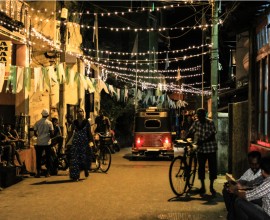
The photo above was taken at a busy intersection in Colombo. How much are we willing to sacrifice to root out the LTTE? Are they the only terrorists in Sri Lanka? What of the President’s own countenance of human rights abuses? What about the allegations of child conscription in the East? What about the President’s brother and his behaviour? Does anyone in this government have their children fighting this war (apart from we all know who, now comfortably residing in England)? Why doesn’t the JVP mobilise its young supporters to go fight and win the war? Why doesn’t at least one monk from the JHU immolate himself to support the violence that they preach should be directed at others? Why is no one interested in why the LTTE came about, even if their methods are despicable? “The important thing is not to stop questioning.” – Albert Einstein Repost This Article

Continue reading »

An infamous proposal

The proposals released by the SLFP on the 1st of May deserve mention only because they epitomise how NOT to foment a process of conflict transformation to address Sri Lanka’s violence. Rohan Edrisinha, in an article on the proposals published recently in this newspaper cogently & disturbingly avers: “The SLFP proposals for constitutional reform 2007 must surely be the most retrogressive set of proposals made by any political party, organization or group in the last twenty five years. They fail to address the core issues both in relation to peace and democracy, and in the area of constitutional reform for conflict resolution offer to the Tamil people and their political leadership less than what they already have and less than what was offered in the past twenty five years… the main political party in the government of Sri Lanka lacks the understanding, capacity, empathy and commitment to accommodate reasonable Tamil aspirations and work towards a negotiated political settlement with justice…

Continue reading »

The SLFP Proposals: The Slap in the Face and the Shot in the Arm

The international spotlight is upon us yet again and this time against the backdrop of the third successful outing of the LTTE air force, the “mountain moved and produced a mouse” SLFP proposals and the House of Commons debate on Sri Lanka. US Under Secretary of State for South Asia Richard Boucher will be here this week, along with the Archbishop of Canterbury, a member of the House of Lords, and most members of the IIGEP as well. It is to be expected that the twin Achilees’ heels of the government – human rights and proposals for a political settlement of the ethnic conflict along power sharing lines, will be further exposed in and by these visits. No doubt, the “offence is the best form of defence”, defence will be used to assure the faithful about the unflinching and furious defence of national sovereignty. Beneath it all, however, the fundamental truth remains undisturbed. As this columnist has opined, be it…

Continue reading »

Right to Information and Good Governance: Linkages and Challenges

“Freedom of information is a fundamental human right and … the touchstone of all the freedoms to which the United Nations is consecrated.” – UN General Assembly Resolution 59(I), 1946 – In this article I explore the symbiotic relationship between good governance, democracy and the Right to Information. The Right to Information is, I argue, a fundamental tenet of democracy. Across the world, the public is demanding more information from the government to understand the reasoning behind its policymaking and decisions taken on their behalf. Governments are lagging behind in providing this information. Recognising that a culture of withholding information leads to corruption and all manner of other malpractices that undermine democratic governance, I make the case for the Right to Information in Sri Lanka as well. While recognising the need for an overarching legislative framework to facilitate the Right to Information, I end with the point that at the end of the day, with or without such laws, the…

Continue reading »
Page 118 of 125« First...102030...116117118119120...Last »

About Groundviews

Located at the Centre for Policy Alternatives in Colombo, Sri Lanka, Groundviews is a citizen journalism website that uses a range of genres and media to highlight critical perspectives on governance, reconciliation, human rights, the arts and literature, democracy and other issues. The site has won two international awards, including the prestigious Manthan Award South Asia in 2009. The grand jury's evaluation of the site noted, "What no media dares to report, Groundviews publicly exposes. It's a new age media for a new Sri Lanka... Free media at it's very best!"

cezarneaga.eu