

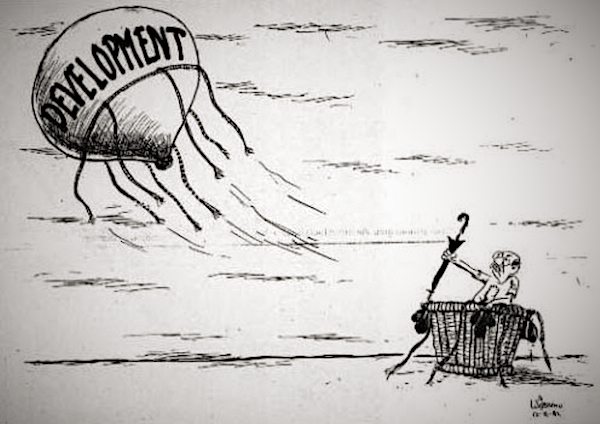
Re-imagine Development: Where Nobody Gets Left Behind

Cartoon by W R Wijesoma – Development that leaves some behind

[Note: This was originally written as part of the When Worlds Collide Sunday column in Ceylon Today, and published on 9 December 2012]

Paul Hermann Müller (1899 – 1965) was a Swiss chemist. He won the 1948 Nobel Prize in physiology (medicine) for his 1939 discovery of DDT’s insecticidal qualities and its use in controlling disease carrying mosquitoes.

That knowledge was soon put to wide use. DDT was sprayed during the latter part of World War II to contain malaria and typhus among troops and civilians, and then adopted as an agricultural insecticide.

Christopher William Wijekoon (CWW) Kannangara (1884 – 1969) was Lankan lawyer, legislator and effectively the country’s first minister of education during the pre-independence era. In the mid 1940s, he introduced far reaching reforms in that sector, enabling children from all levels of society to study from kindergarten to (and including) university level for free.

It’s unlikely that Müller and Kannangara ever met. But their legacies have impacted twentieth century Sri Lanka’s development process in ways that neither individual could have imagined.

In both respects, 1945 was a watershed year. Dust was still settling on the Eastern and Western theatres of war thousands of miles away. The sun was slowly setting on the British Empire. In Ceylon, the movement for political independence was gaining momentum.

On 1 October that year, Kannangara’s educational reforms came into effect, having survived stiff opposition in the State Council and sections of the media. A quiet social revolution was launched.

Around the same time, by coincidence, Ceylon became the first Asian country to develop a scheme of indoor industrial spraying using DDT. Memories of the devastating malaria epidemic of 1934-35, which reported 5.5 million cases, were still fresh in people’s minds.

In 1946, when spraying commenced in earnest, the island still had around 3 million malaria cases, high for a population of 6.6 million (1946 census). With widespread use of DDT and other measures, there was a drastic reduction: down to 7,300 cases in 1956 and just 17 in 1963. (There was a resurgence in the late 1960s which took two more decades to bring under control. But that’s another story.)

DDT Generation

There was another population census in the year we almost beat malaria: it returned a head count of 10.58 million – a 60% increase in just 17 years. That was due to post-war and post-independence baby booms, combined with a reduction in deaths from malaria and other infectious diseases. I have called this Sri Lanka’s DDT Generation.

This demographic wave was the first to benefit from free education. It inspired a tide in rising expectations and aspirations that has preoccupied every Lankan government in office since the 1950s.

Sustained investments in public health and education yielded impressive social indicators. Life expectancy went up, and infant deaths came down. As a nation, we quickly added years to life. Adding life (quality) to years proved harder.

It’s these demographic and aspirational imperatives that all development responses in independent Sri Lanka addressed. That includes the Green Revolution of the 1960s and the Mahaweli River diversion programme of the 1970s.

Such development was pursued under considerable duress: two youth insurgencies in the south, and one protracted separatist war in the north and east. While these conflicts arose from multiple causes, the mismatch between aspirations and opportunity added to the social tensions.

By the time a pro-market government was elected in July 1977 with a five-sixths majority, the “DDT Generation” was rising in the work force.

President J R Jayewardene, himself a former finance minister, correctly read the writing on the wall: a massive demand for more jobs, higher incomes and better infrastructure. How his government responded to that challenge is still being hotly debated 35 years later. But then, it’s easier to be critical in hindsight.

As the Jayewardene juggernaut flexed its muscle to make sweeping policy reforms that, in turn, triggered massive societal changes, only a few public intellectuals and activists dares to question — let alone challenge — any of it.

Mahaweli diversion

Systems ecologist Dr Ranil Senanayake did so – and paid a high price. For a short while in the late 1970s, he worked as an advisor to the Mahaweli Ministry. But when he questioned the mega-project’s development premises and dubious ecological practices, the minister promptly sacked him.

Did anyone at the time offer viable alternatives to the big and quick Mahaweli, I asked Ranil in an interview earlier this year. He strongly believes there were other options that were soundly ignored.

For example, instead of a few large dams, many medium sized ones could have generated the same or higher quantities of electricity. But that wasn’t glitzy enough.

“The idea was to grab the (aid) money and put up the largest possible things! Also, they were making huge reservoirs without consideration of the silt load coming off the mountains…So the huge investment we were doing was being ‘discounted’ almost from the time we were constructing!” Ranil says.

My long conversation with Ranil (“Remember the Mahaweli’s Costly Lessons!” on Groundviews.org, 3 June 2012) is highly relevant in view of today’s massive infrastructure development.

The current ‘development spurt’ is comparable to the Mahaweli. Now, as then, a strong government is bulldozing its way through without adequate public debate of the cost-benefits, choices and alternatives.

How many discordant voices do we hear this time around?

Development of the kind we have had in Sri Lanka is certainly imperfect.

Failures there have been many – of vision, leadership and implementation — some far more costly than others.

Yet, it serves little purpose now to question the motives of those who shaped and implemented development policy decades ago. They had to cope with the confluence of DDT and CWW legacies…

It would be more instructive to dispassionately critique that development’s impact — and learn from it. The Centre for Poverty Analisys (CEPA), a think tank, is aiming for this at their annual symposium on December 11 and 12. This year’s theme: Reimagining Development.

Imagination is more important than knowledge, as Einstein once said. For imagination to be meaningful in development debates, however, it needs to be rooted in ground realities and informed by analysis. Run-away imagination of the fanciful kind, which some of our environmentalists indulge in, won’t solve the tough problems of today.

Yes, development planners must belatedly question their blind acquiescence at the Bretton Woods ‘temples’. Likewise, development researchers and activists must also rethink on their uncritical hero worshipping of those who challenged the status quo, such as Ernst Schumacher, Edward Goldsmith and Rachel Carson.

Village in the Jungle

The bottomline: inclusive development is all about creating choices for everybody – and ensuring that nobody gets left behind. Not quite rocket science, but a bit harder than launching satellites…

It’s a century since an empathetic colonial officer named Leonard Woolf wrote one of the most evocative novels based in Ceylon. The Village in the Jungle, first published in 1913, was based on Woolf’s experiences on the island from 1904 to 1911, culminating as assistant government agent of Hambantota.

The novel captures the harsh reality of an impoverished village, where men and women were completely at the mercy of the encroaching jungle, assorted disease, unkind climate and uncaring government. Multiple hardships fuelled suspicion, fear and superstition among them.

A century on, our jungles have receded, and Hambantota is the new epicentre of fast-tracked development. But significant numbers of rural and urban poor still struggle with many forces that once bedevilled the residents of Woolf’s Beddegama.

Modern day Silindus and Punchi Menikas walk among us, leading lives of quiet desperation. They have been bypassed by decades of development. Cosy slogans and romanticised strategies – many of which don’t work at the scales or speeds required – will not liberate them.

Print This Post Print This Post

3,372 views

6 Comments

  1. The talk of a developed country brings visions of skyscrapers, super highways, fast cars, designer clothes and luxury lifestyles to our minds. Ethics, morals and principles are sacrificed at the altar of mammon. Power is sought to bend the rules in ones favour to achieve this dream.

    But the truth is that this applys only to a mere 1% or less of the population whilst the rest live in either drudgery or squalor. This is the preserve of the super rich who earn millions at the flick of a pen. They defy the golden rule that there is no free lunch. For ordinary mortals you need to work to earn and earn to live. But for these priviledged folks money is there for jam. Millions earned on commissions at the nod of a head. Power corrupts and absolute power corrupts absolutely.

    What follows is we have massive development with projects targeted for the rich and powerful. Budgets made to benefit a few. Money spent without any transparency. Development without any accountability. Beaches were the common folk used to gather and walk with their families become the exclusive preserve of tourists and the rich. Fisherfolk chased from their habitat. Small retailers and businesses heavily taxed, shut down, because they cannot compete with imports and duty concessions that benefit a few. Tanks that supported agriculture beome the playgrounds for the rich and powerful. etc.

    This development is not for the common man left behind and neglected in his own homeland while the select few hobnob with the rich and mighty in the various capitals of the world and flit around in their SUV’s, Helicopters and Private Airlines.

    However when the country is sold and economy indebted it is every one left behind who will have to pay for generations to come.

  2. I don’t think this “inclusive development” is possible. What other country has actually achieved it?

    In our tribal past, there was not much economic stratification at all. We didn’t have lot of resources for stratification to occur. But over the last 6000 years, with the emergence of civilizations, we have been accumulating resources, and that has caused stratification. It’s just inevitable.

    Now you can of course try to reduce stratification, mainly by income/wealth redistribution. But this would slow down economic growth. It’s really hard to find a balance. Economic growth inevitably leads to stratification, unless controlled, and that kind of control slows down economic growth because it reduce efficiency.

    But this is not necessarily a bad thing. For example “An American having the average income of the bottom US decile is better-off than 2/3 of world population.” Even though the gap between rich and poor will widen, overall, everyone will be better off if economy really grows.

    • Sharanga,

      Perhaps “inclusive development” must be thought of as a matter of degree, and not a binary proposition? If so, it is surely possible to point to many countries where the general population has achieved a high standard of equality/opportunity?

      I’d also like to hear your views on why you believe that “Economic growth inevitably leads to stratification, unless controlled, and that kind of control slows down economic growth because it reduce efficiency.”?
      In addition, even if true, is it not also necessary to establish that reduced efficiency is a worse thing, if traded off for reduced suffering?

      Lastly, with regard to income inequality – multiple studies have indicated that income inequality is a major determinant of societal health. Therefore, massive inequality is necessarily a bad thing!
      See this for example:

      • Two minor corrections.
        This sentence should have read: In addition, even if true, is it not also necessary to establish that reduced efficiency is a worse thing, even if traded off for reduced suffering?

        And this should have read:
        Therefore, massive inequality is necessarily a bad thing! (Provided the studies are correct of course!)

        • Gamarala,

          I’m currently unable to view the video you’ve embedded so my reply will not have anything to do with it. Sorry about that.

          What I meant when I said I don’t think this “inclusive development” is possible, I only meant that the kind of development that Nalaka has in mind is possible. He’s coming at it from a moral perspective, and as such, probably has in mind that is impossible to achieve in the real world. I can’t read his mind, so I might be wrong.

          As I said, I don’t view it (the fact that the kind of development that I think Nalaka thinks possible is impossible) as a bad thing. You can take a look at different Gini coefficients of different countries. Take a look at this graph:

          http://en.wikipedia.org/wiki/File:GINI_retouched_legend.gif

          The less the Gini coefficient is, the less the inequality. Generally, the idea Gini coefficeint is thought to be something betwen 0.25 to 0.4. This is because if an computer programmer is getting paid the same as a waiter, no one would bother to write code, and on the other hand if the disparity is too high, there are lot of other problems that would cause. You would note that developed countries have better Ginis than less developed ones. So there’s no barrier to developing your country that way. But my impression was, what Nalaka means by “inclusive development”, is not really a lower Gini.

          Further more, a lower Gini doesn’t necessarily mean it’s better than a higher Gini. There are more to it than that. As you can see, you would rather live in the USA than in India if you had a choice, even though India is having a perfect Gini. South Africa has a very high Gini, but that’s doesn’t necessarily mean the economy sucks. A high Gini could be good or bad, does not correlate with what’s best for human development.

          Reducing income disparity means income redistribution and according to standard economic theory, it reduces economic growth rate (there are few who object to that. But they are few). So it really comes to a question of what your priorities are. If all countries heavily redistributed income since the beginning of history, we wouldn’t have internet. So it’s really a trade-off.

  3. As far as my experiance goes,Kannangara introduced Free ENGLISH Education.
    Education in the ‘swabasha’ was free but english education was not – there were schools which taught in english only and charged fees.

    27% of the budget maintains the peacetime armed forces – but 6% for education is denied.
    Much more is spent on loosing state enterprises, while ‘loosing private enterprises’ were taken over by the state under the Appropriations Bill,but noone knows their fate.
    All this is disregarded by the ‘yes men’ comprising the 2/3rds majority
    who also OKed the 18th Amendment – which was a far reaching modification to the constitution – but our brilliant (fastest in the world) Supreme Court approved it in 24 hours!
    Same was expected of the Divineguma Bill but the Court suggested modifications…………..!

Leave a Reply

This is a moderated forum. Comments are the sole responsibility of the person posting them. Please do not post comments that are off topic, defamatory, abusive, threatening or an invasion of privacy. Comments are automatically scanned for spam and obscenity.

Comments are only approved if they are in line with the site guidelines. Those that do not will be edited or deleted without prior intimation. Comment approval may take up to 24 hours.

Thanks in advance for your civil and constructive engagement.


3 + = nine

About Groundviews

Located at the Centre for Policy Alternatives in Colombo, Sri Lanka, Groundviews is a citizen journalism website that uses a range of genres and media to highlight critical perspectives on governance, reconciliation, human rights, the arts and literature, democracy and other issues. The site has won two international awards, including the prestigious Manthan Award South Asia in 2009. The grand jury's evaluation of the site noted, "What no media dares to report, Groundviews publicly exposes. It's a new age media for a new Sri Lanka... Free media at it's very best!"

cezarneaga.eu