
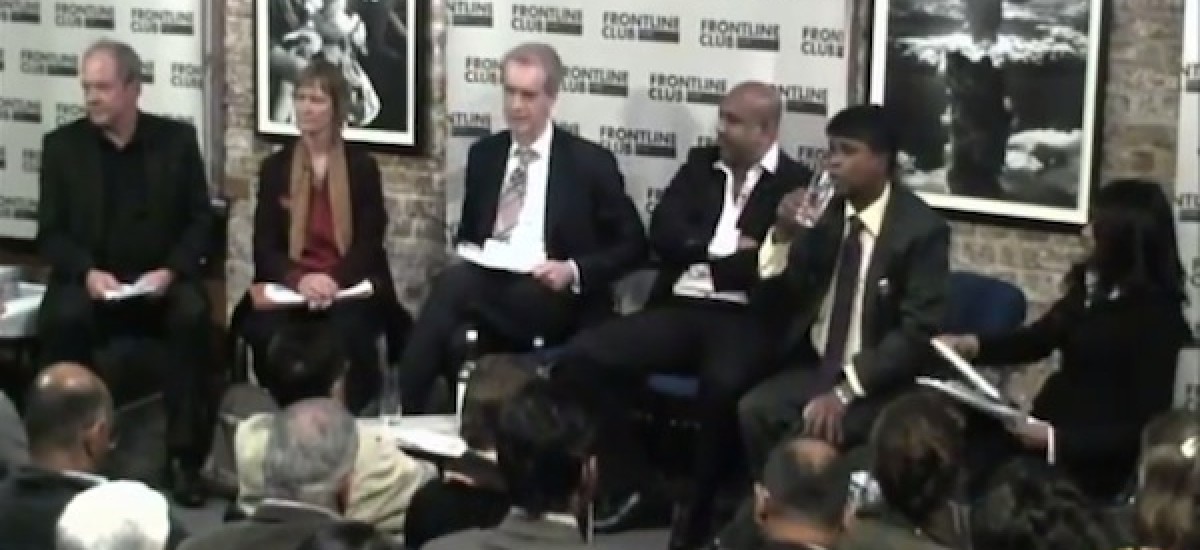

I watched the Frontline Club panel on Sri Lanka, belatedly and reluctantly. I am skeptical about such public enquiries and debates into complex matters, which threaten to reduce the dialogue and truth into performance.
In my view, the problem with these ‘events’, for that is what they are, is that the truth is reduced to a many-sided thing; the more one counts the sides the more fragmented the truth itself becomes. But of course you never get ‘all sides’ of the story. So, for example, someone keeping a count of the sides could say the Muslim question or the gender dimension figured not at all.
In fact, Stephen Sackur set the tone for an evening of performance with his opening line: “First thing to say is that it is fantastic to see such a great audience.” The panelists inevitably came with their own scripts—prepared remarks, notes, papers (Mr. Wijesinha had loads of them), computers etc. Then there were the self-appointed (or chosen?) cheerleaders—prompting, laughing, clapping and some even heckling on cue. If at all anyone listened it seemed like it was only to rebut. Thus did the evening proceed to rehearse well-trodden narratives and imaginaries of dominance, violence and marginality in Sri Lanka. And I have no doubt that the panelists and their supporters will have also enaged in post-event reviews; “how did it go?”
I am not suggesting that the issues raised and discussed were not important, on the contrary. It just seemed like a classic case of the very gravity of the issues dwarfing the forum itself. I am certainly not saying that everyone who participated lacked seriousness or genuine intent, which may nevertheless be true of some, but I fear that in forums such as this, in which, at the very least, no one wants his or her position to come out looking ‘lesser’, ‘weaker’, or a ‘loser’ the truth is often the casualty. It is a battle, not always subtle, between well-held positions. It is not a conversation.
The fact is, like in adversarial adjudication, theatricality is a norm in such forums. Or at least, a la Derrida, it is inevitable that the performative elements of dialogue and truth are the ones that tend to get most play. The most theatrical moments of the evening were inevitably around the most sinister—such as the number of people dead or missing in the final months of the war. Numbers and counter-numbers were tossed around until the moderator, inevitably, said it was time to move on, “we have done the numbers.”
If, however, there was one moment when the mask dropped, it was in Mr. Wijesinha’s response to Dr. Manoharan, the father of one of the five students executed on a beach in Trincomalee 6 years ago, widely believed to be the handiwork of Sri Lankan security/law enforcement agents. The first part of this exchange is, sadly, worth recalling. Dr. Manoharan asked why no progress had been made in the case, including despite Dr. Wijesinha’s personal assurances. Mr. Wijesinha, began sagely enough, acknowledging that there was a strong case. He then said that he was present when the President had asked the Attorney General to issue indictments, who had said (to Mr. Wijesinha) that he did not do so because he felt there was not enough evidence to secure a conviction. Mr. Wijesinha went to say, “I said [to the Attorney General], for God’s sake take a leaf out of the British. What they do is prosecute ten people, acquit nine, one person gets two months in jail and then they will say justice.” Stephen Sackur—a seasoned Hard Talk moderator—could scarcely restrain himself and remarked, “I can’t believe that you told that to the Doctor [Dr. Manoharan] thinking it would reassure him.”
Mr. Wijesinha no doubt realised, from Sackur’s spontaneous response and the murmur of disbelief in the room, that it was actually looking more like a case of hit-wicket and tried again, this time making sure to mouth the ‘right’ words, restoring theatre. However, that was perhaps the one time he was being utterly unpremeditated.
Actually, Mr. Wijesinha’s performance of the evening in general merits particular comment because it embodies the theatre that is the Rajapakse regime itself—wearing a devil-may-care cockiness and triumphal face one instant followed by an innocent, we-are-oh-so-victimised cry the next; seeming polite and reasonable one instant but menacing and name-calling the next; full of confidence and bluster one moment but petulant and childish the next. Yes, this too is a familiar sort of theatre, one induced by a deep sub-conscious fear, of knowing that you simply cannot fool everyone forever.
###
Editors note: As we were watching the live web stream of the Frontline event, a few moments after Rajiva Wijesinha’s incredible response to Dr. Manoharan, we tweeted: