
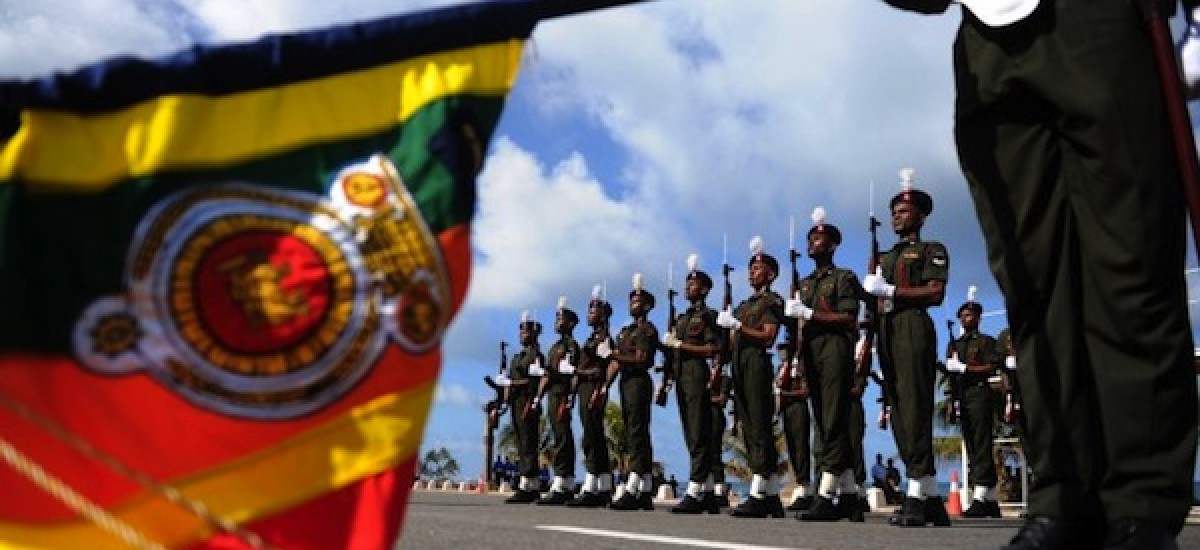


Sri Lankan Army soldiers march during a Victory Day parade rehearsal in Colombo on May 16, 2012. Sri Lanka celebrates War Heroes Week with a military parade scheduled for May 19. PHOTO/ AFP, text courtesy Haveeru Online
“There is no State of Emergency today.” – President Rajapaksa’s Address to the Nation, 19 May 2012
vs.
“Therefore, the attempt of the Sri Lankan government to replace emergency laws with another set of laws under a different name, yet meant to do the same task is not surprising. State of emergency is not only a particular set of laws. Removing emergency regulations while continuing with militarisation and a massive project of policing in socio-cultural arenas do not indicate a journey towards normalcy.” – Amali Wedagedara, Groundviews, 5 September 2011
“It is no secret that through 30 years there were armed groups and militias operating, especially in the North and East. All such groups have now been disarmed.” – President Rajapaksa’s Address to the Nation, 19 May 2012
vs.
“March 3, 2012 marked a very dark ebb in our society as it saw the horrific rape and murder of little Jesudasan Lakshini (13), allegedly at the hands of former EPDP cadre, Kanthasami Jegatheswaran (alias Kiruba) (31), from the Delft Island, Jaffna. Currently being held in remand at the Jaffna Remand Prison, the accused was produced before the Kayts Magistrate this week (30). However, the hearing was further postponed to April 9, 2012, as the Delft Police had failed to conclude their compilation of eye witness statements, said attorney-at-law K.S. Ratnavel, who is appearing on behalf of the victim’s family. The pending statement is the last of four eye witness statements attesting to having witnessed Lakshini being intercepted and taken by the accused on her way to the market, he added. This raises the glaring question as to why the Police was unable to obtain a mere four eye witness statements in the course of almost a month following this incident, unless of course exterior political forces are in play.” – Marissa de Silva, Groundviews, 2 April 2012
“We have systematically removed from our vocabulary the references of refugee camps, land mines and villages under threat. ” – President Rajapaksa’s Address to the Nation, 19 May 2012
vs.
“Back at the destroyed camp, we learned that earlier the same morning, the industries and commerce minister, Rishad Bathiudeen, had also paid a visit to the site. Upon his arrival, bombarded by residents’ desperate pleas to finally be allowed to return to their homes, he responded that he had only come to see what could be done to help them after the storm and ordered, “don’t try and turn this into a political issue”. Unfortunately, what Mr. Bathiudeen does not seem to know or acknowledge is that the reason for not allowing these people to return to their villages for almost three years is a political decision.” – Watchdog, Groundviews, 7 April 2012
“There were limits imposed on fishermen under which they could not go beyond a certain distance. These restrictions are also no more.” – President Rajapaksa’s Address to the Nation, 19 May 2012
vs.
“Many problems regarding the fishing industry in the North in many ways related to the militarization that was strengthened during the last phase of the war but not completely relaxed even after the end of the war. For instance, some coastal areas, which are very significant to fishing, still remains as High Security Zones (HSZ); and therefore fishermen are banned from engaging in their livelihood activities in those areas; in many areas, fishermen were allowed to go to sea only within a permitted corridor, and even for that they had to get passes from military forces.” – Sumith Chaaminda, Groundviews, 31 March 2012
“The check points and road blocks that we had through every two or three kilometers, and even on this Galle Road, are not there anymore… We are aware that the armed forces do not participate in the administration of the North or East. These regions are administered by the public service and the police. ” – President Rajapaksa’s Address to the Nation, 19 May 2012
vs.
“The reality that most, if not all the soldiers manning the Omanthai Checkpoint are not proficient in Tamil, is also quite telling in terms of the complete non-recognition of, and lack of respect for the Tamil community. More often than not, Tamil passengers unfamiliar with the routine have to rely on the Tamil translation of a more seasoned traveller. This indignity is further heightened when each of these passengers are made to have their personal belongings rifled through, until such time that the army personnel is adequately satisfied of the innocence of the specific passenger in question.” – Marisa de Silva, Groundviews, 16 April 2012
and
“The ubiquitous presence of armed security forces, weapons drawn, fingers on the trigger was fearsome. Every 100 metres on the Jaffna highway there was a security picket; every three kilometres, an army post; every 10 km, an army camp. The army was everywhere, running roadside shops, hotels and hospitality businesses. Even funerals or marriages or social functions in Tamil areas needed army permission in advance.” – The Hindu, 21 March 2012
“You will recall how terrorism compelled us all to live in the midst of much restrictions and obstructions, through 30 years. It is just three years since the war ended. Today, the country that faced such restrictions has returned to normal.” – President Rajapaksa’s Address to the Nation, 19 May 2012
vs.
“Especially for those living in the North, normalcy is far from reality. Only a part of these are the deciduous problems encountered, unfortunately but unavoidably, by people living in former conflict zones in the aftermath of war. It is now disconcertingly apparent that the militarisation of all spheres of life in the North is becoming increasingly institutionalised, and moreover, that this is the deliberate policy of the government. The regime is able to implement its policy with regard to the North, and more generally the continuation in force of disproportionate and repressive wartime national security measures, with virtually no meaningful democratic opposition.” – Asanga Welikala, Groundviews, 29 April 2011
“We are a country that is a member of the United Nations, working with friendship with all countries and sit with equality with all its members.” – President Rajapaksa’s Address to the Nation, 19 May 2012
vs.
On 30 June [2010], senior Government Minister Wimal Weerawansa urged the public to surround the UN office in Colombo and hold its staff hostage until moves by the UN to appoint a panel on Sri Lanka is dropped, putting the UN in Sri Lanka on high alert. On the same day, UN spokesman Farhan Haq said that when the UN contacted the Sri Lankan government over this statement, the government assured they were Minister Weerawansa’s “individual opinion”. On 2 July, it was reported that the government may tender an apology to the UN over the Minister’s comments. Any communication to this effect by the government to the UN is, to date, not in the public domain. On 4 July, Minister Weerawansa said he stood by his comment, and clarified that he made it as the National Freedom Front (NFF) leader and not in his capacity as a Government member. He also reiterated his call for the public to surround the building and protest against the UN panel. On the morning of 6 July, the NFF surrounded the UN compound in Colombo… Related to this, the Lanka Truth website runs a story on an alleged phone call with the President’s brother, the churlish Gotabaya Rajapaksa, in which he directly orders the Police to withdraw from the vicinity of the UN compound. – Groundviews, 8 July 2010
“We are already carrying out what we can agree to and can implement among the recommendations of the LLRC.” – President Rajapaksa’s Address to the Nation, 19 May 2012
vs.
The official media page of the Lessons Learnt and Reconciliation Commission (LLRC) tells its own story. It’s blank. There’s literally nothing on the official website of the LLRC that provides information on public statements by the LLRC and coverage of its proceedings in the media. Furthermore, it’s impossible to find the interim recommendations or the final report of the LLRC on the official website… What remains of the LLRC’s proceedings and output – its interim report and recommendations, the accessibility and translations of its Final Report, most of the public submissions in Tamil, Sinhala and English, audio recordings and detailed records of media reports – are all, without exception, carefully curated and published online for public access by the very NGOs and platforms, including this site, that have been openly and repeatedly vilified by those in and partial to government. And all the government itself has managed to do was to establish a website for the LLRC – that too rather late into the LLRC’s activities and bereft of vital records. – Groundviews, 20 March 2012
“National political parties are today able to work and function freely in the North in absence of fear.” – President Rajapaksa’s Address to the Nation, 19 May 2012
vs.
The bizarre responses to what was a brutal attack, post-war, in broad daylight, against unarmed Parliamentarians engaging in nothing more subversive than the democratic process and it’s subsequent denial by the President himself – essentially shutting the door on any investigation or punitive measures – reflects a desire by government to, unilaterally and violently if necessary, define Tamil politics and moreover, throttle the growth of a more plural Tamil polity and society. These attacks are justified by senior government ministers, who believe that “the UPFA and other political parties represented more Tamils than the TNA”, which means that more can be expected in the future. The resulting humiliation of the TNA MPs is keenly felt and watched by a larger Tamil community, domestic as well as international. – Groundviews, The attack on TNA Parliamentarians in Jaffna: A timeline of outrageous denials (Updated), 5 July 2011
“Sri Lanka would soon pull out its remaining troops from areas still under military control in the Tamil-dominated northern province that was once an LTTE bastion, a prominent Tamil minister has said. ‘We have successfully taken the military presence off in most of the areas in the Northern Province. Only two in tenth of the areas are still under military control. We will soon make this area free of military presence. I need a month’s time from you to work on this,” Minister Douglas Devananda said while addressing people at Mathagal.” – Press Trust of India, 10 February 2012
vs.
“Sri Lanka’s president has rejected a call by Indian legislators to withdraw soldiers from the island’s former war zone in the north where minority Tamils are concentrated, his spokesman… President Mahinda Rajapakse told a delegation of visiting Indian lawmakers that troops could not be pulled out despite the end of the decades-long Tamil separatist war in 2009.” – AFP, 22 April 2012
and
“President Mahinda Rajapaksa speaking at the Victory Day celebrations today said that it was not advisable to remove or reduce military camps in the North as the Tamil diasporas had not given up its attempts to win Eelam.” – Ceylon Today, 19 May 2012