
Some Thoughts on the Eve of 2012 Vesak

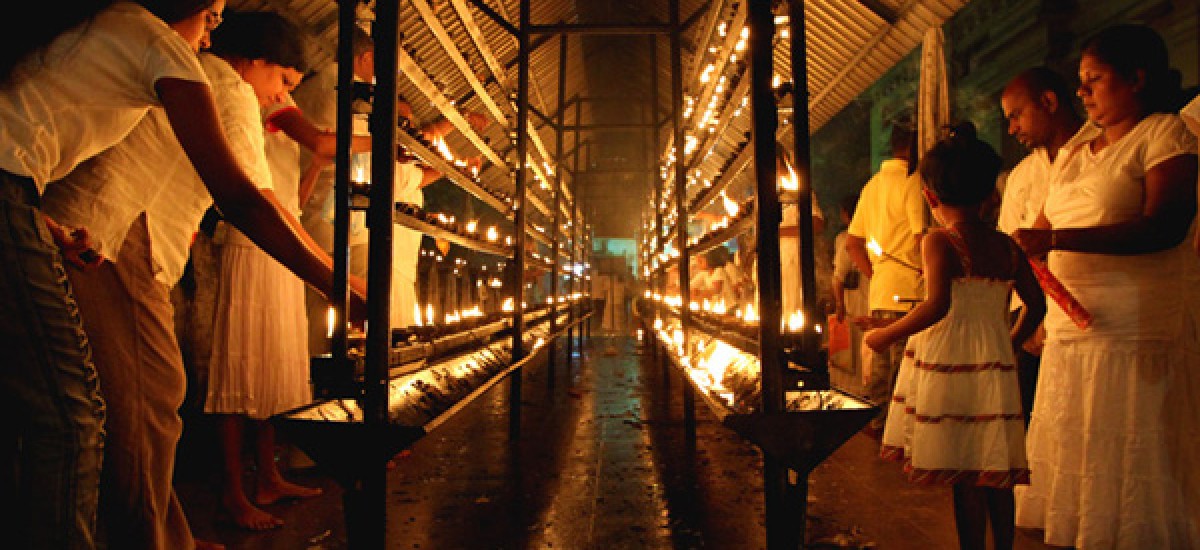
Image courtesy Reuters

Two  Veask Poyas  have come and gone and three years  have  sped by since May 2009 when the prolonged war with the LTTE ended. And we Sri Lankans are yet trapped in post-war rhetoric and caught up in punches and counter-punches arising from different visions of what post-war Sri Lanka ought to be.  Debates on who is a patriot/nationalist and who is a traitor have raged. Some Sri Lankans, sadly, have  tended to the viewpoint that saving face is more important than national  self-preservation  and self-respect.  Is   one  who has a honest disagreement with the government in office, no matter how different and opposed to that of the establishment point of view his/her opinion may be, actually a traitor? No fair-minded Sri Lankan will think so. Conversely any citizen who uncritically agrees with everything the establishment says or does  is not ipso facto a patriot or a sensible nationalist.  Happily  most  Sri Lankans, not blinded by bigotry or misguided  by narrow political loyalties,  are fair-minded human beings.

We must not permit  propaganda from any quarter to colour our opinions. In all situations  where misperception and confusion seem to prevail,   and  seemingly powerful voices seek to fashion opinion and thereby lead us to indiscretion , we must fall back on our convictions and  the courage stemming from the latter to act independently.  To question dominant views, subject them to our intelligent scrutiny and then respond meaningfully to them is a duty we owe to our fellow-sufferers on life’s complex journey, as exhorted by the supreme human being whose birth, life and death we commemorate as we mark   another Vesak Poya  in a few days.

Way too many of us who subscribe to the tenets of Buddhist philosophy tend merely to pay lip service to them. If we truly believe in metta ,karuna  mudita and upekka,  the freedom of thought and enquiry as outlined in the  Kalama Sutta,  and above all for today’s purposes, the concept of equality  that Buddhism seeks to teach those of us willing and able to learn, then there is no basis whatsoever for the majority of Sri Lankans who are followers of the Buddha dhamma to behave the way we have done and are doing today. To be certain, the Buddha by means of his spiritual emphasis on equality, was opposing the iniquitous caste system and the social discrimination that prevailed in his time in India, but his teachings on equality of all human beings are  also equally applicable to discrimination on grounds of ethnicity. According to Buddhist philosophy then the rights of all human beings must be protected. No one community or group has special rights that others do not or cannot enjoy. All of us are afraid of punishment, moreso when such punishment is unjust and uncalled for.  Buddisht philosophy reminds us that this fear of unjust punishment stems from  our human determination to be free from dukka  during our samsarik existence:  Sabbetasanti  dandassa/ sabbe  bayanti  maccuno is how the dhamma explains this to us. The Sigalovada Sutta  similarly teaches us  to respect one another and points us in the direction of how to get on with our fellow citizens along life’s difficult journey towards nibbana.

It is my fervent hope that we Sri Lankans will begin from   2012 Vesak onwards to shed our irrational fears and animosities springing from inter- ethnic  or intra-ethnic differences and learn to live together in peace and harmony. We have gone through more than three decades of awful violence, deep pain and monumental tragedy. There is no Sri Lankan regardless of his or her ethnicity who has not been adversely affected one way or the other in the last several years. Some who are yet not aware what exactly has happened to certain of their loved ones who have disappeared continue to suffer even today long after the guns have fallen silent. Anger at what has happened is the emotion that comes easily to us and we must avoid this negative emotion at all costs. Samyutta Nikya (SN 1.71) reminds us that anger is the only thing that is good to kill and in verses 3.14 and 3.15 it notes that in war, there is no winning side. All who participate in war ultimately end up as losers.  Additionally  in the Dighavu-kumara Vatthu: The Story of Prince Dighavu (Mahavagga 10.2, 3-20 PTS: Horner  vol 4, pp.489- 498) we are told that only forbearance, never revenge, can bring an end to war.

Instead of creating fresh wounds in our fractured community, we must hasten to build bridges of human understanding in addition to building those urgently needed bridges to speedy economic development. Both building projects must go hand in hand as they are not mutually exclusive. Sri Lanka cannot hope to achieve economic prosperity without social contentment. One is reminded in this regard of Bhutan’s concept of   the Gross National Happiness Index(GNHI).  The fact that we may have more money in our pockets will not make us content. We will be nearer  contentment  when all of us citizens are made to feel we have a stake in our country regardless of our ethnicity and our social status, no matter how far we may be from the centre of political power. The fact that some citizens are not in agreement with our political masters of the day should not be a reason to label them as traitors and be made guilty of treason. It is when we are made free of the tentacles of the ‘national security state’ that Sri Lanka has slowly evolved into in the last four decades or so that we will begin to feel secure in our own country once more. The freedom to think and act responsibly without fear of unjust reprisals from the state or its law enforcement agencies will also contribute handsomely to the promotion of the kind of contentment referred to above.

And above all, we must mark the anniversary of the third year of the end of the war that falls on the 18th of May by  re-doubling our efforts at achieving lasting peace and true reconciliation in Sri Lanka. I suggest that we do away with the ostentatious military parades and exhibitions  that are usually held at this time of year. They smack of triumphalism and seek to  divide us further rather than unite us. By all means, let us bear in mind lessons learnt and not forget what damage violent extra-parliamentary challenges can cause to democratically elected governments and the state in general. But to forgive those that have harmed us,  whether they  hail  from the north or south, and whether they are Tamil or Sinhala, is essential. As the old saying has it, to err is human, forgive divine.  Such forgiveness ideally ought to be accompanied by multi-religious observances and commemoration of the dead regardless of the fact that they died attacking or defending the state. It is our fellow citizens who died on either side of the conflict, not outside invaders. By our collective (politico-moral) sins of commission and omission, we caused the southern and northern insurgencies to materialise. Hence all of us are culpable for the violence and mayhem that have recently taken us and our country away from our true character and nature. It would be perfect if the President and the government take the lead in this regard and set the rest of the country an example. Let the 18th of May, 2012 mark a new beginning for our battered state. We may be assailed on many a front, but through the demonstration of our true national resilience based on our wonderful religio-cultural values, let us prove that while we may be down we are far from out. We have it in ourselves to resurrect, resuscitate and revitalize our country.

The battle for peace and reconciliation must be fought and won in and though the hearts and minds of the people of Sri Lanka, Tamil, Muslim, Malay, Burgher and Sinhala. Let us discard all false   labels that, at the end of the day, do not hold any meaning. Let us stop squandering   our national energies on frivolous debates on traitors and patriots. Let us cease shooting our  messengers  and instead seek to heed their messages. Let us not seek to make enemies of our friends the world over and instead extend our hand of friendship to them once again as we have traditionally done. A Sri Lankan welcome is something   visitors to our shores treasure forever. A few days ago, I bumped into a British couple at a bookshop who told me that this was the 21st year running that they have visited Sri Lanka and how much they love the island.  And, this expression of appreciation for our island home  is by no means an isolated phenomenon. A significant number of Sri Lanka’s admirers  feel the same way. There is much goodwill out there which could so easily be harnessed for our collective well being. There are thus very good and cogent reasons why we should think anew as the Veask Poya of 2012 dawns on us. We should endeavour  to marshal our thoughts and energies along these reasons, avoid the dangers emanating from the extreme diasporic Tamils and ultra-nationalists alike at home and engage with Sri Lanka’s moderate middle to achieve a national renaissance that will carry us into the kind of future Sri Lanka and all Sri Lankans deserve.

Print This Post Print This Post

2,351 views

14 Comments

  1. Tissa Jayatillaka
    Thank you for sharing your Vesak thoughts.

    ”three decades of awful violence” is actually six decades of awful violence.
    Who can forget the 50s/60s/70s ?

    • Good intentions.
      Very good intentions indeed.
      To end ever-lingering menace 0f violence.

      Vesak’s true meaning.
      Embrace the noble thoughts.
      To end ever-lingering hatred and injustice.

      ”Three decades” for some
      Sixty four years for the others
      To end ever-lingering inter-ethnic divide.

      • As long as people think of only the reactive violence of ”three decades”, we can see only the ”extreme diasporic Tamils”.

        If we look at the structural violence of the state from the time of independence till today we can also see the ”extreme” diasporic ”Sri Lankans” outside BBC and Channel4 protesting the news smuggled out by trophy-earning Sri Lankan soldiers, etc.

    • 1.”let us bear in mind lessons learnt and not forget what damage violent extra-parliamentary challenges can cause to democratically elected governments”

      Most of the causes of inter-ethnic divide have been coming from inside the ”democratically elected” governments !!

      2. ”we must hasten to build bridges of human understanding in addition to building those urgently needed bridges to speedy economic development”

      It’s justice(= political power-sharing) that will build bridges of human understanding and sustainable economic development. Political oppression in the Northeast is promoting unsustainable development and preventing sustainable development.

  2. ”avoid the dangers emanating from the extreme diasporic Tamils” ????

    Let’s put our house in order so that others will not have to attempt to do that:
    ”But that truth cannot excuse human rights violations that currently afflict the nation as a whole; or for that matter obscure the looming threat of the cultural and political colonisation of the north by the Sinhala Buddhist majority” – Biased and Prejudiced Collection on Sri Lanka, *Gananath Obeyesekere, Economic & Political Weekly, VOL 47 No. 04, 28 January-03 February 2012 (*a Sinhalese Buddhist and Emeritus Professor of Anthropology, Princeton University)

  3. Exceedingly nice wishes. How do we put them into practice?

    Will someone correlate the various parts of UN Charter with the various precepts of Buddhism here please ?

    Then next Vesak may come to see changes in our behaviour.

    • ”In a democracy like ours, it is ONLY we who decide and choose what we want to be and how we should look like and like to be seen and heard; and thus elect a government that we deserve” ?

      We are part of a bigger system and we have signed up for norms affecting the whole system. We even send ”peacekeepers” when some other countries cannot keep peace. When the governance of our government fails sections of our citizenry, there are norms for the system to do something about it. If we don’t accept the norms we should withdraw from the system. We are free to do so.

      ”democracy” cannot be in name only but must be seen in practice. Hence some citizens try to do something about it:
      http://groundviews.org/2012/05/07/democracy-good-governance-human-rights-and-the-effective-implementation-of-the-llrc-report/
      Democracy, Good Governance, Human Rights and the Effective Implementation of the LLRC Report:
      ”good governance is democratic governance”

  4. Presentation style of this article is excellent. It reflects the author’s genuine desire and thoughts for well-being of people and invites those who want to join and strive to be called as ‘Sri Lankan’.

    Each one of us is responsible for our actions / deeds. Our conscience, individually or collectively, plays an important decisive role in nurturing and projecting ourselves – as to how we should look like and to be seen at local level as a community and collectively at national level by large – as a national. Such projection determines our fame and glory. In a democracy like ours, it is ONLY we who decide and choose what we want to be and how we should look like and like to be seen and heard; and thus elect a government that we deserve. What’s the use of listening overnight sermons if we don’t live up to and fulfill, at least the minimum requirement of the Scriptures? Let’s do our part thus enable God doing His part – evaluating our performance for ‘Reward’.

    If we abide by the principles taught by the religions – the experiences and lessons that we learnt from the history, rich literature and civilization – this land, our small country, will harmoniously move on prospering. May God bless our Lanka! Thanks, Nithy!

  5. Thank you for the alert: ”avoid the dangers emanating from the extreme diasporic Tamils and ultra-nationalists”.

    http://www.thesundayleader.lk/2012/05/06/inside-menik-farm-a-students-tale-of-the-continuing-hardship-in-the-north/
    Inside Menik Farm A Student’s Tale Of The Continuing Hardship In The North, 6 May 2012: ”Towards the end of March, they were all asked to sign a blank sheet of paper before accepting their rations. They were not told why their signatures were needed. Later, they found out that they had unwittingly signed a petition against the US resolution.”
    …… During her travels, Raksha also visited Vavuniya, Mannar and Jaffna, as part of her study on how women cope with running a household in the North, and the economic and social problems they face. She met with over 40 women, some from towns and some from more rural areas.
    What she found was an enduring resentment mixed with fear for the military. Many accused Army personnel of taking their goods without paying for them.
    In Jaffna, for instance, a restaurant owner said that a policeman came in every week, twice a week, often with a group of ten. The group sometimes ate food worth as much as LKR 18,000, but walked out without paying. The Jaffna mayor too ate at different restaurants every day, also without paying.”

  6. Tissa, thank you for: ”There is much goodwill out there which could so easily be harnessed for our collective well being. There are thus very good and cogent reasons why we should think anew as the Veask Poya of 2012 dawns on us.”

    But….:”It is my fervent hope that we Sri Lankans will begin from 2012 Vesak onwards to shed our irrational fears and animosities springing from inter- ethnic or intra-ethnic differences and learn to live together in peace and harmony. We have gone through more than three decades of awful violence, deep pain and monumental tragedy”

    NOT ”three decades” – I hear this almost everywhere. Let’s refine ourselves:

    Jayantha Dhanapala’s submission to Lessons Learnt and Reconciliation Commission(LLRC), August 2010: ‘’The lessons we have to learn go back to the past – certainly from the time that we had responsibility for our own governance on 4 February 1948” – http://www.llrc.lk/images/stories/docs/August2010/LLRC-JD-Transcript.pdf

    Let the implementation of the recommendations start asap so that next Vesak finds us more just and more peaceful a society.

    Tissa, thanks again for suggesting a good time-frame: Vesak.

    What can be better?

    • May next Vesak see the ethnic divide of ”three decades” and ”64yrs” disappear with 65yrs of lessons for Justice-and-Peace !

      Bandara, a good reminder: Vesak as time-frame.

  7. In a very vicious and protracted conflict of 64+ years, good intentions are not enough: we need to understand the reality very well:

    ‘’In 1992 I accompanied its leader Dr A T Ariyaratne to Dambulla. This was to join in a peaceful meditation with the Ven. Inamaluwe Sumangala, the head priest of the Dambulla temple, to protest against the building of a luxury hotel on the banks of an ancient irrigation tank. Subsequently during the period of the ceasefire, in 2005, I went again to the Dambulla temple for a peace photography exhibition. This was an exhibition for which the Ven. Inamaluwe Sumangala gave his permission to hold in a large hall next to his temple. At that time he represented the liberal and universal values of Buddhism that sought peace through compassionate means and looked to the welfare of all. It would appear that the change that has taken place in more recent years represents the change in values that now dominate the country.

    The experience of peace making is that inter-ethnic and inter-religious relations need to be deliberately harnessed and nurtured. The positive outcome of the Galle conference did not happen by itself. The participating religious clergy and laity from multi religious backgrounds had met each other on previous occasions, through district level workshops and exposure visits where they travelled from their own districts to other districts and interacted with the people there. Civic leadership that shows positive results at the micro level is an inspiration that the government can take on at the macro level by shedding narrow nationalism. It is also important that the Dambulla incident be seen in its larger context, and not simply as a Muslim issue. It has implications for all communities, for Sri Lanka’s international relations and reconciliation after war’’ – National Peace Council of Sri Lanka, 30 April 2012

    We cannot change one part when we ignore one hundred other parts connected to it:
    http://www.thejakartaglobe.com/world/sri-lankan-buddhists-demand-demolition-of-mosque/516530

  8. ”Sri Lanka’s moderate middle” has been in the minority for 6+ decades ?

    Let us persuade more to support the visionary leadership:

    http://groundviews.org/2010/09/23/submissions-before-lessons-learnt-reconciliation-committee-llrc-by-chandra-jayaratne/

    ”…. Recognizing that a credible visionary leadership, driving with accountability within an acceptable political culture, the nation and its people towards growth, development and prosperity, encompassing a democratic, fair, just, and  equitable governance structure and system embedded with adequate checks and balances that assure transparency, good governance, rule of law and rights/freedoms is fundamental to assuring long term reconciliation and integration, the LLRC is urged to include appropriate recommendation towards such a governance framework.”

Leave a Reply

This is a moderated forum. Comments are the sole responsibility of the person posting them. Please do not post comments that are off topic, defamatory, abusive, threatening or an invasion of privacy. Comments are automatically scanned for spam and obscenity.

Comments are only approved if they are in line with the site guidelines. Those that do not will be edited or deleted without prior intimation. Comment approval may take up to 24 hours.

Thanks in advance for your civil and constructive engagement.


one + = 4

About Groundviews

Located at the Centre for Policy Alternatives in Colombo, Sri Lanka, Groundviews is a citizen journalism website that uses a range of genres and media to highlight critical perspectives on governance, reconciliation, human rights, the arts and literature, democracy and other issues. The site has won two international awards, including the prestigious Manthan Award South Asia in 2009. The grand jury's evaluation of the site noted, "What no media dares to report, Groundviews publicly exposes. It's a new age media for a new Sri Lanka... Free media at it's very best!"

cezarneaga.eu