Archive for April, 2012

Photo essay: Freedom, Religion, and Dambulla

Screen Shot 2012-04-30 at 10.16.35 PM

Navin Weeraratne’s photo essay around the recent violence in Dambulla has already been shared widely on Facebook, and elsewhere on the web. Describing himself to us as “an amateur photographer, toy painter, and pub quizzer”, Navin has succeeded in capturing some of the best photos on the controversy surrounding the mosque ostensibly within the “sacred grounds” of the Dambulla Temple. As journalist Dharisha Bastians avers on Navi’s Facebook page, “This story needs to be told. It really is a wonderful piece of journalism at a time when mainstream reporting can only say so much.” When going through the album, make sure to read the captions. Repost This Article

Continue reading »

Where do we come from?

Coast

Photo by author The current controversy on the identity and significance of the series of mounds linking Rameshwaram in India with Mannar in Sri Lanka has attained international attention due to a proposal to dig a channel though it.  It might also help address a burning question today ‘Where do we come from ?’ The environmental risks of the project were ignored in the pursuance of ‘economic expediency’ until, the tradition of the land spoke of its importance. It was the route that Rama followed in his quest to rescue Sita from Ravana. The developers suggested that these are nothing but mounds of sand, but what if science, rigorously applied, suggests that there might indeed be a historical reality to what sceptics have dismissed as myth?  That these mounds might represent a part of the southern hills of that mythical land called Kumari Kandam? Studies of the coastline of India and Sri Lanka during the progression of the Holocene Transgression…

Continue reading »

The State and Religion in South Asia

The Christian Tribes of Khandamal Under Siege

Photo by Massimiliano Clausi, courtesy SAJA Secularism implies the relationship between Religion and Politics, more specifically between Religion and the State. The concept of secularism has drawn its sources from the philosophy that Humans can order their lives and their societies without recourse to transcendant or supra natural powers, and hence they could also organize and manage the State and its government , without direct connections with the religious establishment. Thus evolved the concept of Secularism and the separation of the Sate from Religion, taking root in Europe and spreading its message across the globe. In South Asia, the concept was popularized in the 20th century, mainly during the anti-colonial struggles and the consequent formation of new, independent States in the 2nd half of the century. Until this period, in South Asia, as in the West and other parts of Asia, the State and Religion were closely intertwined. Religion played an important role in legitimizing the State and rulers, the degree…

Continue reading »

The middle finger to the middle-path in Sri Lanka

Screen-Shot-2012-04-24-at-11.08.16-PM

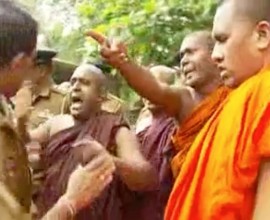
A week ago, we disgraced ourselves. Racist louts, some in the garb of Buddhist monks, engaged openly in speech and behaviour so violent, even those who led it were forced to suggest later the footage broadcast on TV and now globally viewed on YouTube was doctored. This was, of course, not the case. Sri Lanka’s tryst with militant Buddhism is not new. It is the fundamental basis of the JHU, which is today deeply embedded in government. As much as the telegenics of last week’s outrageous violence shocked many, it is this very behaviour that most temple-going Buddhists in Sri Lanka have nurtured over decades, and continue to unquestioningly venerate when they support, through silence, word or deed, this violence. Much remains to be said by the President, government and media on Dambulla. Not so long ago, a journalist – J.S. Tissainayagam – was jailed, tortured and humiliated for writing the government thought incited communal hatred. No such action will…

Continue reading »

The Geneva Debacle of March 2012: The lessons not learnt

6934853965_7295234e19_b

Photo courtesy Vikalpa The outcome in Geneva last year (March 2011) of the voting on Sri Lanka’s conduct of the war and related human rights record was very clearly in favour of the Sri Lankan government. The line up in the voting and the scale of the majority were such that is appeared that this year too the outcome would be similar, despite some recent wavering by India. But the conduct of the Sri Lankan government in the mean time was so counter- productive that it precipitated the debacle of March 2012. We should have anticipated the disaster but it seems to have taken the Sri Lankan government by surprise. If the Sri Lankan government had learnt at least the main lessons that it had opportunities to learn in recent years, the voting would have been very different – perhaps even more favourable to the Sri Lankan government than last year. Apart from mindlessly deflecting votes that could have come…

Continue reading »

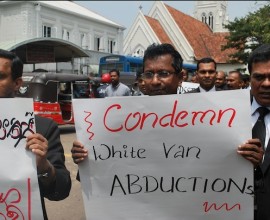
Discovering the White Van in a Troubled Democracy: An analysis of ongoing “abduction blueprint” in Sri Lanka

Screen Shot 2012-04-26 at 7.56.32 AM

The author demonstrating in Colombo against white van abductions. Photo courtesy Vikalpa.  In a country that has achieved so much in literacy, education and social development, is it not indeed unfortunate that “White Van” has frightened the entire nation? Appearance of a white van assures a disappearance of some one.  If you Google or do any other internet search  (or any media that is not controlled by the Government) on Sri Lanka, “White Van” resembles the Defence Authorities of our country.  Are we not ashamed of it? “White van operation” is the most used mode of enforced disappearances in Sri Lanka at present. Enforced disappearance violates a range of human rights including  the right to security and dignity of a person, right to a legal personality, humane conditions of detention, right to fair trial, right to a family life and when killed, the right to life. The disappeared person is often tortured and in constant fear for life, removed from…

Continue reading »

Buddha wept as we beat our women

violence

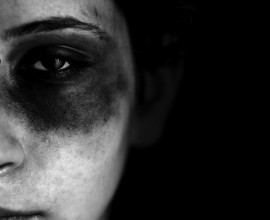
54% of adolescent girls in Sri Lanka feel that a husband is justified in beating his wife. The UNICEF Global Report Card on Adolescents 2012 however is not available yet to try and unpack this further. What do they mean? Surely, they cannot be suggesting that the arbitrary violence that some wives are subject to in Sri Lanka is acceptable; burned rice that results in cut lips and black eyes? It must be wives that were somehow overly flirtatious with another man. Wives that have behaved, or even worse, dressed, inappropriately. Wives that have proved to be whores! What about those husbands that use wives like dogs? Psychologists call it displaced aggression, commonly known as kick-the-dog syndrome. Surely the adolescent girls can’t mean these husbands? Their wives did nothing more than open the door and welcome them home. What about the husbands that come home inebriated and then proceed to beat their wives to a pulp for looking at them…

Continue reading »

Coping with little support: Batticaloa’s women ex-combatants and their reintegration

Photo by author The end of hostilities in May 2009 saw some 270,000 to 300,000 Tamils fleeing the conflict zone in the North and settling in camps for internally displaced people. Fleeing the fighting, together with the civilians, were thousands of Tamil Tiger combatants – many of them injured women fighters – both young women and more experienced middle-aged female fighters. M10 – who lost her left leg in a 1995 battle in the Wanni region – surrendered herself at the Omantai military checkpoint in the closing days of the war after fleeing the heavy shelling on Puthikkudiyiruppu with civilians. There she was immediately taken to Pampaimadu Camp for interrogation by Sri Lankan army intelligence and the Criminal Investigation Department (CID) of the police force.  A year later, in late April 2010, M10 was released. M7, like M10, is an injured ex-Tamil Tiger young woman combatant who surrendered at the Omantai checkpoint in the closing days of the war.  In…

Continue reading »

Cluster bombs in Sri Lanka: From denial to discovery

Sudar Oli - 06.03.2012

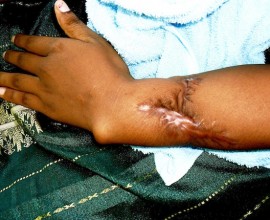
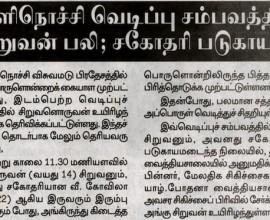
Ravi Nessman from Associated Press has broken what’s perhaps the most important story on the war, since it ended three years ago. In a story published by AP a few hours ago, he notes, The Associated Press obtained a copy Thursday of an email written by a U.N. land mine expert that said unexploded cluster bomblets were discovered in the Puthukudiyiruppu area of northern Sri Lanka, where a boy was killed last month and his sister injured as they tried to pry apart an explosive device they had found to sell for scrap metal. The email was written by Allan Poston, the technical adviser for the U.N. Development Program’s mine action group in Sri Lanka. “After reviewing additional photographs from the investigation teams, I have determined that there are cluster sub-munitions in the area where the children were collecting scrap metal and in the house where the accident occurred. This is the first time that there has been confirmed unexploded…

Continue reading »

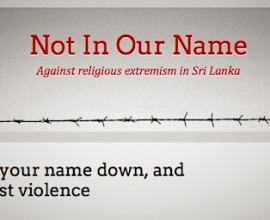
Not In Our Name: Against religious extremism in Sri Lanka

Screen_Shot_2012_04_26_at_7.52.36_PM

A week ago, a violent a mob of about 2,000 Sinhalese, including a group of Buddhist monks led by the Mahanayaka of the Rangiri Dambulu chapter Inamaluwe Sumangala thero, stormed and vandalised a mosque in Dambulla. The mosque was declared an illegal structure, but it is unclear how this far this is accurate. The shameful behaviour and expression employed by the Mahanayaka of the Rangiri Dambulu chapter Inamaluwe Sumangala thero, along with the monks he led and the crowd of thugs is not remotely associated with or reflective of the philosophy of the Dhamma, the teachings of the Buddha, or the way in which a Buddhist monk is supposed to behave and speak. Many online have already expressed their dismay and deep concern over the actions of a few, placing Sri Lanka in the media spotlight again for all the wrong reasons. We have a choice, but time is running out. Speak up. Sign up to this online statement and…

Continue reading »

Human Rights and Reconciliation Challenged in Dambulla and by Disappearances

rock_cave_temple_-_dambulla

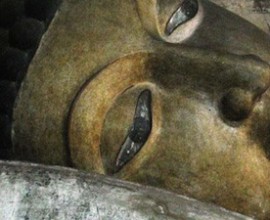
In more ways than one, a sleeping Buddha in Dambulla Rock Cave Temple. Courtesy University of Peradeniya Whilst the country awaits the decision of the regime regarding which recommendations, if any, of the LLRC report it will implement, human rights and reconciliation continue to be challenged, by disappearances and now, the ugly spectre of religious intolerance. From October 2011 to March 2012, there have been some 56 cases of disappearances and abduction recorded.  Some 29 of these have been in February and March of this year and 19 happened whilst the UNHRC was in session.  Of the 29 cases, 16 have been reported from Colombo and 08 from the Northern Province.  Five of the cases reported from the north are said to be ex-LTTE cadre who had been detained, released and then abducted. Egregious cases include that of Mr Ramasamy Prabhakaran who was abducted in Colombo two days before his fundamental rights petition was to come up before the Supreme…

Continue reading »

Nurturing Public Trust in Times of Crisis: Reflections on April 11 Tsunami Warning

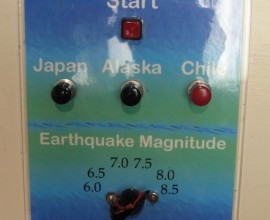
This is only a game, no one can create Earthquakes! Photo from Pacific Tsunami Museum, Jan 2007

Five years ago, on a visit to the Pacific Tsunami Museum in Hilo, Hawaii, I played an interesting simulation game: setting off an undersea earthquake and deciding whether or not to issue a tsunami warning to the many countries in and around the Pacific. The volunteer-run museum, based in ‘the tsunami capital of the world’, engages visitors on the science, history and sociology of tsunamis. The exhibits are mostly mechanical or use basic electronic displays, but the messages are carefully thought out. The game allowed me to imagine being Director of the Pacific Tsunami Warning Centre (PTWC), a US government scientific facility in Ewa Beach, Hawaii, where geophysicists monitor seismic activity round the clock. When the magnitude exceeds 7.5, its epicentre is located and a tsunami watch is set up. Then, combining the seismic, sea level and historical data, PTWC decides if it should be upped to a warning. The museum game allows players to choose one of three locations…

Continue reading »

Is Dambulla, Babri Masjid Redux?

Screen Shot 2012-04-23 at 4.35.19 PM

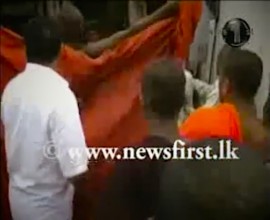
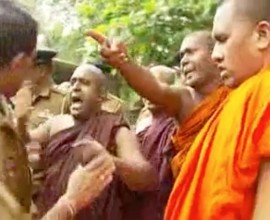
A Buddhist monk flashes a mosque in Dambulla. Screen grab from News 1st TV footage.  The events in Dambulla over the past week, when Buddhist monks led the storming of a mosque, bear chilling resemblance to events in Ayodhya, India, on and around the 6th December 1992, when mobs lead by Hindu fundamentalist clergy demolished the Babri Masjid. The consequences of the events in the run-up to the demolition and its aftermath are still being felt across India today. The similarities between Ayodhya 1992 and Dambulla 2012 go well beyond frenzied crowds trying to storm a mosque egged on by saffron clad clergy. The reference to this act as shramadaanya sounds disturbingly akin to kar seva, a euphemism coined by Hindu fundamentalists for an otherwise unholy act. Images of a monk apparently exposing himself to the mosque in a vulgar frenzy underlines the same deeply macho, misogynist militancy that Hindu fundamentalism has embodied in India, paving the way for the…

Continue reading »

Fake video and lies: The strange case of Dambulla’s Inamaluwe Sumangala thero

Screen Shot 2012-04-24 at 11.08.16 PM

The Mahanayaka of the Rangiri Dambulu chapter Inamaluwe Sumangala thero, one of the key figures in the on-going tensions in Dambulla over the presence of a mosque and kovil near his Temple, perhaps in response to the public outcry against the violence instigated by him, has told the BBC that TV footage that showed monks engaged in violence – including one monk disrobing and exposing himself to the mosque – were fake. The Mahanayaka of the Rangiri Dambulu chapter Inamaluwe Sumangala thero told BBC Sandeshaya that he only led a ‘peaceful and democratic protest against illegal constructions’. He maintained that no violence was used. “Videos that portrayed the protest as violent were technically manipulated,” said the Mahanayaka thero who also heads a media outlet. Let us for the sake of argument not disbelieve or dismiss what Inamaluwe Sumangala thero says. Musāvāda veramaṇī sikkhāpadaṃ samādiyāmi, or refraining from incorrect or false speech, is after all one of the five Noble Precepts….

Continue reading »

Deeds of mosque in Dambulla and photos of damage: How is this structure illegal? (UPDATED)

Dam-11

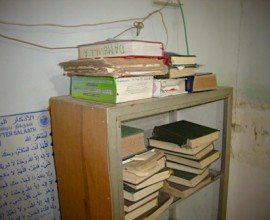
Groundviews was sent a copy of what we were told was the deed of the mosque at the centre of an on-going controversy in Dambulla, Sri Lanka. We were also sent photos of the damage and vandalism wrought by the mob violence a few days ago. We’ve uploaded the document to Scribd as a PDF, and the high resolution, original scanned images of the deed to Flickr. Both are embedded below, along with four photos of vandalism to copies of the Quran and the cupboards in which they were stored. Groundviews has already flagged that the basis upon which the PM, in a televised submission, said that the mosque was an illegal construction is hugely suspect. In a video of a community meeting uploaded to YouTube two days ago, in the presence of Senior Minister for Urban Affairs A H M Fowzie and the Assistant Government Agent, there is a discussion in Sinhala about, inter alia, the legality of the…

Continue reading »
Page 1 of 3123

About Groundviews

Located at the Centre for Policy Alternatives in Colombo, Sri Lanka, Groundviews is a citizen journalism website that uses a range of genres and media to highlight critical perspectives on governance, reconciliation, human rights, the arts and literature, democracy and other issues. The site has won two international awards, including the prestigious Manthan Award South Asia in 2009. The grand jury's evaluation of the site noted, "What no media dares to report, Groundviews publicly exposes. It's a new age media for a new Sri Lanka... Free media at it's very best!"

cezarneaga.eu