
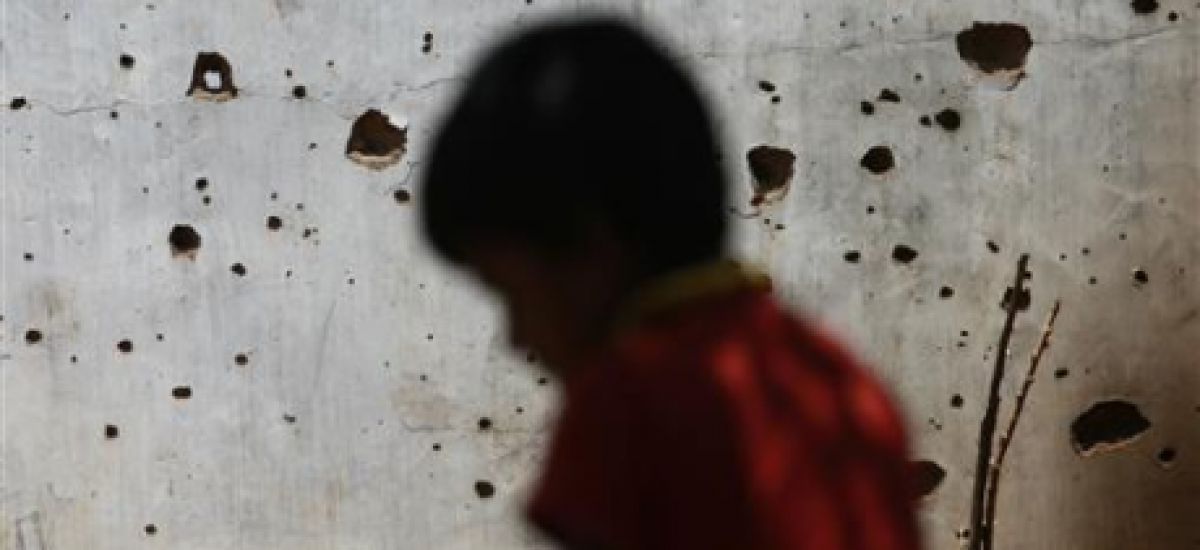

- Photo courtesy of Reuters/Dinuka Liyanawatte
[Editors’ note: The article below was sent to us by a regular contributor to the site whose name we have redacted due to security considerations.]
With the airing of Channel 4’s new film, Sri Lanka’s Killing Fields: War Crimes Unpunished, a follow-up to their first one Sri Lanka’s Killing Fields first broadcast nearly a year ago, there is bound to be a renewed interest in the matter of alleged war-crimes concerning the Sri Lankan Government. Because, let’s face it: Channel 4’s first video came and went, and while there were about two weeks of discussion around it, mostly everyone eventually forgot about it.
Now, with the emergence of the new film and its alarming new footage, released in time with the Human Rights Council meetings in Geneva, we are forced to remember what we forgot then:
- That it is undeniable that Tamil civilians were maimed and killed during the last stages of the war, despite what we were told by the authorities, perhaps in larger numbers than we had ever imagined – and perhaps unnecessarily.
- That there is perfectly good evidence pointing to extra-judicial executions of imprisoned LTTE fighters by members of the Sri Lankan Armed Forces, during these last few days.
- That there is a good possibility that civilians were, at best, neglected and deprived of adequate food and aid, and at worst, deliberately ignored while they lay dying, starving and wounded.
- That there is strong evidence indicating that multiple Government-allocated ‘No-Fire-Zone’s were repeatedly bombarded by the Sri Lankan military, in an attempt to run out the remainder of the LTTE, at best carelessly, at worst deliberately.
- That it is fairly obvious that the various spokespeople for the Government of Sri Lanka at the time knowingly lied about the number of civilians trapped in the narrow strip of land in Mullaitivu, caught in the final battle between the Sri Lankan Army and the LTTE, hugely downplaying the severity of the situation and blatantly denying civilian casualties and deaths.
- That it’s fairly clear that the Government deliberately kept independent observers out of this area in the final days of the war, even those that could have helped protect and care for civilians.
Channel 4’s films on Sri Lanka are not shining examples of good journalism. They give an unmeasured, sensationalist view of a very complex and difficult issue. Jon Snow is melodramatic. A lot of their information, including the crucial interviews, is somewhat vague and difficult to recognize as credible. On one hand, they reek of propaganda themselves at times, and seem strangely unconvincing in the way they present their information at other times. On the other hand, the footage, recorded mostly on camera phones, if you believe it’s authentic, speaks for itself. It’s hard to look away. This time, it may be harder to forget.
One can understand anyone in Channel 4’s position is in an impossible position, attempting to make films about ‘the truth’ of what happened during those last few months of the war in Sri Lanka. After all, how can they reveal their sources for the sake of credibility? How can they interview Tamil civilians and run the interviews with faces unmasked, and names at the bottom of the screen? It is impossible for us to hear directly from the victims of this ordeal, or those who were there to witness it first-hand, because of what this film is trying to say: it’s trying to say that the Government of Sri Lanka, from the very top down, including the President himself, is guilty of very serious war crimes, crimes against humanity and human rights violations. Which Tamil civilian would willingly appear in such a film, for fear of their life? Which Sri Lanka Army soldier would candidly step forth to speak of his experiences, unafraid? Who can protect the people we need to hear from? Given these circumstances, it’s very nearly possible to forgive Channel 4 for some of the seeming carelessness. Perhaps it is not carelessness then, but the impossibility of the task they are trying to accomplish: the task of making and broadcasting internationally a film that criticizes the Sri Lankan Government and accuses it of breaking the law.
You can say what you like about these films, but the fact remains that they are as close as we’ve gotten to finding out more than merely what we were told by the Mahinda Rajapakse regime. The fact remains that Channel 4 has gotten closest to giving the world an opportunity to choose what they believe about what happened during the last stages of the civil war in Sri Lanka. And so we must all choose.
What is ‘the truth’? Will we ever know? Is it important to know? There are no easy answers.
Yes – I think the truth is always important, and if not in its entirety, it’s important to know as much of it – from as many different viewpoints – as possible. Yes, I believe the truth is not singular; it is plural, in cases like these. And that’s where we’re going wrong: all we know now is what one entity is telling us, and therefore things – opportunities – like the Channel 4 films can be useful and important.
The Channel 4 film forces us to remember. Let’s not forget what happened, even as we stand amidst new highways, roads and the boom of infrastructural development around the island; amidst a renewed flourishing of the tourism industry; amidst promises that our economy is on its way to being one of the best in the region: that not even three years ago, this country underwent a monumental change that would, by default, transform and shape our identity as a nation in the years to come. Let’s not forget that, despite this change being upon us, those who rule our country have refused, bluntly, to this day, to accept or acknowledge that we all suffered, we all paid a price, and that we all lost something along the way. It has refused to drop the triumphalism, even for a second, and reflect, to spend even a moment in introspection, examining truly why we had a civil war, why it ended the way it did and who can answer to the people whose lives were permanently compromised because of it. Let’s not forget that there’s been a veil of mystery surrounding what happened in April and May 2009, in particular what happened to the civilians that were caught in the cross-fire of the final battle. Let’s not forget, that even now, Tamil civilians in the Vanni continue to live in temporary housing, and still live under a series of restrictions on movement, livelihood and other rights, imposed upon them by the Sri Lankan Army, who are stationed in the North and North East in something that strongly resembles a military occupation, demanding total control of all operations in the area, dominating the economy and occupying buildings and property that rightfully belong to the civilians. Let’s not forget that there is corruption at almost every level of government, and we are all, our families, our businesses, vulnerable to the whims and fancies of the powers that be. Let’s not forget that there are still hundreds of detainees held in custody, in terrible conditions, to this day, with no trials and no idea of when they’ll be out, or if they will, or the unexplained disappearances of young Tamil men, many of whom were last seen surrendering to the Sri Lankan Army in the last days of the war. Let’s not forget the slain journalists and media-workers, Tamil and non-Tamil and all of those who continue to live in fear, live in exile, or are simply not alive at all anymore.
We are tiring now, we all are. I can hear people – people who did not support the way the war was finished, or the way the call for accountability has been ignored, or the way the facts were distorted and then conveniently swept under the rug – I can hear even these people mutter words about ‘moving on’. ‘Anyway, the war is over. What’s done is done. We need to find a way to move forward’ they say, exhausted. But why is it, that so often moving on and moving forward in this country, in this culture of ours, seem inextricably connected with forgetting?
Let’s not forget. Forgetting is easy and, let’s admit it, when it comes to matters like this one, forgetting feels nice. It allows us to carry on with our day-to-day lives, attempting to keep our heads above the water and solve our mundane problems. It allows us to momentarily convince ourselves that everything is OK, and that we are a nation that is indeed, moving on. We’re good at forgetting, us Sri Lankans. And there are a lot of plans, and a lot of people’s ambition that depend solely on this very characteristic, this flaw, of ours. We’re told accountability is not important; the truth is not great. Do we believe these things? Do we have choice?
The fact is, yes, we do have a choice. You must choose what to believe and hold on to those beliefs and convictions, steadfast. You have a right to ask, to demand even, that you are given some answers. We are all legally obliged, as tax-playing, law-abiding citizens, to ask that we are told the truth. If you don’t care about civilian casualties and deaths, then care about the fact that you were lied to.
There’s no saying we will ever know the total and absolute truth. And there is certainly no saying that Channel 4’s graphic new film has all the answers. But it’s important that we watch it: take the information at hand, and filter it through your own sensibilities, and your own sense of logic and reasoning. Think carefully about what you believe, not what you want to believe. This film is not the game-changer, but perhaps, if nothing else, it will create the space for a more intelligent and intellectually measured debate and conversation about the facts at hand; perhaps, it will remind us that it is important to remember, to not forget just because we are asked to. Perhaps it will compel us to be sure that we never look away again.