

Milinda Moragoda’s on-going mayoral campaign is interesting on many counts. Particularly appealing to me is that it is extremely web media savvy. The campaign’s central website, http://www.ourcmb.com, is leagues ahead of what any candidate, at any election in Sri Lanka has produced. Aimed to elicit public feedback on a 12 point, 100 day plan for Colombo, the website is a model for how politicians can use the web to co-create policy in what is promised is an open, transparent manner. Milinda’s Facebook group, growing apace in the number of fans, is something other candidates have done in the past, but not to this degree of curatorial prowess. He also has a presence on YouTube and Twitter. All this would prima facie suggest a politician unafraid of public scrutiny, genuine engagement on critical issues and uses these tools to be the change he proclaims he wants to see.
Sadly, not so. In an article titled ‘Open-source policy formulation for Sri Lanka’s capital’ the Head, Policy Planning Group, Milinda for Mayor Campaign Prof. Rohan Samarajiva, though he doesn’t identify himself as such in the article, makes a great deal of the approach adopted by the Moragoda campaign. He may not even know it or immediately recall that his son, though far less coherently, first mooted the idea open source government over 8 years ago. Noting the flaws with the traditional approach to manifestos and public policy, Prof. Samarajiva notes,
“The traditional approach is to rely on expertise. Experts formulate policy. Other experts debug it. Not very different from what goes on at the Redmond Campus of Microsoft.”
A more apt description would have been to Apple and Steve Jobs. The message however, for the non-geeks, was clear. Co-creating policy transparently is infinitely better than codifying in closed groups. This is the guiding mantra of the open source movement, a process of production and development that promote access to the end product’s source materials. Jobs recently stepped down as CEO of Apple, but his command and control of the company is the stuff of legend. He has been called a Genius Control Freak, unwilling to relinquish control even over the slightest aspect of design and development, wielding an incredible degree of personal oversight as fondly recalled by Vic Gundotra of Google.
Gotabaya Rajapaksa is to Milinda’s campaign what Jobs was, and perhaps to a degree still is to Apple (coincidentally, Gotabaya seems to be a fan of Apple products!). He, and he alone, determines policy. This is not just our speculation or submission. It is quite openly acknowledged by leading bloggers actually heading the media relations for the Milinda Moragoda campaign as well as mainstream media that it’s Gotabaya who runs Colombo. Not the Colombo Municipal Council. Not the post of Mayor. The Secretary of Defence post-war has branched out into urban renewal, and with the unlimited resources of the Ministry of Defence, is going about revamping the city and its environs as he sees fit. There is no public access to his plans. No one really knows how much of money is involved, to whom tenders are awarded, or on what grounds. We are told there is a plan, and to trust its implementation to the hands of the man who won the war. Few, if any, are willing to question that. Following from this, the central argument to support Moragoda’s campaign is, as the Sunday Leader, succinctly puts it, that ready access to Gotabaya guarantees Moragoda a much better chance than any other candidate of developing Colombo to the city we all want it to become. Amongst the candidates then, he is primus inter pares.
Gotabaya’s singular character traits are well known. Here is a man who conflated terrorists with Tamils and actually defended the overnight eviction of hundreds of hapless Tamils from Colombo a few years ago. We recall his shrill comments on and dismissal of Lasantha Wickremetunge’s murder. We now know through Wikileaks that within government, he was the most intolerant of dissent and the freedom of expression during war. Even today, reading through the cables, it’s mind-boggling the degree to which he was in control of or responsible for the suppression of independent media in Sri Lanka. We know that even before these details came to light courtesy Assange, RSF called him a predator of media freedom. A single word from Gotabaya was enough to send any detractor into panic and flight. Worse, he does so with complete and utter impunity. He was heinous in 2007. Four years on, he is no better, and though less shrill now pontificates on matters of governance to boot. As noted by Dr. Paikiasothy Saravanamuttu years ago,
“The relationship of the Defence Secretary to the President and the structure of power institutionalised by this regime, give his pronouncements and opinions greater weight than that of any other cabinet minister including the Prime Minister. Furthermore, his minister is none other than the President, his brother. Gotabhaya Rajapakse’s behaviour begs the question of the militarisation of government and governance in this country. Shocking though it may seem, there is the story doing the rounds that Sri Lanka has in fact a militarised if not military government without having a military coup.“
Emphasis mine.
It is important to not forget who Gotabaya is, what he is capable of and how unbridled his real power is. If and when Milinda Moragoda wins these elections, it’s Gotabaya who will run our city. It’s Gotabaya’s plans, vision and apparatchiks that will define our city, not, emphatically, Moragoda’s frameworks of public engagement and accountability. In many ways, this is going back to the Premedasa era of governance, where most are interested in getting stuff done, not on how it’s done and at what cost. Ergo, Moragoda may speak of Right to Information, but this is rendered nonsensical given the regime’s vice grip on everything, and everyone. To argue therefore that Moragoda’s candidacy is viable above all others because of access to this individual is in effect to suggest that constitutional rule, the rule of law and civil administration – all of which have been systematically and egregiously undermined by the Rajapaksa regime – are non-issues in these elections. In fact, the single most important factor in Moragoda’s campaign was flagged by Wikileaks,
@MilindaMoragoda “enjoys the confidence of & direct access to President Rajapaksa & his two brothers” http://t.co/UVGc52a Need we say more?less than a minute ago via Twitter for Mac  Favorite
  Retweet
  Reply
Reply Groundviews
groundviews
Interestingly, the head of Milinda’s Policy Planning Group, Prof. Samarajiva, writing in 2010 noted,
“The events of the past few months (and indeed the past few years) in Sri Lanka have puzzled me. The President and his coterie are flagrantly violating the Constitution and laws. That is shocking, but what is more shocking is the casual acceptance of this behaviour by all concerned. What is surprising is not that the President violates the law and disregards explicit directions from lawful authority, but that the citizenry seem to accept it. Not that the President tries to impress university teachers by inviting them to dinner at Temple Trees, but that most of them go, and some even kiss the hands of their host. So it appears that the political elite’s dalliance with Constitutionalism has about run its course, 60 years after independence. We are reverting to our native Feudalism: not just the ruling family but large swaths of the populace, including opinion leaders and intellectuals.” From Sri Lanka under Rajapakse regime becoming feudal kingdom with constitutional veneer
Emphasis mine. If he looks in the mirror, one wonders if Prof. Samarajiva recognises that what he warned us against is what he has allowed himself to become?
The Ranil factor
On Twitter, and defending his decision to back the Moragoda campaign, Prof. Samarajiva observed,
#NalakaG assumes political parties exist. All we have: conglomerations around a person. No internal democracy. Ur apprch Rx for inactionless than a minute ago via web Favorite Retweet Reply Rohan Samarajiva
samarajiva
A lot of the arguments around supporting Moragoda are anchored to, politely put, the ineffectiveness of the Leader of the Opposition, Ranil Wickremesinghe. Interestingly, the media relations / campaign manager for Milinda Moragoda and Prof. Samarajiva’s son was, on the Sri Lankan blogosphere, one of the first and most vocal champions of Ranil Wickremesinghe, only to lose interest by 2010 and ask him to leave his office. He’s not the only one disillusioned. Wikileaks mentions Moragoda around a 148 times. The cables range from January 2003 to December 2009. Moragoda’s character, role and relevance to various governments at various times is evident when reading through them in chronological order. Equally evident is his growing disenchantment with the UNP’s leadership. To quote the US Ambassador in Sri Lanka in 2007,
“There is no doubt that a substantial part of the UNP is unhappy with Wickremesinghe’s autocratic leadership style, and with some of Ranil’s strategic decisions. There are others who, nearing the end of their public lives, may in fact simply be yearning to end their careers as ministers. Basil Rajapaksa’s assurances notwithstanding, the President has aroused expectations of change by announcing publicly that he would undertake a major cabinet reshuffle and expected a number of UNP crossovers. Ranil will have his work cut out to head off a defection by the dissidents in his party and get the President to back off on his plan to recruit them for his cabinet.”
In 2011, the very real prospect of an electoral loss in Colombo for the UNP is what the fall of Killinochchi was to the LTTE, the end of the road. An enervated Opposition today will become a ceremonial one, which then refocusses our attention on Prof. Samarajiva’s point – are voters only left with individuals who promise what they do because of who they know and have access to? I think not. A year ago, the Professor agreed. To quote again from his seminal essay,
“Constitutionalism is not words on paper, but broad acceptance across society that certain kinds of words on paper have binding authority and must be respected. It is what will give meaning to the word of a candidate… The larger question is the governing framework. Do university teachers rush to kiss the ring and vice chancellors prostrate themselves before presidents in modern societies? Can we have a modern economy, when the largest companies in the country obey patently illegal directions from regulators? Is it normal to name a government-owned, money-losing airline for the head of state and paint the tail of the leased aircraft with his campaign livery? These are symptoms of a transition from a Constitutional State to a feudal one.”
Sans any real democracy in Sri Lanka, http://www.ourcmb.com is actually not a framework for public engagement. Rather, it is essentially a platform (arguably a rather parasitical one) to get the best ideas from amongst us and make them hostage to the parochialism of a single ruling family that circumscribes in turn what Moragoda – if he should win – can and should do as Mayor. Ironically, in this position, he is akin to party leader he left behind – both largely symbolic figures sans any real authority, one a hostage to a blinding ego, the other never able or willing to question the excesses of a regime that in effect demarcates the boundaries of his power. If this is too dystopic, consider the following video. This was broadcast on public TV. It isn’t the creation of someone against the Rajapaksa regime or the Moragoda campaign. In fact, it features the President’s son speaking in public. At around one minute in, Namal Rajapaksa says something quite revealing in a tone and expression that doesn’t translate, but a Sinhala audience would understand full well,
“But, Mr. General Secretary, I told the President that if they don’t give us votes, go put them elsewhere [Applause] Why (should we) make houses and others get the votes? Isn’t it? But no one will be put outside this area. But remember what I told (you) earlier.”
I asked Moragoda about what his response to this thinly veiled threat was, especially in light of Point 6 of his manifesto which notes,
- The Government has to relocate people in certain circumstances to fulfill its commitment to give decent, liveable housing, but I will ensure that no citizen is relocated outside of metropolitan Colombo. (See here)
- Before any relocation plans are made, communities will be included in the process and consulted. (See here)
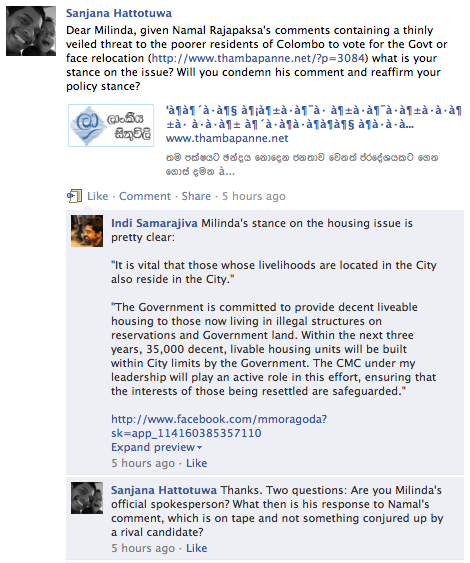
To date, the candidate has not given an answer, which in a sense, is its own answer.
The foibles of the campaign
Moragoda’s adoption of new media could suggest he’s actually a more engaged candidate with those online. Colombo’s surely got the highest per capita penetration of broadband in the country. Though nowhere close to what Obama did with his online campaign in the US, but is about the most sophisticated we’ve seen to date. Which sadly, isn’t saying much. Moragoda created his Twitter account in 2010. He abandoned it on 7th April, days before the General Election. No public engagement till 6th September this year. Not a single tweet, not a single word about what he was doing to champion what he stood for even out of power. From the 6th this month to the time of writing, there are around 23 updates, one or two of which are system generated (i.e. automatic cross-posting from Facebook updates). Not a single tweet has engaged anyone who has included him in their tweets, which is a complete reversal from his behaviour on Twitter in 2010, when he actually did have conversations over the medium and engaged his detractors. He hasn’t answered a single question directed at him, which is one of the reasons one would assume a Twitter account is set up, and what in fact he did over last year’s campaign. The tweets Groundviews posted directed at Moragoda included observations about those who were part of his campaign, questions over allegations of his corruption noted in Parliament, several ideas for improving Colombo city, a request that his manifesto is translated into Sinhala and Tamil, and observations about the complete turnaround by some in involved in his campaign. In one of our tweets we simply asked the campaign to look at the Melbourne City website and learn from how they had made it into the world’s most liveable city this year. We also flagged several serious concerns,
@samarajiva Trust deficit here @MilindaMoragoda celebrates diversity http://t.co/v4uCM8h A racist Gota evicts Tamils http://t.co/21mM39mless than a minute ago via Twitter for Mac Favorite Retweet ReplyGroundviews
groundviews
@samarajiva Local issue for the day: Where’s @MilindaMoragoda’s declaration of assets? http://t.co/wcfGrGe mere words for others? #lkaless than a minute ago via Twitter for Mac Favorite Retweet ReplyGroundviews
groundviews
Groundviews immediately chastised for a hidden agenda, and asked if we were paid to ask hard questions. When we said real power lay with the Ministry of Defence and not with the Colombo Municipal Council, we were told that “This is a local government election. Dealing with garbage & traffic. Why conflate with grand issues?”
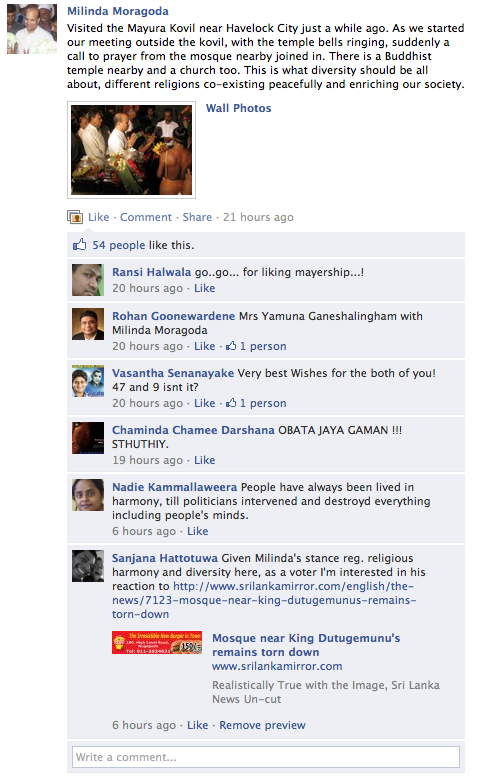
The somewhat farcical public engagement extends to Facebook. When I attempted to engage on the Facebook platform, the response from Milinda Moragoda’s campaign manager was tragi-comic, almost as if the fan page was set up for adulatory messages instead of real, hard engagement on vital issues. In response to the questions we published on Facebook, the son of Prof. Samarajiva, Milinda’s media campaign manager, accused the Centre for Policy Alternatives, in fact no stranger to the candidate himself of ‘coordinated personal attacks’. Note the word personal. And what were these ‘attacks’? The following questions apparently, amongst others that are in full public view,
On the issue of religious tolerance
On the Right to Information

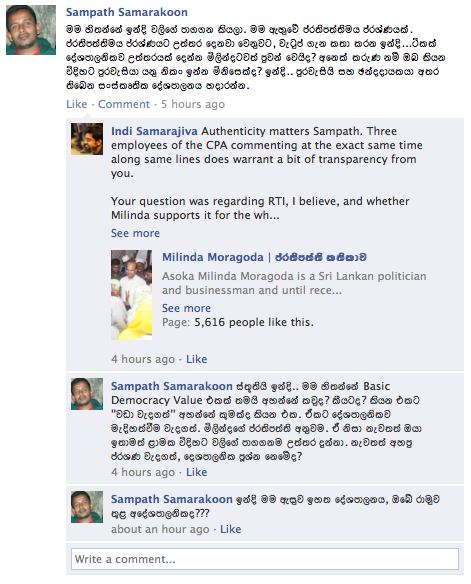
Sampath, Chief Editor of Vikalpa, makes the point here that the copy and paste tactic of the campaign demonstrates the paucity of original thought and genuine engagement.
On Namal Rajapaksa’s comments
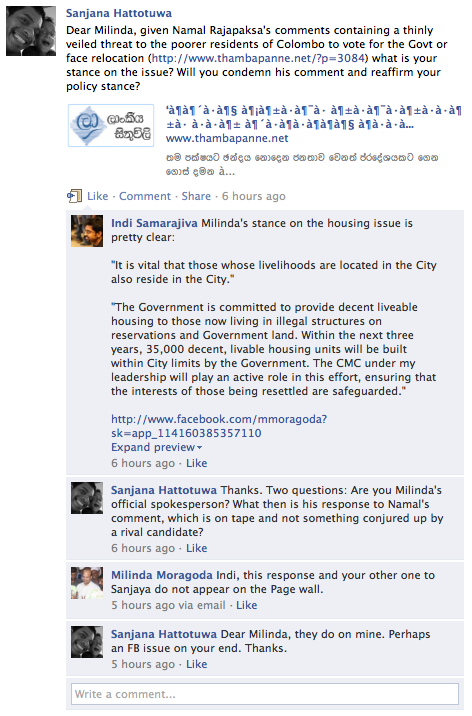
Note there is no engagement at all here with Namal’s comments. And the ‘Milinda Moragoda’ isn’t really Milinda Moragoda. More on this anon.
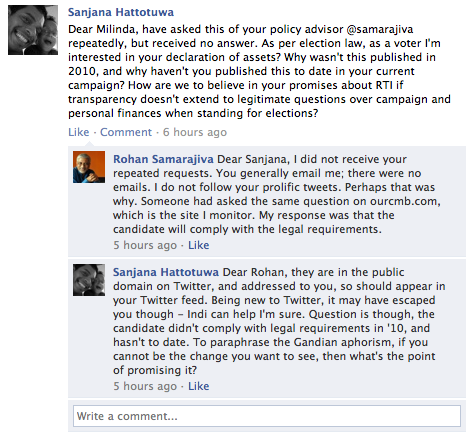
On Moragoda’s non-compliance with election law in 2010 and again during the present campaign
On the inability of the campaign to deal with hard questions (in Sinhala)
On attempting to dodge hard question by facile logic
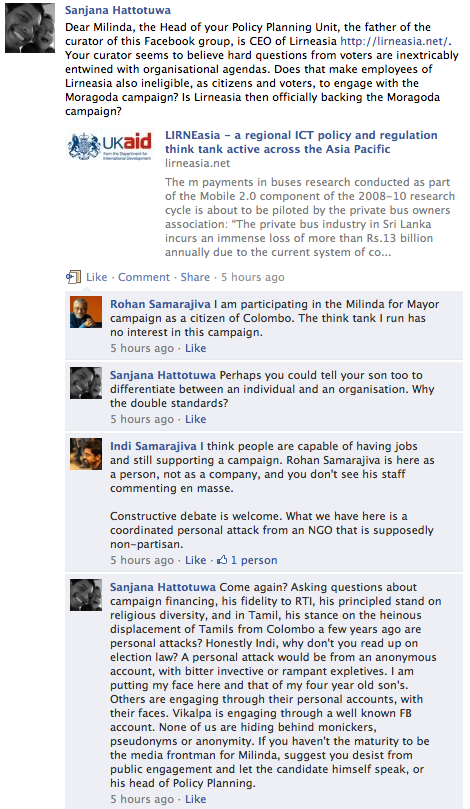
This question alone generated an exchange of over 25 comments between the media campaign manager, Prof. Samarajiva and I. It is evident the campaign cannot come up with an answer to the questions asked, most notably why Moragoda to date has not made public his declaration of assets, as per election law (and never did in 2010 either). What is also evident is a media campaign manager who cannot manage hard questions, and a Head of Policy Planning, infinitely more capable of dealing with vital issues yet unable to engage as robustly as he can on account of a day job. In sum, a rather dysfunctional campaign to deal with anything other than the sporadic citizen input, and that too if sycophantic or supportive in nature.
It gets worse.
The optics of engagement, or lack thereof
Twice during the day on Moragoda’s Facebook page, I noticed that ‘Milinda Moragoda’ said something that in minutes was magically attributed to Rohan Samarajiva. I flagged this to the campaign.
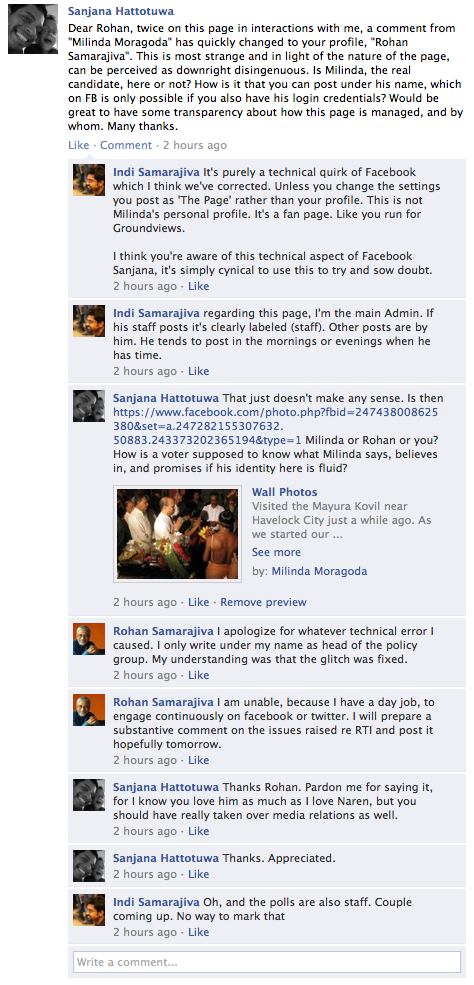
Yes despite assurances this has been fixed, one sees strange anomalies. For example, the following notes that even though the identity that appears is ‘Milinda Moragoda’ its a member of his ‘staff’ that is posted the response.
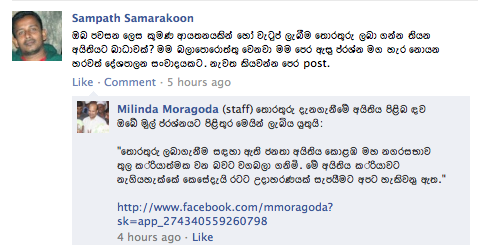
However, in the case of the example below, that which appears to come from Milinda Moragoda, one suspects actually comes from Prof. Samarajiva.
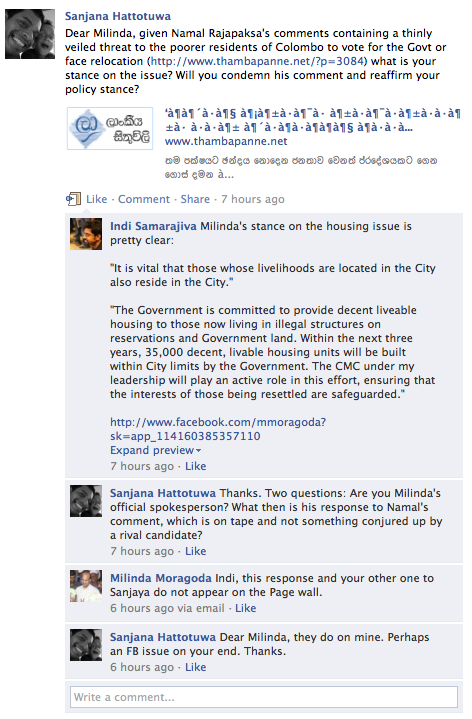
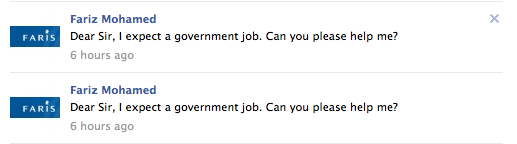
This may well be a temporary technical glitch. I’m not suggesting that Prof. Samarajiva deliberately misleads voters, but this is just not the way to build public confidence in authentic online engagement. Moragoda we are told only posts content himself in the morning and the evenings. We aren’t sure then whether this post on Milinda’s avowed celebration of diversity was actually posted by himself or not. There is no comment moderation policy. There is certainly comment moderation (not all comments that are submitted go up), but this isn’t made explicitly clear. What you see on Facebook may only be a subset of what is received by the campaign, with content published at their discretion not really giving a sense of what fans really send in, want to see and think. What one immediately notices is that up until today, there was not a single hard question or policy related discussion on the Facebook page. The only status a bit different to the rest was this hilarious yet revealing post,
Is any of this of consequence?
“I am persuaded that Constitutionalism, the rule of laws, not men, is most conducive to the happiness of our people. But I am open to persuasion that what is appropriate for the Sri Lankan climate is something else.” Prof. Rohan Samarajiva, Sri Lanka under Rajapakse regime becoming feudal kingdom with constitutional veneer
Prof. Samarajiva may have been persuaded to believe that supporting the proxy of a feudal kingdom is the best way forward. So too, many others? Now famously quoted, the Gallup Poll reveals that the President’s popularity is at 91%. A recent poll by Social Indicator, the social polling arm of the Centre for Policy Alternatives on perceptions of post-war democracy in Sri Lanka indicates that 58.8% of Sri Lankans think that the country has been the most democratic under President Mahinda Rajapaksa’s period. This view is shared by 69.9% of Sinhalese respondents. 62.2% of respondents in the 18 – 30 age category consider the country most democratic under President Mahinda Rajapaksa. The latest age breakdown for Colombo’s inhabitants I could access was from 2001. It’s clear though that the appeal of the Rajapaksa regime will possibly translate into votes for Moragoda in a city with a younger demographic. The concerns Groundviews noted below are quite possibly non-issues to the majority who vote.
@aufidius Sadly though, the reality is that principles, decency and honesty are victims of expedient politics and parochialism.less than a minute ago via Twitter for Mac Favorite Retweet ReplyGroundviews
groundviews
@aufidius Is Ranil or Gota or Mahinda together or alone to blame for this? Fear not – voters get who they vote for & real change eludes us.less than a minute ago via Twitter for Mac Favorite Retweet ReplyGroundviews
groundviews
Nalaka Gunewardene (a close friend of Prof. Samarajiva’s), along with Groundviews, attempts to hold Milinda Moragoda accountable to a higher standard than the rest of the candidates via frequent engagement on Twitter. As Nalaka avers,
Yes, I do hold @MilindaMoragoda 2 a higher standard precisely becos he invokes liberal ideals unlike most politicos. He must walk da talk!less than a minute ago via web Favorite Retweet Reply Nalaka Gunawardene
NalakaG
@ThilinaRa One difference: @MilindaMoragoda campaign projects him as da most honest & open politician. So let’s test that claim! #lka #MiMoless than a minute ago via web Favorite Retweet ReplyNalaka Gunawardene
NalakaG
Perhaps Nalaka and I are wrong in seeing him differently to any other politician, particularly during elections. But Moragoda says, repeatedly, that he is different. Wielding the tools of public engagement online, Moragoda suggests that he is capable of robust conversations on engendering real change in a participatory manner. He wants to deal with issues. Yet, he eludes the inconvenient ones. He wants to bring about a new expression. Yet his campaign wastes no time in precisely the kind of expression his opponents are vaunt to use. He says he is for the Right to Information. Yet he flouts election law by not revealing his assets. Despite all this, I have little doubt he will win Colombo. On Facebook, Prof. Samarajiva wanted me to “Nail us (meaning Moragoda and himself) to the wall if we do not deliver after getting the mandate. That seems to be the only practical course, if you do not want to get all candidates to adopt RTI.”
My response to him on Facebook is a good note to end,
“Thanks again, but I think the thrust of my point is at variance with your submission. My point is the trust deficit – not a hum in support of RTI after his defeat last year, on *principle*. One can not be in a position to implement, but stand up for something nevertheless? I get what you are saying too, but I think you place too much of power in my / voters hands. Once and if elected, he is the frontman for a regime that trucks no check or balance, no critical question. Moragoda himself closed Twitter and YouTube the day after he lost in 2010. What gives us hope he will continue to be held accountable through these fora once elected? Your involvement in the campaign and your early tweet “… we are serious” is that much more cruel in this context. You may be, but the context of electoral democracy in this country is just not set up to ‘nail’ you (or any politician) on performance. You and Moragoda ask for faith, in essence. I have little of it in Moragoda, and none at all in the regime that backs him.”
Many of course will disagree, and say that Moragoda is the best choice in an irrefutably illiberal context. I do wonder how we got here.