
Spirtuality, Religion and Human Conflict


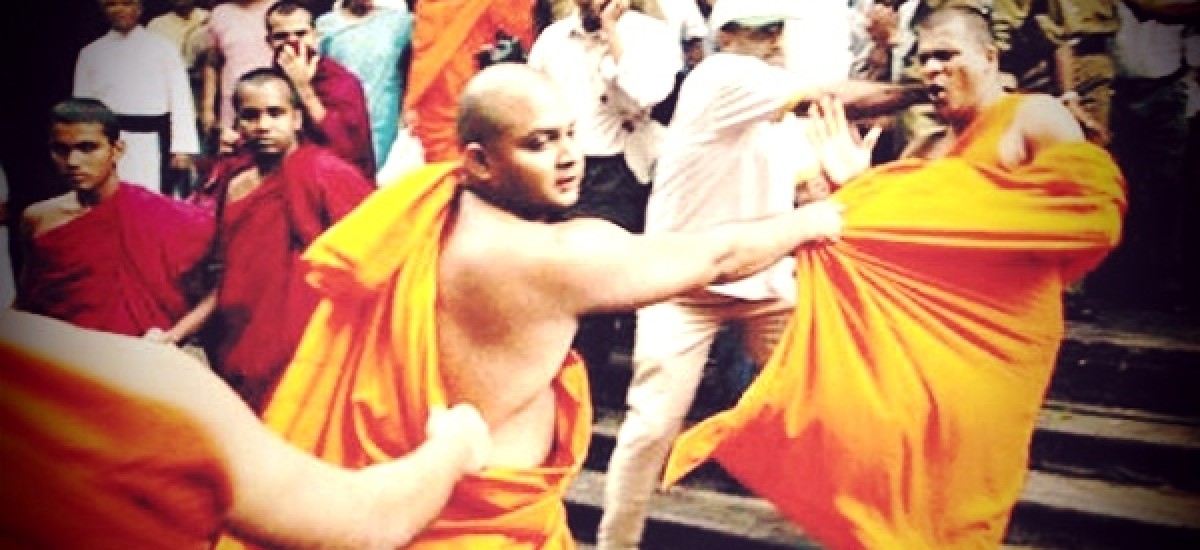
Image credit NowPublic

Spirituality
The desire for the triumph of good over evil is an inherent human spiritual need and consequently it is the underlying theme of all religious teachings. It is a universally accepted truth that the propagation of good leads to happiness while the propagation of evil leads to suffering. The concept of Good can be defined as human thoughts, words and deeds which benefit and sustain the physical, emotional, intellectual and spiritual wellbeing of humanity without compromising all other life and non life which supports and sustains human survival. It follows that the definition of Evil is the exact opposite of Good.

A feature common to all religions is the personification of good and evil primarily through icons such as God and the Devil portrayed as super natural beings. The purpose of it could be that personification of abstract concepts serves to facilitate better understanding of same. Religious belief is further reinforced by unique faith based doctrines and rituals built around religious icons, myths, legends and history distinctive to peoples, cultures and regions of the world.

Since the advent of the scientific method, there has been a growing trend towards reason based spirituality, particularly, in privileged sections of society. Reason based spirituality can be defined as the understanding of the concepts of good and evil and its impact on humanity based on logical reasoning. According to Maslow’s hierarchy of needs, man’s needs start with satisfying physical needs followed by emotional needs then by intellectual needs and finally by spiritual needs. The power of reasoning which comes with intellectual maturity leads to a greater emphasis on reason based spirituality. In contrast, people  who have not yet achieved intellectual maturity  find faith based spirituality more comforting as it provides hope for supernatural intervention when human intervention is not forthcoming in addressing their  basic  needs. Faith can be defined as the unquestioning acceptance of religious doctrine which identifies God, a divine power as the source of all good and the devil, a supernatural being as the source of all evil.

Religion
Is organized religion too compartmentalized through rigid doctrine and rituals which serve to divide rather than harmonize the common spirituality of man? If so, who is responsible for this? Are religious authorities guilty of over emphasizing differences in doctrine while underplaying common spiritual values?  Religions survive mainly by advocating the supremacy of their own doctrines. Competing for supremacy can corrupt religious authorities. History is replete with evidence to this effect.

Man’s primeval need for belief in the supernatural can be attributed to his apparently isolated state in the universe, inability to physically identify a Creator and due to lack of understanding of the role and purpose of humanity. When man lacks rational explanations for such profound issues, he tends to turn to the supernatural which can fill the void easily through faith based religious doctrine.

Consequently, the spirituality of man is in a constant state of tension between reason based as spirituality versus faith based spirituality. Faith based spirituality has a greater influence on society as it is strongly backed by religious advocacy. Thus it is evident that man’s appeal to the supernatural in seeking spiritual solace can be easily exploited through the influence of organized religion which is pervasive at all levels of society. Many progressive countries have opted to do away with religious education in schools in order to promote reason based spirituality which has a harmonizing effect compared to faith based spirituality.

Islam and Social control
The practice of Islam in the Arab world provides a striking example of the use of religion to control society in several ways, the most obvious being the strict dress code, particularly for women. Laws which infringe on a person’s fundamental rights such as dress code, public display of emotions, sexual relations and blasphemy laws based on Islam are embedded in the constitutions governing most Islamic countries. Punishments prescribed for any violations of faith based laws are generally extreme and inhumane as they are highly anarchronistic such as stoning to death, cutting off limbs and ‘eye for an eye’ type punishment. Consequently, the fanatical practice of religion can have a detrimental impact on the basic freedoms of people.

Buddhist Nationalism and ethnic conflict
In Sri Lanka, we can also see the negative impact of nationalizing Buddhism as a state religion and the obligation of the state to give it primacy of place over all other religions and foster its practice as required by the Constitution. The politicization of Buddhism favours the majority Sinhalese as it happens to be practiced only by Sinhalese in Sri Lanka and therefore marginalizes all other ethnic/religious minorities, particularly the largest minority group, the Tamils which has contributed to the ethnic conflict. Although the conflict culminated in a war resulting in the successful decimation of the extremist terrorist movement by the state, it has given rise to fanatical Buddhist supremacy which is intolerant of other creeds.

Hinduism and Caste discrimination
Hinduism is a ancient religion based largely on myths and legends which serve to define the universal principle of the triumph of good over evil. A serious flaw is its anachronistic belief in the archaic Caste based classification of society which has unfortunately endured over the centuries and also has been transmitted to Sri Lanka and currently practiced by both the Buddhist clergy through caste based sects as well as covertly by its followers in the social context. Despite suffering the epic tragedy of the Tsunami, it was common knowledge that many ‘higher caste’ Sinhalese victims were not prepared to re locate their homes close to those of  ‘lower caste’ victims which was an even greater  tragedy. In fact, many believed that the fisher caste community were most severely impacted by the Tsunami as punishment or ‘karma’ for practicing a trade of killing fish which is considered immoral according to Buddhism. Hypocritically, it is not considered unethical to consume fish and meat according to Buddhist religious authorities.

The ethnic conflict can also be attributed, in part to, marginalization through caste discrimination within the Tamil community resulting in the impoverishment and consequent frustration of many, particularly the youth. This was one of the reasons for the extremists who largely represented the impoverished ‘lower castes’ to be in conflict with the ‘high caste’ Tamil political leadership as they did not consider them their true representatives. Even after the war, we can see the unethical issue of Caste in the context of rehabilitation and re settlement. ‘Higher caste’ Tamils continue to covertly resist in assisting impoverished war victims who are predominantly ‘lower caste’ in re settling in ‘higher caste’ neighbour hoods or admitting such children into ‘higher caste’ schools. Unless and until ‘higher caste’ Tamils accept Caste as an  unethical practice, the impoverished and marginalized in their community cannot hope for justice and equity provided through legitimate means and may thus seek redress through illegitimate extremist methods as attempted in the past. Ironically, Tamil Christian religious leaders have always empathized with the Tamil marginalized classes and consequently were suspected as terrorist supporters.

Christianity, Evangelism and Conversions
Active Christian missionary work has been obnoxious to Buddhist religious leaders ever since colonial times Consequently, Buddhist religious authorities in Sri Lanka have always been suspicious of Christian evangelism due to many conversions from Buddhism to Christianity among the marginalized classes. Consequently, the state is  seriously considering an anti conversion law “Bill for Prohibition of Forcible Conversions,” against the spread of Christianity. In this instance as well, Christian religious leaders have also empathized with Sinhalese Buddhist ‘lower caste’ communities resulting in many conversions to Christianity which has been criticized by Buddhist religious leaders as the spiritual manipulation of vulnerable social groups.

Conclusion
It is evident form the above analysis that religion plays a negative role in harmonizing the common spirituality of man. In fact, religion, throughout the ages has aggravated human conflict and imposed arbitrary control through stringent laws which have compromised fundamental human rights. Its requirement  for unquestioning faith in the divine causes conflict in the minds of men who have been educated to think rationally and scientifically on all other issues.   It is time that societies in the developing world are made aware of  the divisive effects of organized religion and encouraged to turn towards reason based spirituality which has no vested interests and consequently  far more ethical, moral and intellectually dignified in addressing man’s spiritual needs.

Sri Lanka, in particular, is the target of this article as a developing nation with a highly vulnerable society due to its endemic poverty, religious and ethnic diversity, a recently concluded brutal ethnic conflict, allegations of war crimes and the government’s unwillingness to investigate such a grave accusation which will have serious repercussions to the country.

There is a palpable need to break away from the organized religious shackles of Buddhist nationalism, Caste Hinduism, Christian Evangelism and Islamic fundamentalism not only in Sri Lanka but throughout the world .  Countries which have religion embedded into their constitutions in order to establish religious supremacy need to re consider its validity for achieving national peace and stability.  Buddhism is a religious philosophy which advocates personal salvation through ethical and moral conduct based on reason. Unfortunately, the custodians of Buddhism have reduced the philosophy to a religion which recognizes divine intervention in the form of deities and also by subscribing to numerous archaic rules and practices which are anathema to Buddhist philosophy. Unfortunately, the majority Sinhalese Buddhists are caught in a trap of deception and manipulation by vested interests to claim the supremacy of sinhala Buddhist nationalism by marginalizing the minority communities.

If we are to prosper as a united country, society needs to break away from divisive thinking based on narrow religious dogma. We need to extract the universally accepted values and principles embedded within archaic and anachronistic religious doctrines and rituals most of which are redundant and irrelevant due to the evolution of civilization to higher levels of thought and existence. For this, we need to exercise our powers of reasoning in addressing our spiritual needs which have a strong bearing on our mutual objective of striving for sustainable peace, justice and equitable prosperity in harmony with our environment.

Print This Post Print This Post

8,383 views

53 Comments

  1. Concerned Citizen

    You say:

    “Active Christian missionary work has been obnoxious to Buddhist religious leaders ever since colonial times Consequently, Buddhist religious authorities in Sri Lanka have always been suspicious of Christian evangelism due to many conversions from Buddhism to Christianity among the marginalized classes. Consequently, the state is seriously considering an anti conversion law “Bill for Prohibition of Forcible Conversions,” against the spread of Christianity. In this instance as well, Christian religious leaders have also empathized with Sinhalese Buddhist ‘lower caste’ communities resulting in many conversions to Christianity which has been criticized by Buddhist religious leaders as the spiritual manipulation of vulnerable social groups”

    And then:

    “It is evident form the above analysis that religion plays a negative role in harmonizing the common spirituality of man. In fact, religion, throughout the ages has aggravated human conflict and imposed arbitrary control through stringent laws which have compromised fundamental human rights. Its requirement  for unquestioning faith in the divine causes conflict in the minds of men who have been educated to think rationally and scientifically on all other issues.   It is time that societies in the developing world are made aware of  the divisive effects of organized religion and encouraged to turn towards reason based spirituality which has no vested interests and consequently  far more ethical, moral and intellectually dignified in addressing man’s spiritual needs.”

    Why is this special sympathy towards Christian religious leaders?

    One more point:

    As it stands now, the apparent lack of a “divine” support for the Buddhists in sorting out their day to day matters (where the practitioners of other religions “try to get” by praying to God)is compensated by them (the Buddhists) by praying to the borrowed hindu gods and regional deities. Does the writer have an ulterior motive in attacking this practice in popular Buddhism in Sri Lanka, in hoping that, a vaccum created thus can be filled by a religion like Christianity, which promises to give results “immediately” if you “communicate with your creator”?

    What do you say, “concerned citizen”?

  2. WRT “good” and “evil”, these are merely creations (Universal as they may be) of the evolved human mind. That evolution is directly associated with the evolution of the brain and specifically co-evolution of parts of the brain that led to evolution of attachment behaviour among mammals and ultimately humans. Good and Evil could be seen as nothing more than the linguistic expression of specific mammalian, and particular human emotions such as guilt, envy, jealousy, pride etc. which when analysed probably evolved to help protect territory and subsequently to protect group relationships, thus leading to survival of groups based on loyalty etc. Whether such emotions and acts related to them are good or evil depends on the interpretation of the dominant cultural values of a particular human groups according to their survival needs.
    In this sense human beings are really no different to animals. However, a good reasoned depiction of good and evil may be on whether a human group uses more of the frontal structures or limbic structures in defining good and evil.

    For example, there are societies in which loyalty and subjugation the to alpha male group is what is expected as appropriate behaviour. Anything that threatens that social structure is depicted as “evil” and stern action is taken by the alpha males (alone or together) to maintain social order. Baboons among primates and Sri Lanka among South Asian states are examples of such evolution. Baboons would tend to be more dominated by limbic as opposed to frontal structures.

    OTOH, there are societies in which what is good and evil are determined by females, and specifically alpha females. In such societies nurturing behaviour is considered good and any aggression is immediately frowned upon. Females will generally band together to pull any male into line if he transgresses the rule “make love not war”. Examples among primates are the Bonobo Chimpanzee of the Congo and the State of Kerala in South Asia. Bonobos would be more dominated by frontal as opposed to limbic structures (I believe that Bonobos are considered to have brains most like humans in frontal lobe evolution).

    I compare Kerala and Sri Lanka because of their proximity geographically and culturally and on social standards indices. I suspect Kerala is now ahead of Sri Lanka on several indices.

    It is of interest that in nature baboon troops are relatively thriving while Bonobo’s are facing extinction. But something strange happened to a Baboon Troupe studied by an American Scientist for the past 30 years. One of Dr. Robert Sapolsky’s original Troupes had ventured close to human habitation and started eating meat (contaminated) from a dumping ground. Guess who had the pick of the meat!
    Well, this troupe found itself minus all its alpha males. Within a generation, the surviving males had come under control of females who did not permit them to act out their aggressive instincts as they reached adolescence. They had become more like the Bonobos. Strangely, the health indices in this troupe including stress hormones, and central obesity vanished. The answer it appeared was emergence of “compassion”.

    Robert Saposlky stars in a video called “Stress the portrait of a killer”. Some one has uploaded a series of 6 videos to Youtube.

    I just wonder if Robert Sapolsky should be taking stress hormone samples from a “random” group of Sri Lankan males over the next 10 years. And what can Sri Lanka learn from the strange liberation experience of a Baboon Troupe when the alpha males were eliminated? More to the point, how did Sri Lanka which was a society more like Kerala 40-50 years ago turn out to be what it is today? Ironically, I suspect it was the “original sin” of an alpha-female who ran a Kitchen Cabinet in 1970.

    • Dear ravana;

      You seem to jump from one subject branch to another subject branch and ultimately fell on the ground without having any branch of subject to reach your long hands.

      A Biological approach to a Philosophical/Moral issue through Sociology and a hasty Political conclusion. Oh! My, My!!

      Thanks!

    • The photograph used to highlight the article alone shows the “Spirituality” of the people concerned.

      Thanks!

  3. WRT Evangelism,
    I was part of a secular aid group which descended on Sri Lanka in 2005. We were intent on initially providing shelter followed by vocational and other forms of rehabilitation. Our intent was to work collaboratively with local groups.

    On one of the visits, we had a fund raiser who accompanied our group. Unbeknownst to some of us he represented a Christian organisation. I have to say that when I landed I was aware of an “Anti Conversion” bill being mooted by JHU baboons. I did not like the idea of it.

    Anyway, we had a female member of the local partners who was keen on being involved in rehabilitation efforts. We were attempting to negotiate for her to have training. She happened to mention that she had previously worked with a local Christian welfare mission. During a subsequent conversation with our fund raiser I mentioned that she had worked previously with a said Christian Mission (not to emphasise Christian but to indicate that she has had experience in the welfare field).

    His answer was “Good, our funders would want to know that the money went to a Christian community!”

    We were gob-smacked! In fact I and my relative who was with me at the time were so shocked that there was an embarrassing silent for some seconds before we changed the subject! Now I understood what Christian Aggression was all about. Wolves in sheep’s clothing indeed. This made me look at events in Sri Lanka with different spectacles. I realised the Christian nature of the terror movement in the North and downloaded images of Catholic Priests at the forefront of Mahveer celebrations holding on to placards of Prabhakaran. I have read letters written by the Bishop of Mannar to the Arch Bishop of Sydney seeking intervention in Sri Lanka (in favour of the LTTE). As embarrassed as I am of the Buddhist clergy who engage in politics and support politicians, neither can I support Christians who engage in terror activities.
    http://www.christianaggression.org/ used to list Christian activities particularly in Asia. Reading such material has opened my eyes to the whole issue of Abrahamic conflict under which the rest of the World has to suffer.

    What made me most alarmed about the completion of the War in 2009 (I knew many children would have sacrificed as they were used as cannon fodder- I was sad but not surprised or alarmed as this was expected) was that after 300 000 people were liberated and behind the lines of confrontation, the Western Countries made the most noise! I just could not make sense why they made so much noise to protect the LTTE when only weeks before, there was very little noise about saving the children in the battle front or the civilians in the midst of it.

    I think an ex-patriate Truth Commission will need to look at truth of these matters as well as the crimes perpetrated by soldiers (whether individually or under command). It has to be the Truth, the Whole Truth and nothing but the Truth!

    It has to include the sordid 40 year history of the common enemy of Sri Lankans (Government,Armed Forces and Police, LTTE, Politicians, 1983 Jathi Ale dogs (minus politicians and Government agents already accounted for), EPDP, Religious Leaders, Foreign Individuals and Governments, assorted arms bearing groups- e.g. PRA, EROS and also the JVP-both those who voted for armed insurrection and those who went beyond that call by terrorising and settling scores and finally agents of the UN)

    I have placed those enemies in rough order of responsibility. LTTE comes third because it was a non-state actor who engaged in more more atrocities (extent, type) than the ones preceding them in the order. I put JVP last because they decided to take up arms twice against the wishes of their leader who nevertheless had to bow to the majority. And rogue elements which could not be controlled because JVP just did not have the same ruthless command structure that Ranjan Wijeratne had access to.

    Truth needs to be told about all this whilst there are still witnesses alive to give evidence under affidavit.

    • In the above comment,
      “I have placed those enemies in rough order of responsibility. LTTE comes third because it was a non-state actor who engaged in more more atrocities”

      is meant to read,

      “I have placed those enemies in rough order of responsibility. LTTE comes third because it was a non-state actor who engaged in no more atrocities”

    • Dear ravana;

      In your first post you seemed to argue against the existence of “good” and “Evil”. This is what you have said

      “Good and Evil could be seen as nothing more than the linguistic expression of specific mammalian, and particular human emotions such as guilt, envy, jealousy, pride etc. which when analysed probably evolved to help protect territory and subsequently to protect group relationships, thus leading to survival of groups based on loyalty etc.”

      Don’t you think from an argument of the same perspective one can argue against the existence of “truth” and “untruth”, isn’t it? In the same line of argument nobody can at least be certain they exist. I think the dialogue about “good and evil” and “truth and untruth” in Philosophy are not very different. They go in the same line.

      But now in your latter post you seems to upholding that non existent or insignificant “truth”. This is what you say there.

      “Truth needs to be told about all this whilst there are still witnesses alive to give evidence under affidavit.”

      Is there some contradiction or inconsistency in what you say in two very close posts?

      Thanks!

      • Yapa,
        Good and Evil are abstract human value judgements.

        Truth and untruth (delusion) are “real” events. The fact that you are deluded (for example) is real. If some one was to say that you are evil then that would be a value judgement. Of course the value judgement itself is most likely to be real event (an untruth- a delusion).

        The truth (or nirvana as followers of Dhamma may call it) is difficult to attain. Science however, helps us get a closer glimpse of it than say those who actively participate in delusions such as “Mae Sinhala Apae Ratai…”

      • Dear ravana;

        Truth and untruth I was talking is not something something special to Buddhism. I am talking about the truth and untruth in general as the general perspective of the philosophy just as in the case of Good and Evil you referred to.

        In that general perspective of philosophy the debate on “Good and evil”
        and “Truth and untruth” are almost same, according to the long lasting and still continuing debate philosophers are of the view that no one is certain “what is good or what is evil” or “what is truth or what is untruth”.

        What you did was to define two of them in two different contexts, one in general context and the other in a special context(In the context of Buddhism) to evade my question with regard to your contradiction, in double standard in to similar situations.

        Are you ready to take the responsibility of what you say or you prefer to talk and talk and talk and talk irresponsibly?

        Thanks!

  4. “If we are to prosper as a united country, society needs to break away from divisive thinking based on narrow religious dogma.”

    POLITICAL DOGMA AS WELL!

    Thanks!

    • @Yapa,

      “POLITICAL DOGMA AS WELL!”

      Absolutely! Let me suggest that you begin by considering breaking away from a confluence of racist/religious fundamentalist political dogma.

      2/3 of the voting public could be persuaded to never vote for the racist, fundamentalist, ultranationalist parties.

      That would essentially leave only 3 prominent parties to vote for:

      UNP- Ultra right wing and capitalist oriented (can be bent to consider social welfare issues if politically expedient)

      DNA- No specific ideology; utilitarian; have vowed to wipe out corruption (acceptable to both the right- for the sake of foreign investment- and the left – for the sake of the workers)

      JVP- Ultra left wing Marxist oriented (can be bent to consider issues specific to the country when politically expedient).

      Between them the three party system would provide the breath of political views and checks and balances which a functioning democracy would require. There is space for the spooky parties that have been left out of the list and it is OK to let them exist just to let off steam from time to time. It is entirely up to the General Voting Public (barring vote rigging, which is a well known occurrence in SL) to ensure that such a political balance can emerge. Once you achieve this please do not give the monkey a razor again!

      The remaining 1/3 are beyond redemption; but if you keep them in the political wilderness for a generation, they will fade away like Robert Sapolsky’s alpha-male Baboons. The next generation might see only 50% hard-core (i.e 15-20%) remain. Even a majority of these will be too embarrassed to vote for the ultra-nationalists in one generation. If you look at Western Democracies, this is what has largely happened throughout the latter part of the 20th century.

      If the minorities voted according to political ideology (if you are rich vote for UNP, if you are poor vote for JVP, if you are middle-calssed vote for DNA or whatever else meet your fancy) then the Sinhala racist Ultra-nationalists could not have got a foot hold as they have. You have managed to get rid of one fascist force from the island. Do you have the courage to get rid of the other?

      One interesting observation, I am not aware of any Conservationist (Green) party in Sri Lanka although they hold some sway in Western Democracies.

      • Dear ravana;

        “Absolutely! Let me suggest that you begin by considering breaking away from a confluence of racist/religious fundamentalist political dogma.”

        When peoples’ understanding is very low about things, sometimes they tend to call them dogma.

        I think this is such a case.

        The man preaching superficial narration about Religions has no significant broad or deep knowledge about religions, but he is very hasty to call all the religions as “dogma”. Lack of knowledge he seems to think as advantage. Really it is advantageous. A person who has some knowledge would be ashamed to such outdated nonsense.

        Ignorance is bliss!

        Thanks!

  5. @ yapa,

    “Dear ravana;

    You seem to jump from one subject branch to another subject branch and ultimately fell on the ground without having any branch of subject to reach your long hands.”

    The author brought up science as a subject matter and contended that reasoned spirituality as based on it. I used scientific knowledge to point out an alternate perspective of so-called spirituality. The aim was to point out that we are after all evolved animals. no more; no less. Sri Lankans are a subset of this species. I used alternate species as an analogy to make a point about the political structure of Sri Lanka. I am sorry if you did not get it. But, watch Rabert Sapolsky. You might develop some insight.

    “A Biological approach to a Philosophical/Moral issue through Sociology and a hasty Political conclusion. Oh! My, My!!”

    Ditto to the first part of this statement. As far as a hasty political conclusion, I presume you are referring to the metaphor of the kitchen cabinet of Mrs. B. Well, if you are not educated about the chain evidence leading from Mrs. B to Mahinda Rajapakse, of successive leaders of SL who have continued to apply the Baboon adage to politics, then again I am sorry; you’d better hit the books!

  6. Why is this article heavy on criticism of Muslims, Buddhists and Hindus, but so light on criticism of Christians? The worst period of religious oppression in the country was when Christians were running the island. Thousands of people were killed, non Christian places of worship destroyed and Buddhists, Hindus and Muslims were persecuted for being “heathens” and “idol worshippers.”

  7. Dear Concerned Citizen

    I will suggest the best way for you to achieve the objective that you seem very keen pursue.

    Leave all religions alone. If you belong to any particular religious group just practice those teachings – but do not under any circumstances seek to reform the adherents of other religions.

    Take a leaf out of the religions and develop your own praxis in human rights (if that is your religion)

    Yes human rights is the latest religion (and it is as good as the others except that it is rather young)and the record of human rights in Sri lanka – what I say the PRAXIS has to be strengthened.

    If the religious professionals are earning a livelihood from religion and human rights professionals are earning their livelihood – they are both doing the same thing.

    What is needed is altruism, simplicity and voluntarism and self help. This is needed among both religious and human rights practitioners.

    I dont see either religion or human rights as problems but as RESOURCES.

    The real problem is our superficiality and lack of depth. The relevant values must be INTERNALIZED AND LIVED AND DEMONSTRATED FOR ALL TO SEE.

    Then you can write less articles and also achieve your objectives.

    Dont problematize the religions – of course they have issues – but just focus on SELF and the duties of self –

    Dont we have too much focus in sri lanka on the duties of others?

  8. You seem not to know what you are talking.

    Buddhism is not a religeon. Lord Buddha is only the teacher and We don’t pray for him asking for salvation or thanking him for providing food us. We are responsible for our fate, this life, after many lives.

    You talk about scientific methods, Quantum Mechanics is based on mathematical equations initially. Then they found evidence on that. Einstein is noa Scientist. He is a mathematician who predicted many things based on mathematics. Mathematics is probability.

    Buddhists have killed and do bad things. Because, they are human and thery are not enlightened. But, buddhism never had Crusade wars or getting rid of infidels. That is all for middle eastern Religeons which believes in Allmighty.

    IF you say, it is scientific Method, Stepahn Hawkings say, that there is no Allmighty.

    • Ummm,
      Let me get one thing straight.

      Damila (Dam- Daham, ila- end of ) appears to be a pure Hela word meaning one without Dhamma (infidel by any other name).

      So, when Dutu Gemunu went to went to war against the Damila, led by the Theravada Sangha, was it not the first recorded Holy War in the World?

      Is this not what a Sinhala Buddhist believes or is it a matter of “Horata nidaa ganna eka negittanna Keli Pollen annina”.

      • “Damila” is a Pali word. It is merely the Pali version of “Thamil”

        The Hela word is “Demala.” It is merely the Hela version of “Thamil”

        “Damila” in Pali and “Demala” in Hela have no intrinsic meaning in the two respective languages.

        It is just how “Ricardo”, “Roberto” and “Miguel” are the Spanish versions of “Richard”, “Robert” and “Michael” in English

      • Dear ravana;

        It seems you have some confidential influence for your version of Demala from the following comment.

        http://dbsjeyaraj.com/dbsj/archives/1956#comment-33770

        However, in ancient Sri Lankan chronicles Demala seems to have used in synonymous with “Invaders”. In Sri Lankan chronicles all the South Indian Invaders were called that common name of Demala irrespective of their ethnicity or the language they used. Elara, Kalinga Magha and Aryachakrawarthi all were Demala according to Sinhalese. Really all South Indian invaders of Lakdeepa were not Tamils, for example Aryachakrawarthi said to came from present state of Orissa, and I think his army is of Keralites, from Kerala. Really people of Kerala are not Tamils. Kalinga was in East India and I am not sure whether Kalinga Magha is a Tamil.

        However, it seems that Demala has come to existence to name “all the south Indian invaders” who were familiarized to Sinhlase trough invasions. In another way we can say it was used to name all the “Dravidian Invaders”.

        Dravidians are a composition of several ethnicities in South India. Present day the people living in Tamil Nadu, Kerala, Andra Pradesh and Karnataka. Though they have genetic relationship they use different languages and they identify them as different ethnicities.

        Though Sri Lankan seem to use Demala, Tamil and Dravidian as synonymously in real terms they represent three different sociological and political entities.

        Thanks!

  9. Yawn! I read the article here and there to be disgusted to see the read a photo copy of the conventional description of religion developed in before the 19th century, understood by then western scholars based on the religion they came to experience in Europe.

    Please see the Oxford Dictionary Definition of Religion,

    as noun]* the belief in and worship of a superhuman controlling power , especially a personal God or gods:

    Buddhism or Jainism cannot be included in this definition.

    Most of the philosophers that dealt in Europe until recent past didn’t have a sufficient knowledge about the religions originated in India. Their writings were based on the religions like Christianity, Judaism and Islam all are based on Creator god. So their definitions , concepts and all the explorations, experimentation were based on that common identity of god, that is only about the religions developed on a superhuman controlling power. So their literature on religion is excluded of the religions like Buddhism and Jainism. So other than modern literature, developed after the “paradigm shift” taken place after the revolution of Modern Science, literature about religion in the west is not relevant to eastern religions. The idea of the people of the western world of the eastern religion was a extension and a generalization of their understanding of their religions, but not something based on any proper study.

    However, with the increase of peoples movements across the continents the awareness of eastern religions felt in the west and they found that they are not similar to the religions of the west. However, real difference came into the surface only with the paradigm shift occurred after the development of Modern Science. The Intellectuals of the west understood that their total understanding of the world they had before is no more valid and reliable. The total understanding they had about the world they understood that have no much value, and have to cast off as refuse. They had to review the general understanding they had about religions and most of them were thrown off. Most of the west religions were slipped off from the “trust” of the people and that is how west is becoming more and more Atheistic.

    However, the people who were armed with the knowledge of Modern Science found that some religions in the east especially Buddhism has many commonalities, with their new findings and the philosophy developed with the new knowledge of the modern thinking. They do not consider Buddhism as a religion cast off by them. They have an intellectual respect toward it.

    However, most of our people who think know but have no an iota of knowledge of what is happening modern day in the west, but relied on the old literature written in outdated perspective still preaching to us, as they have come from god’s mouth.

    Oh, God!, Please be mercy on this ignorant man!

    Thanks!

  10. Instead of targeting Sri Lanka, just take the whole world as example.

    Consider the many INGOS operating in the world and what their objectives are. They are mostly backed by the church for the purpose of conversion.

    Who made Tamils this extremists ?. It is the colonial missionaries. They made, Tamil anti Hindi, anti–Hindu and anti-Brahmin. So, Tamils continue it as Anti-Sinhala, anti-Buddhist.

    Islam was as bad as christian. but, it became civilized when it lived in India. See Sufi, Sikh. they all have ISlam taste directly or indirectly. Only the aggressive christians made Islam very threatening.

    Now, Asia is bas, They are against, Burma, Middle east, Sri Lanka. George bush had given Direct orders to comvert India to christianity. Why all these mayhem.

    In order to make the god happy or to make the evil happy ?

    Anyway, Western thinkers say, there is no evil. It is just the LACK OF EMPATHY for others.

  11. One more for Concerned Citizen

    Is it in accordance with your faculty of reason to extend your concern to the SELF?

    I mean you deal with a lot of things but they are not as important as the SELF.

    You may think I am referring to ‘your’ self but whether your self is something separate or something which is deeply shared between all of us is another question.

    The SELF is the gateway to any kind of spirituality – whether this is reason based or faith based.

    So I say east or west
    depth is best

    Please dont worry about ‘the majority of sinhala buddhists’ – just go into this one thing – the SELF. Then you will find that you have got under the skin of ALL BEINGS.

    What you seek to accomplish was achieved in India in the 19th century through the life works of Ram Mohan Roy and the Tagores. Check on the Bengali renaissance. The point is that those were all authentic – deep and heart felt explorations.

    I wonder when the sri lankans will drop all these pretensions and get dead honest with themselves?

  12. @ Rodrigo,

    The word “Demala” does not occur in Sinhala literature and vocabulary until the middle ages. If you read Sidath Sangravaya you could work out how the Hela word “Damila” could evolve to “Demala”.

    There are no roots for Damila in Pali (Maghadi) that I can find but these roots are clearly evident even in a modern Sinhala dictionary.

    Are you a linguist? If so could you clarify how I could be wrong in my conclusions. If you are not, then perhaps you could ask a linguist to clarify.

    • [[The word “Demala” does not occur in Sinhala literature and vocabulary until the middle ages. If you read Sidath Sangravaya you could work out how the Hela word “Damila” could evolve to “Demala”.]]

      It is precisely in the Middle Ages where there was a development in the Sinhala language, and it is during this period that there was a trend that favoured Sanskrit words over Prakrit ones. ‘Damila’ is not a Hela word; it is a Pali word that was co-opted into the Sinhalese language. It is found primarily in the Pali Chronicles of the island. In Pali, Sinhalese is known as “Seehala.” In Hela it is “Sihala,” and it is only “Sinhala” in Sanskritised Sinhala. “Lanka” – the name for the island – is the same in Sanskrit and Pali, but the Hela word is actually “Laka.” Many Pali words that were co-opted (borrowed if you will) lost their double consonants and aspiration (common features of Pali) when they became Sinhala words. There are also many Tamil words that entered Sinhala and were appropriately Sinhalised. The Hela version of “Thamil” is Demala. If you are interested in learning about more Hela words please see: http://en.wikipedia.org/wiki/Elu_language

      [[There are no roots for Damila in Pali (Maghadi) that I can find but these roots are clearly evident even in a modern Sinhala dictionary.]]

      There are no roots for Damila in Pali because it is the Pali-ised version of “Thamil.” Just as there are no roots for the Sinhala word ‘parlimentuwa’, it being the Sinhala version of the English word “parliament.” There are no roots for “Demala” in Sinhala either because it is the Sinhala version of the word “Thamil”, or if you will, the Sinhala version of the Pali word “Damila.” Similarly, English becomes Ingreesi, Portuguese becomes Prutugeesi, Chinese becomes Cheena. The Tamil version of “Sinhala” is “Sinkala” and there is no intrinsic meaning in Tamil for it.

      Your attempt at breaking down the world “Damila” to mean something along the lines of “one without the Dhamma” is as patently absurd as trying to break down the word “Prutugeesi” as follows

      Prutu – earth
      Gee – songs
      Si – top

      “Hey! It actually means “earth-songs-on-top” and NOT the name for a language or a group of people!”

      [[Are you a linguist? If so could you clarify how I could be wrong in my conclusions. If you are not, then perhaps you could ask a linguist to clarify]]

      No I am not a linguist. But I study languages – particularly South Asian ones. And you are more than welcome to believe what you wish but do expect your comments to be challenged when you place them in a public forum such as this – especially when they make no sense whatsoever and seem like deliberate misinformation.

      • @Rodrigo,
        Thanks for the reply. That was useful. “Earth songs on top” does not make the same sense in context as my interpretation of Damila. I would still like an opinion of a linguist.

        Even though you are not a linguist, it is of interest that you study South Asian languages. Now, I have not been able to find reliable reference to a group that refers to themselves as Thamil in the ancient South Asia. Only the Seehala Sangha writing in Pali appear to use a word called Damila. There might be reference to Damilagam in Sri Lankan archaeology.

        I understand (Kamil Szvebil) there is one reference in Sangham poetry to Thamilakam. Sangham were as I understand the Jain monks.
        Taymoli means “my language” same as Siyabasa. But these are languages. Not groups of people.

        Other than that the South Indians are called Chera, Pandya and Chola and overwhelmingly so.

        Can you please enlighten us about a group that called themselves Thamil, where they lived what ideology brought them under this banner and why they became such arch enemies of the Seehala Sangha?. Please keep in mind that the Dutu Gemunu period was a time when the Jains and Buddhists dominated South India and Heretic sects emerged challenging Theravada. Nagarjuna the great proponent of “Sunyata” I believe was South Indian. Why did the Mahayanists insult the Theravadins with the epithet “Heenayana”?
        Why did the Saivites nearly 800 years later begin to persecute Jains?

        If Dutu Gemunu fought a War against Damilas, even if they were South Indians what was their religion? Why were the Buddhist monks so intent on re-establishing theravada. What did the Damilas practice? They were certainly referred to as “not human” when salving Dutu Gemunus conscience.

        Returning to my primary premise that Dutu Gemunu fought a holy war on behalf of the Theravadins, why wouldn’t “Damila” (infidel) make sense?

        If you can give me details and references to evidence that a group calling themselves Thamil, and called so by others existed in those days (for that matter pre-19th century) other than through Sinhala racism/sectarianism I would be grateful. At least then I could cite reasons why they were only as cynical 1500 years ago as the Sinhala Buddhist polity is today (i.e. prepared to use and abuse identified minorities for political purposes). I would not have to contritely acknowledge that the very article worshipped by us, the Mahavamsa was not the first example of a Fascist Manifesto the World has seen (cf Mein Kampf) one that was deliberately created to persecute an ideological other based on their beliefs and values. You see, their is something a little more Hannibal (I mean as in Lichter, not as in the guy with the elephants) like in a program setting out to create an enemy that wasn’t there before as opposed to identifying communities already willing to be segregated.

        Rodrigo, do you realise I’ve given you a double edged sword. You can either choose to prove that no race called “Tamils” existed before the 19th century “we-Tamil” movement but have to accept that the Sinhalas were one of the most fascist group who have existed on Earth. Or you can choose to prove that Tamils existed from very ancient times and probably have had significant presence in the North of Sri Lanka and even controlled the whole island at times and as the ancient enemies of the Sinhalas have a reliable claim to establish a separate nation on the North and East of Sri Lanka. Given the “Srebrenica moment” of Sri Lanka please be very cautious about “othering”; a favourite pass time of ours.

        Don’t you just love a challenge?

    • ravana,

      just a bit information for you:

      The Ravana of the Ramayana was a Hindu Brahmin from India.
      While Ravana ruled over Lanka (and presumably any Helas who were there too) he himself was certainly not a hela.

      Dutugemunu was of Tamil Pandyan descent and his war with Ellalan is better understood in the context of the Chola Pandya conflicts of south India.
      Both were Tamils, but the Pandyans believed that they had more rights to Lanka than the Cholas. Because, as even the Mahavamsa attests, it was the Pandyan Tamils who established what subsequently became what is considered the ‘Sinhala’ throne in Lanka; and so they, the Pandyans, considered the Chola Ellalan to be an invader.
      It was a Tamil versus Tamil conflict.
      There were no Sinhalese as such in those days.

      • Dear Sambar,

        Because, as even the Mahavamsa attests, it was the Pandyan Tamils who established what subsequently became what is considered the ‘Sinhala’ throne in Lanka

        Then why does the Mahavamsa in Dutugemunu’s chapter describe the south Indians as “Damilas?” Have you even read the Mahavamsa?

        Are you now supporting the Mahavamsa as an authoritative historical text?

      • These mythical nonsense of Tamils are the main reason for the problems in this country. They manipulate everything to their advantage. No Tamil living in Sri Lanka has a history going beyond 13th century. Most of them are descendants of the Tamils brought by the Dutch and English colonials to work in tobacco and tea plantation.

        Sinhalese is a ethnic group of mix of races early inhabitants of Lanka about 34000 years, Arya migrants and some south Indian Dravidians. All these groups mixed together in King Pandukabhaya’s period to became Sinhalese. With the embrace of the Buddhism, during the Devanampiyatissa period, the whole country became a Sinhala Buddhist Nation except for a few who chose to live in jungles as Veddas.

        Permanent Tamil settlement in Sri Lanks came in the 13th century with the invasion of Aryachakrawarthi. He invaded Jaffna Peninsula and established “Jaffna Kingdom”.

        Many Tamil historians of the recent time distorted the Sri lanka History to support the separatist claim of “Tamil Homeland”. These lies were taught to Tamil children and they believed them and tried to realize their Eelam dream on these myths. This person is trying to do it again.

        Thanks!

  13. Just on the issue how one religion can influence another I like the following point made by Sinhala Buddhist

    QUOTE

    Islam was as bad as christian. but, it became civilized when it lived in India. See Sufi, Sikh. they all have ISlam taste directly or indirectly. Only the aggressive christians made Islam very threatening.

    UNQUOTE

    Who or what made sinhala buddhism very threatening? Centuries of violence by Portugese, Dutch and English – followed by Missionary christians. Then came the post independence insecurities fuelled by minority religions. Right now sinhala buddhism has entered a grand celebratory phase.

    All this by the way is only indirectly connected with the Buddha’s path itself.

  14. no longer concerned – or only concerned to monologue? why this fixation on religion?

    ALL EMPTY

    Hide your emptiness
    With statues and flags
    Symbols and words
    Be a Buddhist
    Don’t ever let go

    Hide your emptiness
    With knowledge and conventions
    Technical jargon
    Stand up for human rights
    Don’t ever sit down

    Both of you are empty
    As the road to Mars
    Your fight is a dream
    Wake up! Wake up!
    Say this prayer

    You to me are everything
    You to me are nothing
    Love is everything
    Wisdom nothing
    Dance, dance in between

  15. Dear Wijayapala,

    When the Mahavamsa refers to Damila, it should be interpreted as the Cholas.
    There is absolutely no reason or evidence to suppose that the Mahavamsa reference to Damila was in regard to all south Indians.

    Sorry to upset your hypothesis, but I have read the Mahavamsa and have even read parts of the original Pali version (with the help of a dictionary).

    In the Dutugemunu story the reference to the Damila is either that they are foreign Damila or that they were simply Damila on the other side of the river.
    Whichever way it is taken the point is that Dutugemnu disagreed with them having rule on the island (even though Dutugemunu’s father thought it was quite ok).

    My guess is that you, like most Sinhalese have not yourselves read the Mahavamsa but have relied on interpretations provided by Sinhala-Buddhist camp. And most Tamils have been silly enough to swallow that erroneous interpretation and got very upset with the Mahavamsa itself!

    The false interpretaion of the Mahavamsa that the Sinhala-Buddhist camp have absorbed is due to Anagarika Dharmapala who was having an identity crisis (due to the British colonialists and the Muslim businessmen) and when the Mahavamsa was found and the Indo-European language connection with Sinhalese was made, he used it to invent a new history and identity for himself and by extension the Sinhalese.

    The prefix pandu is the Pali version of Pandyan.

    Also the Cholas considered themselves more Tamil than Tamil, or at least the most authentic of all the Tamils.

  16. Yapa,

    According to you: “No Tamil living in Sri Lanka has a history going beyond 13th century.”

    Aren’t you a silly willy!

    Are you saying that none of the Tamils that the Mahavamsa refers to left any descendents?
    What do you say about the view that lots of people who call themselves Tamil now were originally Sinhalese who became ‘Tamil’ due to the proximity with India and the ‘invaders’. Wouldn’t their history have to go back beyond the 13th century.
    Etc.

    Warning about what follows: you may not be able to cope.
    Hold on to your seat and have someone hold your hand; you may even need a doctor:

    The Pandu prefix of the king Pandukabhaya refers to none other than his Pandyan ancestry!
    Pali Pandu = Tamil Pandyan
    He was of the Tamil Pandyan dynasty!

    When Parakarmabahu brought the island under his rule he used Pandyan help and this was possible exactly because of their ancestral connections.

    Those days there were no Sinhala-Buddhist extremists or Tamil separatists!
    There were simply different dynasties who ruled and fought each other.
    And the people in the parts of the island nearer to India spoke Tamil, the more isolated south spoke what became Sinhalese.

    There were no borders along ethnic/linguistic lines those days.

    The AryaChakaravarti claimed right of rulership of the island of Lanka owing to some Kalinga connections – the Kalinga line is also mentioned in the Mahavamsa.

    (But given the attitude of the Sinhala-Buddhist extremists I must say I understand those Tamils who say that they cannot live together with such politically dishonest libray burning extremists.)

    The Portuguese and Dutch both brought people over from India (mainly Kerala) to work on cinamon and tobacco and they were absorbed into both the Sinhalese and Tamil communities that existed at the time.
    Note that since they were from Kerala they would have originally spoken Malayalam, not Tamil (though some Tamils may have come across too).

    String-hoppers, hoppers and so on are due to these Keralites. Before that the Tamils probably ate Thosai and iddli and kothu rotti, but common the Sinhalese probably just boiled rice. So be happy that the Dutch brought these Keralites with their cuisine over and that the Tamils knew how to make thosai and kothu-rotti!

    It was the British who mainly brought over Tamils to work on the tea estates, but the British treated them like slaves and so they never joined in with the rest of the people.
    The British were also responsible for causing a number of arificial famines in Tamil Nadu so that is probably why those Tamils came over so willingly.

  17. Dear sambar;

    Leave aside holding my hands, I think I will have to become a doctor as well as a teacher at the same time to give some antibiotics and a lesson to kill your ignorance.

    True, there should be a small amendment to my statement, I will correct it and give my statement again.

    “Except Tamilized Sinhalese, No Tamil living in Sri Lanka has a history going beyond 13th century.”

    Do you say it is not true?

    I will ask a simple question before start my lesson to you. I will give the antibiotic injection at the end. The question is do you know the difference between “race” and “ethnicity”?

    Ok!, I will try to do the lesson as an interactive session, hence I will have to ask some more questions on the way it will help also you to get some knowledge about the concepts of “race” and “ethnicity”.

    Now, you have said “The Portuguese and Dutch both brought people over from India (mainly Kerala) to work on cinamon and tobacco and they were absorbed into both the Sinhalese and Tamil communities that existed at the time.”

    Questions:

    1.You accept I hope,that the tobacco plantations were in Jaffna, and most of the people brought their by Portuguese and Dutch are “Keralites”, not Tamils.

    Does any one say there are Keralites in Jaffna? What happened to those Keraltes? Vanished into thing air?

    2. You say some Keralites were brought to work in Cinnamon Plantation in the South? Where are those Keraltes? Vanished into thing air?

    3. When Aryachakrawarthii captured Jaffna Peninsula there were Sinhalese there and all did not flee to the South. Where are the Sinhalese descendants of them?

    Please answer these questions, then I will give you the injection to kill your ignorance and then to teach you who were the natives of this country, until Aryachakrawarthi invaded and captured Jaffna Peninsula in 13th century.

    Do you dare to say they are not Sinhala Buddhists and Vedda community? Do you dare to say anybody else other than the above two communities lived there until 13th century?

    Thanks!

    • Dear Yapa,

      You said: “Except Tamilized Sinhalese, No Tamil living in Sri Lanka has a history going beyond 13th century.”

      If you mean individual/personal history then you are absolutely right no Tamil living in Sri Lanak (or anywhere else for that matter) has a lifetime of over 800 years. But are you claiming that Tamlized-Sinhalese on the other hand have life-times of over 800 years?

      But if you mean ancestral history then you are obviously wrong.
      Of course were Tamil speakers on the island long before the 13th century who were the ancestors of at least some of the Tamils living on the island.
      The Mahavamsa for example mentions the existence of Tamils living on the island (including the ‘Sinhala’ kings and their families and advisors and others). Are you saying that they all magically dissappeared without leaving any descendents?

      But you seem to be defining in your mind what a Tamil is as someone who’s ancestors were not on the island before the 13th century!

      There are also lots of so called Sinhalese whose ancestors arrived much much later than the 13th century – are they Tamil in your mind?

      You seem not to actually read things – you should probably see an optometrist as well.
      When I wrote that the Keralites became assimiliated into the populations they were with, that is exactly what I meant.
      They didn’t vanish into thin air, thick air or any air, they became ASSIMILATED into the dominant population around them.

      The spice cinamon was what the Portuguese and Dutch were really after. So many more were more brought to the south, and they added much more to the southern Sinhalese population than to the Jaffna population. That is one of the ways the Sinhalese ethnic group grew so much, to over 70%.

      If there were any people who thought of themselves as distinctly Sinhalese in Jaffna and they remained there, they probably became Tamilized in the same way lots of Tamils in the Chillaw and Negombo areas became Sinhalized.

      All the kings of Lanka (wherever they ruled and whoever they ruled) came from India invading at different times with their armies. Not only that they were all somehow related (by blood/ancestry or through marriage).
      And the kings of the Sinhalese can all trace their ancestry to India including to kings who would have identified as Tamils!

      But earlier there were tribal people in Lanka too, just like there are tribal people in India, and their descendents are now in Lanka too.

      Now have your injection and try reading up as well.

      • Dear sambar;

        Though you have silenced yourself after my post of June 28, 2011 • 7:14 pm, I would like to respond to your last posts appeared a little bit earlier to my last post.

        ****You said: “Except Tamilized Sinhalese, No Tamil living in Sri Lanka has a history going beyond 13th century.”

        If you mean individual/personal history then you are absolutely right no Tamil living in Sri Lanak (or anywhere else for that matter) has a lifetime of over 800 years. But are you claiming that Tamlized-Sinhalese on the other hand have life-times of over 800 years?*****

        Yes!, exactly! Ancestors of the Tamilized Sinhalese were living in those areas when Aryachakrawarthi invaded Jaffna Peninsula. Though the North-Western provinces had been invaded by South Indians, no invader had ever invaded North and East of the country before Aryachakrawarthi. Therefore, the presence of Tamils in those areas are very minimal and hence the before the 13th century the majority of the people living in North and East were Sinhalese. With the increase of the Tamil presence and power in those areas after they went out of control of the Sinhalese kingdom, those Sinhalese became Tamils and no one disputes their presence before 800 back. Not only in those areas Sinhalese were living throughout the country without any Tamil community definitely from Devanampiyatissa period to the latter part of the 13th century. During this period the people living in this country were Sinhalese and Vedds only, Except a few insignificant other communities if there were.

        *****But if you mean ancestral history then you are obviously wrong.
        Of course were Tamil speakers on the island long before the 13th century who were the ancestors of at least some of the Tamils living on the island.******

        Can you name a single Tamil person so lived? There is a very very low possibility of such persons who worked in Kovils, without assimilating to Sinhalese community, however, still I doubt you can find a such person.

        Present Tamils are a different group who cannot claim the legacy of the ancient people. Their descendants were not Tamils and they never left Tamil traits, but only Sinhala Buddhist traits.

        If Tamils who came after Aryachakrawarthi can claim the legacy of ancient people you tend to call Tamils, then the people living today in Bengal, Orissa etc.. must be able to claim their legacy as the relatives of ancient Arya migrants who settled in here. There is no such accepted norm in anywhere in the world. Just as Bengal and Orissa people do not have a legacy for Sri Lanka on the basis of their race traits, Tamils who came here after the 13th century cannot claim a legacy for the Tamils assimilated to the Sinhala community long long ago. Hence other than the Tamilzed Sinhalese no present day Tamils have a history going beyond 13th century, and many of the Tamils have no history beyond the colonial era.

        *****The Mahavamsa for example mentions the existence of Tamils living on the island (including the ‘Sinhala’ kings and their families and advisors and others). Are you saying that they all magically dissappeared without leaving any descendents?******

        I think I have already given answer to this question. They assimilated to the Sinhala society and became a one nation called Sinhala Buddhists.

        ****But you seem to be defining in your mind what a Tamil is as someone who’s ancestors were not on the island before the 13th century!****

        I am talking of the present day Tamils only. Earlier Tamils never continued to be Tamils. They became Sinhalese and therefore they didn’t have Tamil descendants, but only Sinhalese descendants. These Sinhalese descendants really fought against the Tamils who invaded this country. They at least were not friends of Tamils leave aside their blood relationship.

        ******There are also lots of so called Sinhalese whose ancestors arrived much much later than the 13th century – are they Tamil in your mind?*****

        They are no more Tamils. This fact further reiterates my points. They change their ethnicity on the influence of the majority community.

        *****You seem not to actually read things – you should probably see an optometrist as well.****

        You have arrived at a wrong conclusion. I am an extensive reader.

        *****When I wrote that the Keralites became assimiliated into the populations they were with, that is exactly what I meant.
        They didn’t vanish into thin air, thick air or any air, they became ASSIMILATED into the dominant population around them.******

        Exactly, the same way ancient Tamils ASSIMILATED into the dominant population around them and they became Sinhalese, leaving no Tamils in the past.

        ****The spice cinamon was what the Portuguese and Dutch were really after. So many more were more brought to the south, and they added much more to the southern Sinhalese population than to the Jaffna population. That is one of the ways the Sinhalese ethnic group grew so much, to over 70%.******

        This is a wrong opinion. Before the latter part of the 13th century,except ASSIMILATED into the dominant population around themeddas, the total population was consisted of 100% Sinhalese. It would have been at most 90% Sinhalese and 10% Veddas, and almost 0% Tamils. Tamil percentage grew with the colonial action of bringing Keralites(Tamils?) into the country, despite the the assimilation of some Keralites into the Sinhalese community. It was never less than 90% before as per my guess.

        *******If there were any people who thought of themselves as distinctly Sinhalese in Jaffna and they remained there, they probably became Tamilized in the same way lots of Tamils in the Chillaw and Negombo areas became Sinhalized.********

        Exactly.

        ******All the kings of Lanka (wherever they ruled and whoever they ruled) came from India invading at different times with their armies. Not only that they were all somehow related (by blood/ancestry or through marriage).
        And the kings of the Sinhalese can all trace their ancestry to India including to kings who would have identified as Tamils!******

        Exactly.

        *****But earlier there were tribal people in Lanka too, just like there are tribal people in India, and their descendents are now in Lanka too.*******

        Exactly, you are agreeing with my points.

        ****Now have your injection and try reading up as well.*****

        I think it the injection has its effects, do you feel it?

        Thanks!

    • Dear Yapa,

      I forgot about your dares:

      OK.

      Lots of people other than Veddas and Sinhala-Buddhist lived on the island of Lanka before the 13th century:
      Nagas, Yakkas, and other tribals, a kind of shaggy small people whom the Veddas chased into a cave and burnt up, then there were Tamil Hindus, Tamil Buddhists, Tamil Jains, there were even Jews and Christians and others.

      In fact I would go as far as saying that there were no Sinhala-Buddhists those days.
      There were Buddhists and there were people whose language evolved into Sinhalese, but definitely no Sinhala-Buddhists!

      You said:”However, in ancient Sri Lankan chronicles Demala seems to have used in synonymous with “Invaders”.”

      Ha ha ha. So give even one example from these ancient chronicles that would demonstrate your claim.
      (Actually there are no ancient Sri Lanakan chronicles at all. ‘Sri Lanka’ only came into being about 40 years ago, due to a name change!)

      • Dear sambar;

        You have written a lot but you have not answered my questions. I am not going to comment on what you have written because it could divert the direction of the discussion.

        Now I will answer my questions and continue with my argument based on those answers, if you cannot agree with my answers please query them and give your answer. Then I will re-answer them and continue the argument again from the beginning.

        Here are the questions I have posed to you,

        1.You accept I hope,that the tobacco plantations were in Jaffna, and most of the people brought their by Portuguese and Dutch are “Keralites”, not Tamils.

        Does any one say there are Keralites in Jaffna? What happened to those Keraltes? Vanished into thing air?

        2. You say some Keralites were brought to work in Cinnamon Plantation in the South? Where are those Keraltes? Vanished into thing air?

        3. When Aryachakrawarthii captured Jaffna Peninsula there were Sinhalese there and all did not flee to the South. Where are the Sinhalese descendants of them?

        My answers to above questions,

        1. There are no Keralites in Jaffna now. They have become Tamils during a period of less than 300 years.

        2. There are no Keralites anymore in South. They have become Sinhalese during a period of less than 300 years.

        3. Those Sinhalese descendants became Tamils.

        I think now it may be clear to you how ethnicity is changed irrespective of their race. You can see how the same Keralites became Sinhala and Tamils in two different parts of the country in a considerably short period. They never claim they are anymore that they are keralites but proudly admit them as Sinhalese and Tamils. If I give an example outside of our country, so many people from different races and ethnicities migrated to America to form the present population there. But all of them lost their races and ethnicities to become American ethnicity. They are American nationals, they don’t call them as Brits, French, Italians, Dutch…….., all of their old identities were lost.

        Race or earlier ethnicity is not an obstacle to change and adopt a ethnicity.

        Now,before the Pandukabhaya period, the population of Sri Lanka(then Lanka or what ever the name used for this island)consisted of natives(descendents of Balangoda Man), South Indian Dravidian migrants, and Arya migrants. They are of different races and different ethnic groups as well. They had different faiths like faith on demons (yakka), Cobra(Naga), Jain, Vedic, must have had some Buddhists too.

        Pandukabhaya united the whole country under a one flag. After the Buddhism came to Sri Lanka, except some Vedda people all embraced Buddhism. After that the country went through a great civilization. During that period,

        1. A new language developed as the language of the whole population (except Veddas), that is Sinhala language. No any languages used by the south Indians, natives or aryans continued.

        2. A single faith developed as the common religion of the population that is Buddhism. No earlier religions continued.

        3. None of them identified them in their original race, or ethnicities, religions, but all of them called them as “Sinhalese Buddhists”.

        After several centuries the country received Buddhism, people of all the different identities have transformed and become “Sinhalese Buddhists”.

        Just like Keralites became Tamils in North East, and Keralites became Sinhala in South, all the native inhabitants, all the Aryans and all the Dravidians including Tamils lived in ancient Lanka became Sinhalese Buddhists, No any Tamils left.

        I think Sinhalization of all the groups were competed before the king Kvantissa’s period.

        “These Sinhalese” fought against the subsequent “Demala” armies invaded this country and chased away all of them to India. Those who were left again were subjected to the massive mechanism of Sinhalization and all of them became Sinhalese. Until the 13th century this was the situation in this country. That is the reason why you don’t find any archeological evidence for any other civilization going before 13th century (Hindu, or Jain)are not found in the country. All the archeological evidence including North and East are of Buddhist. All the Tamil/Hindu archeological material found in Sri Lanka are not older than 13th century.

        So can anybody say, other than the Tamilized Sinhalese, present day Tamils have a history going farther than the 13th century?

        For further details you can refer my discussion in,

        http://dbsjeyaraj.com/dbsj/archives/1956

        Thanks!

      • Mr Yapa, that is an excellent argument. All I can say is, going by your piece I think you will be happiest living in Lanka pre-13th Century among your homogeneously pure aryan society. However, this article on which we are commenting ‘Spirituality, Religion and Human Conflict’ is firmly about the SL we live in today; addressing some pertinent issues we face today.

        I make this observation though. If you DID have the chance to live in Lanka of pre-13th Century you may be surprised to find (despite The Yapa’s Homogeneity Theory) the enormous diversity that must have existed in those times. There was no national television, no national language – people spoke local languages as there was no national curriculum, and most inhabitants will not be able to tell you who rules the land at any one time, or for how long; before someone else bumps them off. So ideas like ‘national language’, ‘national religion’ ??? eh? Few could read.

        I would guess (note: ‘guess’, based on common sense), we have more commonality today (with mass media etc) than people who lived 1,000 years ago. Your homogeneous society is a fantasy Mr Yapa. A myth, just like many of the others you peddle. Bet you have a ‘quantum physics’ proof that society in a land thinly populated with pockets of local tribes had much in common with each other. I doubt if many people in those times even knew that Lanka is an island!

      • Dear BalangodaMan;

        Don’t bring up fantasy against facts and arguments. Without just pronouncing opposite claims, please refute my argument and conclusions with facts and arguments if possible. This challenge is to any body not only for you, even for “Great Historians”.

        What you claim may be the ideal and the best. But it is not the reality. Ideal and best never ever were realities.

        Sweet or bitter I am talking the reality and truth.

        I know truth has been always bitter for you and you always liked fantasies. Every one knows that you have no knowledge of arguments and never appreciated them but “fantastic arbitrary claims”.

        Thanks!

      • Dear BalangodaMan;

        All your posts are nothing more than your “EXPRESSION OF DESIRES”.

        Please try something objective and has some common value.

        Thanks!

      • Dear samber;

        I would be thankful if you could respond to my last post addressed to you, in our debate.

        Thanks!

    • Oh dear! Mr Yapa, you are still thinking that 2 separate amoebas billions of years ago evolved separately through dinosaurs and primates into separate species of humans in 2 different parts of India, that became 2 separate races that are totally unconnected going back to those 2 amoebas (!) – the Sinhala race and the Tamil race.

      We had this debate not long ago.

      So who told you which amoeba was YOUR ancestor, and why do you believe that?

      • Dear BalangodaMan;

        You have shown once again that you have no idea what an argument is. Please just don’t sabotage a discussion just like a b-ll jumping into the middle with some nonessential slogans.

        Learn to say, “Yes sir, but… . Be patient a bit. Let me do my business with samber and mind your own business if you cannot watch it.

        Thanks, if you don’t jump to the middle as a blind b-ll.

    • Dear Yapa,

      I did answer your questions – I think you need to check what the word “assimilated” means!

      According to your theory Tamils thought of themselves as Sinhala-Buddhists those days and fought any south Indians that they considered as invaders.
      Does that make sense???

      Briefly, the history of Lanka was something along these lines:
      Around Viyaya’s time the Pandyan Tamils set up a throne.
      Due to various royal connections the Kalingas and some others also laid claim to that throne – this is why Kalinga magha, and others of that line wanted to conquer the whole of the island. They never thought of themselves as just being Tamil kings, anymore than the last king of kandy worried that he was a Tamil ruling over the Sinhalese.

      I think you should revise your Sinhala-Buddhist theories and in the spirit of true Buddhism banish your ignorance!

      You haven’t answered my earlier question:
      You said:”However, in ancient Sri Lankan chronicles Demala seems to have used in synonymous with “Invaders”.”
      Can you give even one example from these ancient chronicles that would demonstrate your claim.

  18. Dear Sambar,

    When the Mahavamsa refers to Damila, it should be interpreted as the Cholas.
    There is absolutely no reason or evidence to suppose that the Mahavamsa reference to Damila was in regard to all south Indians.
    Also the Cholas considered themselves more Tamil than Tamil, or at least the most authentic of all the Tamils.

    The argument long held by many Sinhala historians was that the Pandyans in those years were not actually Tamils but transplants from N. India, like the Sinhalese of SL themselves. This argument was based on a number of flawed premises, such as 1) the reference in the Mahavamsa of Madurai as “southern Madura” (with the N. Indian city of Mathura being the original) and 2) the initial assessment of epigraphists that the language of the oldest inscriptions was prakrit, not Tamil.

    I find it rather odd that you are supporting these arguments, especially your claim that the Cholas were more Tamil than Tamil, given the contributions that the Pandyans (and Cherans) gave to the Tamil language.

    Around Viyaya’s time the Pandyan Tamils set up a throne.
    Due to various royal connections the Kalingas and some others also laid claim to that throne
    The prefix pandu is the Pali version of Pandyan.

    It is not very easy to discuss this period of history given 1) there aren’t any archeological remains or inscriptions from that period and 2) the chronology as laid out in the Mahavamsa is clearly faulty. If we were to go strictly by the Mahavamsa, we would see that King Panduvasudeva who succeeded Vijaya was not from Pandya Nadu but from Vijaya’s own homeland (presumably Kalinga).

    The oldest decipherable inscriptions in Sri Lanka, which date to slightly after the time of King Dutugemunu, are not Tamil. Therefore I must ask you sambar, at what point did the “Pandyan Tamil” civilisation in SL cease to be Tamil (assuming that it was really Tamil, a point which you contrarily seem to be doubting)?

    And most Tamils have been silly enough to swallow that erroneous interpretation and got very upset with the Mahavamsa itself!

    I have to give you some credit for self-analysis, a trait sorely lacking in Eelamist circles.

    • correction: 2) the initial assessment of epigraphists that the language of the oldest inscriptions in Tamil Nadu was prakrit, not Tamil.

      • Dear Wijayapala,

        One more point:

        Mathura in north India is too far from the coast so that could not be Vijayas place of origin.
        Getting to the coast across possibly hostile territory just to give Vijaya a send-off is not a likely scenario.

        Also Vijaya’s wife and the wives of the men he was with, together with the ministers etc. came over in boats.

        Pandyan Madurai in south India it is!

    • Dear Wijayapala,

      To elaborate on what I meant when I said that the Cholas thought of themselves as the more Tamil than Tamil:
      The Cholas were the only Tamil group to remain strongly Saiva Hindu, while the others Pandyan and Chera did absorb Jain and Buddhist influences and with this some outside ‘non-Tamil’ influences which went with those other belief systems; for example even Tamil Buddhists preferred to use Pali rather than Tamil.
      The Pandyan (and Chera) contribution to Tamil itself is of course huge and undeniable.

      Those days there was no North-South divide in India, (though of course there were different kingdoms). For example in the MahaBharata northern and southern kings are mentioned as equals in status – princes from all over India attend contests and suyambarams (i.e. where the princess gets to choose who she will marry).

      Apparently the Cholas joined the great Kurushetra war effort as cooks on the side of the Pandavas! This is really interesting because this could possibly indiate that the Cholas, like the Aryachakravartis of Jaffna, were of Brahmin origins. Food cooked by a Brahmin (especially who is able and authorised to do all the rituals) is considered to be the most spiritually pure (with no bad vibes that would sap strength when it is neeeded etc.) and most nourishing.

      Also the Hindu religious leadership is rotated (north south east west) even now.

      So whether some Tamil king had northern origins or southern origins has no relevence to the fact that the Pandyans were Tamil kings!

      The N-S divide was introduced and pushed by the British as part of their divide and rule policy.

      Notice that there is no mention of Vijaya’s actual lineage, but only a possible region that may or may not be around east India. But when he wnated a queen to fit his status he went to the Pandyans in Mathurai. So it is most likely that what might have happened was along the lines that the area Vijaya came from was also under Pandyan control. If Vijaya was definitely Kalinga it would have been mentioned. But the Kalingas and Pandyans are not unrelated.

      The Pandyans never ceased to be Tamil, nor did the kings who ruled over the Sinhalese. Parakramabahu for example left inscriptions in Tamil which was the language of the ruling classes.
      Lots of Sinhalese (especially the Sinhala-Buddhist variety) confuse their kings (their rulers) with themselves (the ruled commoners).
      The kings who ruled over different parts of Lanka or sometimes the whole island were not the same as the people whom they ruled. The Sinhalese speakers in the south (or elswhere at the time) may have given their support to this or that king or royal house, (and likewise Tamil speakers on the island too). But there were no Sinhalese kings, nor did any of the kings think of themselves as Tamil kings even though it was Tamil that they used.
      Even the AryaChakravarti, who retook the Jaffna throne from Sappumal kumaraya = Sembaha Perumal (himself a Tamil, possibly Chera origins), intended to conquer and rule the whole island of Lanka. But the arrival of the Portuguese upset those plans. AryaChakravartis did not consider themselves as just a Tamil kings! (Eelamists do not get this!)

      The argument for separation is not so much that there were separate Tamil kingdoms and Sinhalese kingdoms (for there were not), but that there were and are traditionally Tamil speaking regions that remained so while the Sinhalese language evolved in the south and interior. And given the Sinhala-Buddhist extremist anti-Tamil pogrom prone library burning ignoramuses it is better to go separate ways.

  19. Oh! Now I see why the Sinhalese are genetically more similar to Sri Lankan Tamils than any of the South Indian races-as proven by the DNA analyses!

    But, what about the theory of a race called Aryan who originated in Asia Minor and Anatolia invading Nothern India and destroying the the Indus civilisation?(and part of the same race going West to invade Europe?)Is it a discarded theory now? I appreciate if someone can update me?

Leave a Reply

This is a moderated forum. Comments are the sole responsibility of the person posting them. Please do not post comments that are off topic, defamatory, abusive, threatening or an invasion of privacy. Comments are automatically scanned for spam and obscenity.

Comments are only approved if they are in line with the site guidelines. Those that do not will be edited or deleted without prior intimation. Comment approval may take up to 24 hours.

Thanks in advance for your civil and constructive engagement.


+ two = 10

About Groundviews

Located at the Centre for Policy Alternatives in Colombo, Sri Lanka, Groundviews is a citizen journalism website that uses a range of genres and media to highlight critical perspectives on governance, reconciliation, human rights, the arts and literature, democracy and other issues. The site has won two international awards, including the prestigious Manthan Award South Asia in 2009. The grand jury's evaluation of the site noted, "What no media dares to report, Groundviews publicly exposes. It's a new age media for a new Sri Lanka... Free media at it's very best!"

cezarneaga.eu