
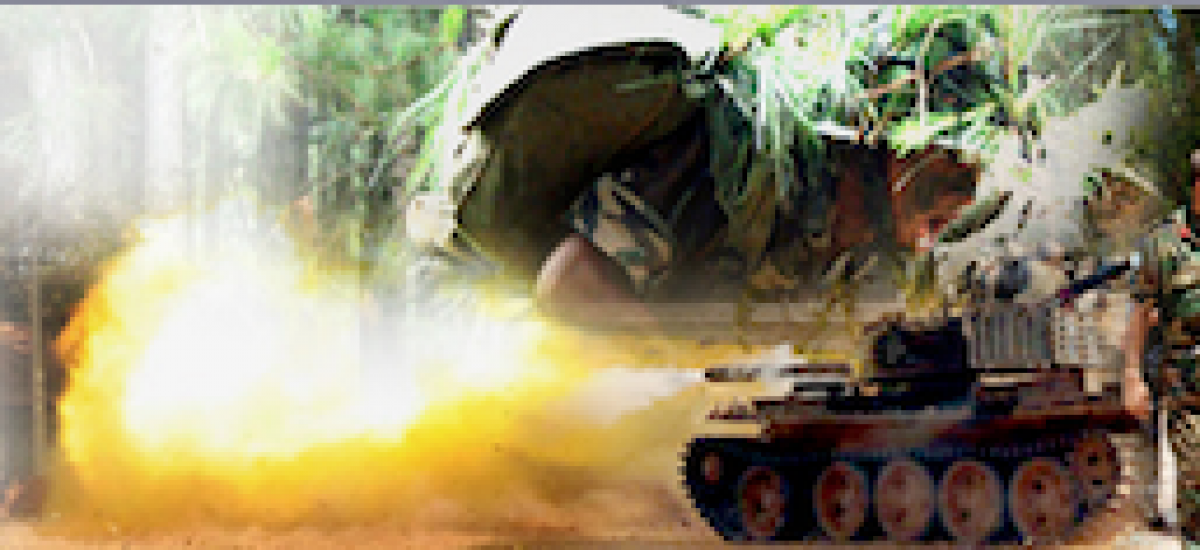

How Sri Lanka Defeated Terrorism, Defence Seminar: Observations from a participant

From the 31st of April to the 2nd of May I attended the Defense Seminar organized by the Sri Lankan Army. I wish to draw on what I saw as some of the positive and negative points of the conference. I will also comment on some of the many ‘highlights’ that occurred during the conference and perhaps give a different narrative of these from the ones I have read so far. What can be said from the outset is not the fact that the seminar was not the resounding success that it was portrayed by some parties, nor was it a dismal failure. The seminar was a mixed bag.

While the seminar was framed as the “Sri Lankan Experience” in defeating terrorism, it mainly presented the view of the Army’s experience on defeating terrorism. I sincerely believe that the army played a pivotal role in combating terrorism, and that without the drive, courage, and execution of the strategic plan set by the Army the LTTE could not have been militarily defeated. However, there was a lack of emphasis on work done by the Navy and the Air Force, with only thirty minute presentations allocated for each during the three day conference. Furthermore, there was no representation by the Police; this came as a surprise to many as The Special Task Force of the police played an integral role in the thirty year conflict. There was also little mention of the civilian institutions that played a part in the military drive. With the exception of Prof. Rajiva Wijesinha’s honorable mention of the work done by the Government Agents (GA) in the different phases of the war, and singling out work done by the current GA of Jaffna Ms. Emelda Sukumar, who read out a hastily put together statement. There was in my mind little attempt made by the presenters to talk about the areas where the GoSL and the forces may have failed to deliver. For instance, the states of affairs of the welfare camps were given a far too rosy picture from what was the reality. The inability for some of the presenters to self-critical yet again reduced the authenticity of the claims.

Furthermore, the work done by the ‘man whose name cannot be mentioned’ was never mentioned. This to me was rather sad. While the personal merits of this individual can be questioned by some, his efforts in the war effort should have received at least some mention. The deliberate attempts to keep his name away from the dialogue only led to the watering down of the importance of the conference since he was the commander of the army at the time of the operation.

In regards to some of the positives that came out of the seminar, I was glad to see that the Army and the GoSL being ready discuss at least in part some of the concerns in regards to the manner in which the last stages of the war was conducted. It was an opportunity, I thought that was missed by some of the countries, organizations and individuals who purposefully boycotted the event to ask some probing questions (if they chose to) and engage some of the individuals who conducted the war. Furthermore, and most importantly the seminar did lead to a discussion on the issues of human rights, the Internally Displaced People (IDP), rehabilitation and reconciliation where the participants had a chance to question and interact with some of the presenters. There was invaluable information that was presented in terms of the cost of the final stages of the war, maneuvers that were employed by the army to win battles, and the larger strategy employed by the army to defeat the enemy. One of the key themes that were highlighted was the army’s ability to continually evolve as a fighting unit to stay ahead of the game.
I now wish to draw attention two major highlights of the conference that caught attention of the local media. Firstly the speech that was presented by Dr. David Kilcullen, that drew the attention to the possible human rights violations that may have happened during the war. I as a participant was extremely thankful to him for bringing what seems to be a difficult topic in to the discussion. What was surprising was how well both the representatives GoSL and the Army reacted to it. The GoSL and the army personnel that were present did not try to either dismiss the allegations nor did they react negatively to it. The comments in regards to human rights did lead to Prof. Rohan Gunarathne stating that in his estimates nearly 1,400 civilians were killed during the last stages of the war due to indirect fire, based on field research on the aftermath of the battle. I was rather disappointed to see the commentary on Groundviews.org alleging that Dr. Killcullen suggested that President Mahinda Rajapakse was responsible for War Crimes. In my opinion highlighting a ‘comment’ made by a source from the seminar and publishing it hints at breaking away from one of the most basic tenants of journalism, which is to check ones sources for validity. Especially since the accusation carries much weight in today’s context. Quite on the contrary to the above narrative, he stated that Sri Lanka has a great case to make for the end justifying the means because the army was dealing with what has been recognized as an especially ruthless terrorist organization. He went on to state that Sri Lanka does not have anything to fear from having an open discussion on the issue. Dr. Killcullen strongly recommend that the GoSL take meaningful reconciliation and address some of underlying issues that may have contributed to the ethnic conflict, he stated that victory over the enemy by itself may not lead to a lasting peace.

Secondly, I want to briefly discuss the comments that were made by the U.S Defense Attaché to Sri Lanka, LTC Lawrence Smith. While the script that Groundviews has posted on his commentary is accurate (http://groundviews.org/2011/06/01/us-defence-attaches-observations-on-the-end-of-war-in-sri-lanka/), the context in which he interjected is absent, which may have led to the misunderstanding of intentions. My understanding of his comment was simply that in a rapidly changing environment (as in the case of the final stages of the war), individuals do not have the luxury of validating to a high degree all information received and spot decisions have to be made. The implication was that the GoSL had to make decisions with regards to authenticity/genuineness of calls to surrender from third parties that lacked credibility at the time.
In summary, while many things could have done better I was glad that the seminar was organized by the GoSL. It provided an opportunity to discuss difficult issues in regards to the conduct of war even though it was done in rather subdued tones. I personally feel, despite claims to the contrary, that there is some space for concerned citizens, NGO’s, civil society organizations and foreign governments to engage the GoSL in a constructive manner.

Print This Post Print This Post

8,057 views

35 Comments

  1. Congratulations to the author on a model of balance, objectivity and fair, constructive criticism, which should become the norm, not least on GV and most especially its comments thread.

  2. Thank you.

  3. “I personally feel, despite claims to the contrary, that there is some space for
    concerned citizens, NGO’s, civil society organizations and foreign governments
    to engage the GoSL in a constructive manner.”

    See this: http://www.lankaindependent.com/2011/05/we-can-fix-cases-we-can-free-people-rajapakse/

    • Dear Agnos,

      I still fail to see why you are so anti-Rajapaksha. After all, The Leader had wanted them to win the 2005 elections, so they can’t be so bad can they?

      • Wijayapala, 

        Your nonsense doesn’t impress me. Indeed, your trivializing of the evil that the Rajapaksa regime represents–and the suffering that it visits upon innocent people–raises questions about where your sympathies lie. Bye.

  4. “I sincerely believe that the army played a pivotal role in combating terrorism”

    How can the army play a pivotal role in combating something they’ve seem to done just as much as the LTTE if not moreso?

    • Thambi, I was not aware that the SLA had not only recruited child soldiers and employed suicide bombing, but to a greater degree than the LTTE. Could you please share your discovery.

  5. Bombs dropping from planes are much more terrorizing than some scrawny guy blowing themselves up in public.

    Child soldiers don’t really have anything to do with terrorism does it? Violation of human rights yes, terrorism no.

    • And lets not forget Black July which started this war or the various massacres in villages by army soldiers as ‘revenge’.

      • Dear Thambi

        Bombs dropping from planes are much more terrorizing than some scrawny guy blowing themselves up in public.

        How so?

        Child soldiers don’t really have anything to do with terrorism does it?

        Why not?

        And lets not forget Black July which started this war

        How was the SLA involved in Black July?

      • Dear Agnos

        your trivializing of the evil that the Rajapaksa regime represents

        Then why did the LTTE want them to come to power?

      • [quote]How so?[/quote]

        Go live in an area that is being bombarded constantly and compare that to living in Colombo with the random bomb going off every few months or so.

        “Child soldiers don’t really have anything to do with terrorism does it?”

        [cit]Why not?[/cit]

        Nobody in the South was terrorized by the LTTE having child soldiers. We didn’t really care.

        “And lets not forget Black July which started this war”

        [cit]How was the SLA involved in Black July?[/cit]

        It’s the biggest ‘revenge’ attack by the SLA army. The dozen or so soldiers are killed by the LTTE and a rampage ensures.

      • Wijayapala,

        “Then why did the LTTE want them to come to power?”

        You can ask VP’s ghost about it. I know for a fact that even many pro-LTTE people in the Diaspora did not want to start any war after the ceasefire or disrupt a bit of normality that was returning in people’s lives.

        But your harping on the LTTE leaderhip’s madness and idiocy in preventing Tamil voters from voting (no sane person would have approved that) in the then Presidential elections, is a bit funny. We could keep going back in time and say “only if so-and-so hadn’t done such-and such, all the conflict and deaths would not have happened.” For instance, someone could ask, why did the State indulge in such terrorism that gave rise to the LTTE in the first place? or, why did India promote militants instead of strengthening unarmed leaders? It is a pointless exercise at this stage.

        But it has been 2 years since the war. Sinhalese in large numbers had voted for MR in two presidential elections, overwhelmingly in the second. The LTTE did not make Rajapaksa hit the solar plexus of Uvindu Kurukulasuriya, or say “Oluwatada wedune” as alleged by Lasantha W.’s wife Sonali.

        It is time for all of you to stop coming up with subterfuges, and face this evil squarely and clean up your act. No political solution or reconciliation is possible when such evil is ensconced at the top.

  6. Sri Lanka Defense Symposium

    Press Statement
    Mark C. Toner
    Deputy Spokesperson, Office of the Spokesman
    Washington, DC
    June 3, 2011

    Remarks earlier this week by the U.S. Embassy’s Defense Attaché at a conference in Colombo reflected his personal opinions. They do not reflect the policy of the United States Government. The United States declined invitations to participate in this conference, and our Defense Attaché attended to observe the proceedings as part of his normal duties.

    The United States remains deeply concerned by the findings of the Secretary-General’s Panel of Experts on Sri Lanka. We are committed to ensuring that there is a credible accounting of, and accountability for, violations of international human rights law and international humanitarian law in Sri Lanka. We believe that the Sri Lankan Government must act quickly and credibly to address the violations alleged in the report and to adopt the measures necessary to achieve national reconciliation and build a united, democratic, and peaceful Sri Lanka.

    From http://www.state.gov/r/pa/prs/ps/2011/06/164992.htm

    • Very Interesting.

      The US Defense Attaché first marginalizes KP and the cohorts as LTTE’s mouth pieces with no authority. And now the US Spokes person (legitimate “mouth piece”?) dismisses that the Defense attaché himself is not even a legitimate mouth piece in making that statement! Funny!!

  7. Correct me if i’m wrong… but aren’t the quoted held-dates of the said defense seminar incorrect? I find this a great short-coming of the article!!

  8. I repeat what I have said before by paraphrasing it:
    What “the white man” says at a “Head Hunters’ Village Gathering” is not the same as what he would say when he returns home.
    I have heard both perspectives, because “the white man” just does not notice my presence in the way he notices “the head hunters”.

    Dr. Jayatilleke just happens to be the only valuable GoSL agent in the International Arena. There was a time when his obfuscation was of more value to Sri Lanka.

    What the guys in SL have to understand is that it is the Sri Lankan Diaspora you have to convince. It is not this GoSL we will engage. After the Rajapakses get what they deserve, the whole Civil Service in Sri Lanka will require a thorough scrubbing. Inside and out!

    • Dear Ravana,
      “What the guys in SL have to understand is that it is the Sri Lankan Diaspora you have to convince.”

      You’ve got to be kidding, right? If by SL diaspora, you mean the non-LTTE supporting segment (mainly Sinhalese), they’re not going to pursue the govt for war crimes. On the whole, they’re delighted with the outcome, but less delighted with the post-war political machinations – I’m talking in very broad terms, obviously.

      If however you mean the pro-LTTE diaspora (mainly Tamil), then you really have to be kidding. They’re never going to be happy until MR & Co are in the dock in the Hague. They also fervently supported the LTTE’s final war – although never with their manpower, only with their chequebooks (odd, no?).

      You expect this or any future govt to pander to their whims? Not a chance.

      p.s. when you say “It is not this GoSL we will engage.”, who is the ‘we’ and on whose behalf do you claim to speak?

      As for the Great White Man condescendingly looking down on the savage brown people, again, you’ve got to be kidding. The ‘white man’ long ago lost any claim to moral or any other superiority, with regard to combatting insurgencies.

      http://thecarthaginiansolution.wordpress.com/2011/02/13/sri-lanka-can-never-beat-the-west/

    • Is Lt Col Smith aware that you’re claiming to share his home? :D

  9. Another point:

    Why not mention the ‘man whose name cannot be mentioned’ in the article?

    Besides, when it is self evident, I guess it is unnecessary even to mention his name let alone what he contributed. History will see what occurred as his achievement in the same way the the “Pacific War” belonged to McArthur of the US.

    So, please don’t take pity on him. He hardly needs it! Instead why not read what he has presented in parallel in the media and compare to presentation by Sri Lanka Army. I have to say that barring the grammar (which Dr. Jayatilleke will no doubt point out) his presentation was much more informative and insightful than the Groundviews presentation of the Army’s summary.

    • Ravana,

      The ‘man whose name cannot be mentioned’, was something I picked up from Harry Potter:), we all know who he is, what he has done but special effort goes in to keeping his name out.

      I take your point on my grammar, since its my weak point. Grammar coupled with my dyslexia ( highlighted by the date mix up) comes make me come off as dumber than I really am.

      • I’m sorry. I was not criticising your grammar. The article/s attributed to General Sarath Fonseka in Lanka-e-news was full of grammatical mistakes. It is also published in a 4 part serial in Sri Lanka Guardian site. I did not check the grammar in it.

  10. Having watched the vids on youtube, a question for Shakya – did anyone mention Gen Fonseka’s name of contribution to the War?

    The ‘reality denial’ aspects of this govt reminds me of Zaphod Beeblebrox’s’ Peril Sensitive Sunglasses which were designed to help people develop a relaxed attitude to danger.

    At the first hint of trouble, they turned totally black and thus prevent you from seeing anything that might alarm you. :) :)

    • Mango,

      There was no mention of SF name during any of the presentations that I was sitting at. Nor was his picture shown in any of the PP presentations.

  11. Dear Agnos,

    I know for a fact that even many pro-LTTE people in the Diaspora did not want to start any war after the ceasefire or disrupt a bit of normality that was returning in people’s lives.

    Then why didn’t these friends of yours firmly declare at that time that if the LTTE returned to war, it would not receive tuppence from the Diaspora???

    It is more likely that this sentiment you are expressing reflects their hindsight views AFTER the LTTE was destroyed. If it was the LTTE that had won the war, it would be safe to conclude that the lot of you would have jumped for joy even if 100,000 Tamil civilians had been killed.

    It is time for all of you to stop coming up with subterfuges, and face this evil squarely and clean up your act.

    But don’t you see how you are really begging the question why you yourself could not face the evil of the LTTE squarely and clean up YOUR own act??? Don’t you understand how your own lack of credibility in this regard (compared to individuals and groups like DBS Jeyaraj and the UTHR, who criticised both LTTE and govt alike) does not really convey any moral standing for you to talk about “good” and “evil?”

  12. Wijayapala, 

    We have gone through this a few times before, but you keep reverting to your assumptions about the Diaspora; that someone like you educated in the US and living there, has the same paranoic mentality about the Diaspora as those Sinhalese nationalists in Sri Lanka, is revealing. 

    “Then why didn’t these friends of yours firmly declare at that time that if the LTTE returned to war, it would not receive tuppence from the Diaspora???”

    That is exactly what they did. You assume that Diaspora is all about the people who show up at protests with LTTE flags. Have you ever looked at the ratio of such people relative to Diaspora population?
    And people who live private lives with active careers and write on blogs when they feel impelled to do so, should not be compared to journalists and full-time NGO activists for whom, given their high visibility, their public standing matters a lot.

    Listen, you can talk all you want about the Diaspora, but most of them have clear consciences and they don’t need character certificates from you as to their moral standing. And they are beyond the reach of the thugs who hold power in SL.  Now go and tell the widows of Lasantha W., Eknaligoda,  Prof. Raveendranath, N. Raviraj and thousands of others that you have to shield the thugs who are responsible for their suffering  because you think some phantom in the Diaspora has no moral standing to say these thugs are pure evil.

    • Agnos,

      You assume that Diaspora is all about the people who show up at protests with LTTE flags. Have you ever looked at the ratio of such people relative to Diaspora population?

      I wasn’t talking about the entire Tamil diaspora. You had mentioned “many pro-LTTE people in the Diaspora” and those were the individuals I was referring to. The flag-wavers might represent only a small part of the diaspora, but unfortunately they are the most visible part and thus are undermining the credibility of your anti-MR cause.

      If you really knew me, as you claim that you do, then you would know that I had worked with quite a number of diaspora Tamils in Sri Lanka during the CFA period, and they knew enough of what was going on to spare me the self-righteous attitude and finger-pointing.

      That is exactly what they did.

      What is your evidence that your pro-LTTE friends told Prabakaran to cool down? Any public statements that you can direct us to?

      you can talk all you want about the Diaspora, but most of them have clear consciences and they don’t need character certificates from you as to their moral standing.

      But that is exactly my point- given your own silence over all the misdeeds committed by the LTTE over the decades, such as the disenfranchisement of Tamils in 2005 that brought MR to power, does anyone need character certificates from you?

      what do you have to say about the SLA interference at Noolaham reported by Ratnajeevan?

      What else is there to say, other than that the SLA was misinformed? What does this have to do with your silence during the LTTE years contrasted with self-righteousness today?

      • Wijayapala,

        “What is your evidence that your pro-LTTE friends told Prabakaran to cool down? Any public statements that you can direct us to?”

        I was referring to the  people in the Mid-Atlantic region, NJ, NY and Canada, who had been pro-LTTE before the ceasefire and who told me they had told the money collectors  (who would knock on their doors or invite them for TRO fundraisers) that they wouldn’t give them anything and that the LTTE would have to transform itself. I can’t point to such people writing about it publicly, but they quietly resisted the LTTE.  In fact, the LTTE was finding that its collection was so poor that they were very elated when the tsunami brought a lot of international recognition to the TRO and consequently financial support.

        Even some people who edited TamilNet from the West told me in 2002/2003/2004  that they didn’t want a war again; they said they wanted to focus on development, and even introduced a section on development.  They assured me that VP wouldn’t start a war again. When I queried how they could be so sure, given that Prabhakaran listened to no one, they said they of course couldn’t speak for him. Although they didn’t think the LTTE would lay down arms immediately, they were very confident there wouldn’t be another war; they themselves didn’t want the LTTE to start a war. They fully understood that the support for the LTTE within the Diaspora was waning, that only a very small number of hardcore people supported restarting a war.

        I personally told Taraki Sivaram  in 2001 when he was in the US at the invitation of Teresita Schaffer, that the LTTE was leading the Tamil people up the garden path, that  if the GoSL wanted to commit mass slaughter as they did with the JVP, the LTTE would meet the same fate, and therefore, they should transform themselves once and for all; at a minimum, stop suicide bombings targeting civilians and save the lives of all those conscripted child soldiers by releasing them. I was pretty harsh with him and insisted that when he got the chance, he should tell that to senior LTTE people, including people like Balakumar. There are several ways in which one can work usefully within his/her circle of influence to try to transform things.  Public criticism may not be the right way in all circumstances. Your assumption that I was silent about the disenfranchisement of Tamil voters by the LTTE at the presidential elections in 2005 is ridiculous. I won’t post anything more for a few weeks.

  13. Wijayapala,

    One more thing–you keep saying you have high respect for UTHR-J. I haven’t seen anything from Rajan Hoole, but his brother, Ratnajeevan, whom I know and who shares many of the same views as the UTHR/Rajan, is not against the UN panel report, going by his observations in the Daily Mirror. Also, what do you have to say about the SLA interference at Noolaham reported by Ratnajeevan?

  14. This seems like a fairly balanced article. I can’t see what all the fuss is about.

  15. Nirmala Rajasingam (Rajani Thiranagama’s sister) wrote a brilliant piece about the poisonous effects of the pro-LTTE segment of the Tamil diaspora, in May ’09 when the situation was at its worst.

    http://experts.foreignpolicy.com/posts/2009/05/15/diaspora_of_doom

    She wasn’t (as far as I know) threatened or harmed by LTTE elements in the UK for being so critical of their cause and stance. So there is space to be critical of the pro-LTTE diaspora and look for alternative solutions. But, hardliners in the Diaspora still dictate the public facing attitudes and symbols – all of which are guaranteed to inflame and/or give cover to the GoSL’s own hardliners stance.

    Look for instance at the recent anti SL Cricket team demos. What exactly did that achieve, except for waving LTTE flags, making themselves feel good about screaming ‘genocide’ and ‘murderers’ at the cricket team?

    I’ve yet to read anyone from the Tamil diaspora (whether pro or anti-LTTE) clearly explain how threatening to take GoSL to war crimes trials will make them more amenable to their demands. I think GoSL should also grow up a little bit and not have country’s agenda dictated to by the TGTE etc. At some point the knee-jerk ‘it’s all the LTTE’s fault’ will lose its effect.

    MR’s greatest worry must be that one day the pro-LTTE diaspora demonstrators will ditch the Tiger flags and start waving the Sri Lanka flag. Now that would be difficult to counter :)

Leave a Reply

This is a moderated forum. Comments are the sole responsibility of the person posting them. Please do not post comments that are off topic, defamatory, abusive, threatening or an invasion of privacy. Comments are automatically scanned for spam and obscenity.

Comments are only approved if they are in line with the site guidelines. Those that do not will be edited or deleted without prior intimation. Comment approval may take up to 24 hours.

Thanks in advance for your civil and constructive engagement.


+ one = 6

About Groundviews

Located at the Centre for Policy Alternatives in Colombo, Sri Lanka, Groundviews is a citizen journalism website that uses a range of genres and media to highlight critical perspectives on governance, reconciliation, human rights, the arts and literature, democracy and other issues. The site has won two international awards, including the prestigious Manthan Award South Asia in 2009. The grand jury's evaluation of the site noted, "What no media dares to report, Groundviews publicly exposes. It's a new age media for a new Sri Lanka... Free media at it's very best!"

cezarneaga.eu