Archive for May, 2011

Floating Spaces: Theatre and censorship in Sri Lanka

Screen shot 2011-05-31 at 12.52.33 PM

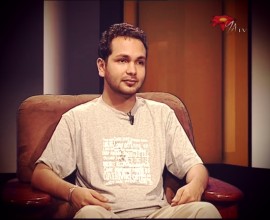
Some of the best conversations featured on this site have been with those involved in the arts in Sri Lanka. Noted theatre personalities featured on Groundviews to date include Tracy Holsinger, Mohamed Adamaly and the iconic Iranganie Serasinghe. Jake Oorloff joins this august list, and as Co-Creative Director of Floating Space Theatre Company, his work has been reviewed and featured on Groundviews before. Gaza Monologues, produced for the first time in late 2010, was reviewed here and an interview with Jake and Ruhanie Perera, the co-founder of the Company, was featured here. A review of ‘My Other History’, their most recent production on post-war reconciliation in Sri Lanka appears here. We ask Jake why a few years ago he started a new theatre company, when there were already quite a few established ones around, which then led into a discussion around Jake’s approach to theatre and acting. Jake explains what theatre is for him and what in general theatre is,…

Continue reading »

Is the war crimes video confirmed by UN as authentic “unrepresentative and irrelevant”?

5F4A18ADD57A0F339B09213AC557831A

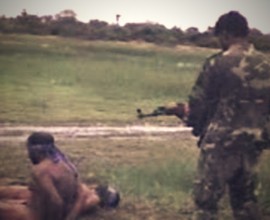
The Report of the Special Rapporteur on extrajudicial summary or arbitrary executions, Christof Heyns, presented at the 17th Session of the United Nations Human Rights Council sessions in Geneva today found, after digital forensic investigations, new footage from the final days of Sri Lanka’s civil war as authentic and proving that war crimes took place there. As noted in this AFP report, “What is reflected in the extended video are crimes of the highest order — definitive war crimes,” the U.N. investigator, South African law professor Christof Heyns, said in a report released Monday to the global body’s Human Rights Council. Heyns said he reviewed the footage showing the apparent execution of unarmed men and women with technical and forensic experts. “The overall conclusion reached by the experts is that the video is authentic and the events reflected in the video footage occurred as depicted,” he told the council. Sri Lanka’s government has maintained that the video is not real.”…

Continue reading »

Finding the Middle Ground

Just over a week ago, a couple of my colleagues and I appeared on a prominent Canadian talk show discussing our attempts, as both individuals and organizing members of the Young Canadians’ Peace Dialogue on Sri Lanka hosted by the Mosaic Institute, to find a middle ground with respect to the relationship of the Canadian Diaspora to the internal politics in Sri Lanka. Joining us on the show was Craig Scott, a renowned professor on international humanitarian law and R. Cheran, a high-profile Tamil Canadian academic and journalist. Amongst both our friends and the wider Canadian community, the panel discussion has been acknowledged as an example of an exercise in ‘truth telling’ rather than ‘finger pointing.’  During the half-hour discussion, key points in relation to understanding the mentality of the Diaspora were raised such the role of ethnic affiliation in adopted sides and the emotional intensity felt in the Diaspora during the last stages in the war. Perhaps more importantly, participants also…

Continue reading »

Trafalgar Tigers

BRITAIN-SRILANKA-Protest-Demo1

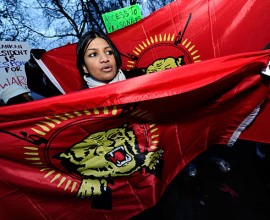
A demonstrator shouts anti-Sri Lankan government slogans during a protest outside a hotel, where Sri Lanka’s President Mahinda Rajapaksa is staying in central London on Dec. 2, 2010. Photo credit Dylan Martinez/Reuters It is truly a pity that the Sri Lankan media did not feature the photographs of the demonstrations by sections of the Tamil Diaspora staged over the week of May 12-19 in variety of western capitals, as protest and in mourning for the final week of the war which was also the last week of Mr Prabhakaran’s destructive life. I saw the demonstration in Paris and the subsequent gathering in the Trocadero which was at a vantage point in line with the Eiffel Tower. A few phone calls that came in told me that the demonstrations in New York, London, Geneva and Toronto were the same, and that Paris was no anomaly. The demonstrations were revelatory, and only those who do not wish to see, for whatever reason,…

Continue reading »

India “Punishing Sri Lanka”: Myth or Reality?

7029_NpAdvHover

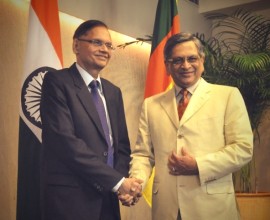
Prof. Rohan Gunaratne- international terrorism expert- addressing the business community last week convincingly and openly cautioned that “India might ‘punish’ Sri Lanka”, if Sri Lanka leans elsewhere to India’s detriment. This is a very serious statement, especially if Indians do not intend doing so. To prove his point, he quoted a meeting with the first Research and Analysis Wing Chief who had told Gunaratne their concerns over President JR Jayewardene stepping away from the Non Alignment Movement, Jayewardene’s intentions to economically favor the USA by opening the Trincomalee Port and the intention to handover China Bay oil tanks to the USA, Voice of America eavesdropping on India etc. Gunaratne would not have had any personal antipathy or bias towards India when he emphatically quoted the past to predict future. Indo- Lanka Joint Statement (JS) The attempt here is to observe whether such punishment could be inferred from the latest hinting basing Indian approaches stated in the JS between India and…

Continue reading »

The Indo- Sri Lanka Joint Communique: Delineating the Parametres of Action in Response to the Panel Report

7029_NpAdvHover

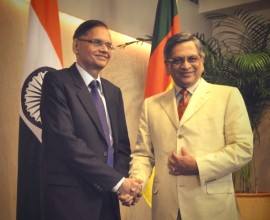
[Editors' note: An edited version of this article appeared in the Daily Mirror on the 26th of May 2011.] 4. Both sides agreed that the end of armed conflict in Sri Lanka created a historic opportunity to address all outstanding issues in a spirit of understanding and mutual accommodation imbued with political vision to work towards genuine national reconciliation. In this context, the External Affairs Minister of Sri Lanka affirmed his Government’s commitment to ensuring expeditious and concrete progress in the ongoing dialogue between the Government of Sri Lanka and representatives of Tamil parties. A devolution package, building upon the 13th Amendment, would contribute towards creating the necessary conditions for such reconciliation. 5. In response, The External Affairs Minister of India urged the expeditious implementation of measures by the Government of Sri Lanka, to ensure resettlement and genuine reconciliation, including early return of Internally Displaced Persons (IDPs) to their respective homes, early withdrawal of emergency regulations, investigations into allegations of…

Continue reading »

A robust debate on No Fire Zones (NFZs) and International Humanitarian Law: Artful dodging of war crimes in Sri Lanka?

s16_18765259

Original image courtesy PEDRO UGARTE/AFP/Getty Images A central challenge of curating content on Groundviews is that some of the most interesting discussions which occur on comment threads get obscured over time, and are less visible than the primary material published here. A case in point is the recent thrust and parry of wit over the establishment of the No Fire Zones towards the end of war in Sri Lanka. The debate was between two leading voices on this site and the Sri Lankan new media landscape, Aachcharya and David Blacker, in response to a review of The Cage, the explosive new book on the end of war by former UN spokesperson Gordon Weiss. What follows are key excerpts from this comment thread. To read the exchange in full, click here and scroll down to see the nested comments. In all of the following excerpts, points in bold are by us and not in the original. The debate began with a…

Continue reading »

Two years after war’s end in Sri Lanka: What can the Tamil and Sinhala diaspora do?

Screen shot 2011-05-26 at 11.30.55 AM

Our review of The Cage by Gordon Weiss elicited an interesting question. Under the monicker Burning_Issue, the comment asked for advice on how best to engage with the Rajapaksa regime, and what the (Tamil) diaspora should do two years after the war ended. The comment is worth reading in full, and the most pertinent section is as follows, I am an expat Sri Lankan Tamil living in the West; I know the majority of the Tamils never wanted a separate state, but prefer that the Tamils should be allowed to live with dignity and security. They need to be able exercise their right to Tamil language on par with the Sinhala. Obviously; given what you have written; the MR regime would not address the Tamil concerns. Against this backdrop, what would you suggest that the Tamil Diaspora should do? There is so much they can do in terms of monetary and technical assistances, but perceive the MR regime as insincere…

Continue reading »

Sri Lanka May Yet Be Lost, or Saved

sl_commandos

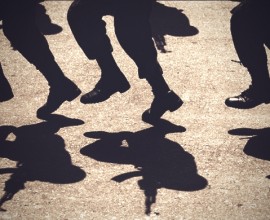
Original photo Ranga Sirilal | Reuters Two years after the comprehensive defeat of the LTTE, the end of Sri Lanka’s civil war is still playing itself out.  Take the events of the past month for example:  the public release of a UN Panel Report supported accusations of war crimes against both main parties to the conflict;  government functionaries decried international conspiracies and local traitors;  a government minister claimed to have trained suicide cadres in the Western Province; and in the Eastern Province, a pair of tit-for-tat political killings were a reminder that full disarmament of paramilitaries and personal armies has not taken place.  With the warfare over, the horrendous loss of human life no longer continues.  However, the post-war situation in the country remains far from ideal, and its future does not seem entirely secure. Thinking about the current state of the nation, my thoughts have returned to a moment in Sri Lanka’s political history when an alternative end to…

Continue reading »

The continuing disinformation campaigns in Sri Lanka: Is mainstream media complicit?

We Will Defend President Obama - Small

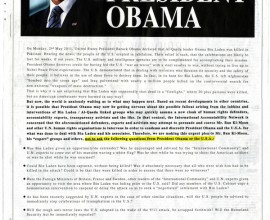
For the second time in a fortnight, subscribers to the Daily Mirror newspaper have been entreated to an interesting disinformation campaign that appears to be conducted with those embedded within, and possibly with the full support of the Sri Lankan Army and its network of patriots. The full page ad above was published on the Daily Mirror on 23rd May. A high resolution scan can be downloaded here. At the bottom, the advertisement is attributed to the ‘Free Mass Media Movement’. No such movement exists, or has existed. With the clear intention to obfuscate rather than enlighten, the name is a spin off from the Free Media Movement, which for a variety of reasons, is well known to government and also amongst media freedom activists. To be fair, the concerns expressed therein about the handling of Osama Bin Laden’s murder raise very serious concerns over the ability of the United States to practice the very policies and practices it preaches…

Continue reading »

Going beyond mainstream media: The best Twitter feeds on and from Sri Lanka

Screen shot 2011-05-25 at 9.51.35 AM

Just over a year ago, in April 2010, Groundviews launched two curated Twitter lists on Sri Lanka to help those in and outside the country access news, information and critical conversations that went far beyond mainstream media’s economic and partisan shackles. One list featured some of the most compelling bloggers in Sri Lanka. The other, a list of news sources and Twitter accounts of journalists. Because they are oriented towards an international audience, the lists largely capture content published in English, though feeds like @vikalpavoices publish mostly in Sinhala. Coupled with our own feed, the two lists are comprehensive and by the very nature of the medium, constantly updated windows into issues, processes and events mainstream media could not, or would not cover. And even when they did, the Twitter updates on these feeds added new perspectives and often, information vital to understand context. On occasion, they have also served to hold mainstream media – both domestic and international –…

Continue reading »

A review of ‘The Cage: The Fight for Sri Lankan & The Last Days of the Tamil Tigers’

Screen shot 2011-05-24 at 3.55.26 PM

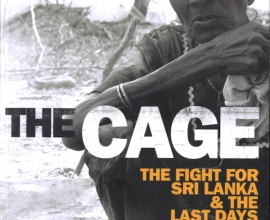
I was elated to take delivery of my copy of The Cage by Gordon Weiss yesterday. Having pre-ordered it off Amazon UK, I fully expected it to be held up by Customs officials in Sri Lanka, given the incendiary issues the book is anchored to and its author, an erstwhile employee of the United Nations (UN) in Sri Lanka. As a friend quipped, they probably thought it had something to do with the Dehiwela Zoo. This may be true for now, but it is highly unlikely, in a country that has repeatedly even blocked issues of The Economist with articles perceived to be against the incumbent government, that this tome will be freely sold in bookstores. The publication and release of The Cage comes soon after the hugely controversial and deeply distressing report by the UN Secretary General’s Panel of Experts, which found credible allegations of war crimes and crimes against humanity by both the LTTE and government armed forces…

Continue reading »

Elephant Walk revisited: Mixing Tea, Jumbos and Monsoons

Movie Poster - Elephant Walk

[Editors note: For an in-depth interview on Sri Lanka's human-elephant conflict, see Humans vs. elephants: Sri Lanka’s tragic on-going conflict] If those hardy Englishmen and Scotsmen who ran large tea plantations in Ceylon were far removed from the local people and realities, western movie makers were much more so. They could just as well have come from another planet to catch glimpses of an exotic island. But feature film makers everywhere enjoy the artistic license to create whole new worlds, and we willingly suspend our disbelief when watching their creations. Elephant Walk (103 mins, colour), released by Paramount Pictures in April 1954, may not be the most artistic or technically perfect movie from that era. Yet, more than half a century after it was shot on location in Ceylon (now Sri Lanka), the film can still hold an audience captivated with a sense of drama and intrigue. Elephant Walk was directed by William Dieterle, and based on the 1948 novel with…

Continue reading »
  • 23 May, 2011
  • 4 Comments
  • Colombo,
    Development,
    Post-War

Marketing a troubled land: War, peace and tourism in Sri Lanka

Screen shot 2011-05-23 at 11.05.19 AM

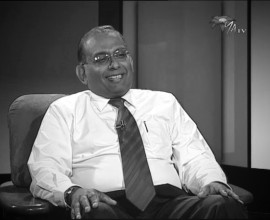
Srilal Miththapala is a Project Director/Consultant at the Ceylon Chamber of Commerce, Sri Lanka. With decades of experience in the hospitality industry, he is also one of the country’s most experienced voices on tourism development. Having experience the fallout of the war, the JVP insurrection and suicide bombings on the tourism industry, Srilal in this programme talks about the potential for tourism to grow post-war, and how the country can sustain this growth over the longer-term. An electrical engineer by training, Srilal took to the hospitality industry by accident, and stuck on. He begins by noting how interesting the sector is, dealing with people everyday and the multitude of issues related to travel. Asked as to what the most difficult time for tourism, Srilal notes that it was during the JVP uprising in the late 80s. He also speaks about how tourism promotion changed – from an exclusive focus on beaches to campaigns that highlighted the diversity of Sri Lanka….

Continue reading »

Removing the Emperor’s Clothes

srilanka_university_students

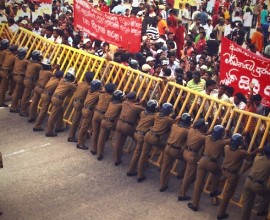
Original image from Lanka Polity Universities, academics and university students have been hogging the limelight in the last several weeks in unprecedented ways. The Rajapakse regime’s systematic destruction of the higher education system in this country has run into a few impediments.  University academics from around the country have emerged from a partly self-induced exile and have finally started making themselves heard. On the other hand, the preposterous scheme of sending new entrants to the university for ‘leadership training’ to military camps has also provoked a series of protests. Whatever the outcome of the academics trade union action or the protests against the ‘leadership training’, higher education in our country will never be the same again.  We will be able to assess in a few months, if this will lead to a victory for higher education in Sri Lanka or the further strengthening of the totalitarian Rajapakse project. The stakes are huge. And the regime knows this, which is why…

Continue reading »
Page 1 of 41234

About Groundviews

Located at the Centre for Policy Alternatives in Colombo, Sri Lanka, Groundviews is a citizen journalism website that uses a range of genres and media to highlight critical perspectives on governance, reconciliation, human rights, the arts and literature, democracy and other issues. The site has won two international awards, including the prestigious Manthan Award South Asia in 2009. The grand jury's evaluation of the site noted, "What no media dares to report, Groundviews publicly exposes. It's a new age media for a new Sri Lanka... Free media at it's very best!"

cezarneaga.eu