
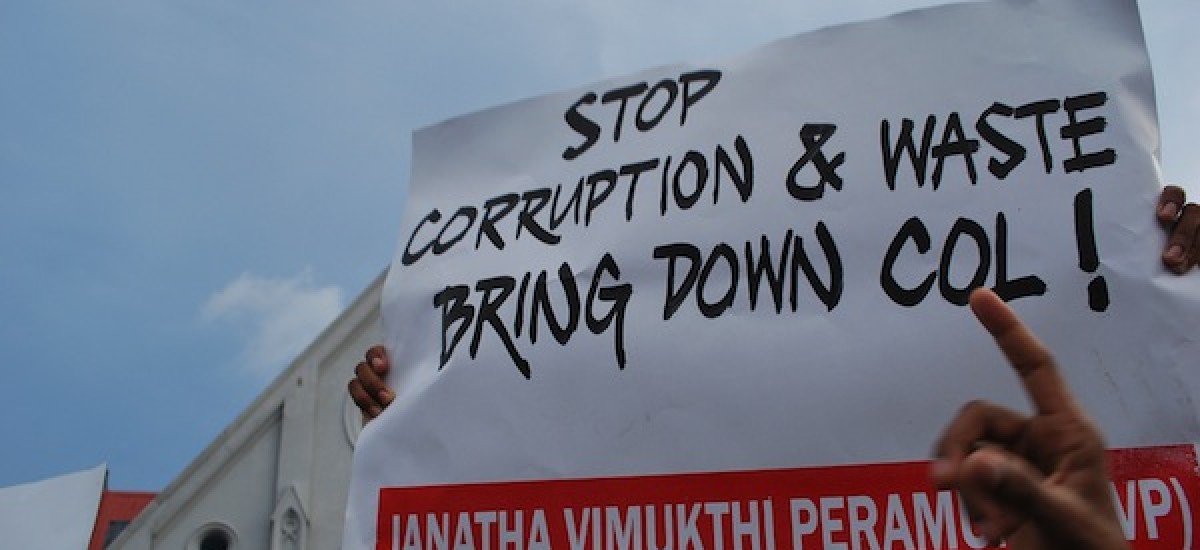


Photo courtesy Vikalpa
This article will briefly discuss alternative explanations to the two youth insurrections and the separatist movements that occurred in post-independence Sri Lanka.[1] While the most recent conflict between the Liberation Tigers of Tamil Eelam (LTTE) is more widely known, there have been two additional, and equally destructive insurgencies in Sri Lanka that are largely ignored by policy makers as well as academics today. The first Janatha Vimukthi Peramuna (JVP) (Marxist) insurrection in 1971 was followed by a second bloodier insurrection from 1987-1989. All three insurrections carved deep social, ethnic and political divisions within Sri Lanka. The conflict between the LTTE and the state led to the death of nearly 80,000- 100,000 people and the victimization of many more. The obscure JVP insurrection in the late 1980s led to the death of nearly 45,000 to 65,000 youth in the country (Gunesekara 1998:10). Both groups engaged terrorism when confronting the state[2].
The JVP was led by ‘Sinhalese educated youth’ from the south of the island who felt that their aspirations were not met by the status quo, and the only way to break from their shackles was to overthrow the state. The movement was spearheaded by a self-proclaimed Marxist leader, Rohana Wijeweera. The LTTE was primarily led by V. Prabhakaran and his followers constituted mainly young Tamils[3] in the North and East of the island who felt that they were openly discriminated by the GoSL and supported by sympathetic diaspora elements (Bandarage 2009:21).
Historically, the JVP-led insurrections have been analyzed primarily through an economic lens, while the LTTE insurrection has been viewed largely through an ethnic lens. Since the end of the war in May 2009, many scholars, academics, policy makers and the public have argued that the conflict between the GoSL and the LTTE has, in the past, been ethno-politicized. In the same vein, it could be argued that the JVP insurrections have been econo-politicized[4]. The JVP insurrections and the conflict with the LTTE have been examined using two very different levels of analysis; however, a close reading of the history shows that all three insurrections were youth revolts, agitated against the state, with important underlying economic causality.
There have been numerous studies done on the history, the causes and remedies for each conflict[5] , but there has been no ‘one’ study that has attempted to look at all three insurrections holistically. The book titled ‘Myths, Decadence and Murder’ (2001) by Ranjan Hoole, has been the closest attempt in understanding the human cost behind JVP and LTTE violence against the state. Yet the book serves more as a chronology of the human rights violations from/by all parties concerned, and does not take into account the first JVP insurrection. Similarly, it lacks analysis on what may have been the antecedents for the violent outbreaks. The work of Asoka Bandarage, ‘The Separatist Conflict in Sri Lanka’ (2009) looks at the conflict with the LTTE from a political economy perspective but does not analyze the role that the JVP had during the same time period.
Factors that may have fuelled each insurrection
Economy and violence?
The first JVP and LTTE insurrections both began in the 1970’s. At this time, the Sri Lankan economy was largely plantation-based[6] and was constantly buffeted by the vagaries of the global economy. The key export crops (tea, rubber and coconut) experienced a secular decline in prices. A Box in the World Bank’s World Development Report (1982) cited Sri Lanka as a country that had experienced dramatic terms of trade decline over the previous 25 years. At the same time, a highly competitive polity led to Sri Lanka becoming a populist democracy dedicating up to 10% GDP (Bandarage 2009:53; Kelegama 2006:46) on welfare programs. The period from the 1950’s to the 1970’s also saw an explosion in the Sri Lankan population that was well educated[7]. The combination of the declining terms of trade and the demographic surge resulted in a squeeze on resources. The political imperatives of maintaining consumption and the welfare threshold meant that investment lagged resulting in a low growth/high unemployment economy. The colonial economy coupled with the GoSL’s inward looking policies (nationalization of private industries, closed-economy[8]) meant that many young people in the North and South were eventually left jobless.
Abeyratne argues that the economic exclusion of youth of all ethnicities has shaped conflict in Sri Lanka (2004). The JVP uprisings of 1971 and 1987 to 1989 were largely the result of the economic exclusion of rural Sinhalese youth. Abeyratne contends that both the LTTE and the JVP were largely made up of marginalized, unemployed rural youth and the LTTE is arguably an ethnic manifestation of the frustrations of rural youth. It is also noteworthy that the leadership of both the JVP and LTTE were from minority castes i.e non Goyigama/Vellala. Abeyratne, in a separate piece of work goes on to illustrate the significance of the economic dimension through a comparison between Sri Lanka and Malaysia (2008:19). The two countries began on similar socioeconomic platforms, both being multi-ethnic countries reliant on plantation exports. He argues that while Malaysia managed to avert ethnic conflict through economic expansion, Sri Lanka was not able to do so due to lower growth rates (ibid:20). This implies that Malaysia was able to undertake its social engineering in a positive sum framework while Sri Lanka was compelled to face the challenges of ethnicity based politics in more of a zero sum situation.
Authors such as A.C Alles (1990) and Prins Gunasekara (1998) stated that economic marginalization of the Sinhala educated youth, and issues related to their upward mobility in society led to the two JVP insurrections. While the economic factors have always been high-lighted there has been a lack of a political analysis on the causal factors for the JVP insurrections. Similarly, in analyzing the conflict with the LTTE, commentators have used mainly an ethno-political sphere, high-lighting ethnic marginalization and lack of political power for Tamils as the key factors for conflict. However, prior to the 1990’s a small proportion of the LTTE was made up of both Muslims and Sinhalese members[9]. All possible causes for the conflict with the LTTE may have not been fully explored by academics since an argument solely based on ethnic marginalization does not explain Muslims and Sinhalese joining the LTTE movement at the outset.
Claims of a nexus between poverty and radicalization contend that the majority of recruits came from poor socio-economic backgrounds while their leaders from more affluent ones (Haleem 2005:127). This may be presumptuous in the case of Sri Lanka, though it cannot be discounted.
Democracy and violence?
While there is little debate on the virtues of a democratic state as the best form of governance, there seems to be evidence that there is a link between relatively open democratic systems and the formation of groups that engage in violence. These states tend to guarantee a great deal of rights to the individuals who may engage in terrorist activities (Waldmann 2005:155).
Furthermore, democratic states are unable to use ‘deterrence’ as policies in controlling dissent as freely as non-democratic counterparts due to the inherent-checks and balances that are built in to the democratic system. Deterrence is a policy that is regularly used by non-democratic states to keep a cold peace (Jean Paul Azam 2009). In essence, liberal democratic theory has as its foundation the right of the oppressed to take up arms and challenge the state when all just and peaceful means have failed (Ignatieff 2004:10).
The above explanation could well be true in the case of Sri Lanka; the first JVP insurrection (1971) occurred in a relatively democratic environment. The state reaction led to the capture of many leaders and their subsequent incarceration. The JVP leaders were later freed by the courts and re-grouped to stage a second uprising (1987-1989). Their return to violence can be linked to their proscription after the ethnic disturbances (1983), despite evidence that these riots were not orchestrated by them. The second uprising was crushed with tremendous state force using the police and the army, democratic values being confined to the doldrums. President Jayewardene, in 1987 told the security forces, “kill, kill and kill all the brutes” and then passed legislation to cover the criminality of his command and its executioners (Gunesekara 1998:9). Both JVP insurrections were motivated by the perceived need to overthrow a capitalist government, seen to be the greatest obstacle for the youth of the country from meeting their aspirations.
Studies have shown that the relationship between government coercion and political violence is shaped like an inverted U; at lower levels of violence the dissent tends to grow while at higher levels dissent can be brought down (Moore 1998 cited by Gupta 2003:24). In Sri Lanka, there have been cycles of democratization followed by subsequent pressures on the practices and institutions of democracy. As the conflict intensifies these come under intense pressure. The Sri Lanka Freedom Party (SLFP) majority that was in power during the 1971 insurrection was voted out of office in 1977. The manner in which the government dealt with the JVP, in 1988-90, became an election issue in 1994 (K.M De Silva 1995: 57), and led to the strengthening of democratic principles through the 1990’s till 2005. The intensification of the conflict between the GoSL and the LTTE after the collapse of the ceasefire in 2005 saw a similar marginalization of democratic values, and parliamentary democracy. Primarily the marginalization was highlighted by the reimplementation of emergency regulations[10], the abuse of state power, censorship and human rights abuses. After the crushing of each insurrection by the state, some form of normalcy returned to Sri Lanka, and democratic institutions and mechanisms that were once frozen, started functioning again. Tilly argues that democracy is in fact ebb and flow and not necessarily a forward march (2007:7).
Concluding Comments
It is also noteworthy that the Sri Lankan economy has consistently failed to generate sufficient employment opportunities to meet the aspirations of the youth. Young people from the South and North have experienced the inability to find secure livelihoods. Foreign employment has reduced some of the pressure but the economy needs to achieve 8 per cent inclusive growth to tackle the employment challenge.
Both the LTTE and the JVP constantly reiterated the fact that they have been forced to take up arms in order to gain their political demands. Violence being used to gain freedom was seen as a necessary evil by the JVP movement, their rhetoric constantly reaffirming that violence will be used as a means to an end, “the way to win freedom lost through the power of the gun also lies in the barrel of the gun,” “only their blood can wash and clean their motherland,” “we shall destroy…” (Alles 1990:50). The LTTE similarly stated that they have been forced to resort to violent action, delivering on their promises time and time again.
While there is no doubt that the Tamil minority in Sri Lanka was marginalized by the government, the absolute violence and the set demand for a separate state may be attributed to Prabhakaran, the leader of the LTTE (Swamy 2010:Xi). Similarly the violence the JVP unleashed on the state can also be attributed to the thinking of its leader, Wijeweera. Both the JVP and the LTTE gained much of its direction from its two leaders who were largely unchallenged internally during the periods of conflict. And questions still remain about the persistence of violence in Sri Lanka, and the states’ reaction to it (violence met with violence).
A general analysis on the history of this period shows that there is a common trend of the Sri Lankan states’ inability to deal with a different ‘form’ of politics. The Sri Lankan state has had difficulty in accommodating different views in relation to the system of governing (the degree of power sharing); this inability to accommodate other players in governance has been termed as the ‘arrogance of power’ on the part of the Sri Lankan state by Hoole (2001). The antecedents of violence may lie in a group’s inability to achieve its political ambitions through the form of democracy practised by Sri Lanka. Both Prins Gunesekara (1998) and A.C Alles (1990) stated that the JVP insurrection may have been the result of undemocratic polices that were followed by the Sri Lankan state, and the insurrection was a culminated reaction to state dominance. Similarly, the LTTE could be seen as the result of the state’s inability to tolerate dissenting views, in regards to power-sharing. Thus, the violence towards the state, and its violent reaction to it, can be seen as endemic to the Sri Lankan system.
In regard to the final conflict with the LTTE, the eventual military conclusion came about after several failed attempts at power-sharing between Tamil groups and the central government. The end of the conflict does not guarantee sustainable peace. The war was a violent manifestation of deeper political tensions between the ethnic and class groups that (co)exist in Sri Lanka. The crushing of the JVP movements did not stop the cycle of violence that has gripped Sri Lanka. Thus an (intensive) analysis of the factors that may have contributed to the outbreak of the three violent uprisings is timely and appropriate.
The three major conflicts that have engulfed Sri Lanka post-independence have been articulated and interpreted in a singular dimension. The JVP insurrections have been analyzed through an economic/class lens and the insurrection with the LTTE has been analyzed through an ethnic lens. A more holistic approach should be taken in assessing the factors that lay have led to the formation of each conflict.
The post-war policies the current government is following have mainly been economic in nature. Goodhand argues that the government is stabilizing a ‘victor’s peace’, that includes the implementation of major development projects (2010). The role of a political solution to the ‘ethnic conflict’ has been sidelined[11], since the direct ‘threat’ from the LTTE has been removed.
References:
Abeyratne, S .2004. “Economic Roots of Political Conflict the Case of Sri Lanka”, World Economy Vol 27, Number 8, August
Abeyratne, S .2008. “Economic Development and Political Conflict: A Comparative Study of Sri Lanka and Malaysia” South Asia Economic Journal, Volume 9, Number 2.
Alles, A.C. 1990. The J.V.P 1969-1989. Lake House Investments Ltd. Book Publishers
Bandarage, Asoka. 2009.The Separatist Conflict in Sri Lanka. iUniverse
De Silva, K.M. 1995. ‘Democracy and the Democratic System: The Sri Lankan Case’ In Democracy South Asia. Ed. Devendra Raj Panday, Anand Aditya. Nepal South Asia Center.
Goodhand, Jhonathan. 2010.‘Stabilising a victor’s peace? Humanitarian action and reconstruction in eastern Sri Lanka. Disasters. Overseas Development Institute
Goodin, E. Robert. 2006. What’s wrong with terrorism?. Polity Press.
Gunesekara, Prins. 1998. A Lost Generation, The Untold Story. Chatura Printing Press
Gunaratna, Rohan. 2001. “Special Report on Al-Qaeda”, Janes Intelligence Review. Vol. 13, no.8, August
Haleem, Irm. 2005. ‘Pakistan, Afghanistan and Central Asia- Recruting grounds for terrorism?’. In Democratic Development and Political Terrorism. Ed. William Crotty. Northeastern University Press.
Hoole, Ranjan.2001. Sri Lanka: The Arrogance of Power- Myths, Decadence and Murder. Wasala Publications.
Ignatieff , Michael. 2004. The lesser evil, Political ethics in an age of terror. Edinburg University Press Ltd.
Swamy, Narayan. 2010. The Tiger Vanquished, LTTE’s Story. SAGE Publications India.
Waldman, Peter. 2005. ‘Social- revolutionary terrorism in Latin America and Europe’. In Root causes of terrorism, Myths, reality and ways forward, Ed. Tore Bjorgo. Routledge.
[1] Sri Lanka gained its independence from Britain in 1948.
[2] The term terrorism is understood to be the use of revolutionary violence or the systematic terrorizing of whole populations as a means to achieve a political end, or using fear to make people do something that may be undesirable or against their own interest (Waltzer 1977:197).
[3] The LTTE had some Muslims and Sinhalese members in the East – Interview with Muslim Activist in Batticoloa, Sri Lanka on the 20th of November 2010
[4] Politicized under an economic explanation ( Artistic Licensing)
[5] Sri Lanka: Arrogance of Power- Myths, Decadence and Murder- Ranjan Hoole (2001), The Separatist Conflict in Sri Lanka- Asoka Bandarage (2009), The J.V.P 1969-1989- A.C Alles, Ethnic Conflict & Secessionism in South & Southeast Asia- Ganguly & Macduff ( 2003), The Tiger Vanquished- M R Narayan Swamy (2010), A Lost Generation: The Untold Story- Prins Gunasekara (1998), Sri Lanka: The Years of Terror- C.A Chandraprema, Inside an elusive mind, Prabhakaran -MR Narayan Swamy, (2003)
[6] Up to 70% of Sri Lanka’s GDP till the mid 1970’s was based on agriculture (Kelegama 2006).
[7] Sri Lanka reached the 90% rate of literacy by the mid 1960’s.
[8] Economy with a high degree of protectionism
[9] Interview with Muslim activist in Batticola, Sri Lanka on the 20th of November 2010
[10] Includes incarceration of suspects without due legal course for six months and increased police powers for arrests and searches.
[11] In relation to the conflict with the LTTE, since it was when the LTTE was a formidable force that the GoSL was ready to negotiate on political devolution