Archive for February, 2011

Moving Tamil Dissent Politics Beyond Anti-LTTEism

IMG_2255

To be able to engage in dissent politics one needs enormous courage. Not only in terms of the threats and dangers that come your way as a result of your decision to dissent (I remember Kethesh Loganathan once mentioning that when you dissent you risk bullets from multiple sides unlike when you take sides, when you have some cover) , but also whether you are convinced whether you are doing the right thing.  Particularly, when you are faced with a situation where as a result of the dialectics of power, one power (which I shall call the ‘initial source of power’) has led to the creation of another as a natural corollary. As a member of a political community subjected to immense oppression by the ‘initial source of power’ I have found it immensely difficult to decide how to respond to the power that was created as an anti thesis – as a response, in opposition and in resistance to…

Continue reading »

Lanka @ 63: The ‘military business model’ of post-war economic development

5186113463_37271ebd65_z

On 4 February, Sri Lanka celebrated its 63rd birthday. After nearly three decades of armed conflict, it is now one of Southasia’s calmest and fastest-growing countries. Its social indicators, apart from the northeast zone, remain the best in the region, and its strategic location is inviting investments from both Asian giants, China and India. Its stock markets are booming, its growth rate bouncing at around eight percent, and tourists are back to enjoy sun, sand, sea, and the island’s natural beauty. Along with big sister India, Lanka is the only other country in the South Asian region with unbroken if rather tattered democracy since independence from the British Raj in 1948, and the International Monetary Fund (IMF) recently congratulated the government of Sri Lanka when it released a Standby Agreement (SBA) loan tranche despite the high ratio of public debt to GDP. As many economists know, however, stock-market booms do not necessarily correlate with socio-economic peace, equity and justice, or…

Continue reading »

Winds of Change 2.0 and its Implications

The sweeping wave of protests over West Asia is refreshing to see twenty-two years after the fall of the Berlin wall. The demise of repressive communist regimes in Eastern Europe was not due to the direct intervention of the west, but the overall impact of home grown people’s power movements, which gathered pace as the USSR was weakened by the inherent failures of the Marxist economic model. History does seem to be repeating itself, but what had led to enduring democracies in the Eastern Europe nearly two decades ago may in the present context usher in fundamentalists as an alternative to the corrupt dictatorships that ruled these countries with the overt blessing of the west, in contrast to those countries behind the Iron Curtain. However, one cannot put these changes to a set pattern as the socio-economic context in each of these countries differs significantly. The situation in Egypt is still volatile. The majority of its population is poor and…

Continue reading »

Sri Lankan cricket and social work: Interview with Kushil Gunasekera

Screen shot 2011-02-22 at 2.24.13 PM

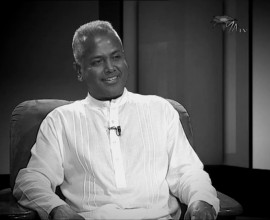
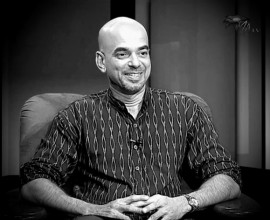
Kushil Gunasekera is Muttiah Muralitharan’s manager for over 10 years. Though this came up in the discussion along with Sri Lanka’s prospects at the Cricket World Cup this year, the chief focus of discussion was based on Kushil’s other life as the founder of the Foundation of Goodness and his social work in Seenigama. Kushil is a successful businessman, and before that a first class cricketer, who eventually gave up his business to become a full time social entrepreneur and help the village of his birth and childhood. The Foundation’s website and his answers constantly refer to good, and doing good. I asked Kushil what for him was goodness. The Foundation’s scope of work in so incredibly broad, as is evident from their website, I asked Kushil whether he had taken on the role that is traditionally associated with government service delivery. I asked him about how he deals with the culture of dependency, and that for the best of…

Continue reading »

Follies and Fantasies in the Sri Lankan Conflict

In an often quoted line Marx remarked, “history repeats itself first as tragedy, second as farce” and years later, Henry Ford, not known exactly either for his scholarship or his political wisdom, nevertheless said wisely “we want to live in the present and the only history that is worth a tinker’s damn is the history that we make to-day.” In considering these two views about history and applying them to events in Sri Lanka, it is clear that we must amend Marx to “history is being written in Sri Lanka by fools and fanatics and is leading to immense tragedy.”  And in Sri Lanka to-day, we must take Ford’s dictum seriously: the only worthwhile history is the history we make today. The conflict in Sri Lanka between the Sinhalese people and the Tamil people, it is claimed, began soon after the country gained its independence from Britain in 1948.  In 1956, the conflict accelerated with the election of a Sinhala…

Continue reading »

The Curious Case of Diplomats & that ‘Internal Conflict’

We are in the USA, far away from Sri Lanka. Dr. Palitha Kohona, Sri Lanka’s Permanent Representative to the UN (in New York), had this to say: “We have come to a point where we don’t need to be defensive. As a country we need to be proud, we need to reach out, we need to look outwards, and express ourselves in a confident manner…” Important words, expressed after Sri Lanka’s Independence Day celebrations. We are in Sri Lanka, far away from the USA. Things do not seem to be easy, the message is of a different nature; a call to be defensive (or offensive? or both?). The Prime Minister had the following to say, in Parliament: that the government has been informed that plans are being made by certain LTTE sympathizers and other elements in the Tamil diaspora in Europe to raise ‘war-crimes’ allegations, again, at the UN Human Rights Council (UNHRC) in Geneva. This, I believe, is not…

Continue reading »

The Tamil Diaspora and the Future of the Tamil Struggle

Today, the 18th of February, finds us three months away from the second anniversary of the “Mullivaikal Massacre”. At this juncture it is important to ask the question: What constructive action can be taken by the Tamil Diaspora to build a better future for the Tamil nation? In Tamil culture, at a funeral, all the people of the village are expected to attend. It’s tradition. But if the whole village was a funeral house, who will go and to whose house?  Also, who will heal the existing souls? This is not just a philosophical question, but an unavoidable reflection on the May 2009 humanitarian catastrophe, where 40,000 Tamils were massacred and nearly 60,000 were wounded. Nearly one in four Tamil people became direct victims of the Sri Lankan government’s offensive military operation. And today the survivors still suffer lingering effects of structural and cultural violence. The disastrous events of May 2009, which were sold to the International Community as a…

Continue reading »

Democracy in Sri Lanka: Ideas and responses

Screen shot 2011-02-17 at 10.13.22 AM

In March 2010, Groundviews launched a unique initiative online to ascertain what citizens perceived and accepted as democracy in Sri Lanka. To date, 74 people have submitted 42 ideas and cast 596 votes, but what do YOU think? Click on http://bit.ly/sldemocracy To coincide with a planned in-depth survey on democracy in Sri Lanka by Social Indicator, the polling arm of the Centre for Policy Alternatives, we are revisiting this initiative that when launched last year generated a lot of buzz online. From blue sky thinking to tried and tested initiatives that need to scale up or be better recognised and supported, we invite you to co-create a unique catalogue of ideas on how post-war Sri Lanka can strengthen democratic governance. We strongly encourage those from the grassroots, or work closely with communities at the grassroots to contribute their ideas. Please vote on the ideas you like, contribute your own, and pass on the word to participate! Repost This Article

Continue reading »

Commemorative lecture on second death anniversary of Lasantha Wickrematunge

DSCF5698

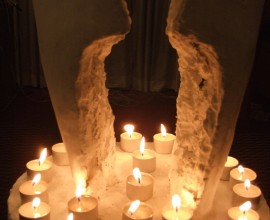
“Our lives begin to end the day we become silent about things that matter” ~ Martin Luther King Jr, (15 January 1929 ~ 4 April 1968), (Activist, Clergyman, and prominent leader in African ~ American Civil rights movement) A commemorative lecture to mark the second death anniversary of Sunday leader editor Lasantha Wickrematunge was held today. This is the first commemorative lecture to pay tribute to Late Lasantha Wickrematunge, who was killed on 8th of January 2009 in Ratmalana, suburb of Colombo. Christopher Warren, former President of the International Federation of Journalists (IFJ) delivered the key note address titled ~ “Role of Media in Post-War Democratization”. Candles were lit around the cement monument of pen with a human hollow to pay tribute to the journalists who sacrificed their lives. The monument stands on a barrel painted in white. The monument was created by the Vibhavi Academy of Fine Arts (VAFA). A large number of human rights activists, diplomats, foreign and…

Continue reading »

It is ubiquitous Februaries, not that unique Leninist October that counts

5442916893_65432846d9_z

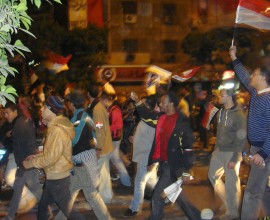
Photo courtesy Al Jazeera. Taken on 11 February 2011, Al Jazeera notes that a crowd of thousands marched back toward Tahrir Square from the presidential palace, young men sprinted along the streets and through the grassy median separating the wide boulevard, trailing Egyptian flags behind them. Grinning drivers waved and held their hands in peace signs through their windows. Celebrating protesters set of fireworks and lit giant streams of aerosol spray on fire. ### When the angry classes and the hungry classes join to make common cause, mass democratic, spontaneous, uprisings break out. That is the lesson now sweeping across the Maghreb and the Middle East. Tunisia’s Zine El Abidine Ben Ali has fled; Egypt’s Hosni Mubarak has been pushed out but may still be strung from a lamppost; the Jordanian cabinet has been fired, and the streets are aflame in Algiers and Yemen. For sclerotic autocrats it’s time to panic. The crisis has been there for decades; political repression,…

Continue reading »

Long Form journalism: An invitation to contribute

As many regular readers and commentators on this site know, in January Groundviews launched the Long Reads section. The print media industry in Sri Lanka, for economic and political reasons, does not afford a space for compelling essays on society, politics, the arts, culture, religiosity, literature and other topics. Long Reads on Groundviews aims to provide a platform for serious, vibrant essayists to publish their writing. Interestingly, long form journalism is going through something of a revival online. The Atavist, a new application for the iPhone / iPad is free to download, but users have to buy essays that are specifically geared for the devices, incorporating not just text, but audio, photography and video as well. Long Reads, a tremendously interesting website that curates essays from many sources on the web, including mainstream print media in the West, serves as the inspiration for GV’s Long Reads section. Then there’s the recently announced Readability, offering a way to both support essayists…

Continue reading »

Sri Lanka’s Flood Response: In Dimbulagala, people protest and plead

4F

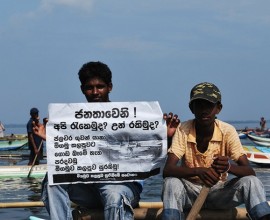
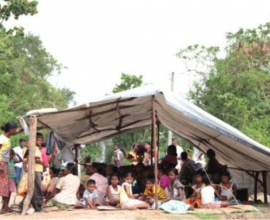
As the rains abated and flood waters begin to recede, the return and resumption of normal lives presents itself as a big challenge in many parts of the country. In the villages in Dimbulagala DS division in Polonnaruwa District, home to some of the poorest people in the country the impact was devastating and the return to normal life daunting. Many families had their wattle and dob houses completely destroyed by the rains. In the mean time it is reported that they had also been asked by officials to vacate from the schools where they had taken shelter due to displacement. This affected several families who had to leave the schools and had nowhere to go in Dimbulagala, Dalukana, Soruwila and Mutugala (Welikanda DS division). They are stranded. While some principals were generous enough to allow the families to stay in schools some others (like Kashappa Vidyalaya, Soruwila Tamil School etc) reportedly were not willing to keep the displaced people….

Continue reading »
  • 11 Feb, 2011
  • 1 Comment
  • Arts and Theatre,
    Colombo,
    Features

Interview with Mohamed Adamaly: A life in English theatre

Screen shot 2011-02-11 at 7.54.44 AM

Mohamed Adamaly is one of Sri Lanka’s best known theatre personalities. As an actor, director and now increasingly a producer of films as well, Adam, as he is often referred to, always brings to English theatre memorable performances and drama. We began our conversation with how Adam started to act at Royal College, including in several directed by Shyam Selvadurai, the current curator of the Galle Literary Festival, who was his classmate. We talked about his grounding for theatre studying in the English medium, and how family bereavement completely changed his plans, taking him unexpectedly into the family business, law and more fully into professional theatre. We talk at length about English theatre, including the reception of Shakespearean productions and how elements of theatre changed since the time Adam first took to stage, especially during the long years of war. We also touched on the economics of theatre, on the paucity of sponsorship for serious productions dealing with contentious political…

Continue reading »

Queen of Murasumottai celebrates her centenary birthday

DSCF5265

“May you live to be 100 and may the last voice you hear be mine” ~ Frank Sinatra (1915 ~ 1998), (American Author and Singer) Louisa Arulamma Thambyrajah celebrates her centenary birthday today ~ 6th of February 2011. She was born on 6th of February 1911 in her ancestral home in Chaavakachcheri in Jaffna Peninsula, North of Sri Lanka.It is a great miracle that she survived the brutal war. Her life, experience and challenges are unbelievable, but they are true. She is a daughter of a priest. She had her education at Uduvil Girls College ~one of the famous Girl’s schools in Jaffna peninsula. After completing her studies, she went back to her home town Chaavakachcheri to serve the community in the Church and teach at Sunday school. “I enjoyed cooking and serving food for all. I love to take care of others. I like all food. I led a healthy and wealthy life in my village ~ Murasumottai” says…

Continue reading »

THE NEED TO ENERGISE CIVIL SOCIETY

Note: The Editors of Groundviews received via email the text of this speech delivered by Jayantha Dhanapala at the Citizen’s Movement for Good Governance on the 9th of February 2011. I begin by expressing my deep gratitude for the invitation to address you so as to share some of my thoughts on this important subject. I have, both while I was abroad and following my return to Sri Lanka a few years ago, observed the activities of the Citizen’s Movement for Good Governance (CIMOGG), with admiration for your courage and your consistency. I have also been associated with your energetic President, Dr.A.C.Viswalingam, for many years and have more recently been together with him in a like-minded forum. The subject we have agreed on arises out of a desire not to yield to the widespread despair as to what civil society can do in the present state of the affairs of our country. It seeks to resist the fatalism of the…

Continue reading »
Page 1 of 212

About Groundviews

Located at the Centre for Policy Alternatives in Colombo, Sri Lanka, Groundviews is a citizen journalism website that uses a range of genres and media to highlight critical perspectives on governance, reconciliation, human rights, the arts and literature, democracy and other issues. The site has won two international awards, including the prestigious Manthan Award South Asia in 2009. The grand jury's evaluation of the site noted, "What no media dares to report, Groundviews publicly exposes. It's a new age media for a new Sri Lanka... Free media at it's very best!"

cezarneaga.eu