

The idea of liberalism in Sri Lankan politics is intimately associated with the life and writings of the leader and founder of the Liberal Party, Dr Chanaka Amaratunga. He passionately believed in the liberal idea, hoped fervently that it would inspire the body politic and be integrated into it and the political culture of Sri Lanka. His all too brief life prevented him from realizing this and from resisting as formidably as he could the equally passionate anti liberal forces and their opportunistic apparatchiks from enshrining a narrow, populist nationalism as the conventional orthodoxy of the day.
Writing about Chanaka is not easy for me. We were each other’s oldest friends – a continuous friendship, unbroken by political differences, of almost four decades.  Our friendship spanned St Thomas’ Prep to College to university – he at Oxford and I at the LSE, which he too later joined to do his doctorate – to Liberal International conferences in Europe and North America, countless evenings that melted into morning at his flat, at mine, at the Oxford and Cambridge Club, numerous restaurants and at home. We talked, he mostly, about politics in Sri Lanka and elsewhere, philosophy, literature, films, theatre, classical music and rank gossip and yes, too many excellent and some indifferent dinners, bottles of claret, port, cognac and champagne, hunks of cheese and kilos of chocolate were consumed with as much discrimination as to their quality and particular properties as undiscriminating relish in respect of their sheer, sensory pleasure.
I have yet to meet someone who could get so thoroughly involved in an idea as well as in a person and talk about that subject endlessly, literally endlessly and knowledgeably when it came to ideas. In this respect he had boundless energy. One interesting and particularly pertinent aspect as it later turned out, was that whilst he was certain and confident about ideas he was more curious than confident about judging character and people. Especially endearing personal qualities of Chanaka were his generosity and his love of being teased – which he was endlessly by all of us who were his friends. He adored the attention and lapped up the affection.
It is difficult to disentangle the personal from the political, the Chanaka I knew as my oldest friend and the Chanaka I knew as the aspiring politician. Entangled too within all of this is Chanaka the liberal in thought and deed.  I parted company with the Liberal Party because I was convinced that his desire to get into Parliament through the National List of the Premadasa UNP was a negation of the liberal idea and too sordid an entry of the Liberal Party into the national legislature.  We would not have agreed about an alliance with the SLMC either. As time went by the Chanaka who had left the Jayawardene UNP over the referendum was willing to enter into Faustian bargains with whoever was willing to put him on the National List. This was sad – he always said to me that he needed to get into Parliament to raise the profile of the Liberal Party; I always responded that the end did not justify the means and that if this were the case the party should be disbanded and turned into his campaign organization. The question of him ever standing for election never arose.
He believed that he was grappling with the moral dilemmas of practical politics as framed by his ideas and popular appeal or lack thereof, and that I was being too idealistic. We never resolved this. After I resigned and he cheated out of his Nationalist List seat by a trusted lieutenant, our conversations ceased to be about the political. That betrayal broke him in many ways and in that period his passion focused elsewhere.
Chanaka was as much a Tory as he was a Whig and right up to the end. He defined himself very much in terms of British politics, the Westminster tradition of parliamentary democracy and constitutional monarchy. A monarchist through and through, and at the same time, a passionate individualist, he deeply abhorred totalitarianism of any form but was perfectly willing to forgive and even condone the excesses of a Haile Selassie or the Shah of Iran at the same time as he would be scathing in his denunciation of a Stalin, Mao, Castro or Pol Pot. His near religious commitment to individual liberty led him to champion the virtues of the Premadasa regime, the Thatcher government and the Reagan administration. He loathed the LTTE, JVP and the soviets; had nothing but contempt for the Labour Party of Foot, Benn and Kinnock. A great proponent of proportional representation, he veered towards the Social Democrats in British politics, largely I suspect because they had left the Labour Party and because of his great admiration and respect for Roy Jenkins.
In the Sri Lankan context, the politician he truly admired was Dudley Senanayake and the one he was fondest of was Anura Bandaranaike. They were in his book, true democrats, unfettered by unfettered ambition or greed for power, gentleman who would reform the status quo if it needed to be reformed.  They like he, knew of a world outside of this island and they like he, would never be given to a shrieking nationalism. They did not have to. They were born to rule, but never harshly.
In the Sri Lankan context Chanaka was a staunch federalist and determined opponent of the executive presidency. He wanted to see the German electoral system adopted here and a second chamber. He was ambivalent on the North-East merger and convinced that the LTTE had to be defeated. Implicit faith in the Rule of Law and constitutionalism, he wanted a strong bill of rights, although the practical defence of human rights and association with the vulnerable and victimized did not come naturally to him or arouse great passion within him. His consuming interest was in the architecture of a liberal democracy; not in the citizen. As for the economy, it was a subject that he was least interested in except for absolute devotion to capitalism.
It is tempting to think as to where he would have stood in these times of the chinthanaya, allegations of war crimes, the culture of impunity, majoritarianism and amidst all of this new opportunities and political firmament. For my part, when I think of Chanaka and the liberal idea he so loved, the words from Tennyson’s Ulysees that I quoted at his funeral always come to mind:
We are not now that strength which in old days
Moved earth and heaven; that which we are,
we are;
One equal temper of heroic hearts,
Made weak by time and fate, but strong in will
To strive, to seek, to find, and not to yield.
###
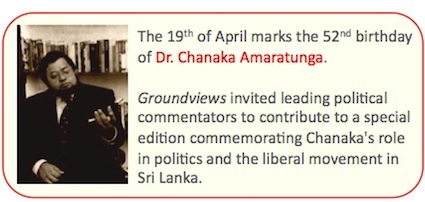
The 19th of April was the 52nd birthday of Dr. Chanaka Amaratunga, the founder of the Liberal Party of Sri Lanka. Groundviews invited leading political commentators to contribute to a special edition commemorating Chanaka’s role in politics and the liberal movement in Sri Lanka.
Other essays in this series include:
- TWO CONCEPTS OF THE CONSTITUTION: AN ESSAY IN MEMORY OF CHANAKA AMARATUNGA by Publius
- IN MEMORIAM DR. CHANAKA AMARATUNGA by Tissa Jayatilaka, Executive Director, United States-Sri Lanka Fulbright Commission
- A Liberal Dilemma by Dr. Devanesan Nesiah
- THE TRAGIC TRAJECTORY OF CHANAKA’S LIBERAL PROJECT by Dr. Dayan Jayatilleka